
At a Glance
Prostate cancer treatment regret is common, but often preventable. It usually stems from unexpected side effects or feeling rushed — not from the treatment “failing”.³ Thorough diagnosis with MRI and targeted biopsy, honest counselling about trade-offs, and properly exploring every suitable option — including active surveillance and, for selected men, focal therapy — give men the best chance of a decision they can live with.¹ ³
Key takeaways:
- Regret is often preventable — it’s usually linked to unexpected side effects, poor communication and limited involvement in the decision.³
- Function matters most — the common regrets relate to sexual function, urinary control, bowel symptoms and loss of ejaculation.¹
- Low-risk cancer may not need immediate treatment — active surveillance is often the preferred approach when safe and appropriate.²
- Better diagnosis helps — MRI and targeted biopsy separate cancers that need treating from those that can be monitored.²
- Focal therapy is an option for selected men — it treats the significant cancer while sparing surrounding structures, but still needs careful selection and follow-up.⁴
- A second opinion can clarify — a specialist team can help you weigh surveillance, focal therapy, surgery and radiotherapy.
A diagnosis of localised prostate cancer can lead to several possible treatment choices — active surveillance, surgery, radiotherapy, or focal therapy in selected cases. For some men, the hardest part is not only choosing a treatment, but later living with the consequences of that decision.
Treatment regret does not usually mean the cancer treatment “failed”. More often, regret develops when the side effects, recovery, or long-term impact on quality of life were different from what the patient expected. Urinary leakage, erectile dysfunction, bowel symptoms, loss of ejaculation, anxiety about cancer control, and a sense of having been rushed can all contribute.
The aim is not to frighten men away from treatment. It is to make sure the decision is properly informed, proportionate to the cancer risk, and based on what matters most to the individual.
Why do some men experience treatment regret?
Mr Alan Doherty answers whether prostate cancer treatment will cost you your independence — and how the right treatment choice protects the life older men value.
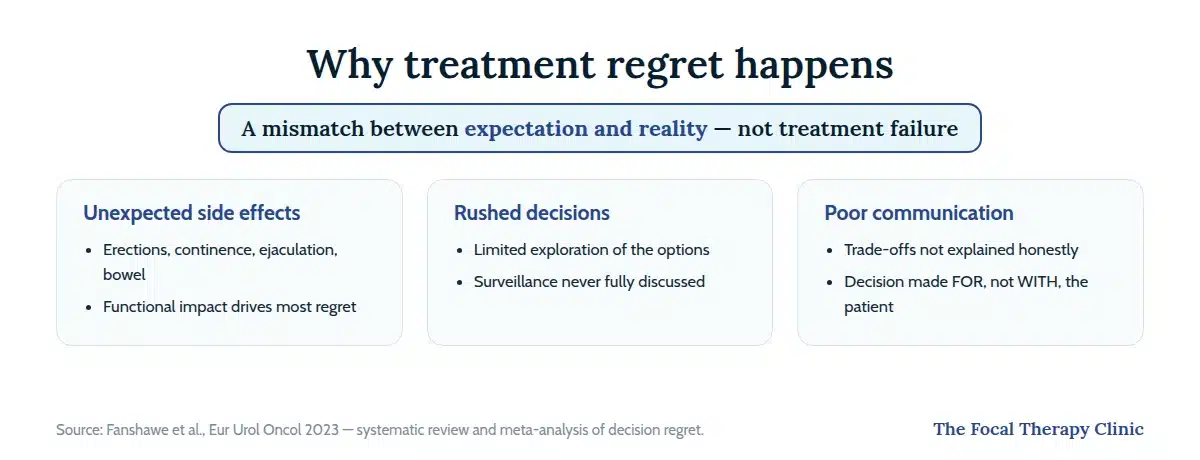
Regret usually develops when there is a mismatch between what a patient expected and what happened after treatment:
- Side effects more troublesome than expected
- A slower or harder recovery than anticipated
- Feeling rushed into the decision
- Not understanding the long-term effects on erections, continence, ejaculation or bowel function
- Later discovering that active surveillance or a less invasive approach may have been reasonable
- Feeling the decision was made for them rather than with them
Regret is not always immediate. Some men feel satisfied at first because the cancer has been treated, but later struggle with the day-to-day impact of side effects — particularly relevant in localised disease, where many men live for decades after diagnosis. A good treatment decision considers both cancer control and quality of life; one without the other is only half the conversation.
Common regrets after prostate cancer treatment
The most common regrets relate to function and quality of life:¹ ³
- Losing erectile function; urinary leakage or the need for pads
- Changes in ejaculation or dry orgasm (see our guide to ejaculation after treatment)
- Bowel urgency, bleeding or irritation after radiotherapy
- Reduced confidence or intimacy
- Not asking enough questions — or not seeking a second opinion
- Choosing radical treatment for a cancer that may have been suitable for monitoring
Some men also regret not being told clearly that all treatments involve trade-offs. Surgery, radiotherapy, active surveillance and focal therapy each have advantages and disadvantages; the “best” option depends on grade, PSA, MRI findings, biopsy results, prostate size, general health, life expectancy, baseline function and personal preference.
Overdiagnosis and overtreatment
Overdiagnosis means finding a prostate cancer that would never have caused symptoms or shortened life. Overtreatment means treating such a cancer aggressively, exposing the patient to side effects without clear personal benefit.
Some prostate cancers grow slowly. In low-risk localised disease, active surveillance can delay or avoid treatment while keeping the cancer under close review — it is not “doing nothing”: it involves PSA monitoring, clinical review, repeat MRI and sometimes repeat biopsy.² For suitable men this avoids unnecessary side effects, and if the cancer later shows signs of significance, curative treatment can still be considered. The key point is risk.
The role of better diagnosis and imaging
Good decisions begin with accurate diagnosis: PSA testing, MRI, and biopsy when indicated. MRI shows suspicious areas and guides the biopsy towards clinically significant disease — reducing both missed cancers and unnecessary sampling.²
A transperineal prostate biopsy takes samples through the skin between the scrotum and back passage rather than through the rectum — now widely used in UK diagnosis, under local or general anaesthetic. MRI locates and risk-stratifies; biopsy confirms and grades. Better diagnosis does not automatically mean more treatment — one of its most important roles is identifying men who can safely avoid immediate treatment.
“In my experience, the men who feel most at peace with their decision are those who understood the trade-offs before treatment, not just afterwards. Focal therapy can offer excellent quality-of-life outcomes for carefully selected men — but it’s the accurate diagnosis and honest counselling beforehand that make the real difference.” — Mr Raj Nigam, Consultant Urological Surgeon (FRCS (Urol), GMC: 3265226)
Can focal therapy reduce the risk of regret?
Focal therapy targets the area containing the significant cancer instead of treating or removing the whole prostate — aiming to control the tumour while reducing damage to surrounding tissue, nerves, the urinary sphincter, bladder neck and rectum. It is associated with favourable urinary outcomes in many published series and may reduce some side effects compared with whole-gland treatment in appropriately selected men.⁴
It is not suitable for everyone. It may be considered when the cancer is localised, clearly identified on MRI and biopsy, technically suitable in position, without disease requiring whole-gland or systemic treatment — and when the patient understands the need for follow-up. PSA, MRI and sometimes repeat biopsy continue afterwards; some men later need a second focal treatment, surgery or radiotherapy. Focal therapy may reduce the burden of side effects for selected men, but it cannot guarantee freedom from regret — the honest conversation matters just as much.
Get Expert Advice & The Latest Research
Subscribe to our newsletter to receive the latest updates, expert insights, and breakthrough research on prostate cancer-delivered straight to your inbox.
Comparing the main treatment approaches
| Approach | Main aim | Continence | Sexual function | Typically considered when |
|---|---|---|---|---|
| Active surveillance | Monitor low-risk (or selected favourable intermediate-risk) cancer; treat only on progression | Preserved | Preserved | Low-risk, slow-growing disease |
| Radical prostatectomy | Remove the whole prostate and seminal vesicles | 80–95% | 30–70% | Localised disease, fit for surgery |
| Radiotherapy | Treat the whole prostate with radiation, sometimes with hormone therapy | Variable | Variable (± hormone effects) | Localised / locally advanced disease |
| Focal therapy | Treat the significant cancer area, sparing surrounding structures | 97% (FTC audit, n=265) | 90%+ (FTC audit, n=265) | Selected localised, MRI-visible disease |
Sources: FTC one-year outcome audit (n=265); published literature.¹ ⁴ Outcomes for surgery and radiotherapy vary by patient and centre.
Every patient at The Focal Therapy Clinic is assessed by an experienced multidisciplinary team — urologists, radiologists, oncologists and other prostate cancer specialists — to ensure the treatment is right for their cancer and circumstances.
Making an informed treatment decision
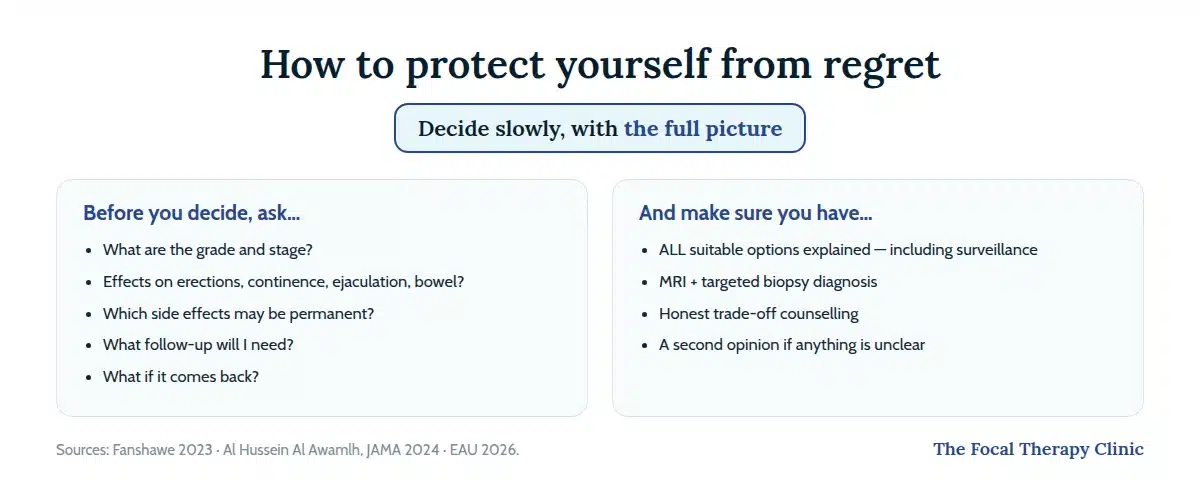
The best way to reduce future regret is to decide slowly, clearly, and with the right information. Useful questions for your urologist:
- What is the grade and stage of the cancer?
- What are the likely effects on erections, continence, ejaculation, bowel function and daily life?
- Which side effects may improve — and which may be long-term?
- What follow-up will be needed after treatment?
- What would happen if the cancer came back or progressed?
- Would a second opinion change the options?
Some men also benefit from speaking with a patient advocate — like Eva, our patient advocate, who helps others navigate their journey. The point is not that every man should choose the least invasive option; it is that every man should understand the consequences of each realistic option before choosing.
Patient experiences and quality of life after focal therapy
Many men choose focal therapy to balance cancer control with quality of life. Published studies suggest favourable urinary outcomes in selected patients, with sexual outcomes varying by baseline function, tumour location, treatment area, age and technology.⁴ Focal therapy can still cause urinary symptoms, erectile changes, discomfort, infection, retention, or the need for further treatment.
The most satisfied patients are usually those who understood the trade-off before treatment: focal therapy aims to reduce treatment burden — not remove risk altogether.
Frequently Asked Questions
Do men really regret prostate cancer treatment?
Some do. Studies suggest treatment regret is not rare after localised prostate cancer — more likely when men experience troublesome side effects, feel poorly informed, or weren’t sufficiently involved in the decision.³ Regret doesn’t necessarily mean the treatment was medically wrong; it often means expectations didn’t match the reality of recovery and side effects.
What are the most common causes of regret?
Erectile dysfunction, urinary leakage, bowel symptoms, loss of ejaculation, anxiety about recurrence, and feeling rushed. Regret also occurs when men later learn that active surveillance or another suitable option was never fully discussed.
Which treatment causes most regret — surgery or radiotherapy?
There’s no single answer. Surgery is more closely associated with urinary incontinence and erectile dysfunction; radiotherapy can affect bowel, urinary, sexual and hormonal function, especially with hormone therapy.¹ Regret tracks functional outcomes and whether the patient felt prepared for them.³
Can treatment regret be avoided?
Not always — but the risk can be substantially reduced: clear information about all suitable options (including surveillance where appropriate), understanding the likely functional effects, shared decision-making, specialist counselling and second opinions all help.
Does focal therapy prevent regret?
It can reduce the side-effect burden for selected men — in FTC’s audit, 97% maintained continence and 90%+ preserved sexual function — but it is not risk-free, and it demands careful selection, honest counselling and follow-up.⁴
Is it worth getting a second opinion?
Often, yes — especially if the options seem unclear or only one treatment was discussed. It may confirm the original recommendation, or identify suitable alternatives such as active surveillance or focal therapy. Our team provides second opinions drawing on 2,500+ focal therapy procedures and 75+ years of combined consultant experience.
This content is not intended to be a substitute for professional medical advice, diagnosis, or treatment. Always seek the advice of your urologist or other qualified health provider with any questions you may have regarding a medical condition.
References
- Al Hussein Al Awamlh B, et al. Functional Outcomes After Localized Prostate Cancer Treatment. JAMA. 2024;331(4):302–317.
- European Association of Urology. EAU Guidelines on Prostate Cancer. 2026. https://uroweb.org/guidelines/prostate-cancer
- Fanshawe JB, et al. Decision Regret in Patients with Localised Prostate Cancer: A Systematic Review and Meta-analysis. Eur Urol Oncol. 2023;6(5):456–466.
- Guillaumier S, Peters M, Arya M, et al. A Multicentre Study of 5-year Outcomes Following Focal Therapy in Treating Clinically Significant Nonmetastatic Prostate Cancer. Eur Urol. 2018;74(4):422–429.