

Leading the research into Focal Therapy for Prostate Cancer
Focal therapy was first described to treat prostate cancer almost 20 years ago, and since then, many thousands of people have benefitted from focal treatments. In the UK, focal therapy is approved by NICE with the provision that data must be reported for monitoring purposes. This means that we have lots of data on how focal therapy has improved outcomes.

Treatments Completed

and Erectile problems

Why research into Focal Therapy matters
As technology, imaging, and patient selection methods continue to advance, focal therapy is emerging as a credible, evidence-supported option within the modern landscape of prostate cancer management.
- Focal therapy is supported by growing peer-reviewed research
- Real-world outcomes are now available from thousands of patients
- Our clinic is a contributor to ongoing clinical studies
Get Expert Advice & The Latest Research
Subscribe to our newsletter to receive the latest updates, expert insights, and breakthrough research on prostate cancer-delivered straight to your inbox.
Summary of clinical evidence
In a prospective registry of 1,379 men treated with focal therapy (primarily HIFU), overall survival at 7 years was ~97% (95% CI 96-99%).
SourceUrinary continence (pad-free) after FT: reported rates ~95-100% in treatment-naïve (primary) settings.
SourceFT provides a “step-wise” approach — if recurrence occurs, whole-gland treatments remain possible; retreatment flexibility is a key feature.
SourceThe National Institute for Health and Care Excellence (NICE) issues official guidance (HTG667) recognising focal HIFU as a treatment option for localised prostate cancer.
SourceClinical Trials Supporting Focal Therapy
Focal therapy trials consistently show good mid-term cancer control (65–90%), very high continence rates (~95–100%), and strong erectile function preservation (~70–85%). Evidence is largely Level II–III, reflecting high-quality prospective but mostly non-randomised data.
| Study / Type | Main Outcomes | Evidence Level* |
|---|---|---|
| HIFI Study (HIFU vs Radical Prostatectomy) Prospective, multicentre (n = 3,328) |
30-month salvage-free survival: ~90% (HIFU) vs 86% (RP); better urinary & sexual outcomes with HIFU | Level II |
| Multicentre Feasibility Trial (HIFU) Prospective, 51 patients |
94% avoided whole-gland treatment at 2 years; continence and QoL maintained | Level III |
| Pooled Analysis (Albisinni et al.) 7 studies, 366 men |
Negative biopsy 87%; potency 74%; continence 96% | Level III |
| 3-Year Prospective Study (HIFU) Single-centre, 91 men |
Failure-free survival: ~65–70% at 3 years; cancer-specific survival 100% | Level III |
| Systematic Review (2010–2020) 50+ patient studies |
In-field recurrence ≤ 22%; continence ~98%; erectile function ~80% | Level II |
- Level II: well-designed non-randomised comparison studies
- Level III: prospective single-arm or pooled analyses
Our Clinic’s Role in Prostate Cancer Research
At The Focal Therapy Clinic, we are honoured to play a role in this through participation of our consultations and patients in this research.
For over 25 years our consultants have participated in groundbreaking clinical trials into focal therapy and prostate cancer treatments. These include seminal trials into the effectiveness of Focal Therapy versus radical treatment.
All Focal Therapy Clinic cases are recorded in national and international patient directories. We have supported their development and ongoing maintenance. Our results have been included in multiple research papers
We audit our clinical results and benchmark them rigorously against others. We have ongoing relationships with leading UK academic institutes but also the American and European Focal Therapy Society members.
For a clinical colleague's perspective on adopting these techniques, read what changed this leading urologist's mind about focal therapy.
Book an Evidence Review Consultation
Hear from some of our patients about the effect focal therapy has had on their lives.


Frequently asked questions
Key clinical evidence includes:
- 99–100% cancer-specific survival at 5 years
- 98% metastasis-free survival at 5 years
- Over 90% cancer-free at one year based on MRI and PSA
- NICE approval for HIFU (HTG667) and NanoKnife IRE (HTG688)
Consultants at The Focal Therapy Clinic, including Mr Tim Dudderidge and Mr Raj Nigam, have published widely in leading journals such as European Urology and The Lancet, strengthening the evidence base.
Focal therapy delivers cancer control comparable to radical prostatectomy while preserving urinary continence and erectile function to a far greater degree.
Book a consultation to explore suitability.
Major evidence sources include:
- HEAT Registry: 1,379 patients with up to 15 years of follow-up
- 5-Year Multicentre Study: 625 patients with 100% cancer-specific survival
- 2025 Meta-Analysis: 50 studies with 4,615 patients
- 2024 Systematic Review: 49 cohorts across HIFU, NanoKnife, and cryotherapy
Research published in Nature, The Lancet, and European Urology shows:
- 86% recurrence-free survival at 12 months
- 82% radical treatment-free survival at 5 years
- 98% overall survival
Consultants at The Focal Therapy Clinic help shape this evidence through ongoing publications and protocol development.
Cancer Control (5–10 years):
- Cancer-specific survival: 99–100% (FT) vs 95–98% (RP)
- Metastasis-free survival: 95–98% for both
- 7-year failure-free survival: 69% (FT), similar for RP
Functional Outcomes:
- Pad-free continence: 93–100% (FT) vs 60–85% (RP)
- Erectile function preserved: 75–98% (FT) vs 13–67% (RP)
The HEAT registry reports 100% metastasis-free survival and no cancer deaths at 7 years in 1,379 patients. Focal therapy can also be repeated, whereas radical surgery cannot.
Current research areas include:
- Registries comparing focal therapy technologies
- Long-term outcome studies beyond 10 years
- Trials for specific patient groups
- Combination therapy approaches
How to explore participation:
1. Speak with your consultant during assessment
2. Review eligibility criteria (often Gleason 6–7, localised disease)
3. Search “focal therapy prostate” on ClinicalTrials.gov
Consultants at The Focal Therapy Clinic, including Mr Tim Dudderidge, actively contribute to research such as the HEAT registry and multicentre studies.
Contact us to discuss available trials.
First Year:
- PSA every 3 months
- MRI at 12 months
- Biopsy only if MRI or PSA raises concern
Years 2–3:
- PSA every 6 months
- MRI only if clinically needed
Long-term (Year 4+):
- Annual PSA
- Optional MRI at 3–5 years
What we measure:
- PSA drop of around 50–70%
- MRI showing no residual disease
- No new suspicious lesions
The PI-FAB scoring system, developed by imaging specialists including Dr Clare Allen, standardises post-treatment MRI reporting. If recurrence occurs (5–10% of cases), options include repeat focal therapy or salvage treatments, with all future treatments kept open.
Any questions?
If you've got any questions about your prostate cancer diagnosis or want to know more about HIFU treatment or NanoKnife treatment, don't hesitate to get in touch with our friendly, knowledgeable team.
Contact the team
Learn more about Focal Therapy and Prostate Cancer
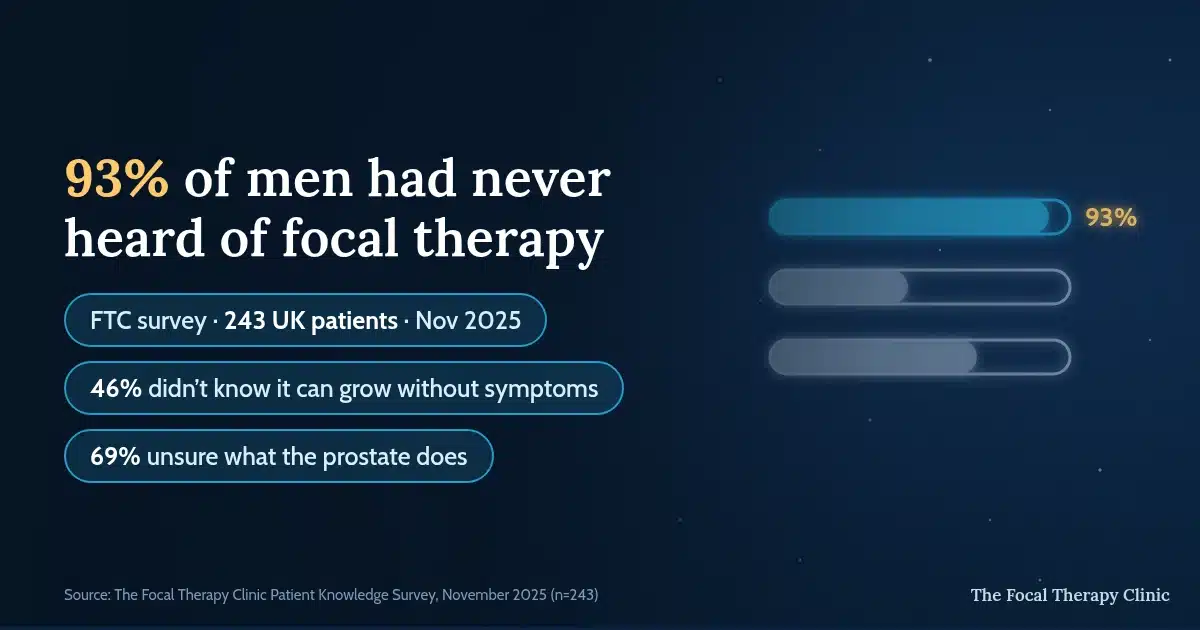
Prostate Cancer Survey: 93% of Men Had Never Heard of Focal Therapy
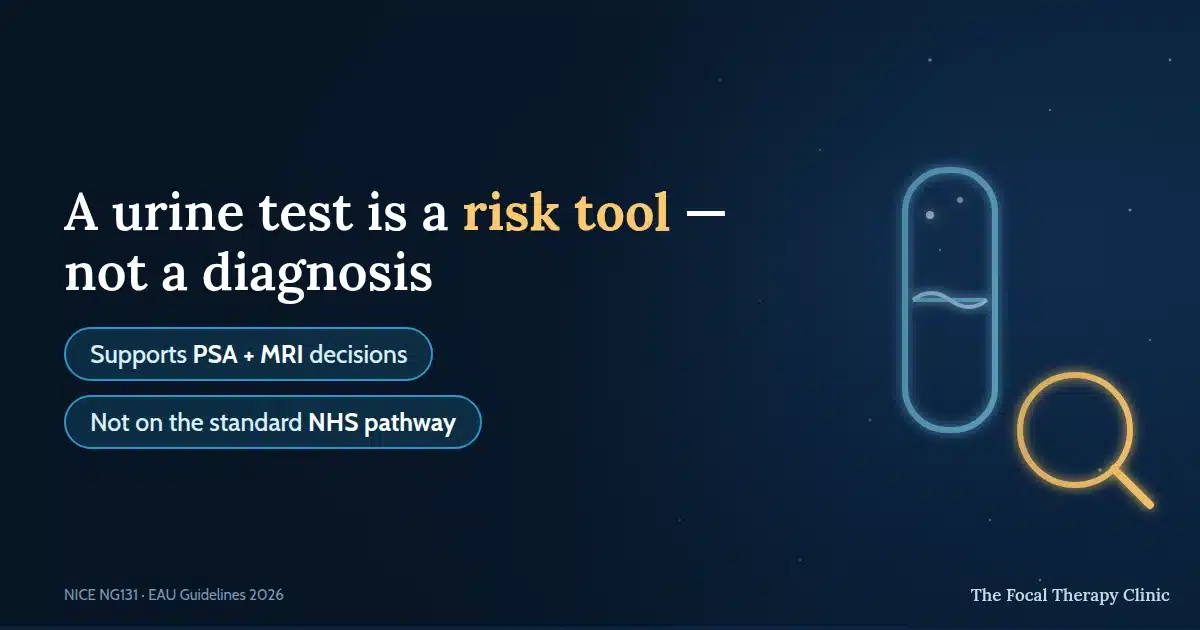
How Accurate Is a Urine Test for Prostate Cancer — and Can It Replace PSA or MRI?
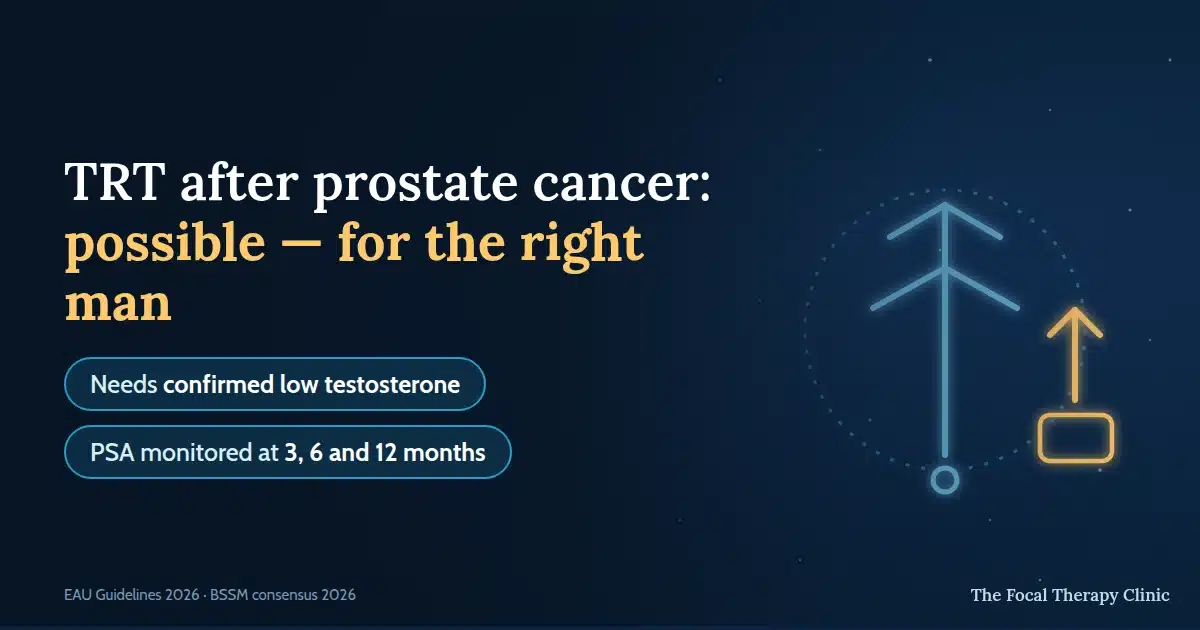
Is Testosterone Replacement Therapy Safe After Prostate Cancer Treatment?
Reference List
Subscribe to our newsletter
Get expert advice & the latest prostate cancer research - straight to your inbox.