
Other treatments for focal therapy
The majority of people that receive treatment for their prostate cancer will have one of the following treatment options:
- Active surveillance or watchful waiting
- Focal therapy, including NanoKnife and HIFU
- Prostatectomy
- Radiotherapy or hormone therapy
There are some others that you may be familiar with, but that aren’t as widely available – usually because they are older, or are very new.
If you’d like a second opinion about any treatments you’ve been recommended, contact The Focal Therapy Clinic to speak to our expert team of clinical specialists. They can help you understand all your options and make a decision that you can be confident in.

“Active surveillance may be highly effective in monitoring cancer, but for me, it was doing my head in — constantly worrying, not sleeping properly, and with my mind taking me to some very dark places.”
Perry Letcher
The Focal Therapy Clinic patient
Cryotherapy
Cryotherapy is another form of focal therapy. It uses extreme cold to freeze and destroy cancer cells, but can also be used to treat the entire prostate. In the UK, it’s only available at some treatment centers.
At The Focal Therapy Clinic, we only offer in cryotherapy in selected cases. This is because it’s not as precise as NanoKnife and HIFU, so carries higher risks of impotence and incontinence. Find out more about these two treatments.
Clinical trials
You may have read about clinical research into new treatments for prostate cancer. When a new medicine or treatment is trialled in a clinical setting, the people who developed it are trying to answer questions including:
- Is it safe?
- Does it work?
- What’s the best dosage?
- Does it work better than current treatments?
- What are the side effects?
Taking part in a clinical trial can help you access new treatments before they are approved. However, it’s important to fully understand the goals of the trial before you agree to participate. With clinical research, there are risks that the treatment isn’t safe, it doesn’t work, and the side effects are unknown. You also may not get to choose, or know, what treatment you’re getting.
If joining a clinical trial is something you’re interested in, speak to us or your existing medical team first. We can suggest any where you might be suitable. You can also try and find a clinical trial yourself.
Any questions?
If you’ve got any questions about your prostate cancer diagnosis or want to know more about HIFU treatment or NanoKnife treatment, don’t hesitate to get in touch with our friendly, knowledgeable team.
Contact the team
Frequently asked questions
What is cryotherapy for prostate cancer?
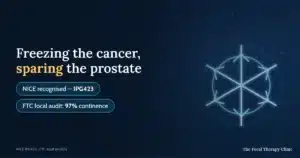
Cryotherapy (also called cryoablation) is a form of focal therapy that uses extreme cold to freeze and destroy prostate cancer cells. During the procedure, cryoprobes are inserted into the prostate under ultrasound guidance, and temperatures as low as -40°C are applied to create an ice ball that destroys cancer cells.
Cryotherapy can be used to treat either a focal area of cancer or the entire prostate, depending on the extent of disease. It’s guided by the NICE IPG423 guideline for focal cryotherapy for prostate cancer.
At The Focal Therapy Clinic, cryotherapy is offered in selected cases where its specific advantages are particularly beneficial for the patient’s situation.
When is cryotherapy especially beneficial for prostate cancer treatment?
Mr. Raj Nigam, Consultant Urological Surgeon at The Focal Therapy Clinic and a specialist in cryotherapy, recommends cryotherapy particularly for specific clinical scenarios:
Salvage Therapy After Brachytherapy Failure: When radiation seed therapy (brachytherapy) hasn’t fully controlled the cancer, cryotherapy can be an effective follow-up treatment. The freezing approach can successfully target residual cancer after previous radiation treatment. Mr. Raj Nigam has extensive expertise in this salvage therapy application.
Larger Lesions: Cancer lesions that are too large or extensive to treat effectively with NanoKnife or HIFU may respond well to cryotherapy. The ice ball created by cryotherapy can cover larger treatment areas, making it suitable for cases where other focal therapy methods may have limitations.
Specific Anatomical Considerations: In certain cases, the location or characteristics of the cancer may make cryotherapy’s approach advantageous over other focal therapy techniques.
While cryotherapy is not offered as a first-line treatment for standard focal therapy cases (due to being less precise than HIFU and NanoKnife), it excels in these specific clinical scenarios where its unique properties provide particular benefits.
Why doesn’t The Focal Therapy Clinic offer cryotherapy for all prostate cancer cases?
The Focal Therapy Clinic specialises in providing the most precise focal therapy options available. For standard focal therapy cases (treating localised prostate cancer as a first-line treatment), we primarily offer HIFU (High-Intensity Focused Ultrasound) and NanoKnife (Irreversible Electroporation) because these techniques offer superior precision compared to cryotherapy.
Precision Considerations: HIFU and NanoKnife can target cancer cells with millimetre-level accuracy, allowing us to destroy cancer while preserving maximum healthy prostate tissue. This precision is particularly important for protecting the nerves and structures responsible for erectile function and urinary continence.
Cryotherapy, while effective at destroying cancer cells, is less precise in its tissue effects. For primary focal therapy, this means higher risk of erectile dysfunction compared to HIFU/NanoKnife, higher risk of urinary incontinence, and more collateral damage to surrounding healthy tissue.
When Cryotherapy is Offered: We do offer cryotherapy in selected cases where its specific advantages outweigh these precision limitations—particularly for salvage therapy after brachytherapy failure and for larger lesions that may be difficult for HIFU or NanoKnife to treat effectively.
This selective approach ensures each patient receives the most appropriate treatment for their specific clinical situation, whether that’s HIFU, NanoKnife, or cryotherapy.
How does cryotherapy compare to HIFU and NanoKnife for prostate cancer?
All three are focal therapy techniques that can destroy prostate cancer while preserving healthy tissue, but they work through different mechanisms and have different advantages:
Cryotherapy:
• Mechanism: Uses extreme cold (-40°C) to freeze and destroy cancer cells
• Advantages: Excellent for salvage therapy after brachytherapy failure, suitable for larger lesions, can cover extensive treatment areas, real-time ice ball monitoring
• Limitations: Less precise than HIFU/NanoKnife for standard focal therapy, higher risk of erectile dysfunction and incontinence for primary treatment, more collateral damage to surrounding tissue
• NICE Guideline: IPG423
HIFU (High-Intensity Focused Ultrasound):
• Mechanism: Uses focused sound waves to heat cancer cells to 80–100°C
• Advantages: Millimetre-level precision, <2% incontinence rate, >95% erectile function preservation, real-time MRI/ultrasound guidance, first-line option for standard focal therapy
• NICE Guideline: HTG667
NanoKnife (Irreversible Electroporation):
• Mechanism: Uses microsecond electrical pulses to destroy cancer cells
• Advantages: Highest precision available, nerve-sparing (electrical pulses don’t damage nerves), ideal for cancers near sensitive structures, <1% incontinence rate, >95% erectile function preservation
• NICE Guideline: HTG688
Treatment Selection: The choice between these techniques depends on your specific situation. First-line focal therapy: HIFU or NanoKnife (highest precision, lowest side effects). After brachytherapy failure: Cryotherapy (Mr. Raj Nigam’s expertise area). Larger lesions: Cryotherapy may be more suitable. Cancer near nerves: NanoKnife (nerve-sparing properties).
Your consultant will recommend the most appropriate technique based on your cancer characteristics, previous treatments, lesion size, and personal circumstances.
What are clinical trials for prostate cancer?
Clinical trials are research studies that test new treatments for prostate cancer before they become widely available. When researchers develop a new medicine, device, or treatment approach, they conduct clinical trials to answer critical questions:
What Clinical Trials Aim to Determine:
• Is it safe? – What side effects does the treatment cause?
• Does it work? – Is the treatment effective at controlling or eliminating cancer?
• What’s the best dosage? – How much of the treatment produces optimal results?
• Does it work better than current treatments? – How does it compare to existing options?
• Who benefits most? – Which patients respond best to the treatment?
Why Participate in a Clinical Trial:
• Early access to cutting-edge treatments before they’re approved for general use
• Potential benefit from innovative approaches not yet widely available
• Contribution to advancing medical knowledge that helps future prostate cancer patients
• Close monitoring by research teams throughout the trial
Types of Trials:
• Phase I: Tests safety and dosage in small groups
• Phase II: Tests effectiveness in larger groups
• Phase III: Compares new treatment to current standard treatments
• Phase IV: Long-term monitoring after treatment approval
Clinical trials play a vital role in developing new and better treatments for prostate cancer. Many of today’s standard treatments (including HIFU and NanoKnife) were once tested in clinical trials.
What are the risks and benefits of participating in a prostate cancer clinical trial?
Participating in a clinical trial can provide access to new treatments, but it’s important to fully understand both the potential benefits and risks before deciding.
Benefits of Clinical Trial Participation:
• Early Access to New Treatments: You may receive innovative therapies before they’re available to the general public, potentially offering advantages over current standard treatments.
• Expert Monitoring: Clinical trials involve close monitoring by specialized research teams, often with more frequent check-ups and tests than standard care.
• Contributing to Medical Progress: Your participation helps researchers develop better treatments that will benefit future prostate cancer patients.
• No Additional Cost: The treatment being tested is typically provided at no cost to participants (though this varies by trial).
Risks and Limitations of Clinical Trial Participation:
• Unknown Safety Profile: Because treatments are still being tested, the full range of side effects may not be known. You could experience unexpected or serious adverse effects.
• Treatment May Not Work: The new treatment may be less effective than current standard treatments, or may not work at all for your type of cancer.
• Randomization: In many trials, you cannot choose which treatment you receive. You may be randomly assigned to the new treatment, the current standard treatment, or a placebo (though placebos are rare in cancer trials).
• Unknown Side Effects: Long-term side effects may not be apparent during the trial period and could emerge later.
• More Time Commitment: Clinical trials often require more frequent visits, tests, and follow-up appointments than standard treatment.
Making an Informed Decision: Before agreeing to participate in any clinical trial, you should thoroughly review the informed consent documents, discuss the trial with your oncologist or urologist, understand the trial’s purpose, procedures, and potential risks, ask about alternatives to trial participation, and feel free to withdraw at any time if you change your mind.
Finding Clinical Trials: Visit Prostate Cancer UK for resources and tips on finding current clinical trials for prostate cancer. You can also discuss trial opportunities with your consultant at The Focal Therapy Clinic.