
Why choose focal therapy?
There are many factors to consider when choosing a treatment for your prostate cancer. Medical factors, such as your cancer stage and tumour location are important. However, your current and future quality of life is also very important.

This content is not intended to be a substitute for professional medical advice, diagnosis, or treatment. Read more.
What are the different types of focal therapy?
“As cancer treatments go, and if this kills my cancer or cures my cancer, I mean, it’s unbelievable. What a prostatectomy would have done to me mentally and what this did, is not even a comparison.”
Michael Anthony
The Focal Therapy Clinic patient
What are the benefits of focal therapy?
Because focal therapy treats just the tumour and doesn’t remove the whole gland, you are significantly more likely to preserve the nerves that are responsible for getting and maintaining erections, and going to the toilet. Focal therapy has also been shown to be as effective in treating prostate cancer as radical prostatectomy, with a 5 year recurrence rate of 12%.
You can also have further treatments after focal therapy, including another focal therapy procedure, hormone therapy, or a prostatectomy. It you have a prostatectomy, you are very limited in further treatments you could have if your cancer comes back.
Learn more about focal therapy and how it works
How could focal therapy preserve my quality of life?
Weighing your treatment options
Many men consider side effects like impotence and incontinence to be an unavoidable part of getting treatment for their prostate cancer. However, this is no longer the case. You deserve the opportunity to make an informed decision about what your life after prostate cancer will look like.
Ask yourself what matters most to you:
- Do you want to preserve erections and the ability to have children?
- Do you want to preserve your bladder control?
- Do you want a treatment that is done within a day, or are you willing to undergo treatment for weeks?
- Do you want all the cancer in your gland gone, at the expense of other risks?
- Do you want the reassurance of your whole prostate gland gone, as the expense of other risks?
Any questions?
If you’ve got any questions about your prostate cancer diagnosis or want to know more about HIFU treatment or NanoKnife treatment, don’t hesitate to get in touch with our friendly, knowledgeable team.
Contact the team

Frequently asked questions
Why should I choose focal therapy over radical prostatectomy for prostate cancer?
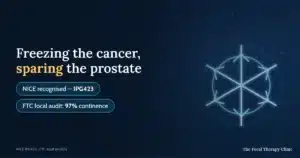
Focal therapy treats only the cancerous tissue, preserving erectile function in 90-95% of patients versus 30-70% with surgery, and maintaining continence in 98-100% versus 80-95%. The 5-year cancer-free rate of 88% is comparable to radical prostatectomy, but with significantly better quality of life outcomes. By targeting only the tumour rather than removing the entire prostate, focal therapy preserves the delicate nerve bundles and sphincter mechanisms responsible for sexual and urinary function. Recovery takes 3-5 days compared to 6-12 weeks, and all future treatment options remain available if cancer returns.
What are the main benefits of focal therapy compared to whole-gland treatments?
The primary benefits include preservation of erectile function (90-95% of men), preservation of urinary continence (98-100%), completion in a single day versus weeks of radiation, minimal recovery time (3-5 days), and the ability to pursue additional treatments including repeat focal therapy, hormone therapy, or surgery if cancer returns. Unlike radical prostatectomy, focal therapy leaves all treatment options open. Additional advantages include no long-term bowel dysfunction (common with radiation affecting up to 20% of patients), preservation of fertility potential, and reduced psychological impact compared to total prostate removal.
How effective is focal therapy at treating prostate cancer long-term?
Focal therapy demonstrates 88% cancer-free rates at 5 years, with a 12% recurrence rate that can be effectively managed with further treatment. Clinical studies show efficacy comparable to radical prostatectomy while preserving quality of life. The treatment is NICE-approved (IPG118 for HIFU, HTG667 for NanoKnife) and supported by extensive clinical evidence from multiple international studies. Long-term data continues to validate focal therapy as a definitive treatment option for appropriately selected patients with localised disease.
Can I have further treatment if cancer returns after focal therapy?
Yes, focal therapy preserves all future treatment options. If cancer recurs, you can undergo repeat focal therapy, hormone therapy, radiation therapy, or radical prostatectomy. In contrast, patients who choose prostatectomy first have very limited options if cancer returns, as the prostate has been removed. This treatment ladder approach represents modern prostate cancer management: starting with the least invasive option that preserves quality of life, while keeping more aggressive treatments available if needed. Clinical data shows approximately 10-15% of focal therapy patients require additional treatment, most commonly with successful outcomes.
How does focal therapy compare to radiation therapy for preserving quality of life?
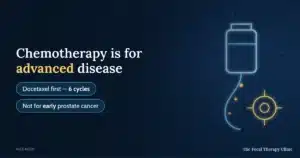
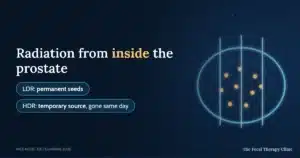
Focal therapy is completed in a single outpatient procedure, while radiation therapy requires daily treatments over 6-8 weeks. Focal therapy shows superior preservation of erectile function (90-95% vs 40-70% with radiation) and urinary continence (98-100% vs 85-95%), with fewer long-term bowel side effects. Radiation therapy can cause gradual deterioration of function over months and years, including rectal inflammation, urgency, and bleeding in up to 20% of patients. Focal therapy, being precisely targeted, avoids radiation exposure to surrounding organs entirely. Recovery is measured in days rather than weeks, with no cumulative fatigue or skin changes.
Am I a good candidate for focal therapy?
Ideal candidates typically have localised, low-to-intermediate risk prostate cancer confirmed on multiparametric MRI and targeted biopsy. This includes Grade Groups 1-3 (Gleason score 6-7), PSA ≤20 ng/mL, and disease confined within the prostate capsule. Approximately 50-60% of newly diagnosed patients are suitable candidates. Patients with Gleason 8+ (Grade Group 4-5), PSA >20 ng/mL, or disease extending beyond the prostate capsule typically benefit more from whole-gland treatment. A comprehensive diagnostic assessment and multidisciplinary team review determines suitability for your specific situation.
What does recovery look like after focal therapy?
Most patients return to normal daily activities within 3-5 days following focal therapy. Sexual activity can typically resume after 2-4 weeks. Day 1-2 involves rest at home with mild discomfort managed by standard painkillers. By days 3-5, most men return to light activities and office work. Weeks 2-4 allow resumption of exercise and sexual activity, with full return to all activities including strenuous exercise by weeks 4-6. The minimally invasive nature of focal therapy means no surgical incisions, short catheterisation (typically 1-5 days), and minimal disruption to surrounding tissues. This contrasts sharply with radical prostatectomy requiring 6-12 weeks recovery or radiation therapy causing gradual side effects over months.
How does HIFU differ from NanoKnife (irreversible electroporation)?
HIFU uses focused ultrasound energy to heat and ablate the target tissue through thermal destruction, while NanoKnife uses electrical pulses to disrupt cancer cell membranes without heat. Choice depends on tumour location, size, and clinical assessment. HIFU is typically preferred for posterior (back) lesions away from the rectum, while NanoKnife excels for anterior (front) lesions near the urethra where heat-based ablation carries higher risks. Both are NICE-approved and equally effective for appropriately selected tumours. Your consultant will recommend the optimal technology based on your specific MRI findings and tumour characteristics.
Can focal therapy be repeated if needed?
Yes, focal therapy can be safely repeated if residual or recurrent cancer is detected. Approximately 5-10% of patients undergo a second focal ablation procedure, typically with successful outcomes and maintained functional preservation. The ability to repeat treatment is a significant advantage over radical approaches. Following repeat focal therapy, all other treatment options including radiation and surgery remain available, depending on clinical findings and shared decision-making with your consultant.