At a Glance
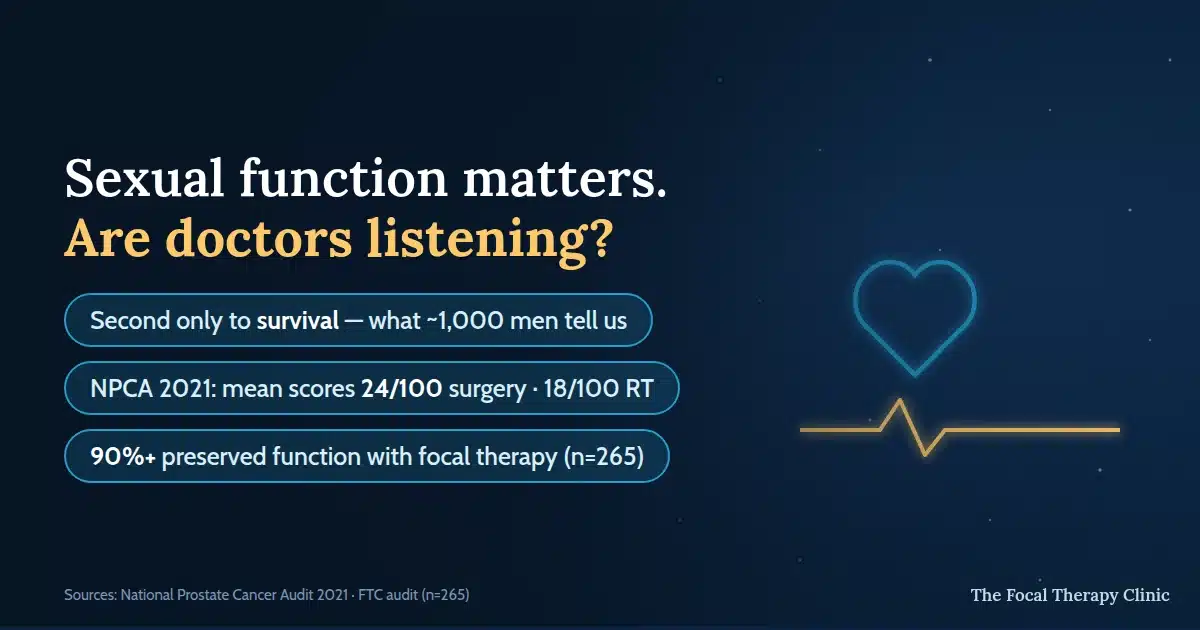
Misinformation about prostate cancer stops men getting tested and pushes others into treatments they might not need. The five myths we hear most — that treatment inevitably ruins your sex life, that incontinence is unavoidable, that PSA testing does more harm than good, that your first doctor’s word is final, and that it’s “an old man’s disease” — all collapse against current evidence. Modern MRI-led diagnosis has roughly halved overdiagnosis,³ and for suitable men, focal therapy preserved sexual function in 90%+ and urinary continence in 97% (FTC audit, n=265).
Key takeaways:
- Sexual function can usually be preserved — with early detection and, for suitable men, minimally invasive focal therapy.
- Incontinence is not inevitable — whole-gland treatments carry the risk; targeted treatment aims to avoid it.
- PSA testing has changed — the MRI-led pathway has transformed what a raised PSA leads to.³
- Second opinions are your right — and often change or confirm the plan with far more confidence.
- 70 is not “old” — treatment decisions should follow fitness and biology, not birthdays.
Living in an era of information overload is challenging — and in healthcare, information that ranges wildly in quality is overwhelming at best and harmful at worst. Prostate cancer is no exception. Prostate Cancer UK once asked publicly: “What myths do you hear most often about prostate cancer? What misconceptions stop men speaking to their GP?” The answers included “The PSA test does more harm than good”, “It’s a good cancer to get”, and “It’s an old man’s disease”. Our patients tell us the same things — here are the five myths we hear most, tested against the evidence.
Myth 1: Prostate cancer will ruin your sex life
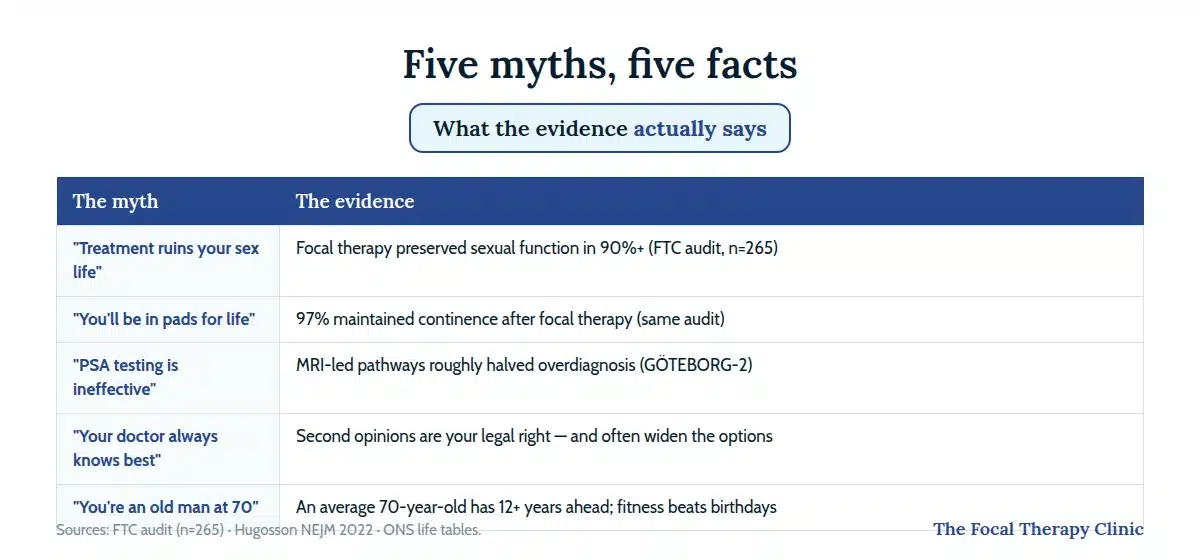
The truth: treatment can affect sexual function — but early detection and targeted treatment protect it for most suitable men.
Radical treatments do carry real sexual side effects: the patient-driven EUPROMS study concluded that its results “revealed the significant and non-negligible impact of prostate cancer treatment on sexual function”.² Campaigner Elvin Box speaks openly about the impact his prostate surgery had on his sex life — and urges men to test early precisely so they can avoid radical treatment.
But the myth’s fatal flaw is the word “will”. One of our patients was warned off treatment by his father, who had endured hormone therapy — then chose NanoKnife focal therapy and maintains healthy sexual function. In FTC’s audited series of 265 men, 90%+ preserved sexual function after focal treatment. The best protection: regular PSA testing, an MRI-led diagnostic pathway with precision fusion biopsy, and — where suitable — minimally invasive focal therapy. Men who have had radical treatment can get real help from sexual-health specialists such as Lorraine Grover.
Myth 2: Prostate cancer will put you in nappies for the rest of your life
The truth: incontinence is a risk of whole-gland treatment — not a certainty of prostate cancer.
This fear drives many men to our clinic. Radical treatments can affect continence — in the ProtecT trial, pad use after surgery reached 46% at six months⁴ — but targeted treatment changes the odds entirely: 97% of men maintained urinary continence after focal therapy in FTC’s audit (n=265). Every man should be counselled honestly about continence risk before choosing treatment, and men who are affected should be referred to specialists who can help — effective treatment exists.
Myth 3: PSA testing is ineffective
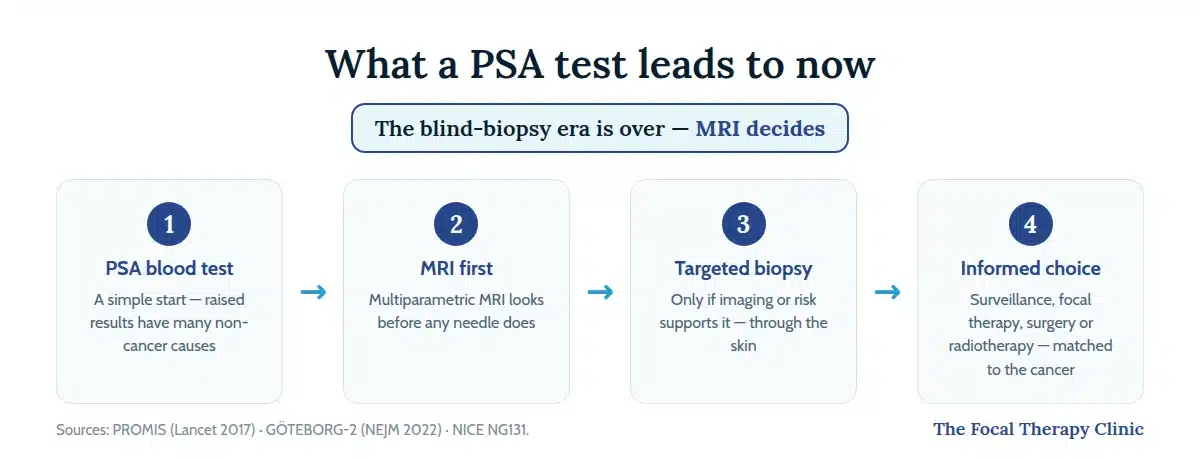
The truth: the pathway after PSA has been transformed — the old criticism no longer describes modern practice.
The criticism was once fair: before modern diagnostics, a raised PSA led straight to “blind” biopsies, overdiagnosis and overtreatment that harmed many men — and an elevated PSA often reflects benign enlargement, inflammation or infection rather than cancer.
That world has gone. MRI now sits between the PSA test and any biopsy: the PROMIS trial showed multiparametric MRI’s power to identify significant cancer,¹ and MRI-targeted screening in the Swedish GÖTEBORG-2 trial roughly halved overdiagnosis compared with PSA-only approaches.³ Prostate Cancer UK’s current testing guidance reflects exactly this MRI-first logic. A PSA test today starts an intelligent pathway — it no longer triggers an automatic biopsy.
Get Expert Advice & The Latest Research
Subscribe to our newsletter to receive the latest updates, expert insights, and breakthrough research on prostate cancer-delivered straight to your inbox.
Myth 4: Your doctor always knows best
The truth: your doctor is your expert ally — and you still have the legal right to a second opinion.
Your doctor is almost certainly well-trained, committed and evidence-driven. But no single clinician has access to every option in every centre — and nobody knows your priorities as well as you do. You are the best advocate for your own health.
The majority of our patients come to us for a second opinion, often to test a treatment recommendation that didn’t feel right. A second opinion doesn’t undermine your team — it strengthens shared decision-making, and sometimes reveals options (active surveillance, focal therapy) that were never on the table.
Myth 5: You’re an old man at 70
The truth: fitness and biology matter more than birthdays.
UK life-table data show that an average 70-year-old man can expect well over a decade more of life — and an active, healthy 70-year-old considerably more.⁵ Biological age — measurable through health biomarkers and shaped by diet, exercise and lifestyle — is increasingly recognised as more meaningful than chronological age.
That matters for treatment: age alone should never rule a man out of curative options. We have seen age discrimination happen — including the lazy description of prostate cancer as an “old man’s disease”. Treatment decisions should follow overall health, life expectancy and personal priorities, not the number on a birth certificate.
Frequently Asked Questions
Should I get a PSA test if I have no symptoms?
From 50 — or 45 if you’re Black or have a father or brother with prostate cancer — you can request a PSA test after a discussion with your GP. Early prostate cancer usually causes no symptoms, which is exactly why testing conversations matter.
Does a raised PSA mean I have cancer?
No. Enlarged prostate, inflammation and infection all raise PSA. A raised result today leads to MRI first — and a biopsy only if the imaging or your risk profile supports one.³
Is focal therapy suitable for everyone?
No — it suits carefully selected men with localised, MRI-visible disease. Suitability depends on your cancer’s position, grade and volume; a multidisciplinary review (and often a second opinion) establishes it honestly.
Where can I get support with side effects after radical treatment?
Specialist sexual-health professionals, pelvic-floor physiotherapy and continence services all help — ask for referral rather than suffering in silence. Campaigners like Elvin Box have shown how much talking openly helps too.
This content is not intended to be a substitute for professional medical advice, diagnosis, or treatment. Always seek the advice of your urologist or other qualified health provider with any questions you may have regarding a medical condition.
References
- Ahmed HU, El-Shater Bosaily A, Brown LC, et al. Diagnostic accuracy of multi-parametric MRI and TRUS biopsy in prostate cancer (PROMIS): a paired validating confirmatory study. Lancet. 2017;389(10071):815–822.
- Venderbos LDF, et al. Europa Uomo Patient Reported Outcome Study (EUPROMS): the impact of prostate cancer treatment on quality of life. (Europa Uomo, patient-driven study.)
- Hugosson J, Månsson M, Wallström J, et al. Prostate Cancer Screening with PSA and MRI Followed by Targeted Biopsy Only. N Engl J Med. 2022;387(23):2126–2137. (GÖTEBORG-2)
- Donovan JL, Hamdy FC, Lane JA, et al. Patient-Reported Outcomes after Monitoring, Surgery, or Radiotherapy for Prostate Cancer. N Engl J Med. 2016;375(15):1425–1437. (ProtecT)
- Office for National Statistics. National life tables, UK. https://www.ons.gov.uk/peoplepopulationandcommunity/birthsdeathsandmarriages/lifeexpectancies
- Prostate Cancer UK. About prostate cancer testing. https://prostatecanceruk.org/prostate-information-and-support/prostate-tests