

Clinical Evidence and Published Research
The clinical evidence for focal therapy is drawn from over two decades of published research, NICE-approved registries, and real-world patient outcomes. Based on our one-year outcome audit of 265 patients, 97% maintain urinary continence, 90%+ preserve sexual function, and 90% are cancer-free at one year. At five years, published data shows 88% remain cancer-free (Guillaumier et al., 2018). Both HIFU (NICE HTG667) and NanoKnife (NICE HTG688) are NICE-approved for treating localised prostate cancer.

Treatments Completed

and Erectile Dysfunction
Focal Therapy Timeline
Get Expert Advice & The Latest Research
Subscribe to our newsletter to receive the latest updates, expert insights, and breakthrough research on prostate cancer-delivered straight to your inbox.
“Active surveillance may be highly effective in monitoring cancer, but for me, it was doing my head in — constantly worrying, not sleeping properly, and with my mind taking me to some very dark places.”
Perry Letcher
The Focal Therapy Clinic patient
NICE approval of focal therapy
To make a decision about HIFU and NanoKnife, NICE reviewed all the data available for them in 2022, including comparing when they were used focally (to target just your tumour) and for your whole gland.
It found that overall survival was higher for people treated with HIFU, compared with radical treatments (97.5% compared with 93.4%). There was a statistically significantly lower incidence of incontinence with focal HIFU compared with whole-gland HIFU. There was a statistically significantly lower incidence of erectile dysfunction with focal HIFU compared with whole-gland HIFU.
Overall survival was also higher for people treated with NanoKnife, compared with radical treatments (99-100% compared with 93.4%). In people fully continent before their procedure, there was generally no incontinence 12 months afterwards. For people that were able to get and maintain erections before their procedure, between 3-7% of people had difficulty doing so 12 months after their procedure. However, there is only a limited number of data available for NanoKnife treatments, as it is newer than HIFU.

At one year after one focal therapy treatment

Of clinically significant cancer is eliminated*
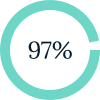
Of men are fully continent*
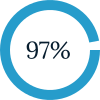
Of men retain erections*
*Based upon our outcome audit of 265 patients (October 2025) who all had treatment at The Focal Therapy Clinic using advanced MRI-ultrasound fusion technology to ensure treatment accuracy
HEAT and ICE registries
The HEAT and ICE registries collect data on everyone who has had focal therapy in the UK. The HEAT registry logs people who receive HIFU and the ICE registry tracks those who receive cryotherapy. There are similar registries for people in Europe and the US.
All surgeons and health centres in the UK can access the anonymised data held in these registries. The HEAT registry published 7-year outcomes for 1,379 patients across 13 UK centres in European Urology (2022), showing 100% metastasis-free survival. Our GMC-registered consultant urologists have performed over 2,500 focal therapy procedures and contributed to research published in these registries. Because randomised trials take a decade to report, registry evidence is what guides men deciding today. As Mr Tim Dudderidge puts it: "We can make a simple statement to men, which is in the medium term, it seems probable that… if you were to go through HIFU, you can be reasonably confident of an equivalent outcome to surgery at around eight years."
The Next Generation of Evidence: The CHRONOS Trials
Registry evidence takes focal therapy a long way, but only a randomised controlled trial — where treatment is allocated by chance rather than preference — can fully remove the bias that affects single-centre case series. That is the job of the CHRONOS programme (trial record: NCT04049747), organised by Imperial College London and now the most important ongoing research in focal therapy.
CHRONOS-A randomises men whose intermediate-risk cancer is MRI-visible and confined to one side of the prostate between focal therapy (HIFU or cryotherapy) and radical treatment — surgery or radiotherapy, whichever the patient would choose. Its primary endpoint is failure-free survival at ten years: no salvage treatment, no metastasis, no death from prostate cancer. CHRONOS-B, now fully recruited, is testing whether prostate-shrinking drugs (bicalutamide or finasteride) given before HIFU improve the precision of treatment; results are expected in the next few years.
Mr Tim Dudderidge, Consultant Urological Surgeon at The Focal Therapy Clinic, is an investigator on the CHRONOS trials. He describes the honest position a recruiting surgeon must take:
"If I can look a patient directly in the eye and say that I do both of these treatments, I am an advocate of both, I'm sitting on the fence here… We're going to let the randomisation take care of the decision making and in the process contribute to a study where eventually we will know which is the best of these treatments."
Frequently asked questions
The approval required:
- Special arrangements for clinical governance
- Informed patient consent regarding uncertainties
- Prospective data collection in registries
NICE also approved NanoKnife (IRE) in July 2023 (HTG688). HTG667 remains the current NICE guidance for focal HIFU.
Key milestones:
- 2005: UK centres begin HEAT registry data collection
- April 2012: NICE HTG667 recognises focal HIFU
- 2023: NICE approves NanoKnife (HTG688)
The 2012 Lancet Oncology study by Ahmed et al. was pivotal in securing this recognition.
MRI enabled focal therapy by providing:
- Precise localisation of prostate tumours
- Detailed treatment planning through 3D mapping
- Improved targeting accuracy using MRI-ultrasound fusion
- Reliable post-treatment surveillance without repeated biopsies
A 2021 Radiology publication by Dr Clare Allen and Dr Francesco Giganti noted that mpMRI is essential for patient selection, planning, and follow-up.
The PI-FAB scoring system, developed by FTC specialists, standardised interpretation of post-treatment MRI scans, helping detect recurrence and differentiate it from healing changes.
Without advances in MRI, focal therapy would not have been possible; imaging made precision targeting achievable.
Ahmed et al., Lancet Oncology (2012)
The pivotal prospective study demonstrating focal HIFU's feasibility and early cancer control.
Multicentre 5-Year Outcomes Study (2018)
625 patients showed 100% cancer-specific survival, 98% metastasis-free survival, and 98% pad-free continence.
HEAT Registry (2022)
The largest dataset: 1,379 patients, up to 15 years' follow-up, 100% metastasis-free survival at 7 years, and excellent functional outcomes.
PRESERVE Trial (2025)
121 NanoKnife patients with intermediate-risk disease. Results led to FDA clearance in 2024 with high negative biopsy rates and low complications.
Propensity-Matched Comparison (2021)
The strongest current comparison is an Imperial College London-led propensity-matched study (Shah et al., Prostate Cancer and Prostatic Diseases, 2021), co-authored by our consultants Mr Tim Dudderidge and Mr Raj Nigam. It matched 246 men treated with focal therapy against 246 men of comparable age, PSA, cancer grade and stage who underwent radical prostatectomy. Failure-free survival — avoiding salvage treatment, systemic therapy or metastases — was 91% versus 86% at three years, 86% versus 82% at five years, and 83% versus 79% at eight years for focal therapy and surgery respectively: no statistically significant difference. Professor Hashim Ahmed, the study's senior author, reported that focal therapy can also reduce urinary and sexual side effects by up to ten-fold compared with radical treatment.
By treatment type:
| HIFU | 80,000–90,000 | Manufacturer registries |
| Cryotherapy | 15,000–20,000 | COLD Registry, reviews |
| NanoKnife (IRE) | 5,000–8,000 | Single-centre and trial data |
Evidence in published research:
- 2025 meta-analysis: 4,615 patients across 50 studies
- 2024 meta-analysis: 49 cohorts
- 2021 review: 5,827 patients across 72 studies
- 2023 review: 8,000+ patients across 124 studies
UK data:
- HEAT Registry: 1,379 patients (2005–2020)
- FTC consultants have contributed to research covering over 2,000 patients
Global uptake is growing by around 7,000–8,500 new cases per year.
Cancer control at 5 years:
| Cancer-specific survival | 99–100% (FT) | 95–98% (RP) |
| Metastasis-free survival | 98–100% (FT) | 95–98% (RP) |
| Failure-free survival | 82–88% (FT) | 75–85% (RP) |
A propensity-matched study showed equivalent 8-year cancer control for both treatments.
Functional outcomes:
| Pad-free continence | 93–100% | 60–85% |
| Erectile function preserved | 75–98% | 13–67% |
| Recovery time | Days to 2 weeks | 4–6 weeks |
One study showed HIFU patients had a 90% lower probability of incontinence compared with surgery. Focal therapy can also be repeated if needed, whereas repeat surgery is not possible once the prostate has been removed.

Any questions?
If you've got any questions about your prostate cancer diagnosis or want to know more about HIFU treatment or NanoKnife treatment, don't hesitate to get in touch with our friendly, knowledgeable team.
Contact the team
Learn more about Focal Therapy and Prostate Cancer
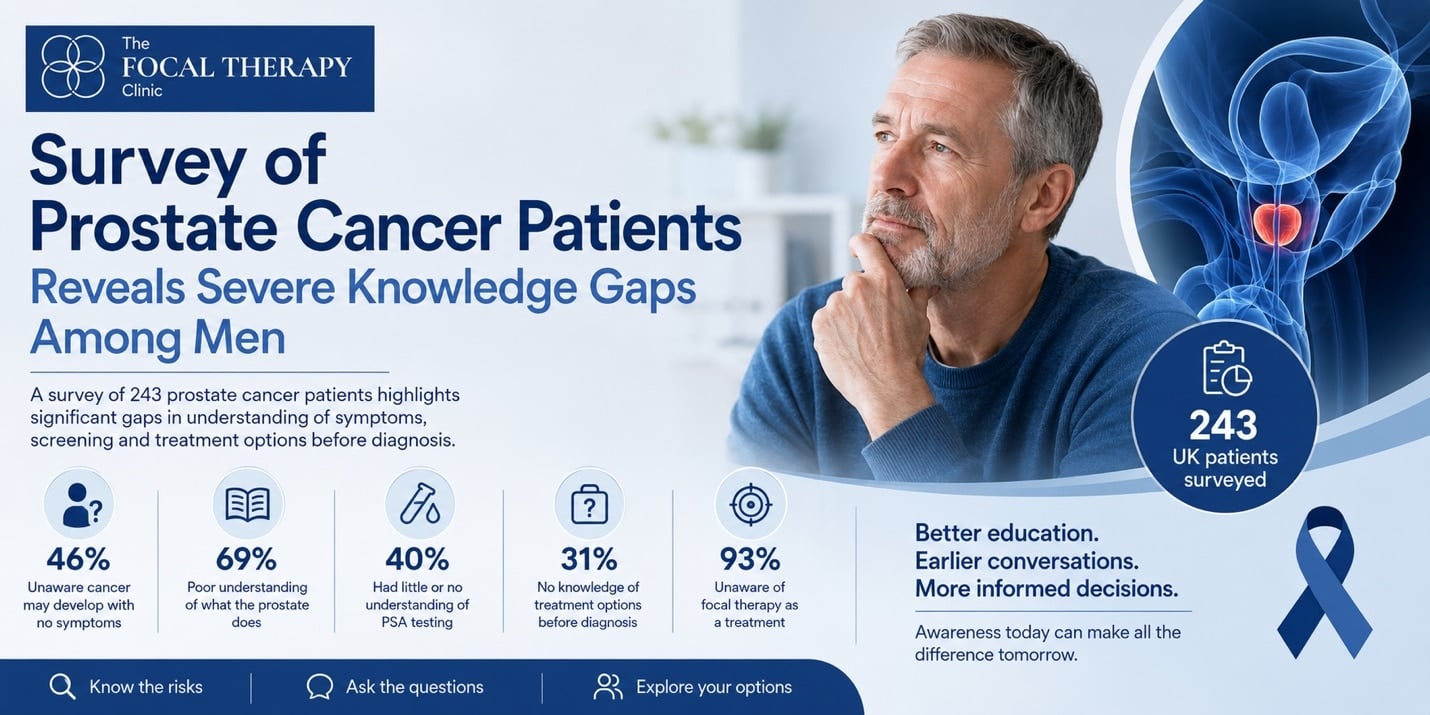
Survey of Prostate Cancer Patients Reveals Severe Knowledge Gaps Among Men
How Accurate is a Urine test for Prostate Cancer – and can it replace PSA or MRI?
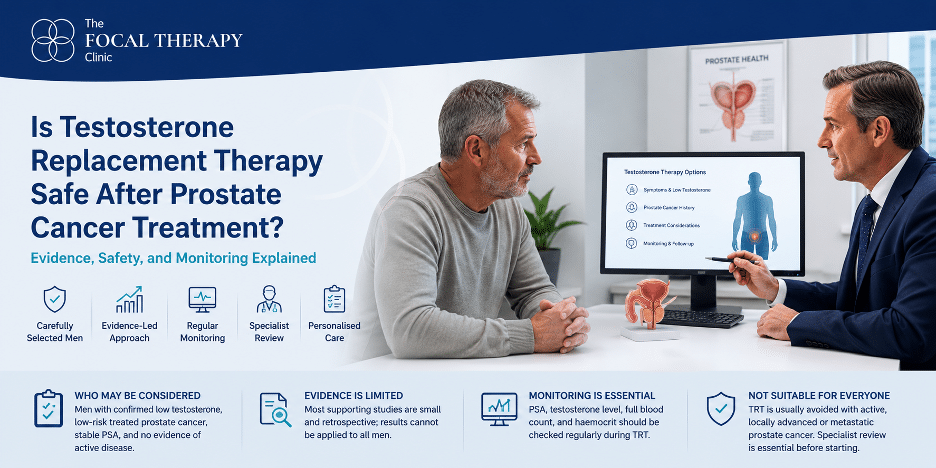
Is Testosterone Replacement Therapy Safe After Prostate Cancer Treatment?
Reference List
HEAT Registry (European Urology, 2022) - Dudderidge T, et al. PMID: 35123819
5-Year Multicentre Outcomes (European Urology, 2018) - Guillaumier S, et al. PMID: 29960750
Focal therapy compared to radical prostatectomy (Prostate Cancer and Prostatic Diseases, 2021) - Shah TT, Reddy D, Peters M, et al. (co-authors include Dudderidge T, Nigam R). PMID: 33504940
Ahmed Lancet Study (Lancet Oncology, 2012) - Ahmed HU, Allen C, et al. PMID: 22512844
MRI and Focal Therapy (Radiology, 2021) - Allen C, Giganti F, et al. PMID: 33533678
PI-FAB Scoring System (Eur Urol Oncol, 2023) - Giganti F, Allen C, et al. PMID: 37210343
PRESERVE Trial (European Urology, 2025) - PMID: 40685282
2025 Meta-analysis (Eur Urol Oncol) - PMID: 40251100
2024 Meta-analysis (Prostate Cancer Prostatic Dis) - PMID: 39468217
2021 Systematic Review (European Urology) - PMID: 34489140
Subscribe to our newsletter
Get expert advice & the latest prostate cancer research - straight to your inbox.