
At a Glance
Urine tests for prostate cancer — such as PCA3, SelectMDx, ExoDx and MyProstateScore 2.0 — look for genetic markers linked to prostate cancer risk. They are not part of the standard NHS diagnostic pathway and cannot diagnose prostate cancer on their own.¹ ² At The Focal Therapy Clinic, our experienced consultants review all test results — including any urine biomarker findings — as part of a complete clinical picture that also includes PSA, mpMRI and biopsy where needed.
Key takeaways:
- Not a stand-alone diagnosis — no urine test can confirm prostate cancer by itself; results always need specialist interpretation alongside PSA, MRI and biopsy.
- Risk-assessment tools — urine biomarkers estimate the chance of clinically significant cancer; they support decision-making in selected cases, they don’t replace other tests.
- NHS vs private — urine tests are not part of the standard NHS pathway; NICE NG131 sets out the evidence-based diagnostic route.¹
- False results are possible — both false positives and false negatives occur; urine tests cannot replace MRI or specialist review.
- Home kits carry risk — most basic home urine tests do not reliably detect prostate cancer; advanced biomarker tests still need medical supervision.³
What is a urine test for prostate cancer?
A urine test checks your urine for markers linked to prostate cancer cells. Some look for gene activity; others for small particles or genetic material released by prostate cells. The aim is to estimate your risk of prostate cancer — especially cancer that may need treatment.
A urine test does not show the position of a tumour, and it cannot confirm the grade or stage of cancer — those details need MRI and biopsy. Urine tests are best understood as risk tools: they may help decide whether further tests are needed.
How do urine tests work?
Different tests work differently. Some samples are collected after a prostate examination or massage — usually during a digital rectal examination — because the pressure helps release prostate cells into the first urine passed afterwards. Other tests don’t require a DRE.
The laboratory checks the sample for cancer-related markers, and your specialist reads the result alongside your age, PSA, family history, prostate size, MRI findings, DRE findings, symptoms and any biopsy history. Some tests produce a score: a higher score may suggest a higher chance of prostate cancer — it does not prove cancer is present.
What can urine tests detect?
Some tests aim to estimate the risk of clinically significant prostate cancer — the distinction matters, because many prostate cancers grow slowly and may never cause harm. Doctors want to find the cancers likely to grow, spread or need treatment.
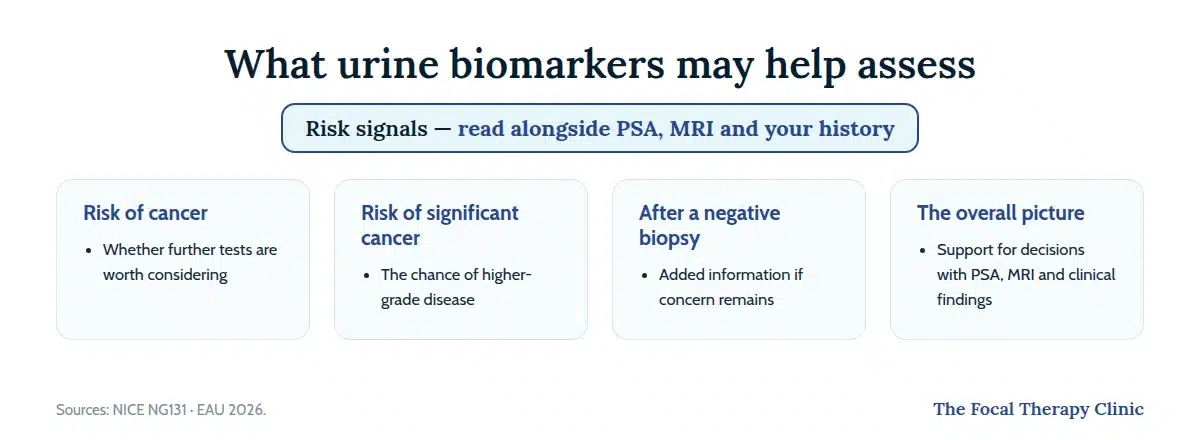
| What the test may help assess | What this means |
|---|---|
| Risk of prostate cancer | May suggest whether further tests are worth considering |
| Risk of significant cancer | May help estimate the chance of higher-grade disease |
| Risk after a previous negative biopsy | May add information if concern remains |
| Overall risk picture | May support decisions when used with PSA, MRI and clinical findings |
Can a urine test replace a PSA test?
A patient urges men to get screened early, describing how a routine PSA test caught his cancer while every treatment option was still open.
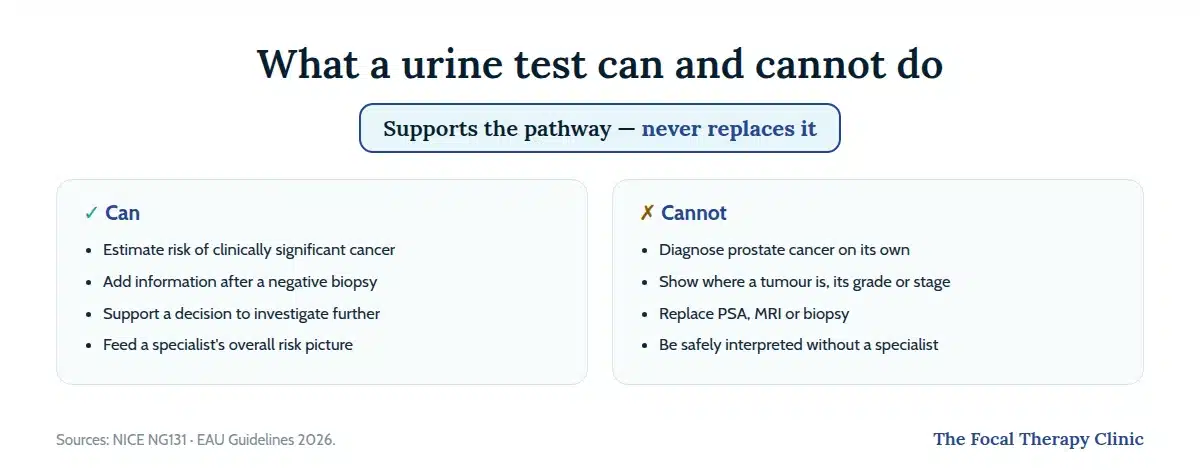
No. The PSA blood test remains the most common first test for prostate cancer risk, in primary care and specialist practice alike. PSA is not perfect — it can be raised by an enlarged prostate, infection or recent prostate stimulation, and it can miss some cancers — but urine tests provide extra information in selected cases, not a replacement for PSA, MRI or biopsy. See our guide to the most accurate test for prostate cancer for where each test fits.
What is PCA3?
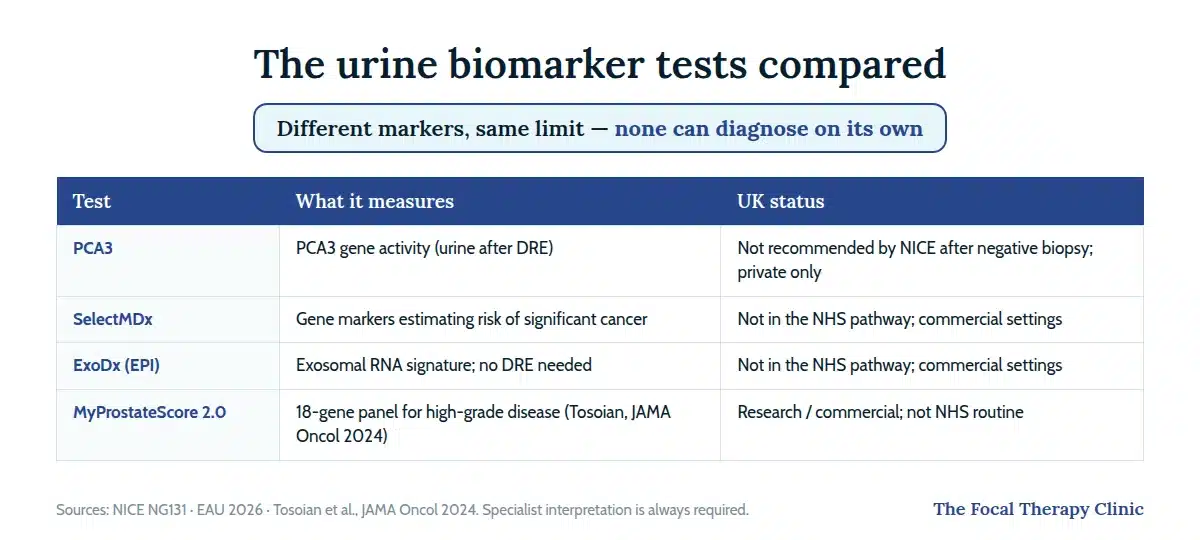
PCA3 (prostate cancer gene 3) is one of the older urine biomarkers — the gene is more active in many prostate cancer cells, and the test measures that activity in urine collected after a DRE.
A higher PCA3 score may suggest a higher chance of prostate cancer. However, PCA3 is not used routinely in the NHS: NICE does not recommend the PCA3 assay for men being investigated after a negative or inconclusive biopsy, and the EAU states its clinical value for biopsy decisions remains unclear.¹ ²
What is MyProstateScore 2.0?
MyProstateScore 2.0 (MPS2) is a newer urine test measuring an 18-gene panel linked to prostate cancer and higher-grade disease. Validation research suggests MPS2 can help identify men unlikely to have clinically significant cancer, potentially sparing some unnecessary biopsies in selected groups.⁴
MPS2 is also not part of routine NHS diagnosis — it belongs mainly to research and commercial settings, does not replace MRI or biopsy, and still needs specialist interpretation within your full clinical picture.
Can urine tests help avoid a biopsy?
In selected men, yes — most plausibly when the result suggests low risk and other findings are reassuring. But urine tests must never be used to dodge a biopsy when risk remains concerning: if PSA, MRI, DRE or history point to significant risk, biopsy is still needed — and only biopsy shows the cancer’s grade, which guides treatment.
Get Expert Advice & The Latest Research
Subscribe to our newsletter to receive the latest updates, expert insights, and breakthrough research on prostate cancer-delivered straight to your inbox.
Are home urine tests available?
Some are marketed for “prostate health” — treat them with caution. Many basic home kits only check for blood in urine, and invisible blood is not a reliable sign of prostate cancer (visible blood needs medical review, but usually has other causes).³ Advanced biomarker tests may offer home collection, but the result still needs medical interpretation — a score without specialist advice can mislead. If you are worried about prostate cancer, speak to your GP or a specialist.
Limitations of urine tests
No urine test is perfectly accurate:
- False positives suggest risk where none exists — causing anxiety and extra testing.
- False negatives suggest low risk when significant cancer is present — which is why they cannot replace MRI, biopsy or specialist review.
- Practical limits — availability, cost and performance vary with the test, the cut-off chosen and the population tested.
Current European guidance recognises that some urine and blood biomarkers may help with risk assessment, but no specific urine biomarker test is recommended for routine practice at present.²
What happens if prostate cancer is suspected?
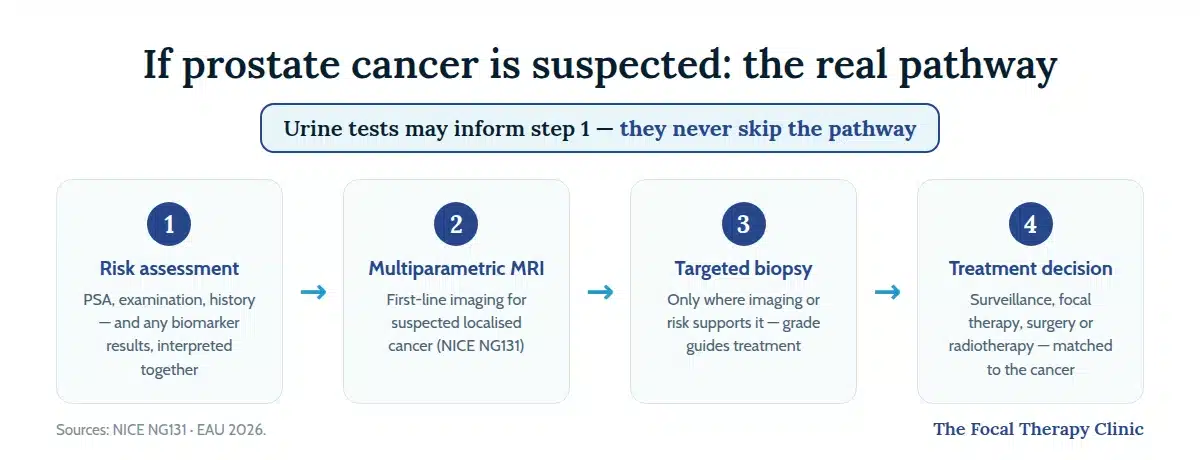
The next step is proper risk assessment: PSA, MRI findings, biopsy grade, stage, cancer volume, general health and your priorities. Treatment is never based on a urine test alone.
Some men are suitable for active surveillance; others need surgery, radiotherapy or hormone treatment. Selected men with localised disease may wish to discuss focal therapy — treating the known cancer area rather than the whole prostate with HIFU (NICE HTG667) or NanoKnife (NICE HTG688). In FTC’s audited series of 265 men, 97% maintained urinary continence and 90%+ preserved sexual function. Suitability depends on cancer position, grade, volume, MRI and biopsy findings — decided after careful review by experienced specialists; our consultants hold 75+ years of combined focal therapy experience across 2,500+ procedures.
Emerging tests don’t stop at urine — genetic screening for prostate cancer explains who benefits from DNA-based risk checks.
Frequently Asked Questions
Can a urine test tell me I definitely don’t have prostate cancer?
No. A reassuring score lowers the estimated risk but cannot exclude cancer — false negatives happen. If your PSA, MRI or examination findings raise concern, further tests are still needed.
Is PCA3 available on the NHS?
Not routinely. NICE does not recommend the PCA3 assay in the investigation pathway, and it is mainly offered privately.¹ Discuss with a specialist whether it would genuinely add anything in your case.
Where can I get MyProstateScore 2.0?
MPS2 sits in research and commercial testing settings rather than the NHS pathway. If you are considering it privately, involve a urologist who can interpret the score within your whole clinical picture.⁴
Are home prostate test kits worth buying?
Generally no. Most basic kits detect blood in urine, which is neither sensitive nor specific for prostate cancer.³ Money is better spent on a GP visit and, where appropriate, a PSA blood test.
My urine biomarker score came back high — what now?
Don’t panic: a high score is a risk signal, not a diagnosis. The next steps are usually a specialist review, PSA, and multiparametric MRI — and a targeted biopsy only if imaging supports it.
This content is not intended to be a substitute for professional medical advice, diagnosis, or treatment. Always seek the advice of your urologist or other qualified health provider with any questions you may have regarding a medical condition.
References
- National Institute for Health and Care Excellence. Prostate cancer: diagnosis and management (NG131). 2019, updated 2021. https://www.nice.org.uk/guidance/ng131
- European Association of Urology. EAU Guidelines on Prostate Cancer. 2026. https://uroweb.org/guidelines/prostate-cancer
- Prostate Cancer UK. The problem with home urine tests for prostate cancer. 2023. https://prostatecanceruk.org/about-us/news-and-views/2023/09/problem-with-home-urine-tests
- Tosoian JJ, Zhang Y, Xiao L, et al. Development and Validation of an 18-Gene Urine Test for High-Grade Prostate Cancer. JAMA Oncol. 2024;10(6):726–736.
- NHS. Tests and next steps for prostate cancer. 2025. https://www.nhs.uk/conditions/prostate-cancer/tests-and-next-steps/
- Cancer Research UK. Tests for prostate cancer. https://www.cancerresearchuk.org/about-cancer/prostate-cancer/getting-diagnosed/tests-for-prostate-cancer