
At a Glance
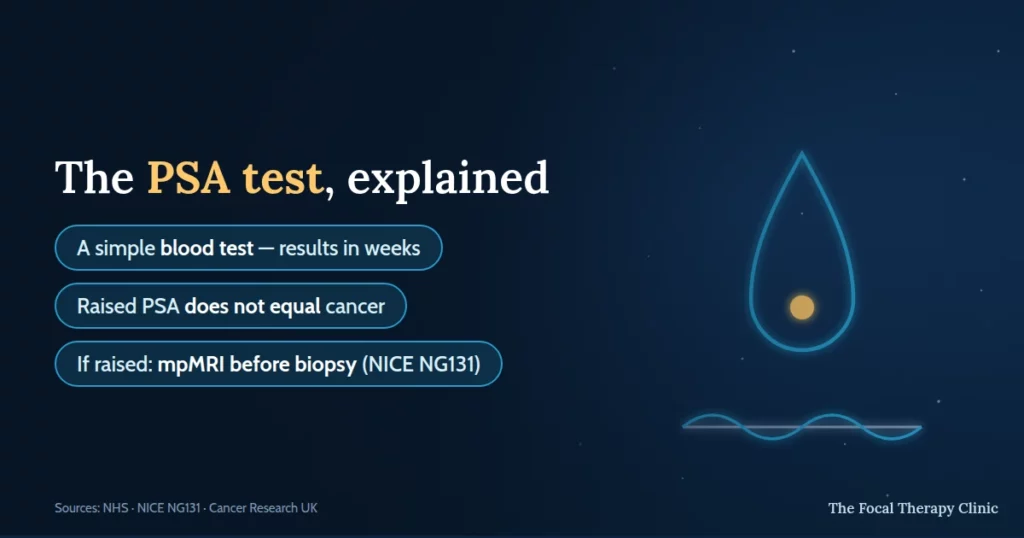
The PSA test for prostate cancer measures a protein (Prostate-Specific Antigen) in the blood, produced by prostate cells. Elevated levels don’t always indicate cancer — age and other factors also affect results. It remains the routine starting point for prostate checks in the UK, and if the result is raised, a high-quality mpMRI scan is the most important next step before any decision about biopsy.
- Who should consider it — any man, particularly over 50; higher-risk men (family history, Black ethnicity) may test earlier
- What affects PSA — infections, recent ejaculation, vigorous exercise (especially cycling), instrumentation, certain medications, prostate size and age
- What the result means — measured in ng/ml with age-related reference ranges; a raised PSA is not an automatic indicator of cancer, and a normal PSA does not fully rule it out
- Pros and cons — early detection and easy monitoring, but false alarms, overdiagnosis and overtreatment are real risks; the decision is personal and informed
- What may change — the PROSTAGRAM study found short MRI could detect around twice as many clinically significant cancers as PSA testing; the TRANSFORM trial is now testing MRI-based screening at population scale
What is Prostate-Specific Antigen (PSA)?
The PSA blood test is a test that measures the level of prostate-specific antigen (PSA) in a man’s blood. PSA is a protein produced by cells in the prostate gland, which sits just below the bladder and surrounds the urethra (the tube that carries urine out of the body). While it’s primarily associated with prostate cancer, it’s important to understand that an elevated PSA level doesn’t always mean cancer. It’s normal for men to have a small amount of PSA in their blood, and this level generally increases with age.
A separate guide covers the PSE test and how it differs from standard PSA testing.
Dr Christos Mikropoulos explains what a PSA result actually means — what raises it, what it can and cannot tell you, and what should happen next.
Who Can Have a PSA Test?
Any man can request a PSA test from his GP in the United Kingdom, especially if he is over 50. Some men, however, are considered at higher risk of developing prostate cancer, including:
- Men with a family history of prostate cancer (especially first-degree relatives like a father or brother)
- Men of African or African-Caribbean descent, as prostate cancer is more common in these groups
- Men over 50 in general, as the risk of prostate cancer increases with age
If you fall into one of these categories, your GP may discuss the pros and cons of the test with you. Men who are younger but have a strong family history or other factors that raise their risk can also discuss PSA screening with their doctor.
What Could Affect My PSA Level?
A variety of factors — both cancerous and non-cancerous — can affect your PSA reading. Keep these in mind when considering a test, as they can lead to temporary increases or decreases in PSA:
- Urinary or prostate infections (for example, prostatitis)
- Recent sexual activity or ejaculation
- Vigorous exercise, particularly cycling
- Recent instrumentation (such as catheterisation)
- Certain medications, including 5-alpha-reductase inhibitors (used for benign prostate enlargement)
- Age and prostate size (PSA can rise naturally as you get older)
If you are planning a PSA test, your doctor may advise you to avoid ejaculation or intense exercise for 48 hours beforehand to prevent an artificially high reading.
What Does the PSA Test Involve?
Most people find that the PSA test is simple and quick. It involves drawing a small sample of blood from your arm, usually in a clinic or GP’s office.
You might be advised not to ejaculate or do heavy exercise for 48 hours before the test. A healthcare professional will place a tourniquet around your upper arm and use a needle to take a blood sample from a vein.
The sample is then sent to a laboratory to measure the amount of PSA in your bloodstream. You will normally get the results within a few weeks.
Some men feel nervous about needles, but the procedure is usually swift. If you have concerns, let the person taking your blood know so they can help you stay as comfortable as possible.
What Will the Test Results Tell Me?
Dr Christos Mikropoulos answers how reliable a PSA test is — what a result can and cannot tell you on its own.
Your PSA test result is usually reported in nanograms of PSA per millilitre of blood (ng/ml). While there are guidelines suggesting what might be considered a typical or raised level for certain age groups, the interpretation is not always straightforward.
What Is a Normal PSA Level by Age?
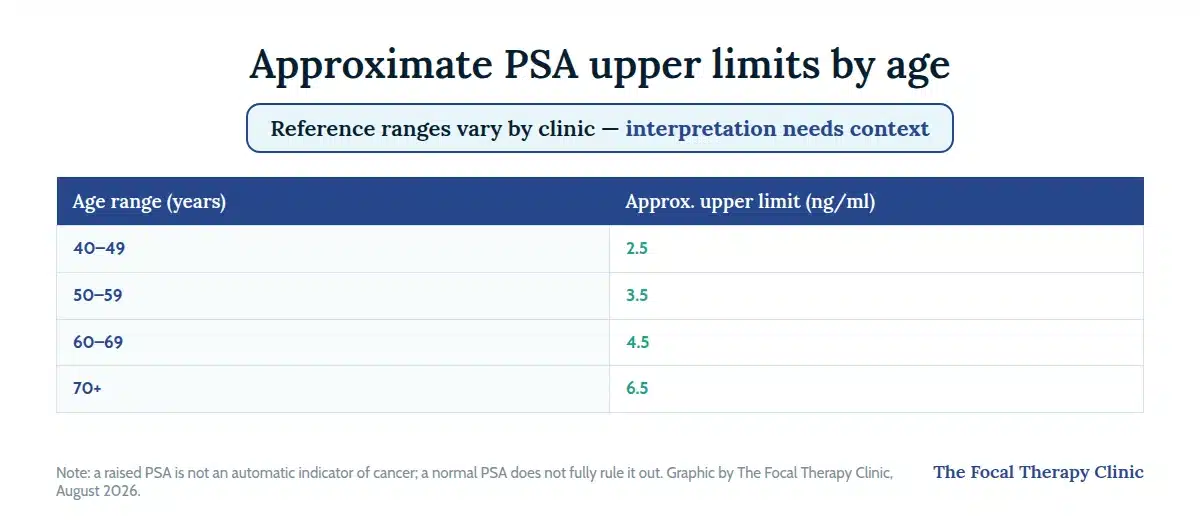
Healthcare professionals often use age-related reference ranges. The table below provides approximate upper limits of normal PSA levels. Note that different clinics may adopt slightly different cut-off points:
| Age range (years) | Approximate upper limit of normal PSA (ng/ml) |
|---|---|
| 40–49 | 2.5 |
| 50–59 | 3.5 |
| 60–69 | 4.5 |
| 70+ | 6.5 |
If your PSA level is above these ranges, your doctor may suggest repeating the test or conducting further investigations, such as an MRI scan. However, a raised PSA is not an automatic indicator of prostate cancer, and many factors can contribute to elevated levels (as mentioned above). Conversely, some men with prostate cancer have relatively low PSA readings, underlining why PSA alone cannot confirm or rule out cancer.
What happens next?
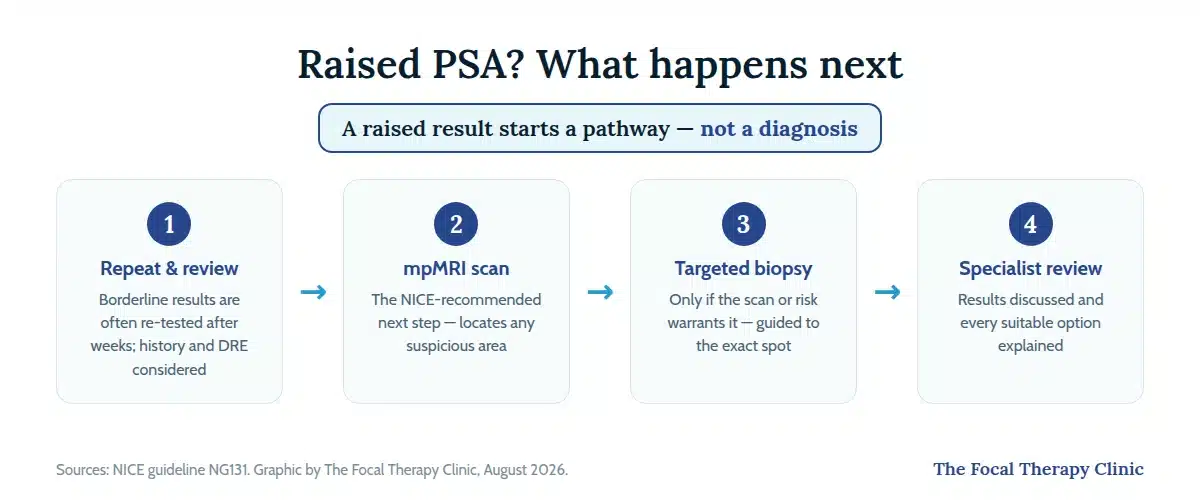
The next steps depend on your PSA level, your age, your risk factors, and any symptoms you may have.
If your PSA level is within the typical range for your age and you have no symptoms, your doctor may recommend repeating the test in the future (the frequency will depend on your individual circumstances).
If your PSA is slightly elevated, your doctor may recommend repeating the test in a few weeks or months to see if it remains elevated or returns to normal. They may also consider other factors — such as your family history and ethnicity, and perform a digital rectal examination.
If your PSA is moderately or significantly elevated, your doctor will likely refer you to a urologist for further evaluation, typically for an MRI scan. If any suspicious areas are identified, or your PSA is very high, a prostate biopsy may be recommended. This involves taking small samples of tissue from the prostate to be examined under a microscope.
Every stage of that pathway — scans, biopsy, grading and the treatment decision itself — is explained step by step in our complete guide to prostate cancer.
Regular PSA tests
Even if your PSA result is within a typical range, you might still opt for regular re-testing, especially if you have risk factors such as a strong family history or if you start to develop urinary symptoms. Your GP or specialist will guide you on how often to test. This is sometimes called “active surveillance” or “watchful waiting” if you have been diagnosed with a low-risk prostate cancer. A rising PSA level over time may be more concerning than a single elevated result.
Advantages and Disadvantages of the PSA Test
Mr Alan Doherty weighs up whether you should have your PSA measured — the benefits of knowing your level and the questions to ask before testing.
Deciding whether to have a PSA test can be complex. Below are some points to consider, but it is important to speak with a healthcare professional about your specific situation.
Advantages
- Early detection: A rising PSA can signal early prostate changes, sometimes before noticeable symptoms appear. Early-stage prostate cancer can be easier to treat.
- Monitoring: If you are on active surveillance or have had treatment for prostate cancer, PSA testing is one way to keep track of changes.
- Widely available: The PSA test is a simple blood test that is widely available.
Disadvantages
- Not definitive: A high PSA does not necessarily mean you have cancer, and normal levels do not guarantee that you are cancer-free. Additional tests are often required (typically in the form of imaging, e.g. MRI).
- False alarms: Anxiety and further invasive tests (like biopsies) may result from raised PSA readings caused by benign factors.
- Overdiagnosis and overtreatment: Some prostate cancers grow so slowly they might never cause harm. Discovering these can lead to treatments and side effects that might have been avoidable.
Get Expert Advice & The Latest Research
Subscribe to our newsletter to receive the latest updates, expert insights, and breakthrough research on prostate cancer-delivered straight to your inbox.
Should I Have a PSA Test?
A patient urges men to get screened early, describing how a routine PSA test caught his cancer while every treatment option was still open.
The decision of whether or not to have a PSA test is a personal one that should be made in consultation with your doctor. Discuss the potential benefits and risks, considering your age, family history, ethnicity, and any other relevant factors. There is no right or wrong answer, and your doctor can help you make an informed decision that’s right for you.
If you do decide to have the test and your PSA levels are raised, remember that further assessment is often needed. In many cases, a temporarily high PSA can return to normal with time or after treating an infection. Should a biopsy confirm prostate cancer, you will be able to explore a range of treatment options, including focal therapy (if the disease is localised and suitable for a targeted approach), surgery, radiotherapy, or other modalities based on the stage and grade of your cancer.
Could an MRI Scan Become ‘The Man’s Mammogram’?
Because the PSA test can miss some cancers and raise the alarm over harmless ones, researchers have long asked whether imaging could do for men what mammography does for women: screen for cancer directly, before symptoms appear.
The first serious test of that idea was the IP1-PROSTAGRAM study, developed by researchers at Imperial College London and published in JAMA Oncology in 2021: 408 men aged 50 to 69, invited through their GP practices, each had a PSA test, a short non-contrast MRI scan and an ultrasound scan, each read independently. The PROSTAGRAM study found that short MRI could detect around twice as many clinically significant prostate cancers as PSA testing. Even at a stricter MRI threshold that sent no more men for biopsy than PSA did, MRI still found more significant cancers (11 versus 7) without picking up more harmless, insignificant ones. PROSTAGRAM was a small feasibility study — too small to prove MRI screening saves lives, but strong enough to justify testing at population scale.
As the Imperial College London investigators put it:
“The prospect of a male equivalent of the breast mammogram or so-called ‘prostagram’ has been a long-standing goal in prostate cancer diagnostics. The revolution of MRI has offered a new opportunity to re-explore this area.” — Imperial College London research team, JAMA Oncology, 2021
That population-scale test is now under way. TRANSFORM — the UK’s largest ever prostate cancer screening trial, led by Professor Hashim Ahmed at Imperial College London, who was also the senior investigator on PROSTAGRAM — screened its first men in March 2026. Its first stage compares the main candidate methods in around 16,000 men — fast MRI scans, PSA testing and genetic risk scores — against current NHS practice; its second stage will take the best performer to population scale in up to 300,000 men, followed for at least ten years. Around £60 million of government-backed funding is expanding its reach, with a particular commitment to recruiting Black men, who are at higher risk and have been under-represented in screening research. TRANSFORM is designed to answer the question that will decide national policy: can an MRI-based pathway safely screen millions of men, save lives, and avoid unnecessary biopsies and treatment?
It helps to understand the difference between screening and diagnosis. Screening looks for cancer in people who have no current symptoms, while diagnostic tests are for people whose symptoms or test results already suggest cancer may be present. Multiparametric MRI (mpMRI) is already the standard first-line diagnostic investigation for men with a raised PSA or suspected prostate cancer, as recommended by NICE Guideline NG131 — but it has not yet been adopted for population-level screening. That is the change TRANSFORM could bring.
Mr Tim Dudderidge, Consultant Urological Surgeon at The Focal Therapy Clinic, sees image-based screening as a natural next step for the whole pathway:
“The Prostagram study opens up a new chapter in the screening, diagnostic and treatment pathway for prostate cancer. Precision screening will improve the detection process — increasing diagnosis of clinically significant disease and reducing unnecessary detection of insignificant disease.” — Mr Tim Dudderidge, Consultant Urological Surgeon
For now, the PSA test remains the routine starting point; if your result is raised, a high-quality mpMRI scan is the most important next step before any decision about biopsy. But if TRANSFORM confirms what PROSTAGRAM suggested, MRI-based screening could one day sit alongside — or ahead of — the PSA test in a national programme. That would matter for treatment too: screening at scale should find more cancers while still small and confined to the prostate, making more men candidates for treatments that target the tumour alone, such as focal therapy, rather than the whole gland.
What to Do If You Are Worried About Prostate Cancer
If you have concerns about prostate cancer:
- A urologist or oncologist can provide guidance on screening and testing options. Seeking a second opinion may also offer reassurance.
- Support groups and counselling can help manage emotional stress.
- Keeping up with new research and advancements can help you make informed decisions.
Newer urine-based biomarker tests are also emerging — read our review of how accurate a urine test for prostate cancer can be.
Frequently Asked Questions
What is a PSA test for prostate cancer?
A PSA test measures prostate-specific antigen levels in the blood to detect prostate abnormalities, including cancer.
Can PSA levels go down with prostate cancer?
Yes, PSA levels can fluctuate. Certain treatments and lifestyle changes can lower PSA levels.
What is normal PSA for age?
PSA levels vary by age. Approximate upper limits: 40–49 years up to 2.5 ng/ml; 50–59 up to 3.5 ng/ml; 60–69 up to 4.5 ng/ml; 70 and over up to 6.5 ng/ml. These ranges are approximate and vary between clinics — a result above the range for your age is a prompt for review, usually a repeat test or an mpMRI scan, not a diagnosis.
What are the warning signs of prostate cancer PSA levels?
PSA levels themselves don’t cause warning signs — PSA is a blood test result, and early-stage prostate cancer is usually asymptomatic. Symptoms that can develop in later stages include difficulty urinating, frequent urination (especially at night), blood in urine or semen, erectile dysfunction, bone pain (if spread) and urinary retention — but these are more commonly caused by non-cancerous conditions. Don’t wait for symptoms: discuss PSA testing and DRE with your doctor for early detection.
What PSA is stage 4 prostate cancer?
There’s no single PSA level that defines Stage 4 prostate cancer. Staging requires a complete evaluation: PSA level, Gleason score from a biopsy, and TNM staging using imaging (MRI, CT, bone scans) to assess tumour size, lymph node involvement and metastasis. Stage 4 means the cancer has spread to lymph nodes beyond the pelvis (N1) or to distant sites (M1), regardless of the specific PSA number.
Is there an alternative to the PSA test for prostate cancer screening?
Not yet as a routine option. The PSA blood test remains the standard first step in checking for prostate cancer in men without symptoms. However, the IP1-PROSTAGRAM study (Imperial College London, JAMA Oncology 2021) found that a short MRI scan could detect around twice as many clinically significant prostate cancers as PSA testing, and the UK’s TRANSFORM trial is now testing MRI-based screening at population scale. Until national guidance changes, the pathway remains a PSA test first, then — if the result is raised — an mpMRI scan under NICE Guideline NG131.
What is the TRANSFORM prostate cancer screening trial?
TRANSFORM is the UK’s largest prostate cancer screening trial, led by Professor Hashim Ahmed at Imperial College London. Its first stage compares screening methods — including fast MRI scans, PSA testing and genetic risk scores — in around 16,000 men against current NHS practice; its second stage will test the best-performing method in up to 300,000 men, followed for at least ten years. The first men were screened in March 2026. Its results will give the UK National Screening Committee the evidence to decide whether national prostate cancer screening should be introduced.
References
- Cancer Research UK — PSA testing.
- Prostate Cancer UK — PSA test.
- NHS — PSA testing.
- NICE guideline NG131 — Prostate cancer: diagnosis and management.
- Eldred-Evans D, et al. (IP1-PROSTAGRAM). Population-based prostate cancer screening with magnetic resonance imaging or ultrasonography. JAMA Oncology 2021.
- TRANSFORM trial — Imperial College London / Prostate Cancer UK (first men screened March 2026).
This content is not intended to replace professional medical advice. Always consult your clinical team about your individual circumstances.