
At a Glance
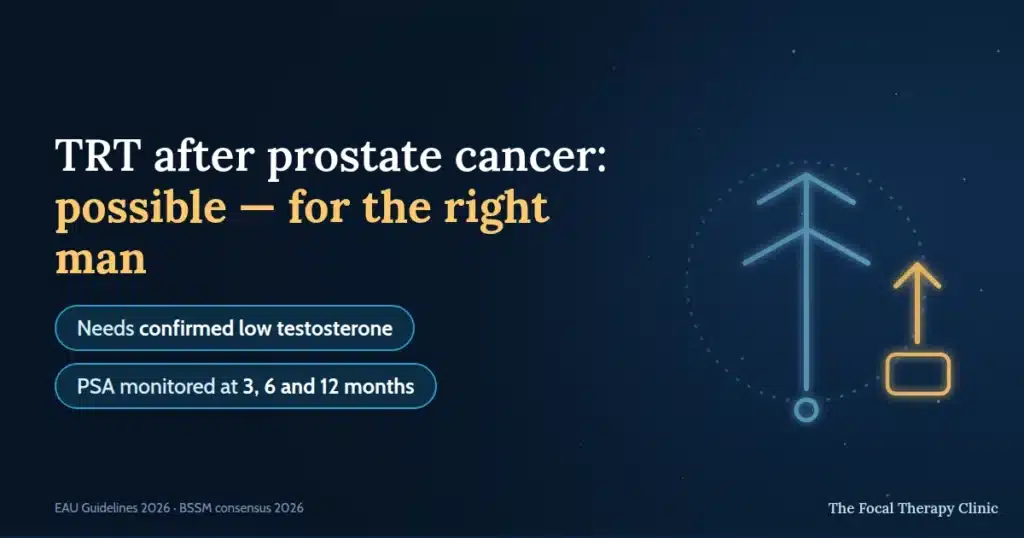
Testosterone replacement therapy (TRT) may be considered for carefully selected men after treatment for localised prostate cancer, but it is not appropriate for everyone. Current evidence does not show that TRT causes prostate cancer in men with confirmed testosterone deficiency, though long-term safety data in cancer survivors remain limited.³ ⁴ Any decision requires full specialist review, including PSA monitoring and assessment of cancer history.¹
Key takeaways:
- Who may be considered — men with confirmed low testosterone, low-risk treated prostate cancer, stable PSA, and no evidence of active disease.
- Historical concern addressed — earlier fears that testosterone fuels cancer came from studies in advanced disease; the saturation model has shifted thinking, but caution remains warranted.
- Evidence is limited — most supporting studies are small and retrospective; results cannot be applied to all men.⁴
- Monitoring is essential — PSA, testosterone level, full blood count and haematocrit should be checked regularly during TRT.
- Not suitable for everyone — TRT is usually avoided with active, locally advanced or metastatic prostate cancer; specialist review is essential before starting.
- TRT after radiotherapy — needs extra caution because PSA does not usually fall to zero.
Why the historical concern about testosterone?
For many years, doctors were cautious about testosterone in men with prostate cancer. The concern came from the fact that prostate cancer cells often use male hormones — androgens — to grow, and testosterone is the main male hormone.
A major prostate cancer treatment is androgen deprivation therapy, which lowers testosterone to slow cancer growth; it is often used for advanced disease or alongside radiotherapy in some higher-risk cases. It was therefore assumed that giving testosterone back could “fuel” prostate cancer — a reasonable concern at the time.
However, the older evidence mainly came from men with advanced disease. It did not answer a different question: whether TRT is safe in carefully selected men with treated, localised prostate cancer and stable follow-up results.
Modern evidence has challenged the idea that more testosterone always means more prostate cancer growth. One theory — the saturation model — suggests prostate tissue may respond to testosterone only up to a certain level. The saturation model is useful, but it is not a guarantee of safety: it does not remove the need for careful selection and monitoring. (Our low testosterone and prostate cancer risk guide covers this evidence in depth.)
What does recent evidence show?
Recent studies suggest TRT does not appear to increase the risk of developing prostate cancer in men who are properly diagnosed with testosterone deficiency.³
Evidence is more cautious in men who have already had prostate cancer. Some studies suggest that selected men may use TRT after successful treatment for localised prostate cancer without a clear increase in recurrence — most reassuring in men with low-risk disease, favourable pathology and stable PSA results.⁴ However, long-term evidence is still limited: many studies are small, retrospective and include carefully selected patients, so the results cannot be applied to every man.
The European Association of Urology advises caution: TRT may be discussed in symptomatic men previously treated for prostate cancer, but this needs full counselling and careful selection.¹ A 2026 British Society for Sexual Medicine consensus statement now also addresses testosterone therapy after prostate cancer treatment, reflecting how actively this field is developing.⁵
Who might benefit from TRT?
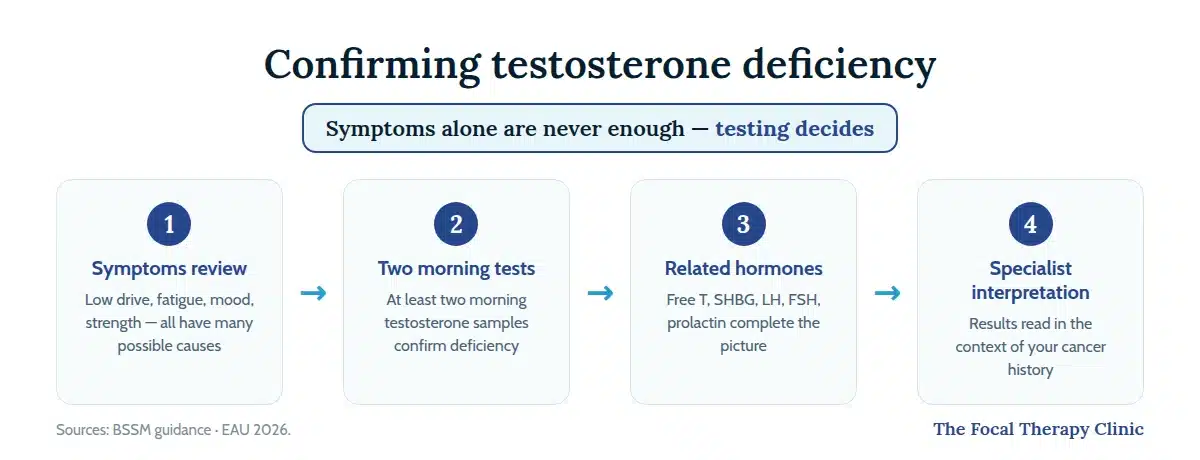
TRT may be considered when a man has both symptoms and confirmed low testosterone.
Possible symptoms include: low sex drive, fewer morning erections, erectile difficulties, low energy, low mood, reduced muscle strength, increased body fat, poor concentration and reduced bone strength.
These symptoms can have many causes — stress, poor sleep, depression, diabetes, obesity, medicines and cancer treatment can all contribute. This is why blood testing matters especially here: a diagnosis usually needs at least two morning testosterone blood tests. Your doctor may also check free testosterone, sex hormone binding globulin, luteinising hormone, follicle-stimulating hormone and prolactin. A specialist should interpret these results.
What monitoring is required?
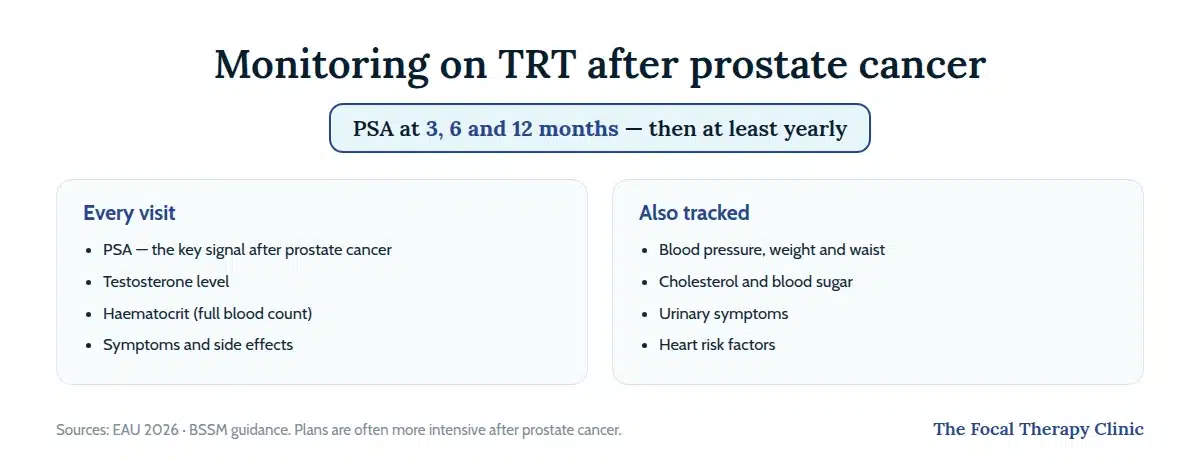
Monitoring is essential before and during TRT. Your clinician may check: PSA, testosterone level, full blood count (especially haematocrit), blood pressure, weight and waist size, cholesterol and blood sugar, symptoms and side effects, urinary symptoms, and heart risk factors.
Haematocrit is the proportion of your blood made up of red blood cells. TRT can raise it, and if it becomes too high, treatment may need to be reduced, paused or changed.
For men with previous prostate cancer, PSA is especially important: many guidelines advise checking PSA at three, six and 12 months during the first year of TRT, then at least yearly.¹ Your monitoring plan may be more intensive if you have had prostate cancer.
What are the potential benefits of TRT?
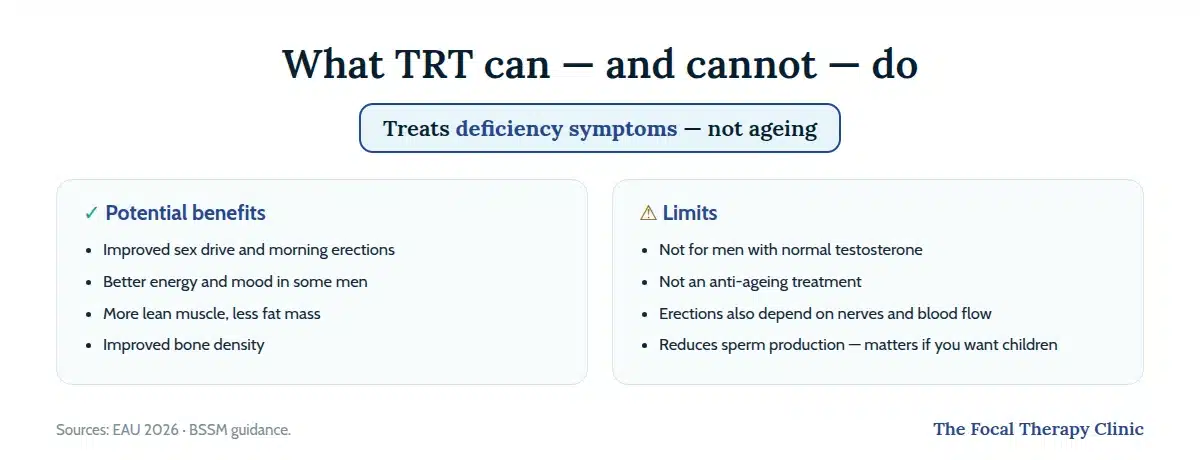
When TRT is suitable, the aim is to improve symptoms caused by low testosterone. Possible benefits may include improved sex drive, better morning erections, improved energy, improved mood in some men, increased lean muscle mass, reduced fat mass, improved bone density and correction of unexplained anaemia in some men.
TRT is not a general anti-ageing treatment and is not recommended for men with normal testosterone levels. Sexual recovery after prostate cancer treatment is also complex: TRT may help desire if testosterone is low, but erections also depend on nerves, blood flow, medication response and the type of treatment received.
Get Expert Advice & The Latest Research
Subscribe to our newsletter to receive the latest updates, expert insights, and breakthrough research on prostate cancer-delivered straight to your inbox.
When might TRT be avoided?
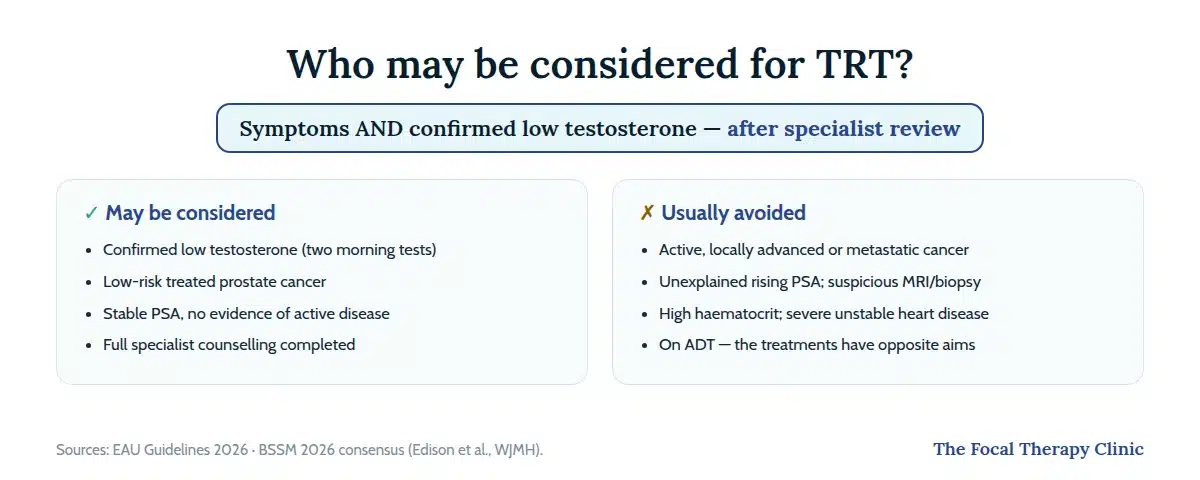
TRT is usually avoided in men with: active prostate cancer where TRT is not considered safe; locally advanced or metastatic prostate cancer; unexplained rising PSA; suspicious MRI or biopsy findings; male breast cancer; high haematocrit; severe unstable heart disease; severe chronic heart failure; untreated severe sleep apnoea; or a current wish to have children.
TRT can reduce sperm production — men who want children may need different options. TRT is also not appropriate for men receiving androgen deprivation therapy: the two treatments have opposite aims.
This is why testosterone replacement therapy and prostate cancer should never be managed through online shortcuts or non-specialist prescribing. Safe care depends on proper diagnosis and structured follow-up — expert oversight protects patients.
The Focal Therapy Clinic approach
Mr Alan Doherty answers the question every man asks — will treatment affect your sex life? — and explains how today’s options for early prostate cancer can protect it, depending on the treatment you choose.
The Focal Therapy Clinic provides specialist assessment for men with localised prostate cancer. Many patients want effective cancer control while reducing avoidable side effects; our team focuses on precision-led care and personalised planning.
For suitable men, focal therapy treats the known cancer area rather than the whole prostate, aiming to preserve urinary continence and erectile function. TRT decisions after prostate cancer need careful review — especially after focal therapy, because healthy prostate tissue remains and PSA monitoring differs from surgery.
Every case is considered in context: the cancer, previous treatment, testosterone levels, symptoms, PSA pattern, MRI findings and personal priorities. We offer HIFU (NICE HTG667) and NanoKnife (NICE HTG688) for suitable patients, with every case reviewed by a multidisciplinary team spanning surgery, oncology, imaging and male health. With 2,500+ focal therapy procedures and 75+ years of combined consultant experience, we also provide trusted second opinions for men comparing their options.
Frequently Asked Questions
Does TRT cause prostate cancer?
Current evidence does not show that TRT causes prostate cancer in men properly diagnosed with testosterone deficiency.³ In men who have already had prostate cancer, the evidence is more cautious and long-term data remain limited — which is why specialist selection and monitoring are essential.
Can I have TRT after focal therapy?
Possibly, after careful specialist review. Because focal therapy leaves healthy prostate tissue in place, PSA monitoring differs from surgery, and TRT decisions need particular care in this group.
How is low testosterone confirmed?
With at least two morning testosterone blood tests, usually alongside related hormones (free testosterone, SHBG, LH, FSH, prolactin), interpreted by a specialist — symptoms alone are not enough, because they have many possible causes.
How often is PSA checked on TRT after prostate cancer?
Many guidelines advise PSA at three, six and 12 months in the first year, then at least yearly — often more intensively for men with a cancer history.¹
Why can’t I just buy testosterone online?
Because safe TRT after prostate cancer depends on proper diagnosis, structured PSA and haematocrit monitoring, and specialist oversight. Non-specialist prescribing skips exactly the safeguards that protect you.
This content is not intended to be a substitute for professional medical advice, diagnosis, or treatment. Always seek the advice of your urologist or other qualified health provider with any questions you may have regarding a medical condition.
References
- European Association of Urology. EAU Guidelines on Prostate Cancer. 2026. https://uroweb.org/guidelines/prostate-cancer
- National Institute for Health and Care Excellence. Prostate cancer: diagnosis and management (NG131). 2019, updated 2021. https://www.nice.org.uk/guidance/ng131
- Bhasin S, et al. Prostate Safety Events During Testosterone Replacement Therapy in Men With Hypogonadism: A Randomized Clinical Trial. JAMA Netw Open. 2023;6(12):e2348692.
- Santucci J, et al. Oncological safety of testosterone replacement therapy in men with localised prostate cancer: a systematic review of observational studies. BJU Int. 2025;136(5):788–799.
- Edison E, Kirby M, Hackett G, et al. British Society for Sexual Medicine consensus statement on testosterone therapy after treatment for prostate cancer. World J Mens Health. 2026;44(1):5–22.