
Prostate Cancer: A Complete Guide for Newly Diagnosed Men
Written by The Focal Therapy Clinic Medical Team
Medically reviewed by Dr Aqua Asif, Clinical Research Fellow (MRCS), with the Focal Therapy Clinic consultant team — Mr Tim Dudderidge, Mr Raj Nigam, Mr Marc Laniado and Mr Alan Doherty (Consultant Urological Surgeons); Dr Clare Allen and Dr Francesco Giganti (Consultant Radiologists); and Dr Christos Mikropoulos (Consultant Clinical Oncologist)
Last reviewed 15 July 2026
Prostate cancer is the most common cancer in men in the UK, but with the right information and care it is highly manageable — and a new diagnosis rarely means an instant decision. This guide from The Focal Therapy Clinic walks you through what your results mean, how diagnosis works, and every treatment path, from active surveillance to focal therapy.
Quick Overview – The Essentials
At a glance: prostate cancer in the UK
Prostate cancer is the most common cancer in men in the UK, with more than 50,000 new cases diagnosed each year[2]
Many prostate cancers are slow-growing and highly treatable, especially when detected early.
Not every diagnosis requires immediate radical treatment — in some cases, active surveillance or targeted therapies may be recommended.
What Is the Prostate and What Does It Do?
The prostate is a small gland that forms part of the male reproductive system. It sits just below the bladder and surrounds the urethra — the tube that carries urine and semen out of the body.
One of the prostate’s main functions is to produce fluid that forms part of semen, helping to nourish and transport sperm during ejaculation.
Learn moreHow the Prostate Changes with Age
The prostate is usually about the size of a walnut in younger men, but it commonly becomes larger as men get older. This growth can sometimes affect urinary function because the gland surrounds the urethra.
Benign Prostate Enlargement (BPH)
BPH is a non-cancerous enlargement of the prostate. While it can cause urinary symptoms, it is not prostate cancer.
When Is It Prostate Cancer?
Prostate cancer develops when abnormal cells in the prostate begin to grow uncontrollably.
In some cases, these cells can spread beyond the prostate to other parts of the body if not treated.
Get Expert Advice & The Latest Research
Subscribe to our newsletter to receive the latest updates, expert insights, and breakthrough research on prostate cancer-delivered straight to your inbox.
What Is Prostate Cancer?
Prostate cancer develops when cells in the prostate gland begin to grow abnormally and multiply uncontrollably. Over time, these cells can form a tumour within the prostate. Doctors assess how aggressive the cancer is using the Gleason grading system, now commonly grouped into ISUP Grade Groups, which help classify cancers as low-, intermediate-, or high-risk.

Types of Prostate Cancer by Stage / Risk
| Risk group | What it means | Typical treatment options |
|---|---|---|
| Low-Risk: Grade Group 1, Gleason 6 | Confined to the prostate, growing slowly, PSA below 10, | Often active surveillance. Focal therapy may also be suitable |
| Intermediate-Risk: Grade Group 2–3, Gleason 7 | Confined to the prostate but with features suggesting faster growth. | Focal therapy, radiotherapy or surgery may be recommended |
| High-Risk: Grade Group 4–5, Gleason 8–10 | More aggressive, sometimes extending toward nearby tissue | Usually active treatment, often combining therapies |
Source: Risk grouping based on NICE NG131 and the EAU Prostate Cancer Guidelines 2024.
What is localised prostate cancer?
Read ArticleUnderstanding advanced prostate cancer
Read ArticleSigns, Symptoms and When to See Your GP
Prostate cancer often develops slowly and without noticeable symptoms, particularly in its early stages. Many men are first identified through a PSA (prostate-specific antigen) blood test, rather than because of symptoms.
- Frequent urination, especially at night
- Difficulty starting or maintaining urine flow
- A weak urine stream
- Blood in urine or semen
- Persistent pain in the lower back, hips, or pelvis
- Any new or ongoing urinary symptoms

Hear from some of our patients about the effect focal therapy has had on their lives.


Understanding your results - PSA, Gleason Score and Risk
PSA: Understanding Your Numbers
PSA Trends Matter: One PSA reading is just a snapshot. Your doctor looks at how PSA changes over time. Rising PSA may indicate a need for further testing.
PSA Density: This compares PSA to prostate size. Higher density can signal a higher risk, even if absolute PSA isn't very high.
Key Takeaway: Don't focus on a single number—patterns and context are what really count.
Learn More
Gleason / ISUP Grade Groups
The Gleason score describes how aggressive prostate cancer cells look under the microscope.
ISUP Grade Groups: Simplifies Gleason into 1–5
Grade 1: Low-risk, slow-growing
Grade 2-3: Intermediate-risk, may need treatment
Grade 4-5: High-risk, more aggressive
Learn More
Risk Grouping & Treatment Guidance
Low-risk: PSA below 10, Gleason 6 (Grade Group 1), confined to prostate. Often eligible for active surveillance or minimally invasive therapies.
Intermediate Risk: PSA or Gleason moderately elevated. Treatment may include surgery, radiotherapy, or focal therapy.
High Risk: High PSA or Gleason 4-5, cancer may have spread. Aggressive treatment is usually recommended.
Your risk group helps doctors choose the safest, most effective treatment for your situation.
Learn More
Prostate Cancer Treatment Options – An Overview
| Active Surveillance | Surgery | Radiotherapy | Focal Therapy | |
|---|---|---|---|---|
| Who it's for | Men with low-risk, slow-growing prostate cancer | Men with localised / some advanced cancer | Localised or locally advanced cancer sometimes combined with hormone therapy | Localised prostate cancer affecting a specific area of the prostate |
| Main Goal | Monitor cancer and delay treatment if safe | Remove the prostate | Destroy cancer with radiation | Target only the tumour area |
| Hospital Stay / Recovery | No hospital stay; regular PSA, MRI, biopsy | 1–3 day stay; weeks of recovery | Outpatient over several weeks | Usually day-case; faster recovery |
| Side Effects | No treatment side effects | Possible incontinence, erectile dysfunction | Urinary, bowel, erectile side effects | Lower risk to continence and erections |
| NHS vs. Private | NHS & Private | NHS & Private | NHS & Private | Mainly Private / specialist centres |
Where does focal therapy fit in?
Focal therapy treats only the cancer-affected part of the prostate rather than the whole gland, which helps preserve urinary and sexual function. The Focal Therapy Clinic offers two NICE-approved focal treatments:
HIFU (high-intensity focused ultrasound, NICE HTG667)
NanoKnife IRE (irreversible electroporation, NICE HTG688).
In our audit of 265 patients, more than 90% kept erectile function and fewer than 2% had lasting urinary incontinence
Read our full guide to focal therapy

Emotional Wellbeing, Partners and Getting Support
A prostate cancer diagnosis can bring shock, anxiety, and decision fatigue—all completely normal reactions.
Partners and family can play an important role, and the Focal Therapy Clinic encourages involving them in consultations if desired.
Support is available through:
Prostate Cancer UK - helplines and peer support
Macmillan Cancer Support - counselling and practical advice
Local counselling or mental health services
Early support can help reduce stress, improve decisions, and maintain quality of life.
Our Consultants
Why Choose The Focal Therapy Clinic?
Advanced MRI-ultrasound fusion technology for precision treatment.
Learn MoreWe have helped thousands of men understand their diagnosis and choose the right treatment.
Learn MoreUrology, radiology, oncology and patient-care experts with a combined 75+ years' experience.
Learn MoreIn our audit of 265 patients, 90% were cancer-free on follow-up biopsy one year after treatment.
Learn MoreQuestions to ask your doctor or nurse

Bring these to your GP appointment, or speak to our team first.
Frequently asked questions

Learn more about Focal Therapy and Prostate Cancer
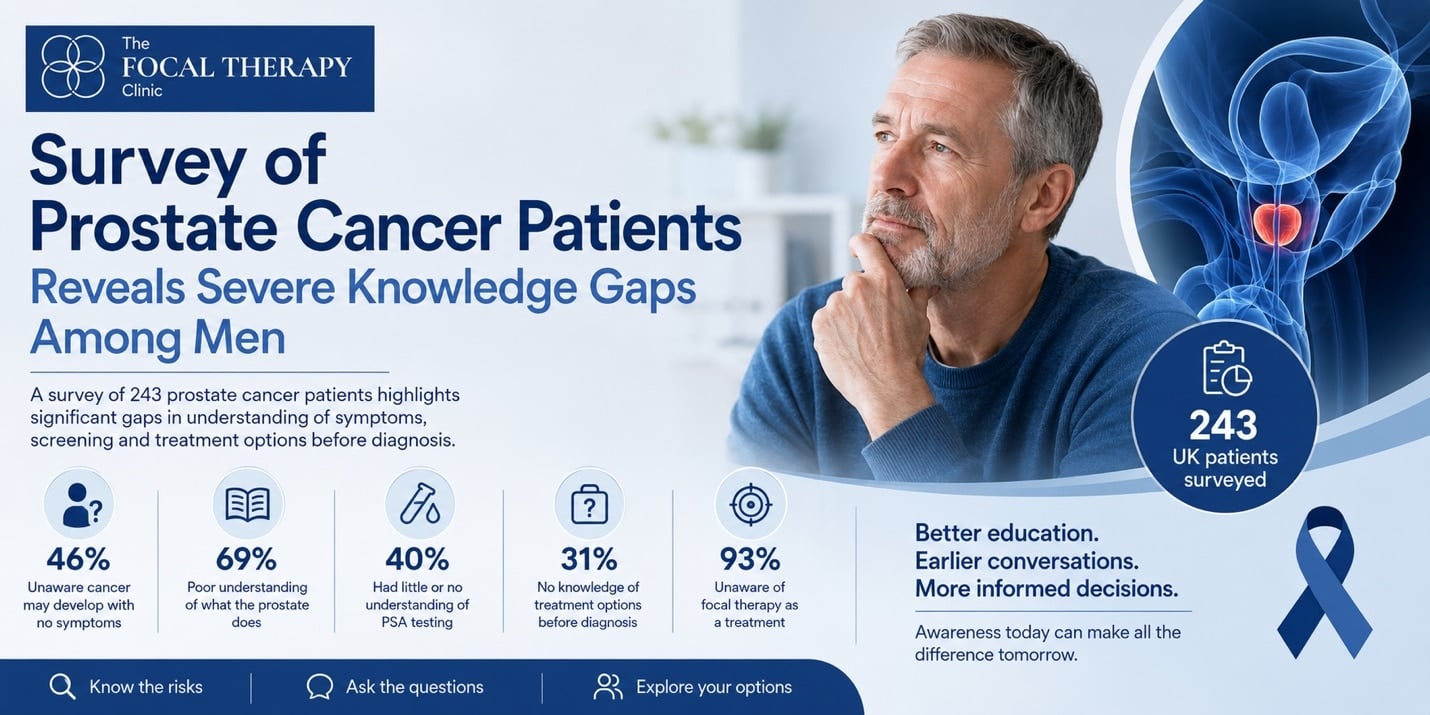
Survey of Prostate Cancer Patients Reveals Severe Knowledge Gaps Among Men
How Accurate is a Urine test for Prostate Cancer – and can it replace PSA or MRI?

Is Testosterone Replacement Therapy Safe After Prostate Cancer Treatment?
Any questions?
If you’ve got any questions about your prostate cancer diagnosis or want to know more about HIFU or NanoKnife, don’t hesitate to get in touch with our friendly, knowledgeable team.
Contact the team
Reference List
- Prostate Cancer UK. About prostate cancer (lifetime risk 1 in 8). prostatecanceruk.org
- Cancer Research UK. Prostate cancer incidence, survival and risk statistics. cancerresearchuk.org
- NICE NG131. Prostate cancer: diagnosis and management (2019, updated 2021). nice.org.uk/guidance/ng131
- NICE HTG667. Focal therapy using HIFU for localised prostate cancer (2023). nice.org.uk/guidance/htg667
- NICE HTG688. Irreversible electroporation (NanoKnife) for prostate cancer (2023). nice.org.uk/guidance/htg688
- EAU Guidelines on Prostate Cancer (2024). European Association of Urology. uroweb.org/guidelines/prostate-cancer
- Kasivisvanathan V, … Asif A, … Moore CM. VISION: MRI-targeted vs standard biopsy (IPD meta-analysis). European Urology 2024;87(5):512-523. DOI: 10.1016/j.eururo.2024.08.022 — Dr Aqua Asif of The Focal Therapy Clinic is a named co-author.
- Giganti F, Ng A, Asif A, et al. Global Variation in MRI Quality of the Prostate (PI-QUAL). Radiology 2023;309(1):e231130. DOI: 10.1148/radiol.231130 — Dr Aqua Asif of The Focal Therapy Clinic is a named co-author.
- Berry SJ, Coffey DS, Walsh PC, Ewing LL. The development of human BPH with age. J Urol 1984;132(3):474-479.
- The Focal Therapy Clinic one-year outcome audit (n=265, Oct 2025) — FTC proprietary data.
Subscribe to our newsletter
Get expert advice & the latest prostate cancer research - straight to your inbox.