
At a Glance
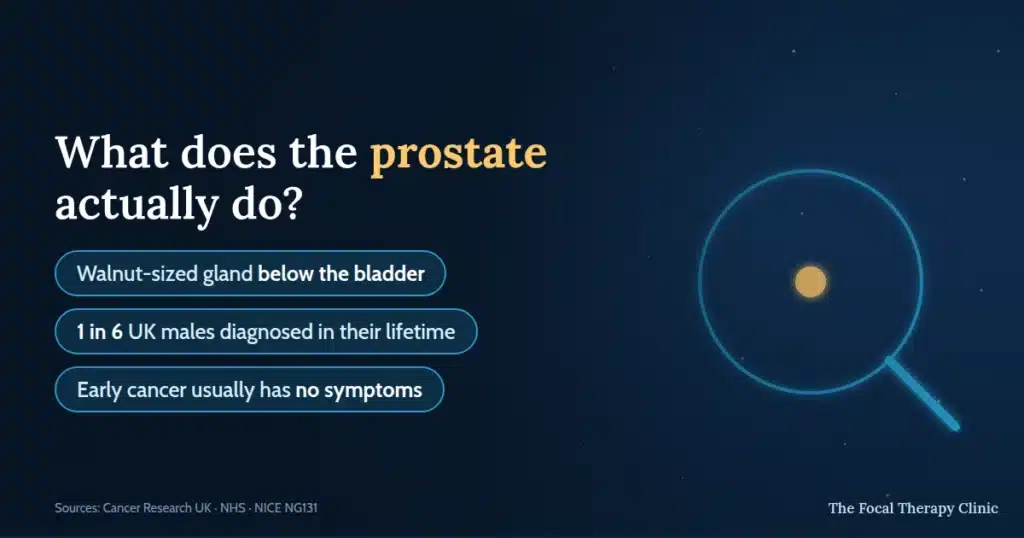
The prostate is a walnut-sized gland below the bladder that produces fluid to nourish and protect sperm. Prostate problems — including benign enlargement (BPH), prostatitis, and prostate cancer — affect the majority of men over 50, and 1 in 6 UK males will be diagnosed with prostate cancer in their lifetime. Early prostate cancer usually causes no symptoms, so awareness and screening are essential.
- Reproductive function — the prostate produces seminal fluid containing PSA, which nourishes sperm and aids fertilisation
- Size and location — sits below the bladder, surrounds the urethra, and grows from walnut-sized (~20–30g) with age
- Three main conditions — BPH (non-cancerous enlargement), prostatitis (inflammation), and prostate cancer (the most common cancer in UK men)
- Early cancer is silent — most localised prostate cancers cause no symptoms; don’t wait for signs before discussing screening with your GP
- Treatment options exist — from active surveillance to focal therapies like HIFU (NICE HTG667) and NanoKnife (NICE HTG688), which target cancer while preserving quality of life
The prostate is a small but important gland that plays a key role in male reproduction — and understanding it matters more than you might think. 1 in 6 UK males will be diagnosed with prostate cancer in their lifetime (Cancer Research UK), making it the most common cancer in men. The good news is that most prostate conditions are treatable, and when cancer is caught early, outcomes are excellent.
At The Focal Therapy Clinic, our consultant urological surgeons specialise in prostate health at 8 hospital sites across six UK cities. This guide explains what the prostate does, where it sits, what can go wrong, and how you can look after your prostate health — whether you have concerns or simply want to be informed.
What Does the Prostate Do?
The prostate gland’s main function is reproductive: it produces a thick, nutrient-rich fluid that combines with sperm to form semen, nourishing and protecting sperm to increase the chances of successful fertilisation.
This prostatic fluid contains important substances, including enzymes like Prostate-Specific Antigen (PSA), which help liquefy semen after ejaculation. PSA is also the protein measured in the PSA blood test used to screen for prostate problems — both cancerous and non-cancerous conditions can raise PSA levels.
Where Is the Prostate and What Does It Look Like?
The prostate is a small, walnut-sized gland that sits just below the bladder and surrounds the urethra — the tube carrying urine out of the body. Its position explains why prostate enlargement or disease often affects urination, and why imaging techniques like multiparametric MRI are so important for assessing prostate health.
Where is the prostate located?
The prostate sits deep inside the pelvis, positioned just below the bladder and in front of the rectum (back passage). It surrounds the first part of the urethra, which is why changes in prostate size or health often cause urinary symptoms.
Its proximity to the rectum also means a doctor can feel the back surface of the prostate during a digital rectal examination (DRE) to check for changes in size, shape, or texture.
What does the prostate look like?
A healthy prostate typically has a smooth surface and a firm, slightly rubbery feel. It contains both glandular tissue (which produces prostatic fluid) and muscle tissue (which helps push semen out during ejaculation).
How big is the prostate?
In younger men, the prostate usually weighs around 20–30 grams and measures roughly 3–4 cm wide — about the size of a walnut or satsuma. It commonly grows larger with age, a process often linked to benign prostatic hyperplasia (BPH), a non-cancerous condition affecting the majority of men over 50.
Get Expert Advice & The Latest Research
Subscribe to our newsletter to receive the latest updates, expert insights, and breakthrough research on prostate cancer-delivered straight to your inbox.
What Can Go Wrong with the Prostate?
Dr Christos Mikropoulos explains the difference between benign prostate enlargement and prostate cancer — why an enlarged prostate does not mean cancer, and which symptoms warrant a check.
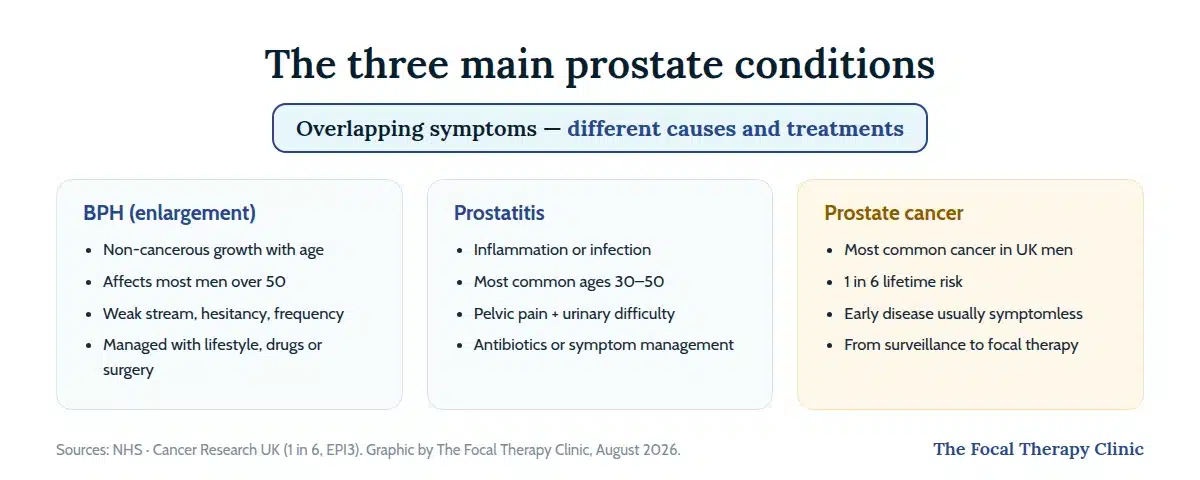
Three main conditions affect the prostate gland, all becoming more common with age. While their symptoms can overlap, each has a different cause and treatment pathway — making accurate diagnosis essential. At The Focal Therapy Clinic, our specialist consultants assess and treat all three conditions at 8 hospital sites across six UK cities.
- Benign prostatic hyperplasia (BPH) — a very common, non-cancerous enlargement of the prostate affecting the majority of men over 50. As the gland grows, it squeezes the urethra, leading to urinary problems like a weak stream, hesitancy, or frequent urination.
- Prostatitis — inflammation or swelling of the prostate, which can affect men of all ages but is more common between 30 and 50. It may be caused by bacterial infection or have an unknown cause (chronic pelvic pain syndrome/CPPS). Symptoms typically include pelvic pain and urinary difficulties.
- Prostate cancer — the uncontrolled growth of cancerous cells within the prostate. It is the most common cancer in UK men (1 in 6 lifetime risk). Many prostate cancers grow slowly, but some forms can be more aggressive and require prompt treatment.
Having one condition (such as BPH) does not necessarily increase your risk of developing another (such as prostate cancer). A proper assessment — including PSA testing and imaging — is needed to distinguish between them.
What are potential signs of prostate problems?
The most common signs of prostate problems relate to changes in urinary habits, typically caused by BPH or prostatitis rather than cancer. However, early-stage prostate cancer usually causes no symptoms at all — so you should never wait for symptoms before discussing prostate health with your GP.
Common urinary symptoms include:
- Increased frequency — needing to urinate more often, especially at night (nocturia)
- Urgency — needing to rush to the toilet
- Hesitancy — difficulty starting to urinate
- Weak flow — a noticeably reduced urine stream
- Incomplete emptying — feeling your bladder hasn’t fully emptied
- Dribbling — urine continuing to drip after finishing
Other potential symptoms include pain in the pelvic area, lower back, or during urination or ejaculation, and blood in the urine or semen.
Important: Early-stage, localised prostate cancer usually causes no symptoms at all. Relying only on symptoms to detect early cancer is not effective. If you are over 50, of Black ethnicity, or have a family history of prostate cancer, discuss prostate screening with your GP — even if you feel well.
How are prostate problems diagnosed?
If you see your GP with potential prostate symptoms, they’ll likely ask about your symptoms and medical history. Initial tests may include:
- Urine test: To check for infection.
- Digital Rectal Examination (DRE): The GP gently feels the prostate’s back surface through the rectal wall to check its size, shape, and texture.
- Prostate-Specific Antigen (PSA) Test: A blood test measuring PSA levels. Levels can be raised by BPH, prostatitis, infection, recent ejaculation, or cancer, but also increase naturally with age. A raised PSA doesn’t automatically mean cancer, nor does a normal PSA rule it out completely.
Based on risk factors (age, ethnicity, family history) and initial results, your GP might refer you to a specialist. For suspected prostate cancer, the next step is often:
- Multiparametric MRI: A detailed scan providing images of the prostate, highly effective at identifying potentially significant cancers and guiding whether a biopsy is needed.
- Prostate biopsy: If the PSA is concerning or the MRI shows a suspicious area, small tissue samples are taken (usually guided by MRI) and examined under a microscope to confirm cancer presence and determine its characteristics (like the Gleason score).
How are prostate conditions treated?
Treatment depends on the specific condition, its severity, your overall health, and personal preferences. The main options are:
- BPH — lifestyle changes, medication (alpha-blockers, 5-alpha-reductase inhibitors), minimally invasive procedures, or surgery (such as TURP)
- Prostatitis — bacterial forms require antibiotics; chronic prostatitis/CPPS focuses on symptom management including pain relief, alpha-blockers, lifestyle advice, and physiotherapy
- Prostate cancer — options vary widely based on stage and aggressiveness:
- Active surveillance — monitoring low-risk, localised cancer without immediate treatment
- Radical prostatectomy — surgery to remove the entire prostate
- Radiotherapy — external beam radiation or internal brachytherapy, often combined with hormone therapy for higher-risk disease
- Hormone therapy — reduces male hormones fuelling cancer growth, used mainly for advanced cancer or alongside radiotherapy
- Chemotherapy — used mainly for advanced or metastatic cancer
- Focal therapy — treats only the cancerous area(s) within the prostate, preserving surrounding healthy tissue
What is focal therapy for prostate cancer?
Focal therapy is a NICE-approved, targeted treatment for men with localised prostate cancer (cancer confined to the prostate). Unlike radical treatments that affect the whole gland, focal therapies destroy only the identified cancerous area(s) — preserving surrounding healthy tissue, including the nerves controlling erections and the urinary sphincter.
The two main focal therapy techniques are:
- HIFU (High-Intensity Focused Ultrasound) — approved by NICE under HTG667, uses focused sound waves to destroy cancerous tissue with precision
- NanoKnife IRE (Irreversible Electroporation) — approved by NICE under HTG688, uses targeted electrical pulses, particularly suited for tumours near critical structures
In our clinic’s experience of 2,500+ focal therapy procedures, outcomes show 90%+ sexual function preservation and 97% urinary continence (FTC audit, n=265). Most patients return home the same day, with 85% back to work within two weeks.
| Outcome | Focal therapy (FTC data) | Radical prostatectomy |
|---|---|---|
| Sexual function preserved | 90%+ | 30–70% |
| Urinary continence | 97% (FTC audit, n=265) | 80–95% |
| Recovery time | 1–2 weeks | 4–6 weeks |
| Hospital stay | Day-case (home same day) | 1–3 nights |
| NICE status | Approved (HTG667 / HTG688) | Standard care |
Source: FTC one-year outcome audit (n=265) and published literature.
“Not every patient is suitable for focal therapy, and we’re transparent about that. We assess every referral carefully with mpMRI and targeted biopsy before recommending treatment.” — Mr Alan Doherty, Consultant Urological Surgeon (FRCS(Urol), GMC: 3279241)
If you or someone close to you has been told it could be prostate cancer, our step-by-step prostate cancer guide walks through diagnosis, grading and every treatment option in plain English.
How Can You Look After Your Prostate Health?
You cannot change risk factors like age, ethnicity, or genetics — but awareness, screening, and a healthy lifestyle can make a significant difference. The earlier a prostate problem is identified, the more treatment options are available, including minimally invasive approaches like focal therapy.
- Know your risk factors — the three main risks are: getting older (risk increases significantly after 50), being Black (about 1 in 4 Black men will get prostate cancer in their lifetime — roughly double the risk of other men; talk about testing from age 45), and having a family history (father or brother diagnosed, especially under 60)
- Talk to your GP about screening — if you are in a higher-risk group, discuss the pros and cons of early screening with your GP, which may include a PSA blood test
- Maintain a healthy lifestyle — while no specific diet guarantees prevention, aim for a balanced diet rich in fruits, vegetables, and whole grains; limit red and processed meats; maintain a healthy weight; and get regular physical activity
- Seek a specialist opinion — if you have been diagnosed with a prostate condition or have concerns, you can request a consultation or second opinion from our specialist team at The Focal Therapy Clinic
Frequently Asked Questions About the Prostate
What is the main function of the prostate?
The prostate’s main function is reproductive: it produces the fluid component of semen, which nourishes and protects sperm. This prostatic fluid also contains Prostate-Specific Antigen (PSA), the protein measured in blood tests used to screen for prostate conditions.
What does PSA stand for in a prostate test?
PSA stands for Prostate-Specific Antigen. It is a protein produced by prostate cells (both normal and cancerous). The PSA test measures the level of this protein in the blood. Elevated levels can indicate prostate problems, including cancer, but can also be caused by non-cancerous conditions like BPH or prostatitis.
What is a prostate exam?
A digital rectal examination (DRE) is a physical examination where a doctor inserts a gloved, lubricated finger into the rectum (back passage) to feel the surface of the prostate gland for lumps, hardening, or enlargement. It is a quick procedure often done alongside a PSA blood test as part of initial prostate assessment.
Can a man live without a prostate?
Yes. The prostate is important for reproduction but not essential for survival. Men who have their prostate removed (radical prostatectomy) live without it, though there can be side effects impacting urinary control or erections. However, for men with localised prostate cancer, focal therapy offers an alternative that treats the cancer while preserving the prostate — with 90%+ sexual function preservation and 97% urinary continence in our clinic’s experience (FTC audit, n=265).
What’s the difference between a swollen prostate and an enlarged prostate?
“Swollen prostate” usually refers to prostatitis — inflammation often linked to infection, which can cause pain and urinary symptoms. “Enlarged prostate” typically refers to Benign Prostatic Hyperplasia (BPH), a common non-cancerous growth of the prostate with age that mainly causes urinary difficulties. Both can produce similar symptoms, so a proper diagnosis is needed to determine the right treatment.
What are the first signs of a prostate problem?
The first noticeable signs often relate to urination changes caused by BPH or prostatitis, such as needing to go more often (especially at night), a weaker stream, or difficulty starting. However, it is vital to remember that early prostate cancer usually has no symptoms. Don’t wait for symptoms to consider your prostate health, especially if you are in a higher-risk group (over 50, Black ethnicity, or family history).
References
- Cancer Research UK. Prostate cancer statistics.
- Prostate Cancer UK. About prostate cancer; Are you at risk?; Diet and physical activity.
- NHS. Prostate problems; Enlarged prostate; Prostatitis.
- NICE guideline NG131 — Prostate cancer: diagnosis and management.
- Ahmed HU, et al. Focal ablation targeted to the index lesion in multifocal localised prostate cancer: a prospective development study. European Urology 2015;68(6):927–936.
- The Focal Therapy Clinic one-year outcome audit (n=265).
This content is not intended to replace professional medical advice. Always consult your clinical team about your individual circumstances.