
What are the stages of prostate cancer?
Prostate cancer is grouped into four numbered stages based on how far the cancer has spread, with Stage 1 representing the earliest, most localised disease and Stage 4 representing cancer that has metastasised beyond the prostate.
The stages of prostate cancer are assessed using three systems together in UK practice: TNM staging, numbered stages, and Cambridge Prognostic Groups. The Gleason grade and PSA level then refine the picture because they show how aggressive the cancer appears and how active it may be. Earlier prostate cancer stages usually have more treatment options and better outcomes.
Key takeaways
- Four numbered stages — Stage 1 (confined, often no symptoms) through Stage 4 (spread beyond the prostate to lymph nodes, bones, or organs).
- TNM plus Gleason and PSA — staging combines tumour size (T), node status (N), distant spread (M), tumour grade, and PSA level.
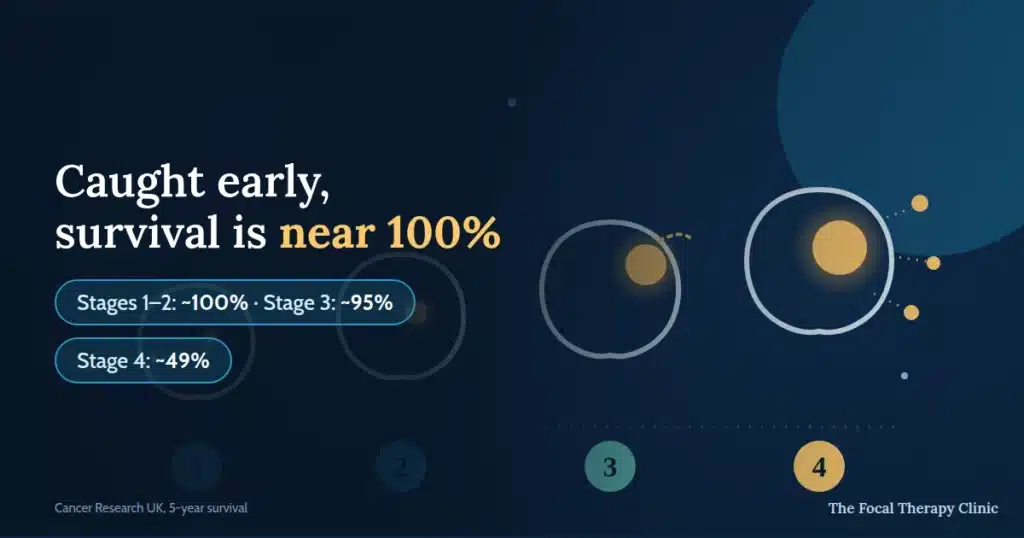
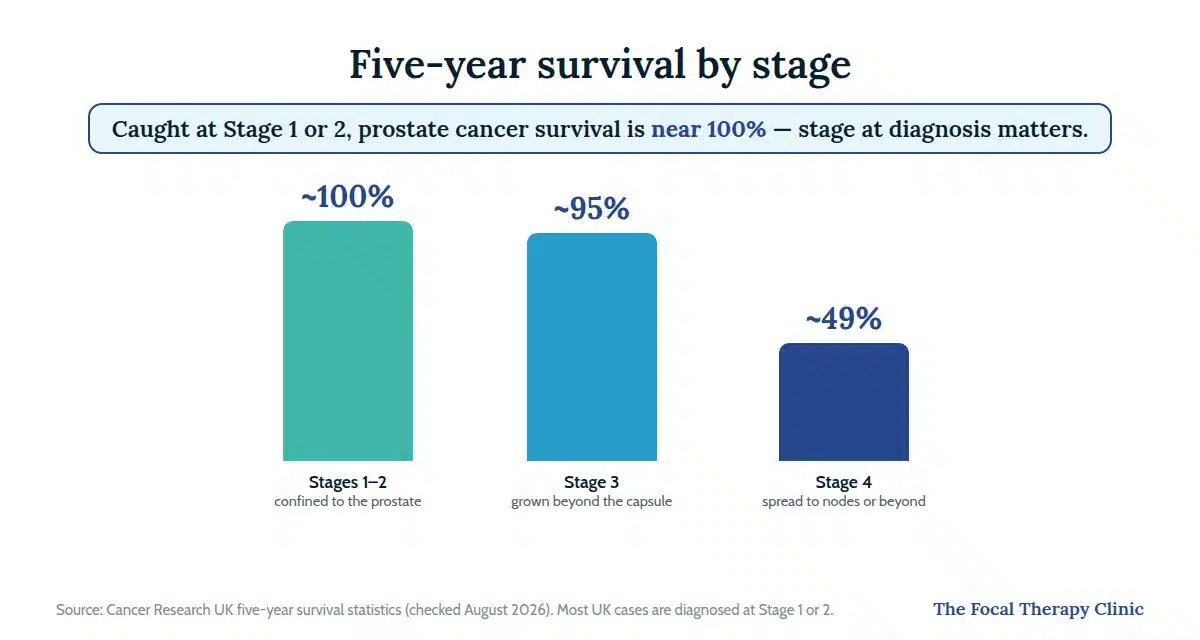
- Early stages are highly treatable — five-year survival for Stage 1–2 is near 100%, with options including active surveillance, focal therapy, surgery, and radiotherapy.
- Focal therapy for localised disease — HIFU and NanoKnife IRE target the tumour only, with 97% urinary continence and 90%+ sexual function preservation (FTC audit, n=265).
- Staging guides your pathway — your consultant uses stage, grade, and PSA to recommend the most appropriate treatment; it is not a fixed verdict on outcome.
How is prostate cancer staged?
Prostate cancer is staged using a combination of digital rectal examination, multiparametric MRI, targeted biopsy, PSA blood tests, and in some cases CT, bone scan, or PSMA-PET imaging. NICE guideline NG131 sets out the UK diagnostic and staging pathway for suspected prostate cancer. These test results are then grouped using TNM staging, numbered stages, and Cambridge Prognostic Groups.
Accurate prostate cancer staging helps doctors recommend the most suitable treatment options. A PSMA-PET scan may be used when doctors need to check whether cancer has spread outside the prostate. This is especially useful in higher-risk disease or when other scans are unclear.
The TNM staging system
The TNM system classifies prostate cancer by three anatomical features: tumour size (T), lymph node involvement (N), and the presence of distant metastasis (M). Each element receives a number to describe how advanced the cancer is. TNM is the foundation that feeds into both the numbered staging system and Cambridge Prognostic Groups, with definitions based on the AJCC 8th edition.
Tumour size (T category)
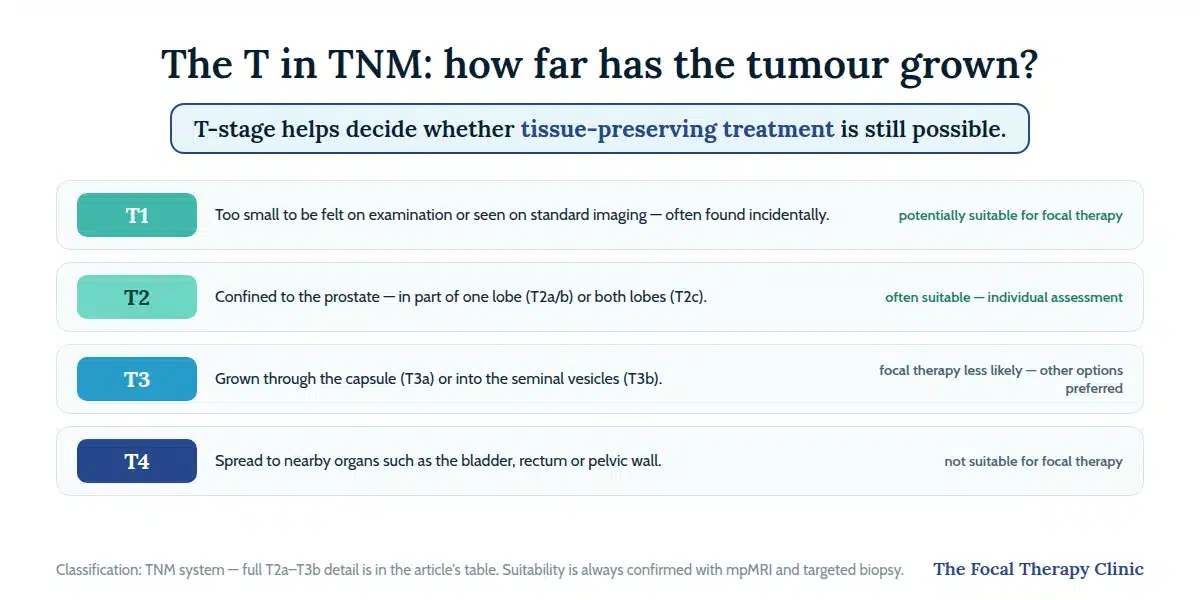
The T category describes the size and extent of the prostate tumour, ranging from T1, a tumour too small to be detected on examination, to T4, a tumour that has spread to nearby organs. T-stage helps doctors understand whether the cancer is still confined to the prostate. It also helps decide whether focal therapy may be suitable.
| T Stage | Description | Focal Therapy Suitability |
|---|---|---|
| T1 | Tumour too small to be felt on digital rectal examination or seen on standard imaging. Often found incidentally. | Potentially suitable, assessment required |
| T2a | Tumour in half of one lobe of the prostate or less. | Often suitable for focal therapy |
| T2b | Tumour in more than half of one lobe, but not both lobes. | May be suitable, individual assessment |
| T2c | Tumour in both lobes of the prostate. | May be suitable, individual assessment |
| T3a | Tumour has grown through the prostate capsule on one or both sides. | Focal therapy less likely, other options often preferred |
| T3b | Tumour has grown into the seminal vesicles. | Not typically suitable for focal therapy |
| T4 | Tumour has spread to nearby organs such as the bladder, rectum, or pelvic wall. | Not suitable for focal therapy |
Focal therapy suitability depends on multiple factors including tumour grade, PSA, and mpMRI findings. At the Focal Therapy Clinic, consultants assess each patient individually using mpMRI and targeted biopsy results.
Lymph node involvement (N)
The N category describes whether prostate cancer has spread to nearby pelvic lymph nodes. Lymph nodes are small immune-system glands that can act as early sites of spread. N-stage helps separate localised prostate cancer from disease that has moved beyond the gland.
- N0: the cancer has not spread to any nearby lymph nodes
- N1: the cancer has spread to nearby lymph nodes in the pelvis
PSMA-PET imaging is often more sensitive than CT or MRI for detecting small-volume lymph node involvement.
Distant metastasis (M)
The M category describes whether prostate cancer has spread to distant sites beyond the pelvis. This part of staging is important because it separates local or regional disease from metastatic disease. Men with M1 disease usually need systemic treatment rather than treatment to the prostate alone.
- M0: the cancer has not spread to distant sites
- M1a: spread to lymph nodes beyond the pelvis
- M1b: spread to bones
- M1c: spread to other organs, such as the liver or lungs
M1b bone metastasis is the most common pattern of distant spread in prostate cancer.
What do Stages 1 to 4 mean?
The numbered staging system groups prostate cancer into four stages based on tumour size, lymph node involvement, distant spread, Gleason grade, and PSA level, and is used alongside the TNM system to guide treatment decisions. Stages 1 and 2 are organ-confined disease, Stage 3 is locally advanced disease, and Stage 4 is metastatic disease. Men asking what are the stages of prostate cancer usually want to know what their stage means for treatment and outlook.
| Stage | What It Means | Treatment Options | Five-Year Survival |
|---|---|---|---|
| Stage 1 | Cancer is confined within the prostate, small, low grade, and often found through PSA testing. Most men have no symptoms. | Active surveillance, focal therapy, surgery, radiotherapy | Near 100%, according to Cancer Research UK |
| Stage 2 | Cancer is still confined to the prostate but may be larger or involve more of the gland. PSA may be higher. | Active surveillance, focal therapy, surgery, radiotherapy, sometimes hormone therapy | Near 100%, according to Cancer Research UK |
| Stage 3 | Cancer has grown beyond the prostate capsule or into the seminal vesicles, but has not spread to distant sites. | Surgery, often with lymph node dissection, or radiotherapy plus hormone therapy | Approximately 95%, according to Cancer Research UK |
| Stage 4 | Cancer has spread to nearby lymph nodes or distant sites such as bones or organs. | Hormone therapy, chemotherapy, targeted therapy, radiotherapy, palliative support | Varies significantly by extent of spread |
Source: staging definitions based on AJCC 8th edition; survival figures from Cancer Research UK.
Stage 1 prostate cancer
Stage 1 prostate cancer is a small, low-grade tumour confined within the prostate gland, typically detected through PSA testing rather than symptoms, with a five-year survival rate of near 100%. It is usually T1 to T2a, N0, M0, with Gleason 6 or lower and PSA below 10 ng/mL. Most men have no symptoms, which is why early detection often depends on PSA testing and MRI.
Treatment options may include active surveillance, focal therapy, surgery, or radiotherapy. Stage 1 disease is often the strongest candidate for focal therapy because the tumour is localised, low grade, and clearly contained within the prostate.
Stage 2 prostate cancer
Stage 2 prostate cancer is still confined to the prostate gland but may be larger or involve more of the gland, with PSA typically between 10 and 20 ng/mL. It is often T2b to T2c, N0, M0, although the exact grouping also depends on Gleason grade and PSA. Stage 2 may be divided into 2A, 2B, and 2C to show increasing risk.
Most men with Stage 2 prostate cancer still have no symptoms. Treatment may include active surveillance for low-risk disease, focal therapy for suitable candidates, surgery, radiotherapy, and sometimes hormone therapy. Many Stage 2 cancers in CPG 1 or CPG 2 remain good candidates for focal therapy, and the five-year survival rate is near 100%.
Stage 3 prostate cancer
Stage 3 prostate cancer has grown beyond the prostate capsule or into the seminal vesicles, with a five-year survival rate of approximately 95% according to Cancer Research UK. It may include T3 disease or higher-risk Gleason and PSA combinations, but there is no distant spread. Stage 3 can be divided into 3A, 3B, and 3C depending on local extension and grade.
Some men notice urinary symptoms, but many still have no obvious symptoms. Treatment often involves surgery with lymph node dissection or radiotherapy combined with hormone therapy. Focal therapy is less commonly recommended at this stage because the cancer has extended beyond the prostate.
Stage 4 prostate cancer
Stage 4 prostate cancer has spread beyond the prostate to lymph nodes, bones, or distant organs, with treatment shifting from curative intent to long-term disease control through hormone therapy, chemotherapy, and targeted treatments. Stage 4A means cancer has spread to regional pelvic lymph nodes only, while Stage 4B means it has spread to distant sites such as bones, liver, lungs, or distant lymph nodes. Stage 4A usually has a better outlook than Stage 4B because the spread is more contained.
Symptoms may include bone pain, fatigue, unexplained weight loss, urinary changes, or general weakness. Modern treatments mean many men live for years with advanced prostate cancer. This is one reason staging should always be discussed with a specialist who can explain the treatment options for the individual case.
What does the Gleason score mean?
Dr Christos Mikropoulos explains the Gleason score — how biopsy grading works and what your score means for treatment choices.
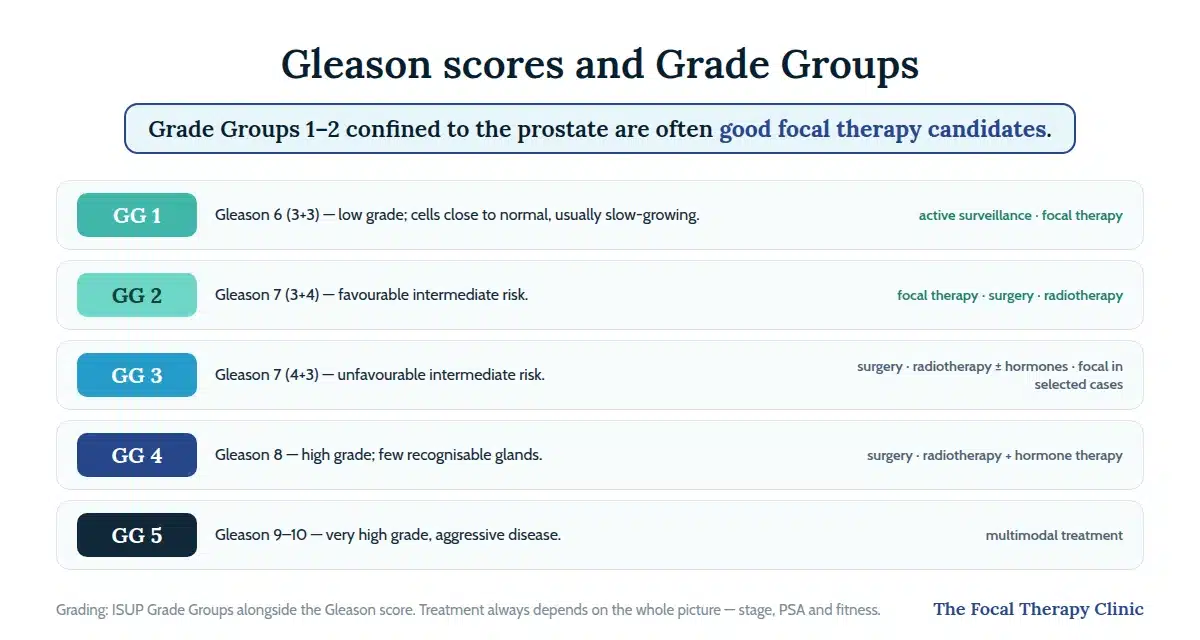
The Gleason score indicates how aggressive prostate cancer cells appear under the microscope and is one of the most important factors in determining which treatments are most appropriate. Pathologists grade the two most common patterns in the tumour on a scale from 3 to 5 and add them together to give the Gleason score, which usually ranges from 6 to 10. Lower scores suggest slower-growing cancer, while higher scores suggest more aggressive disease that may need radical or multimodal treatment.
The newer ISUP Grade Group system runs from 1 to 5 and is used alongside the Gleason score to simplify interpretation. This helps consultants explain risk more clearly when discussing prostate cancer stages and treatment options.
| Grade Group | Gleason Score | What It Means | Typical Treatment Options |
|---|---|---|---|
| Grade Group 1 | 6 (3+3) | Low grade, cells look close to normal and are usually slow-growing | Active surveillance, focal therapy |
| Grade Group 2 | 7 (3+4) | Favourable intermediate risk, mostly better-formed glands with some poorer-formed areas | Focal therapy, surgery, radiotherapy |
| Grade Group 3 | 7 (4+3) | Unfavourable intermediate risk, more poorly formed glands | Surgery, radiotherapy with or without hormone therapy, focal therapy in selected cases |
| Grade Group 4 | 8 | High grade, few recognisable glands | Surgery, radiotherapy plus hormone therapy |
| Grade Group 5 | 9–10 | Very high grade, aggressive disease | Multimodal treatment, including surgery, radiotherapy, hormone therapy, and sometimes chemotherapy |
At the Focal Therapy Clinic, men with Grade Group 1 or 2 prostate cancer confined to the prostate are often good candidates for focal therapy. In the clinic’s audit of 265 patients treated with focal therapy, 90% remained cancer-free at one year, with 97% maintaining full urinary continence and 90%+ preserving sexual function.
What are the Cambridge Prognostic Groups?
Cambridge Prognostic Groups (CPGs) are a UK-specific five-tier risk classification system used by clinicians to combine tumour stage, Gleason grade, and PSA level into a single risk category that guides treatment recommendations. CPGs are referenced in NICE guideline NG131 and are widely used in UK prostate cancer care. They help translate TNM, Gleason, and PSA information into a practical treatment category.
| CPG | Risk Level | Typical Profile | Treatment Options |
|---|---|---|---|
| CPG 1 | Low | Gleason 6, Grade Group 1, PSA below 10, T1–T2a | Active surveillance, focal therapy |
| CPG 2 | Favourable intermediate | Gleason 3+4, Grade Group 2, PSA 10–20, T1–T2b | Focal therapy, surgery, radiotherapy, active surveillance in selected cases |
| CPG 3 | Unfavourable intermediate | Gleason 4+3, Grade Group 3, or higher PSA | Surgery, radiotherapy with or without hormone therapy, focal therapy in selected cases |
| CPG 4 | High | Gleason 8, Grade Group 4, or T3 disease | Surgery plus radiotherapy, or radiotherapy plus hormone therapy |
| CPG 5 | Very high | Gleason 9–10, Grade Group 5, or T4 disease | Multimodal treatment, including surgery, radiotherapy, hormone therapy, and chemotherapy |
Men in CPG 1 and CPG 2 are often strong candidates for focal therapy at the Focal Therapy Clinic. The clinic’s medical suitability assessment includes detailed mpMRI review and targeted biopsy to confirm whether focal therapy is appropriate for the patient’s specific situation.
Get Expert Advice & The Latest Research
Subscribe to our newsletter to receive the latest updates, expert insights, and breakthrough research on prostate cancer-delivered straight to your inbox.
Which stages are suitable for focal therapy?
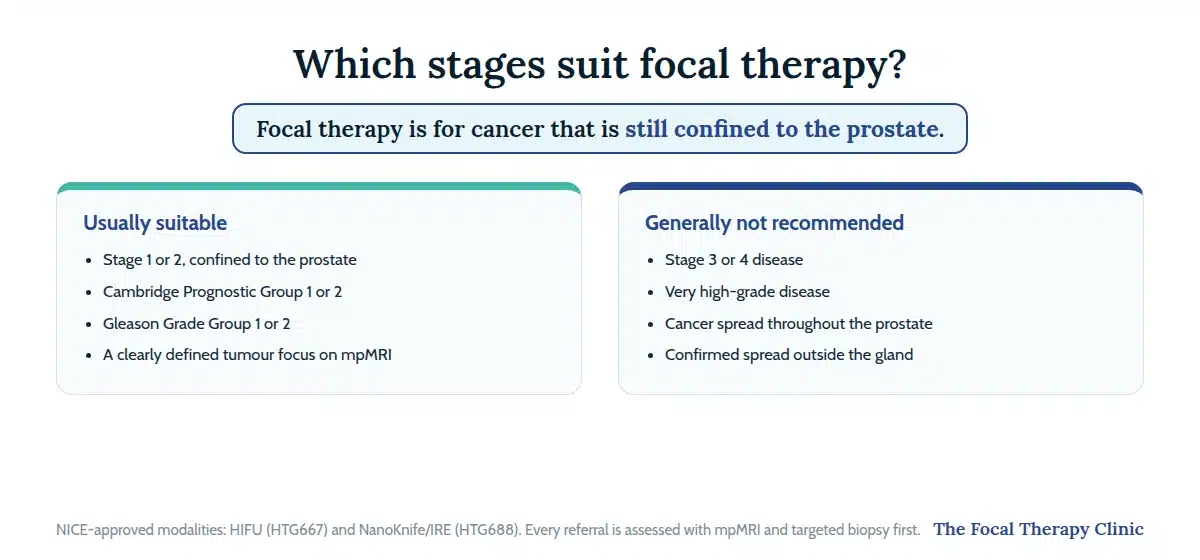
Focal therapy is most suitable for men with Stage 1 or Stage 2 prostate cancer confined to the prostate, particularly those in Cambridge Prognostic Groups 1 or 2 with Gleason Grade Group 1 or 2 disease and a clearly defined tumour on mpMRI. The strongest candidates usually have organ-confined, low-risk or favourable intermediate-risk cancer with one main tumour focus. mpMRI and targeted biopsy help confirm tumour location, grade, and extent before any treatment is recommended.
Focal therapy is generally not recommended for Stage 3 or Stage 4 disease, very high-grade disease, or cancer spread throughout the prostate. Men often ask are there different stages of prostate cancer because they want to know whether local treatment is still possible. In most cases, focal therapy is only considered when cancer remains localised.
NICE-approved focal therapy modalities include:
- HIFU treatment, approved under NICE HTG667, uses focused ultrasound energy to destroy the tumour.
- NanoKnife IRE treatment, approved under NICE HTG688, uses electrical pulses to destroy cancer cells while preserving surrounding tissue structures.
In the clinic’s experience of more than 2,500 focal therapy procedures, focal therapy achieves 90%+ sexual function preservation and 97% urinary continence, based on the FTC audit of 265 men. Most patients return home the same day and 85% are back to work within two weeks. Men asking how many stages of cancer are there in prostate cancer should understand that Stage 1 and Stage 2 are usually the stages where tissue-preserving options are most relevant.
“Not every patient is suitable for focal therapy, and we’re transparent about that. We assess every referral carefully with mpMRI and targeted biopsy before recommending treatment.” — Mr Tim Dudderidge, Consultant Urological Surgeon (FRCS Urol, GMC: 4505451)
If cancer comes back after initial treatment, staging is reassessed — learn what happens when prostate cancer returns.
Frequently Asked Questions
What are the 4 stages of prostate cancer?
Prostate cancer is staged from 1 to 4 using the TNM system alongside Gleason grading and PSA levels. Stage 1 is small, low grade, and confined within the prostate, while Stage 2 is still organ-confined but may be larger. Stage 3 has grown beyond the capsule, and Stage 4 has spread.
What are the symptoms of stage 2 prostate cancer?
Most men with Stage 2 prostate cancer have no noticeable symptoms. The cancer is still contained within the prostate gland and is usually detected through PSA testing or MRI rather than symptoms. Some men may notice urinary changes, but these are more commonly caused by benign prostatic hyperplasia.
What is the life expectancy of a person with prostate cancer?
Life expectancy depends on the stage and grade of the cancer, the man’s age and overall health, and the treatment received. For early-stage prostate cancer, including Stage 1 and Stage 2, the five-year survival rate is near 100% according to Cancer Research UK. Stage 3 survival is approximately 95%.
What is the prognosis of stage 4 prostate cancer?
The prognosis for Stage 4 prostate cancer varies significantly depending on the extent of spread and response to treatment. Stage 4A, which has spread to nearby lymph nodes only, generally has a better outlook than Stage 4B, which has distant spread. Modern treatments mean many men live for years.
What is the difference between Stage 4A and Stage 4B prostate cancer?
Stage 4A prostate cancer has spread to regional pelvic lymph nodes only, while Stage 4B has spread to distant sites such as bones, liver, lungs, or distant lymph nodes. Stage 4A usually has a better prognosis because the spread is more contained. Treatment often combines hormone therapy and radiotherapy.
Can early-stage prostate cancer be cured?
Yes, early-stage prostate cancer, including Stage 1 and Stage 2, is highly treatable and often curable. Treatment options include active surveillance for low-risk disease, focal therapy for suitable candidates, surgery, and radiotherapy. Cancer Research UK reports five-year survival rates near 100% for early-stage disease.
How quickly does prostate cancer progress between stages?
Prostate cancer typically progresses slowly, especially when it is low grade. Gleason 6 cancers may remain stable for many years, which is why active surveillance can be suitable for some men. Higher-grade cancers, such as Gleason 8 to 10, can progress within months and need closer monitoring.
Speak to a Focal Therapy Specialist
If you have been diagnosed with prostate cancer and want to understand whether focal therapy is suitable for your stage, the Focal Therapy Clinic team can help. The clinic offers consultations with leading UK consultant urological surgeons across six UK cities, and every case is reviewed by a multidisciplinary team. Men with Stage 1 or Stage 2 disease in CPG 1 or CPG 2 are often strong candidates for focal therapy, but suitability requires individual assessment with mpMRI and targeted biopsy.
Book a consultation to discuss your diagnosis, staging results, and treatment options.
This information is for educational purposes and does not replace professional medical advice. All treatment decisions should be made in consultation with a qualified healthcare professional.
References
- National Institute for Health and Care Excellence. Prostate cancer: diagnosis and management. NICE guideline NG131. London: NICE; 2019 (updated 2021; reviewed 2025). https://www.nice.org.uk/guidance/ng131
- Amin MB, Edge SB, Greene FL, et al., editors. AJCC Cancer Staging Manual. 8th ed. Cham: Springer; 2017.
- Cancer Research UK. Prostate cancer stages. https://www.cancerresearchuk.org/about-cancer/prostate-cancer/stages · Survival for prostate cancer. https://www.cancerresearchuk.org/about-cancer/prostate-cancer/survival (accessed August 2026)
- Prostate Cancer UK. Just diagnosed. https://prostatecanceruk.org/prostate-information-and-support/just-diagnosed
- National Institute for Health and Care Excellence. Focal therapy using high-intensity focused ultrasound for localised prostate cancer. HealthTech guidance HTG667. https://www.nice.org.uk/guidance/htg667 (accessed August 2026)
- National Institute for Health and Care Excellence. Irreversible electroporation for treating prostate cancer. HealthTech guidance HTG688. https://www.nice.org.uk/guidance/htg688 (accessed August 2026)