
At a Glance
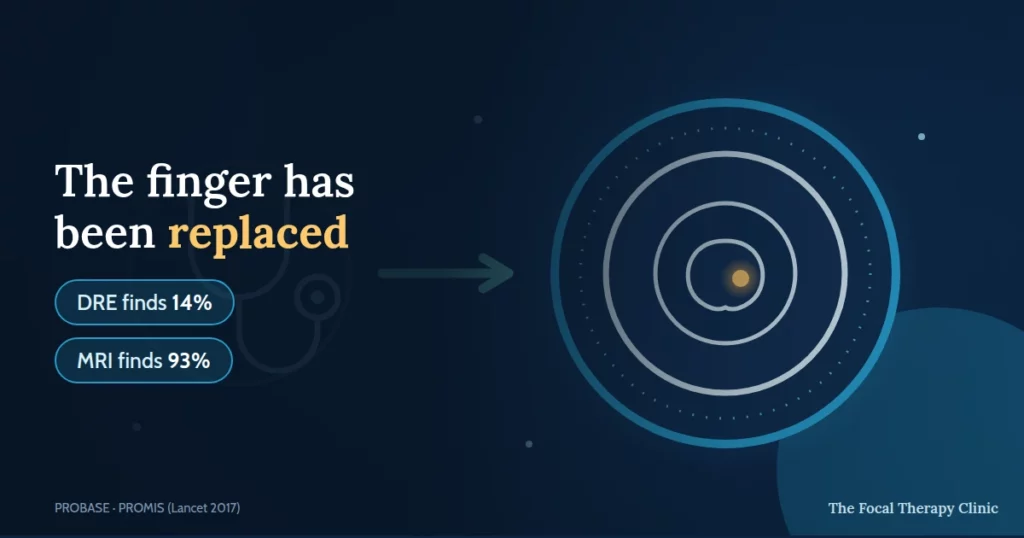
For routine prostate cancer screening, the digital rectal exam is no longer recommended as the first-line test. The modern UK pathway starts with a PSA blood test, followed by multiparametric MRI before any biopsy (NICE NG131). The DRE keeps a limited role in assessing symptoms, a raised PSA or known cancer.
Key takeaways:
- Screening evidence is weak — in the PROBASE trial of over 46,000 men, PSA detected around four times more cancers than a stand-alone DRE.
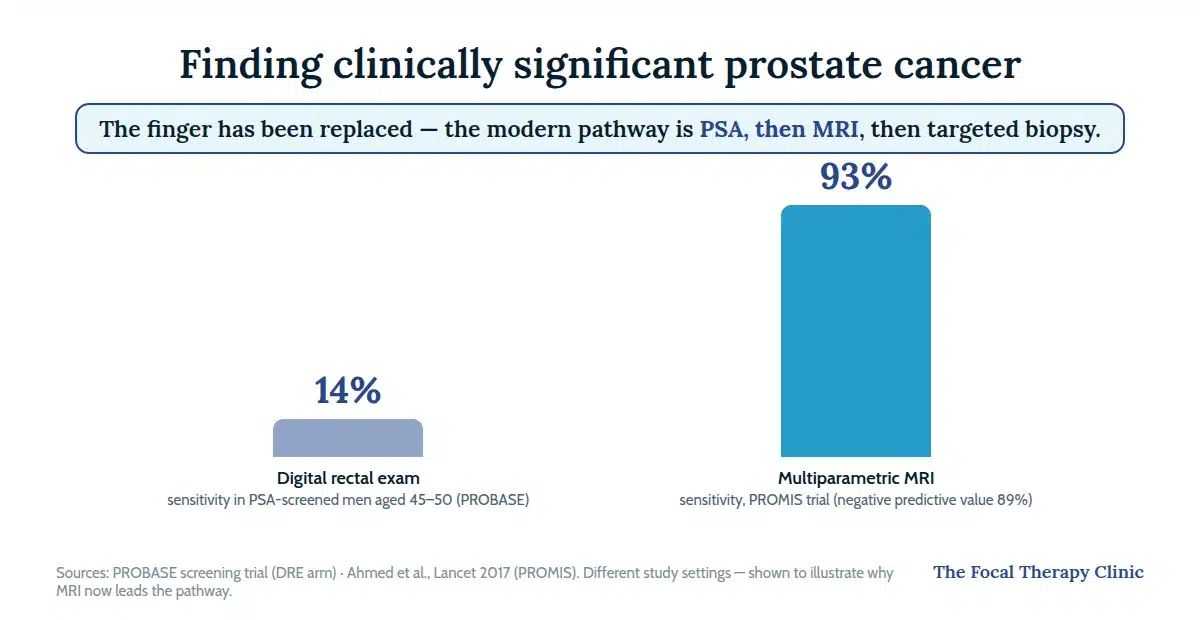
- MRI does the real work — in the PROMIS trial, mpMRI showed 93% sensitivity for clinically significant cancer.
- The exam deters men — fear and embarrassment around the DRE delay testing; a blood test starts the process without it.
- Still not obsolete — symptoms, staging and clinical assessment keep a role for the examination.
- Know your risk — age, Black ethnicity and family history should drive when PSA discussions start.
For routine prostate cancer screening, a digital rectal exam is no longer recommended as the first-line test. The modern UK pathway starts with a PSA blood test, followed by multiparametric MRI before any biopsy. A digital rectal examination still has a limited role when symptoms, a raised PSA, or known cancer need further clinical assessment.
What Is a Digital Rectal Exam?
A digital rectal exam is a brief physical examination in which a clinician feels the back surface of the prostate through the rectum. A gloved, lubricated finger is used to check for hardness, lumps, asymmetry, tenderness, or unusual enlargement. The examination mainly reaches the posterior part of the gland, so it cannot assess the whole prostate or reliably detect tumours towards the front. Men asking how is a prostate exam done should know that the test takes only a few seconds and is not an accurate test for ruling out cancer on its own.
Is the DRE Still Recommended for Screening?
No, major guidelines and professional bodies no longer support the DRE as a stand-alone or first-line screening test. The AUA states that it should not replace or precede PSA as the first screening test, while updated German guidance has removed it from early detection. BAUS and Prostate Cancer UK have also called for an end to its routine use in UK prostate cancer checks.
A digital rectal examination should not replace PSA testing for prostate cancer. The question is digital rectal exam still recommended therefore depends on the clinical setting. It is not the starting point for routine screening, but the EAU still includes it in selected assessments after symptoms or a raised PSA.
Limitations of the DRE
The DRE performs poorly when used alone to screen men without symptoms. The PROBASE trial included more than 46,000 men and found only three cancers among 6,537 men given a stand-alone DRE. PSA detected cancer at around four times the rate achieved by the examination.
Key findings included:
- More than 99% of the 6,537 examinations did not raise suspicion of prostate cancer.
- Only 57 examinations were suspicious enough to lead to further investigation.
- Three men were diagnosed with prostate cancer after a suspicious examination.
- Two of the three cancers found were low grade (ISUP grade group 1); the third was grade group 2.
- The DRE detection rate was about 0.05%, compared with about 0.21% for PSA screening.
- Among cancers later found through PSA screening, 86% had produced no suspicion on the DRE — even though most sat in parts of the gland a finger can potentially reach.
- Suspicious examination rates varied from 4% to 28% between clinicians in another screening study.
These findings help answer how accurate is a digital rectal exam for prostate cancer. The answer to can a digital rectal exam detect prostate cancer is yes, but only in a limited number of cases. Small tumours, anterior tumours, and cancers that do not change the prostate’s surface may all be missed.
How the DRE deters testing
Fear, embarrassment, and expected discomfort around the DRE are recognised barriers to prostate checks. Some men delay speaking to a GP because they assume an intimate examination is unavoidable, which can be especially harmful in groups already at higher risk. Removing an off-putting, low-yield first step may help more men come forward for earlier assessment. Blood-based options, including PSA and emerging tools such as the PSE Test, can begin the process without a routine rectal examination.
What Has Replaced the DRE?
Mr Tim Dudderidge explains the tests you need before choosing a prostate cancer treatment — PSA, examination, imaging and biopsy — and why getting them right matters before any decision.
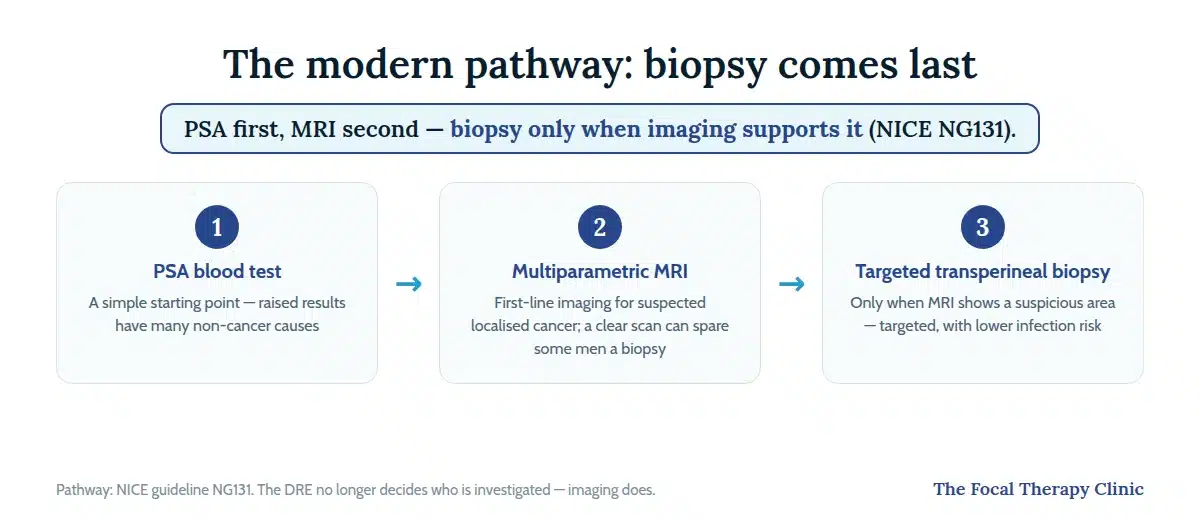
The modern route starts with a PSA blood test, followed by risk assessment and prostate MRI where the result is concerning. MRI can identify suspicious areas before biopsy and help clinicians avoid sampling the gland without a clear target. The pathway combines blood results, imaging, personal risk, and tissue findings rather than relying on touch alone.
The modern diagnostic pathway
The modern diagnostic pathway uses PSA first, multiparametric MRI for prostate cancer second, and biopsy only when the findings support it. NICE NG131 recommends MRI as the first-line investigation for suspected clinically localised disease and uses a five-point Likert score. The PROMIS trial found that mpMRI had 93% sensitivity and an 89% negative predictive value for clinically significant cancer under its primary definition.
The usual sequence is:
- A PSA blood sample is taken and considered alongside age, symptoms, ethnicity, family history, prostate size, and previous results.
- A moderately raised PSA may be repeated after temporary causes, such as infection or recent prostate manipulation, have been considered.
- An MRI maps the prostate and grades suspicious areas using a Likert or PI-RADS score.
- A low-scoring MRI may support monitoring when the PSA level and wider clinical risk are also low.
- A suspicious MRI can lead to a targeted transperineal prostate biopsy.
- The biopsy confirms whether cancer is present and establishes its grade, pattern, and clinical significance.
- The clinical team combines PSA, MRI, biopsy, health, and patient priorities to discuss monitoring or treatment.
MRI does not guarantee that cancer is absent. PSA density, family risk, symptoms, and changes over time can still justify monitoring or biopsy after a low-scoring scan. The pathway aims to reduce unnecessary biopsies while still identifying clinically important disease.
How precision diagnosis guides treatment
Precise diagnosis shows where a tumour sits, how much of the prostate it involves, and whether more than one area needs assessment. MRI-guided biopsy can confirm the grade within a suspicious region and provide the tissue information needed for treatment planning. The modern prostate cancer diagnosis pathway therefore supports choices between active surveillance, focal therapy, surgery, and radiotherapy. Accurate mapping is especially important for focal therapy because treatment must cover the clinically significant cancer with a planned margin while preserving healthy tissue where possible.
When the DRE Still Has a Role
The DRE is not entirely obsolete and can still support selected clinical assessments. It may help evaluate urinary symptoms, retention, prostatitis, pelvic pain, or a prostate that feels clearly abnormal, and it can contribute to staging after cancer has been diagnosed. The EAU still includes DRE in the diagnostic work-up of men with symptoms or an elevated PSA because an abnormal finding can increase suspicion of significant disease. A treatment suitability assessment still depends on PSA, MRI, biopsy, cancer grade, and tumour location rather than the DRE alone.
Get Expert Advice & The Latest Research
Subscribe to our newsletter to receive the latest updates, expert insights, and breakthrough research on prostate cancer-delivered straight to your inbox.
What to Do Next
A man who wants to check his prostate health should start with a PSA test and a discussion about personal risk, not a routine DRE. Risk rises with age and is higher for Black men, men with a close family history, and some men with inherited gene changes. Localised disease often causes no symptoms, although the early symptoms of prostate cancer can include urinary changes, blood in urine or semen, pelvic discomfort, or unexplained bone pain in advanced disease. There is no single answer to how often should a man get his prostate checked because timing depends on age, baseline PSA, ethnicity, family history, symptoms, and shared decision-making with a clinician.
Frequently Asked Questions
What is a digital rectal exam?
A digital rectal exam is a brief physical check in which a clinician inserts a gloved, lubricated finger into the rectum to feel the back surface of the prostate. The clinician assesses its size, shape, firmness, and texture for lumps or asymmetry. It takes seconds but cannot reach every part of the gland.
Is a digital rectal exam essential for a prostate cancer check?
No, a digital rectal examination is not essential as the first step in a prostate check. The modern pathway begins with a PSA blood test and may move to MRI when the result or personal risk is concerning. A DRE may still help when symptoms or an elevated PSA need wider clinical assessment.
Why is the DRE no longer recommended for screening?
The DRE is no longer recommended as a stand-alone screening test because it misses most early cancers. In PROBASE, 99% of examinations raised no suspicion, while PSA detected around four times more cancers. The test also cannot reach many anterior tumours and produces results that vary between examiners.
What has replaced the digital rectal exam?
A PSA blood test followed by multiparametric MRI has largely replaced the DRE as the first-line route for detecting suspected prostate cancer. Under NICE guidance, MRI takes place before biopsy in men with suspected localised disease. Suspicious areas can then be sampled through a targeted biopsy rather than an untargeted first procedure.
Does the DRE still have any role at all?
Yes, the DRE still has a role in specific clinical situations. It may help assess urinary symptoms, stage known cancer, or guide care where MRI is unavailable, and an abnormal result can inform treatment suitability. It should support PSA, MRI, and biopsy rather than replace them.
Can a digital rectal exam raise PSA?
A DRE can cause a very small and temporary PSA rise, but the effect is usually not clinically significant. Blood is often taken before the examination to avoid uncertainty when a result sits near a decision threshold. The answer to does a digital rectal exam affect psa is therefore yes, but usually not enough to change management.
Is the DRE painful?
A DRE is not usually painful, although it may feel briefly uncomfortable, unfamiliar, or embarrassing. The examination normally lasts only a few seconds, and the clinician should explain each step before starting. A patient can ask questions, request a chaperone, or ask for the examination to stop.
Discuss the Modern Prostate Cancer Pathway With a Specialist
Understanding prostate health starts with the modern pathway, using accurate testing without unnecessary or off-putting steps. The Focal Therapy Clinic offers consultations in person, by phone, or by video. Patients can discuss symptoms, PSA history, family risk, and previous results with our consultants.
A specialist can review PSA results and arrange multiparametric MRI when further investigation is appropriate. A targeted biopsy may then be recommended only if the imaging or wider clinical findings support it. Book a consultation to discuss the findings and plan the next step.
References
References verified via PubMed / issuing bodies, 26 August 2026.
- Krilaviciute A, Becker N, Lakes J, et al. Digital rectal examination is not a useful screening test for prostate cancer (PROBASE). Eur Urol Oncol 2023;6(6):566–573. PMID 37806841.
- Krilaviciute A, Albers P, Lakes J, et al. Adherence to a risk-adapted screening strategy for prostate cancer: first results of the PROBASE trial. Int J Cancer 2023;152(5):854–864. PMID 36121664.
- Gosselaar C, Kranse R, Roobol MJ, et al. The interobserver variability of digital rectal examination in a large randomized trial for the screening of prostate cancer. Prostate 2008;68(9):985–993. PMID 18409186.
- Ahmed HU, El-Shater Bosaily A, Brown LC, et al. Diagnostic accuracy of multi-parametric MRI and TRUS biopsy in prostate cancer (PROMIS): a paired validating confirmatory study. Lancet 2017;389(10071):815–822. PMID 28110982.
- Wei JT, Barocas D, Carlsson S, et al. Early detection of prostate cancer: AUA/SUO guideline part I: prostate cancer screening. J Urol 2023;210(1):46–53. PMID 37096582.
- National Institute for Health and Care Excellence. Prostate cancer: diagnosis and management. NICE guideline NG131. https://www.nice.org.uk/guidance/ng131
- British Association of Urological Surgeons and Prostate Cancer UK. Joint statement on the digital rectal examination in prostate cancer diagnosis. June 2025. https://prostatecanceruk.org/about-us/news-and-views/2025/06/rectal-exam-poor-test
- Früherkennung des Prostatakarzinoms — Empfehlungen der aktualisierten S3-Leitlinie 2025. Die Urologie 2026. DOI 10.1007/s00120-026-02811-w.
This information is for educational purposes and does not replace professional medical advice. All treatment decisions should be made in consultation with a qualified healthcare professional.