
Prostate Cancer Symptoms and Screening: What You Need to Know
Early-stage prostate cancer is usually silent — most men have no symptoms at all and feel perfectly healthy. That is why screening matters more than symptoms. A PSA blood test or digital rectal examination (DRE) can detect prostate cancer before it causes any noticeable changes, giving you the widest range of treatment options including focal therapy
Does Prostate Cancer Have Symptoms in Its Early Stages?
Most urinary symptoms appear in both cancer and benign conditions — and early prostate cancer is often entirely asymptomatic (NICE NG131, 2021). Symptoms alone cannot distinguish cancer from benign disease; PSA testing and (where indicated) MRI followed by targeted biopsy are needed for diagnosis (Kasivisvanathan/Asif et al., VISION, European Urology 2024).
| Symptom | Prostate Cancer | BPH / Prostatitis (benign) |
|---|---|---|
| Urinary frequency | Common | Common |
| Weak / slow stream | Common | Common |
| Blood in urine | Possible | Possible |
| Pelvic / perineal pain | Rare / late stage | Common in Prostatitis |
| Bone pain / back pain | Possible — advanced | Not Typical |
| Feeling unwell / fatigue | Possible — advanced | Possible in Prostatitis |
*Symptom overlap data derived from NICE NG131 (2021), EAU Prostate Cancer Guidelines 2024, and the VISION meta-analysis (Kasivisvanathan/Asif et al., European Urology 2024). Dr Aqua Asif of The Focal Therapy Clinic is a co-author of VISION.
What Are the Symptoms of Prostate Cancer?
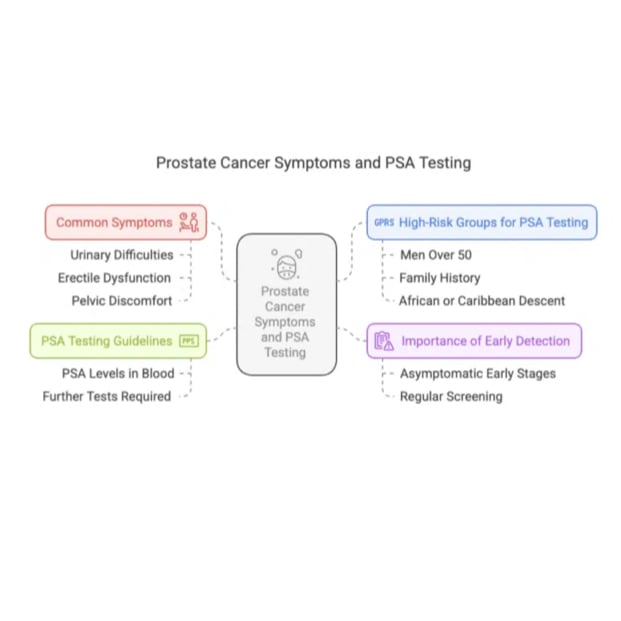
Urinary changes
Urinary symptoms are among the most common reasons men visit their GP about prostate health, but they are far more frequently caused by benign prostatic hyperplasia (BPH) than by prostate cancer.
Don't Ignore: Sudden changes in urinary habits that develop over weeks or waking more than twice a night to urinate when this wasn't previously normal for you.
Blood in urine or semen
While blood in urine or semen may be linked to infections or other benign causes, it always merits further assessment by a medical professional.
Don't Ignore: Even a single episode of pink, red, or brown urine should be investigated – even if it clears up on its own.
Pelvic or lower back pain
Although this can be explained by muscle strain or other benign conditions, it may in rare cases suggest prostate cancer that is affecting nearby areas.
Don't Ignore: Unexplained pain lasting more than a few weeks that doesn’t improve with rest or standard pain relief, particularly if it worsens at night.
Erectile difficulties
Early-stage prostate cancer does not typically cause erectile dysfunction; however, any new or persistent erection problem should prompt a consultation with your GP or urologist.
Don't Ignore: Sudden onset of erectile difficulties, particularly in men over 50, especially when combined with urinary symptoms or unexplained pain.
When Should You See a Doctor About Prostate Cancer Symptoms?
Being proactive about your health isn't overreacting — it's sensible. If you are concerned about a symptom, it is worth having it checked — your GP can arrange tests quickly.
Your GP can arrange a PSA blood test and, if appropriate, a digital rectal examination. These are quick, straightforward tests that can provide important information about your prostate health
Blood in urine or semen (always get checked within a few days)
Multiple urinary symptoms appearing together
Persistent bone pain in the back, hips or thighs
Unexplained weight loss combined with fatigue
Any symptom that is getting progressively worse
If you've just been diagnosed, our complete guide to prostate cancer walks you through what your results mean.
Prostate Cancer Screening — Why It Matters More Than Symptoms
Speak to your GP
Early prostate cancer causes no symptoms; NICE NG131 recommends informed discussion about PSA testing for men at risk before symptoms arise.
PSA blood test ± DRE
A PSA test measures prostate-specific antigen in the blood, though levels can be raised by BPH, infection, recent ejaculation or vigorous exercise (NICE NG131, 2021).
Digital rectal examination (DRE) allows a clinician to feel for irregularities in the prostate’s shape or texture.
If raised: mpMRI followed by targeted biopsy
If screening raises concern, NICE-recommended multiparametric MRI (mpMRI) followed by targeted biopsy confirms diagnosis. MRI-targeted biopsy detects clinically significant cancers more accurately than standard biopsy while reducing overdiagnosis of clinically insignificant disease(¹). FTC provides both mpMRI and targeted biopsy at our seven UK locations.
(¹) Kasivisvanathan/Asif et al., VISION meta-analysis, European Urology 2024 — Dr Aqua Asif of The Focal Therapy Clinic is a co-author
Risk Factors for Prostate Cancer
Prostate cancer risk depends on several factors, some of which cannot be changed. Understanding your risk profile helps you and your GP decide whether prostate cancer screening is appropriate for you.
Age: over 50 — risk increases significantly with each decade (NICE NG131, 2021)
Family history: Father or brother with prostate cancer approximately doubles your risk (NICE NG131, 2021). BRCA2 mutation carriers face approximately 7-8 times higher lifetime risk and are more likely to be diagnosed with aggressive disease (Castro et al., J Clin Oncol 2013).
Ethnicity: Black men in the UK have approximately twice the lifetime risk — one in four Black men will be diagnosed with prostate cancer, compared with one in eight white men (Lloyd et al., BMC Medicine 2015). Black men also tend to be diagnosed at a younger age.
Genetics: Specific genetic mutations increase prostate cancer risk: BRCA1 and BRCA2 (Castro et al., J Clin Oncol 2013), and the HOXB13 G84E variant which is associated with approximately twenty times higher risk in carriers (Ewing et al., NEJM 2012). Consider asking your GP about genetic testing referral if you have multiple first-degree relatives affected or relatives diagnosed under age 65.
At The Focal Therapy Clinic, our consultants assess every referral with multiparametric MRI (mpMRI) and targeted biopsy to determine the most appropriate management, whether that is active surveillance, focal therapy, or another approach.
Learn more about prostate cancer


Which Conditions Cause Similar Symptoms to Prostate Cancer?
Benign Prostatic Hyperplasia (BPH)
Prostatitis
Urinary Tract Infection (UTI)
Can You Lower Your Risk of Prostate Cancer?
Maintain a balanced diet(¹):
A diet rich in fruits, vegetables, and whole grains, and low in red and processed meats, may be beneficial. However, the evidence for specific dietary recommendations is not conclusive.
(¹)World Cancer Research Fund Continuous Update Project
Stay physically active(²):
Moderate exercise helps manage weight and can support overall wellness. This might include brisk walking, swimming, or resistance training.
(²)Friedenreich et al., European Urology 2016, systematic review of physical activity and prostate cancer
Regular check-ups(³):
If you are over 50, Black or have a family history of prostate cancer, discuss screening with your GP. Early detection through a PSA test is the single most effective step that you can take.
(³)NICE NG131 / Prostate Cancer UK PSA Consensus
Treatment Options When Prostate Cancer Is Found Early
Active surveillance
This involves closely monitoring the prostate cancer without taking immediate action, often used when tumours are very small or slow-growing. You will undergo regular PSA tests, DREs, and periodic imaging or biopsies to check for any changes.
Recommended by NICE NG131 (2021) for men with low-risk localised prostate cancer (Gleason 6, PSA below 10, stage T1-T2a).
Learn More
Focal therapy
A NICE-approved (IPG756, 2023) minimally invasive approach that treats only the confirmed cancer zone within the prostate. This precision approach is designed to preserve both sexual and urinary function. At The Focal Therapy Clinic, over 90% of men maintained erections following focal therapy(¹). Published focal therapy series report erectile function preservation in 74-95% of men, depending on baseline function and treatment volume(²).
(¹)FTC audit, n=265 — methodology available on request
(²)Hopstaken et al., European Urology 2022
Learn More
Prostatectomy
A surgeon removes the entire prostate gland and sometimes surrounding tissues. This is a common choice for men with localised but significant prostate cancer.
NICE-recommended treatment for localised and locally advanced disease (NG131, 2021). Outcomes depend on tumour stage and surgical approach.
Learn More
Radiotherapy
This can be given externally (external beam radiotherapy) or internally (brachytherapy). Radiation is aimed at cancer cells to shrink or destroy them, often with success in early-stage disease.
NICE-recommended for localised prostate cancer. Patient-reported outcomes from the UK ProtecT trial show comparable cancer-specific survival across active monitoring, surgery and radiotherapy at 15 years (Hamdy et al., NEJM 2023).
Learn More
Patient Voices: How early screening preserved quality of life
Why Choose The Focal Therapy Clinic?
Only clinic using advanced MRI US fusion technologies for precision treatment
Learn MoreWe have helped thousands of people with prostates understand their diagnosis and choose the right treatment for them and their prostate cancer.
Learn MoreWe've assembled a team of urology, radiology, oncology and patient care experts with over 75 years of experience.
Learn MoreOur own data shows that after 1 year of treatment, 90% of clinically significant cancer is eliminated.
Learn MoreQuestions to ask your doctor or nurse

Bring these to your GP appointment, or speak to our team first.
Frequently asked questions

Learn more about Focal Therapy and Prostate Cancer
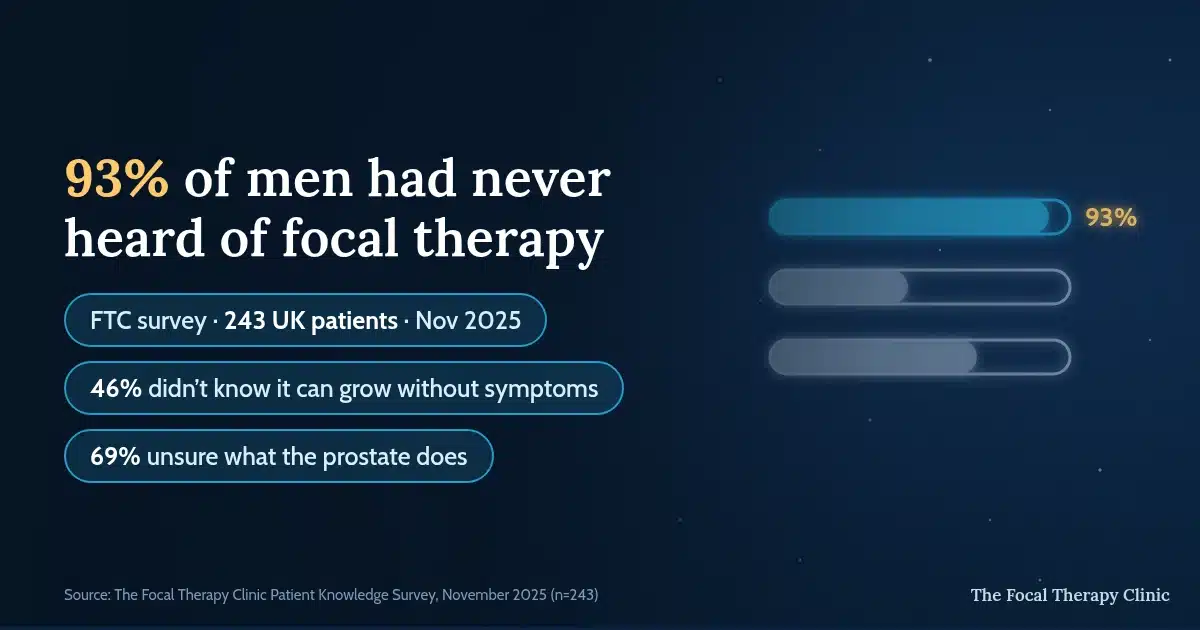
Prostate Cancer Survey: 93% of Men Had Never Heard of Focal Therapy
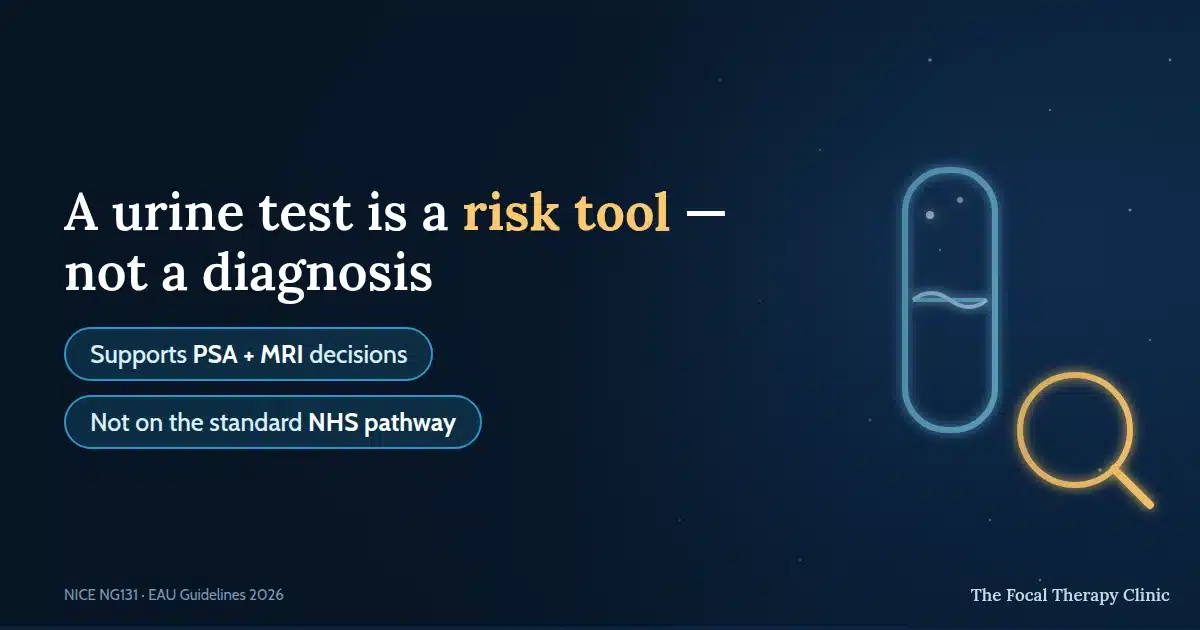
How Accurate Is a Urine Test for Prostate Cancer — and Can It Replace PSA or MRI?
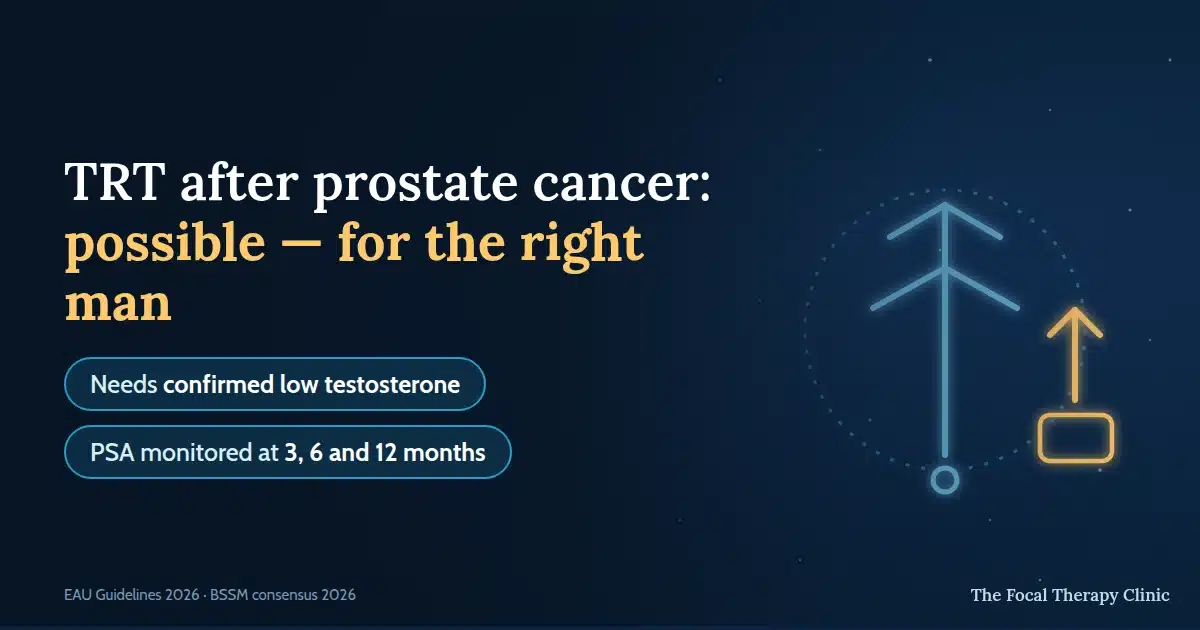
Is Testosterone Replacement Therapy Safe After Prostate Cancer Treatment?
Any questions?
If you’ve got any questions about your prostate cancer diagnosis or want to know more about HIFU or NanoKnife, don’t hesitate to get in touch with our friendly, knowledgeable team.
Contact the team
Reference List
- Kasivisvanathan V, Wai-Shun Chan V, Clement KD, Levis B, Ng A, Asif A, Haider MA, Emberton M, Pond GR, Agarwal R, Scandrett K, Takwoingi Y, Klotz L, Moore CM. VISION: An Individual Patient Data Meta-analysis of Randomised Trials Comparing MRI-Targeted Biopsy with Standard TRUS-Guided Biopsy in the Detection of Prostate Cancer. European Urology. 2024;87(5):512-523. DOI: 10.1016/j.eururo.2024.08.022. Dr Aqua Asif of The Focal Therapy Clinic is a named co-author.
- Giganti F, Ng A, Asif A et al. Global Variation in Magnetic Resonance Imaging Quality of the Prostate. Radiology. 2023;309(1):e231130. DOI: 10.1148/radiol.231130. Dr Aqua Asif of The Focal Therapy Clinic is a named co-author.
- Castro E, Goh C, Olmos D et al. Germline BRCA mutations are associated with higher risk of nodal involvement, distant metastasis, and poor survival outcomes in prostate cancer. Journal of Clinical Oncology. 2013;31(14):1748-1757. DOI: 10.1200/JCO.2012.43.1882
- Ewing CM, Ray AM, Lange EM et al. Germline mutations in HOXB13 and prostate-cancer risk. New England Journal of Medicine. 2012;366(2):141-149. DOI: 10.1056/NEJMoa1110000
- Berry SJ, Coffey DS, Walsh PC, Ewing LL. The development of human benign prostatic hyperplasia with age. The Journal of Urology. 1984;132(3):474-479.
- Lloyd T et al. Lifetime risk of being diagnosed with, or dying from, prostate cancer by major ethnic group in England 2008-2010. BMC Medicine. 2015;13:171. DOI: 10.1186/s12916-015-0405-5
- Hopstaken JS et al. An Updated Systematic Review on Focal Therapy in Localized Prostate Cancer. European Urology. 2022;81(1):5-33.
- Hamdy FC et al. (ProtecT Study Group). Fifteen-Year Outcomes after Monitoring, Surgery, or Radiotherapy for Localized Prostate Cancer. NEJM. 2023;388:1547-1558. DOI: 10.1056/NEJMoa2214122
- NICE NG131: Prostate cancer — diagnosis and management. NICE, 2019 (updated 2021). nice.org.uk/guidance/ng131
- NICE IPG756: Focal therapy using high-intensity focused ultrasound for localised prostate cancer. NICE, 2023. nice.org.uk/guidance/ipg756
- EAU Guidelines on Prostate Cancer, 2024. uroweb.org/guidelines/prostate-cancer
- Prostate Cancer UK PSA Consensus, 2024. prostatecanceruk.org/for-health-professionals/guidelines/psa-consensus-2024
- NHS: Prostate cancer — Symptoms. nhs.uk/conditions/prostate-cancer/symptoms
- UK Government: PSA testing — advice for men without symptoms. gov.uk/government/publications/prostate-specific-antigen-testing-description-in-brief
- FTC erectile function audit (n=265). Methodology summary available on request from The Focal Therapy Clinic clinical team.
Subscribe to our newsletter
Get expert advice & the latest prostate cancer research - straight to your inbox.