
At a Glance
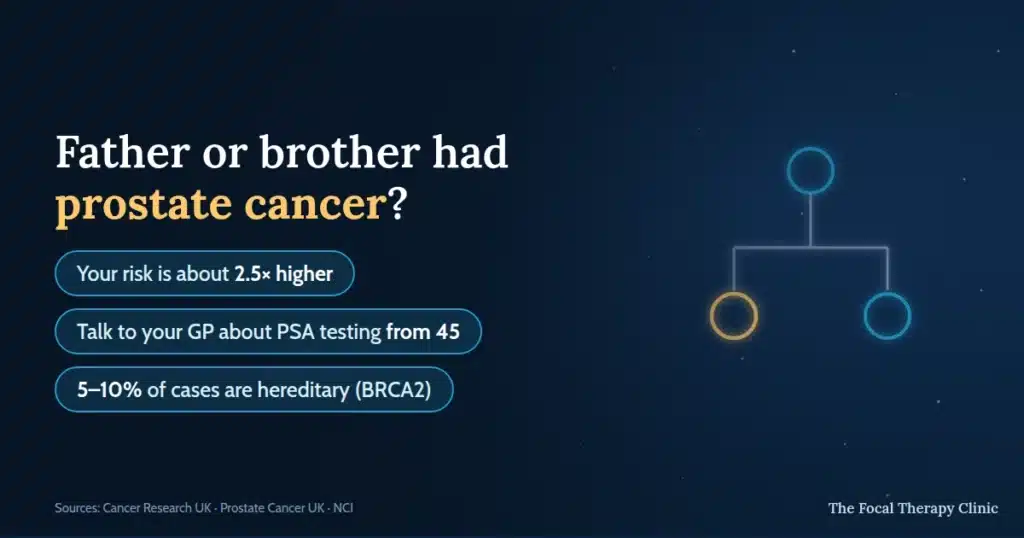
If your father or brother had prostate cancer, your risk of developing it is about 2.5 times higher than average (Cancer Research UK). Around 5–10% of prostate cancers are hereditary, often linked to BRCA2 gene mutations. Starting PSA screening discussions with your GP around age 45 — or earlier if relatives were diagnosed under 60 — gives you the best chance of early detection and more treatment options.
- Family history raises risk — a father or brother with prostate cancer makes you approximately 2.5× more likely to develop it yourself
- BRCA2 genes matter most — inherited mutations in BRCA2 can cause earlier-onset, more aggressive prostate cancer
- Start screening at 45 — discuss PSA testing with your GP, or earlier if family diagnoses occurred under age 60
- Black men face higher risk — about 1 in 4 Black men in the UK will get prostate cancer in their lifetime, roughly double the risk of other men
- Early detection expands options — proactive screening leads to more treatment choices, including targeted focal therapies like HIFU (NICE HTG667) that preserve quality of life
Family history is one of the strongest known risk factors for prostate cancer. Men with a father or brother who had prostate cancer are about 2.5 times more likely to develop it themselves (Cancer Research UK). If multiple close relatives have been affected — or if diagnoses occurred before age 60 — the risk may be higher still.
Understanding your family history allows you to be proactive. At The Focal Therapy Clinic, we encourage men with a family history to discuss PSA screening with their GP from age 45. Early detection leads to more treatment options — including targeted focal therapies that preserve urinary continence and sexual function.
In this guide, we cover how family history influences your risk, the role of BRCA1 and BRCA2 genes, why ethnicity matters, and when you should consider getting checked.
Is Prostate Cancer Hereditary?
Dr Christos Mikropoulos answers whether prostate cancer is genetic — how family history and inherited risk affect your chances and when testing is worth discussing.
Yes, prostate cancer can be hereditary. While most cases occur by chance, about 5–10% of prostate cancers are primarily caused by inherited gene mutations passed down through families (National Cancer Institute, Genetics of Prostate Cancer PDQ). Hereditary prostate cancer often develops before age 60 and may be more aggressive than sporadic cases.
A complete picture of your family’s cancer history is important — not just prostate cancer, but also breast (including male breast cancer), ovarian, and pancreatic cancer. These cancers can share the same inherited genetic mutations, particularly in the BRCA1 and BRCA2 genes.
My father had prostate cancer. What are my risks?
If your father had prostate cancer, your risk of developing it is about 2.5 times higher than a man with no family history (Cancer Research UK). This makes family history one of the strongest known risk factors for the disease. Share this information with your GP — it may mean starting PSA screening discussions from age 45, rather than waiting for symptoms to appear.
If your father was diagnosed before age 60, or if you have a brother who was also affected, your risk may be higher still. In these cases, your GP may recommend screening conversations even earlier.
Does your family have a history of prostate cancer?
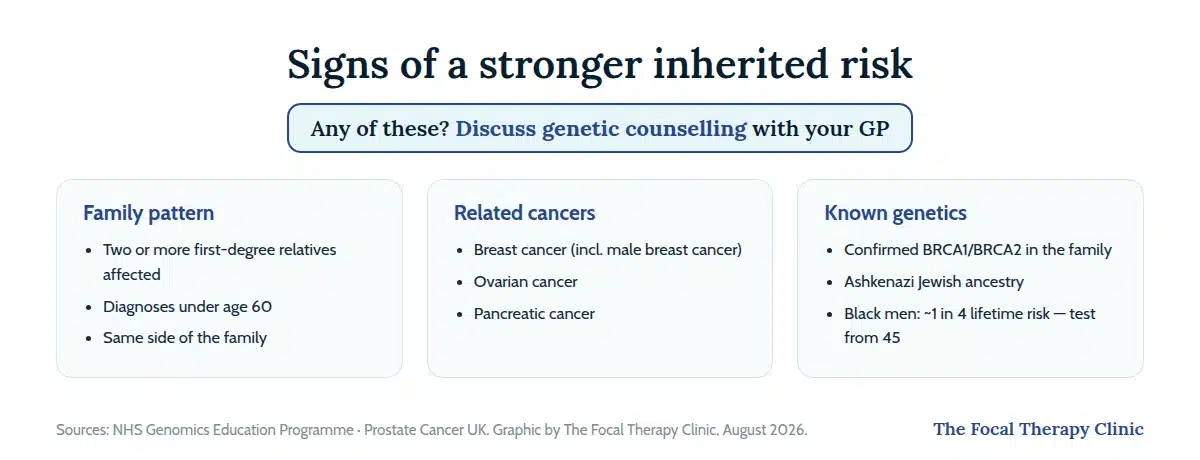
Look beyond just your father. Your brothers, paternal uncles, and grandfathers all contribute to the picture. A pattern across generations or multiple diagnoses on the same side of the family strengthens the possibility of an inherited genetic risk (NHS England, Genomics Education Programme).
Signs that may suggest a stronger inherited risk include:
- Multiple close relatives affected — two or more first-degree relatives (father, brother) diagnosed with prostate cancer on the same side of the family
- Early-onset diagnoses — prostate cancer diagnosed in relatives under the age of 60
- Related cancers in the family — particularly breast cancer (including male breast cancer), ovarian cancer, or pancreatic cancer
- Known BRCA mutations — confirmed BRCA1 or BRCA2 gene mutations within the family
- Ashkenazi Jewish ancestry — associated with a higher frequency of BRCA mutations
If any of these apply to you, discuss genetic counselling with your GP. A referral to a genetics service can help clarify your personal risk and guide screening decisions.
How do BRCA genes affect prostate cancer risk?
BRCA1 and BRCA2 are genes everyone has. Their job is to help repair damaged DNA — acting like cellular mechanics to prevent cells from growing uncontrollably. When there is a fault (mutation) in one of these genes, that repair mechanism does not work properly, increasing the risk of several cancers (National Cancer Institute, Genetics of Prostate Cancer PDQ).
Mutations in BRCA2 are linked to a significantly higher risk of developing prostate cancer — often at a younger age and potentially a more aggressive form. A BRCA1 mutation may also slightly increase risk, though the evidence is less clear-cut.
If there is a known BRCA mutation in your family, or a strong history of breast, ovarian, or pancreatic cancer, genetic counselling and testing should be discussed with your GP. At The Focal Therapy Clinic, understanding your genetic profile helps our consultants tailor the most appropriate screening and, if needed, treatment pathway.
Risks for Black Men
Black men face a significantly higher risk of developing prostate cancer compared to White or Asian men. In the UK, about 1 in 4 Black men will get prostate cancer in their lifetime — roughly double the risk of other men (Lloyd et al., BMC Medicine, 2015; Prostate Cancer UK). Black men are also more likely to be diagnosed at a younger age and potentially with more aggressive disease.
The reasons for this increased risk are complex and not fully understood, but are thought to involve a combination of genetic and other factors. Given this higher risk, it is particularly important for Black men to start conversations with their GP about prostate cancer screening early — ideally from age 45.
Get Expert Advice & The Latest Research
Subscribe to our newsletter to receive the latest updates, expert insights, and breakthrough research on prostate cancer-delivered straight to your inbox.
Can Prostate Cancer Be Prevented?
There is no guaranteed way to prevent prostate cancer. However, maintaining a healthy lifestyle may help reduce your risk of developing aggressive disease — particularly relevant if you have a family history.
Steps that support general health and may influence prostate cancer risk include:
- Balanced diet — rich in fruits, vegetables, and whole grains, while limiting red and processed meats and saturated fats
- Regular exercise — staying physically active and maintaining a healthy weight
- Avoid smoking — linked to more aggressive forms of prostate cancer
While these steps are beneficial, they do not eliminate the risk — especially with strong genetic predispositions. Regular screening discussions with your GP remain the most effective way to catch prostate cancer early.
“If you have a family history of prostate cancer, I would recommend speaking to your GP about PSA testing from age 45. Not every man with a family history will develop prostate cancer, but early awareness gives you the best options if treatment is ever needed.” — Mr Alan Doherty, Consultant Urological Surgeon (FRCS(Urol), GMC: 3279241)
Frequently Asked Questions
Does family history affect prostate cancer?
Yes, family history is one of the most significant risk factors for prostate cancer. Having a father or brother with prostate cancer makes you about 2.5 times more likely to develop it yourself (Cancer Research UK). This is one of the strongest known risk factors for the disease. Sharing your family history with your GP is essential for deciding the right screening and monitoring plan for you.
When should I discuss my family history of prostate cancer with my doctor?
If you have a father or brother who had prostate cancer, it is generally recommended to start PSA screening discussions with your GP around age 45 (Prostate Cancer UK). If your relative was diagnosed under the age of 60, or if multiple relatives are affected, your GP may suggest starting even earlier. Do not wait for symptoms — early prostate cancer often has none.
What is a BRCA gene?
BRCA1 and BRCA2 are genes that normally help repair damaged DNA in our cells, preventing cancers from developing. If you inherit a faulty version (mutation) of one of these genes, your risk of several cancers increases (National Cancer Institute). For men, a BRCA2 mutation significantly increases the risk of developing prostate cancer, often at a younger age and potentially a more aggressive type. A BRCA1 mutation may also increase risk, though the evidence is less established.
References
- Cancer Research UK — Prostate cancer risks and causes.
- Prostate Cancer UK — Are you at risk?
- National Cancer Institute — Genetics of Prostate Cancer (PDQ), Health Professional Version.
- NHS England Genomics Education Programme — Patient with a family history of prostate cancer.
- Lloyd T, et al. Lifetime risk of being diagnosed with, or dying from, prostate cancer by major ethnic group in England 2008–2010. BMC Medicine 2015;13:171.
- Prostate Cancer UK — Knowledge is power: men who know they have family history of prostate cancer more likely to survive it (2023).
This content is not intended to replace professional medical advice. Always consult your clinical team about your individual circumstances.