
PSE Test for Prostate Cancer: What It Is and How It Works
The Prostate-Specific EpiSwitch (PSE) test is a blood test that analyses epigenetic markers — how your genes behave — to assess prostate cancer risk. Unlike PSA testing, which measures protein levels and can be affected by infections or activity, the PSE test examines more stable genetic patterns. It is available privately through The Focal Therapy Clinic, though it is not yet part of standard NHS screening or endorsed by NICE..
Reported accuracy (2023 pilot validation study): combined with continuous PSA, the PSE test reported 86% sensitivity, 97% specificity, 93% positive predictive value, 95% negative predictive value and 94% overall accuracy (Pchejetski et al., Cancers 2023). These come from a pilot validation study and should be interpreted alongside MRI and biopsy findings, PSA history, prostate size, symptoms, family history and clinical review.
Complementary, not replacement: designed to work alongside PSA and MRI, not replace them; may help reduce unnecessary biopsies
If results suggest risk: next steps typically include MRI scanning or targeted biopsy

What Is the PSE Test?
The Prostate-Specific EpiSwitch (PSE) test is a blood test that analyses epigenetic markers — how certain genes behave — to assess prostate cancer risk. Unlike a PSA test which measures protein levels that can fluctuate with infections, activity, or benign prostate conditions, the PSE test examines more stable genetic patterns that may help identify clinically significant cancer.
Developed by Oxford BioDynamics, the EpiSwitch PSE test has been assessed in studies involving men with suspected prostate cancer (Pchejetski et al., Cancers 2023). When used alongside PSA results or MRI scans, it aims to add diagnostic clarity and could help reduce unnecessary biopsies.
The PSE test is not currently recommended by NICE (National Institute for Health and Care Excellence) or included in standard NHS prostate cancer screening. It is available privately through The Focal Therapy Clinic, with more research needed before it can be considered part of routine care.
This page is medically authored by Dr Aqua Asif, a named co-author of the VISION MRI-targeted-biopsy meta-analysis (European Urology, 2024) and the PI-QUAL prostate-MRI quality standard — research at the centre of the modern prostate-cancer diagnostic pathway. The PSE evidence itself was co-developed by Professor Hashim Ahmed of Imperial College London.
How is the PSE test different from a PSA test?
PSA tests has been used for decades, but elevated PSA levels can be caused by infections, physical activity, or benign prostate enlargement — not just cancer. This means PSA alone has a relatively high false-positive rate, which can lead to unnecessary anxiety, MRI scans and biopsies.
The PSE test analyses epigenetic markers that appear more stable than PSA protein levels, which is why its reported specificity (97%) is substantially higher than PSA testing alone. When used alongside PSA, the combination may give clinicians a clearer picture of whether a biopsy is warranted.
| Characteristics | PSE Test | PSA Test |
|---|---|---|
| Method | Analyses epigenetic markers associated with prostate cancer risk | Measures prostate-specific antigen (PSA) protein levels in the blood |
| Accuracy | Less affected by temporary factors such as infection, exercise, or benign prostate enlargement | PSA levels can be elevated by infection, exercise, and benign prostatic hyperplasia (BPH) |
| Specificity | Reported 97% specificity in a single published study | Relatively high false-positive rate, with specificity typically around 30–40% |
| Clinical Status | Not currently NICE-endorsed and not part of standard NHS prostate cancer screening pathways | Long-established test used across the NHS and supported by NICE guidance |
| Availability | Mainly private providers | Widely Available |
| Role in Testing | Designed to complement PSA testing by providing additional risk information | Often used as the first-line blood test to help identify men who may need further investigation |
Still not sure which test to take?
At The Focal Therapy Clinic, our consultant urological surgeons can advise on whether a PSE test alongside your existing PSA results and MRI findings would add value to your diagnostic pathway.
Access matters as much as accuracy — read how direct hospital PSA testing is breaking down barriers to early detection.
How accurate is the PSE test?
Research suggests the PSE test may offer improved accuracy when used alongside PSA testing, potentially helping to avoid some unnecessary procedures. Studies have reported that the test can detect prostate cancer in most men who have it, whilst also reducing false positives in those who don’t.
However, it’s important to understand that the evidence supporting these claims comes from relatively small studies. The main research was conducted after the participants’ cancer status was already known, which is different from real-world screening situations. Larger studies with more diverse populations are needed to confirm these findings.
86%
Sensitivity - detecting cancer when present
97%
Specificity - correctly identifying when cancer is absent
93%
Positive predictive value
95%
Negative predictive value
94%
Overall accuracy
Source: Pchejetski et al., Cancers 2023. A pilot validation study; interpret alongside MRI, biopsy, PSA history, prostate size, symptoms, family history and clinical review.

Limitations and what the evidence currently shows
While the PSE test shows promise, it’s not yet offered as standard care across the NHS. Right now, it’s mainly available through private providers like The Focal Therapy Clinic. This means some patients may need to cover the cost themselves.
Remember that the test is based on relatively small studies that need to be confirmed in larger, more diverse populations before it can be considered reliable for widespread use. Leading prostate cancer charities, including Prostate Cancer UK, have noted that more research is needed to establish whether the test can correctly identify men with prostate cancer when their diagnosis is unknown.
Cost: In the UK, the EpiSwitch PSE test typically costs around £875–£925 for the test itself, or roughly £950–£1,050 all-in once a blood draw or consultation is included. See our fees →
Current Evidence Status:
| Evidence Potential | 🟠 Promising |
| Clinical Status | ⚪ Not NICE-endorsed |
| Clinical Findings | 🟠 More research needed |
How is the PSE test performed?
Consent & consultation
A specialist explains the test and obtains consent, since the test analyses your genetic information
Blood sample
A standard blood draw, identical to a routine blood test
Laboratory analysis
Your sample is sent to a certified laboratory where it is analysed for epigenetic markers linked to prostate cancer
Results review
our clinician reviews PSE results alongside your PSA findings and any MRI scans to provide a comprehensive picture
Who is the PSE test suitable for?
Those who may benefit from a PSE test
- Men with a raised or borderline PSA result
PSA levels can be affected by factors other than cancer, including infection, exercise, and benign prostate enlargement. A PSE test may provide additional information when the need for further investigation is unclear. - Men with a family history of prostate cancer
Men with a close family history of prostate cancer are at higher risk of developing the disease. Some may choose to use PSE alongside PSA testing as part of a proactive approach to risk assessment. - Men with a previous negative biopsy
A previous negative biopsy does not always remove concern, particularly if PSA levels remain raised. A PSE test may provide additional information to support discussions about next steps with a clinician. - Men hoping to avoid an unnecessary biopsy
Prostate biopsies are invasive procedures. When the clinical picture is uncertain, some men may seek additional information before deciding whether to proceed with further testing.
Who may not benefit from a PSE test
- Men already diagnosed with prostate cancer
Once prostate cancer has been confirmed, monitoring and treatment decisions are typically guided by established clinical assessments, imaging, pathology results, and specialist review. - Men with a clearly indicated need for biopsy
In cases where PSA levels are significantly elevated or where other clinical findings strongly suggest the need for further investigation, a biopsy or other diagnostic procedures may already be clearly indicated. In these circumstances, additional screening tests may be unlikely to change the recommended clinical pathway.
What happens if my PSE test result suggests cancer risk?
If cancer is confirmed through these additional tests, your care team will walk you through all available options. These may include active surveillance, radiotherapy, surgery, or focal therapy, depending on the location and severity of any cancer found.
PSE Results Reviewed alongside PSA and MRI findings
The result should be considered together with PSA levels, symptoms, family history, MRI findings (if available), and other relevant clinical information.
Further investigation if risk is elevated
If the overall assessment suggests an increased risk of clinically significant prostate cancer, further investigations may be recommended, such as a multiparametric MRI (mpMRI) or prostate biopsy.
Cancer staging if diagnosis is confirmed
If prostate cancer is diagnosed, additional tests may be used to determine the stage, grade, and extent of the disease.
Treatment options discussed
A specialist team will discuss appropriate management options. These may include active surveillance, radiotherapy, surgery, or focal therapy, depending on the location and severity of any cancer found.

How PSE results can inform focal therapy candidacy
If the PSE test and subsequent investigations identify cancer localised to specific areas of the prostate, this information may help doctors determine if focal therapy could be appropriate. This approach aims to treat only the affected regions whilst preserving healthy prostate tissue.
At The Focal Therapy Clinic, treatments like HIFU and NanoKnife are used for this kind of targeted care when suitable. These procedures are guided by advanced MRI fusion technology, aiming for precision whilst minimising side effects. Our expert clinicians carefully assess each case to determine the most appropriate treatment approach.
Learn more about Focal Therapy
The PSE test at The Focal Therapy Clinic
Understanding prostate cancer risk is rarely about a single test result. At The Focal Therapy Clinic, the PSE test forms part of a wider diagnostic pathway designed to provide a more complete assessment before important decisions are made. No single test can provide a complete picture. That's why PSE results are reviewed alongside PSA levels, MRI findings, symptoms, family history, and other relevant clinical information. This helps ensure that decisions are based on the fullest possible understanding of an individual's risk profile.
Specialist review and personalised recommendations
Every patient's situation is different. That's why PSE results are assessed by an experienced consultant as part of your overall clinical evaluation.
This allows us to provide personalised advice on whether further investigations, such as MRI scans or biopsy, may be appropriate.
Available at FTC locations nationwide
The PSE test is available across Focal Therapy clinics.
The PSE test is available as a private diagnostic option at The Focal Therapy Clinic. If you're considering testing, our team can discuss suitability, expected costs, and how the test fits into your overall assessment during your consultation.
Why choose The Focal Therapy Clinic?
A world leading localised prostate cancer treatment from our expert urologists with more than 75 years of combined experience
Only clinic using advanced MRI US fusion technologies for precision treatment
MRI scans explainedWe have helped thousands of people with prostates understand their diagnosis and choose the right treatment for them and their prostate cancer.
Your treatment journeyWe’ve assembled a team of urology, radiology, oncology and patient care experts with more than 75 years of combined experience.
Meet our consultantsOur own data shows patients are 90% free of clinically significant cancer at 1 year (FTC audit, n=265)
See the clinical evidenceQuestions to ask your doctor or nurse

Bring these to your GP appointment, or speak to our team first.
Frequently asked questions about the PSE test

Learn more about living with prostate cancer
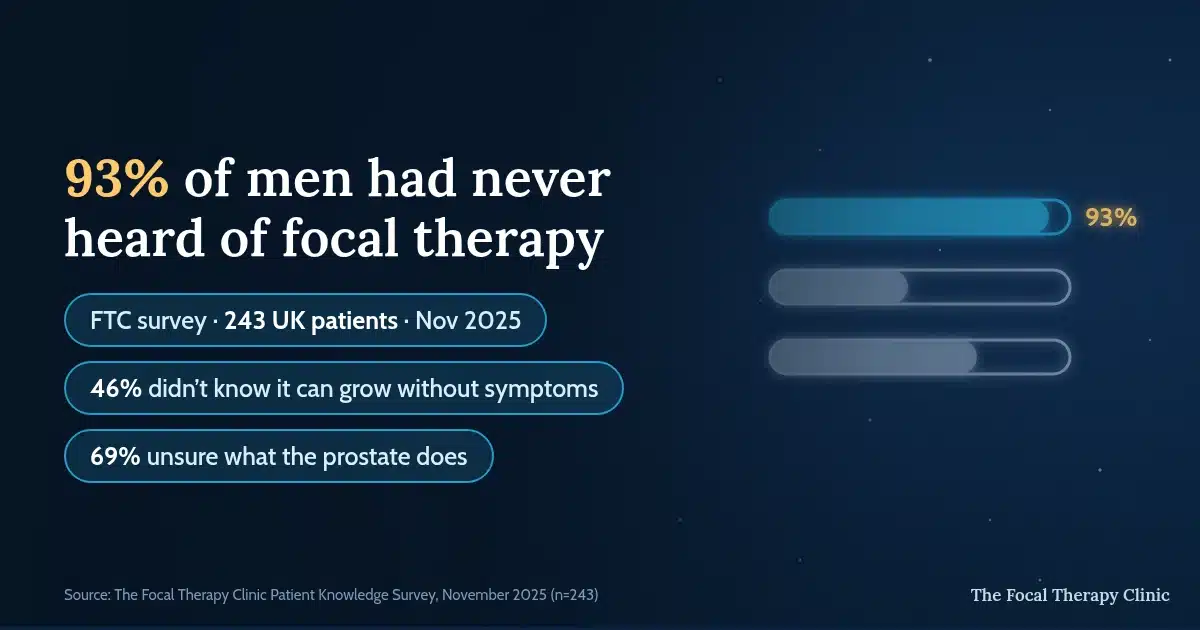
Prostate Cancer Survey: 93% of Men Had Never Heard of Focal Therapy
How Accurate Is a Urine Test for Prostate Cancer — and Can It Replace PSA or MRI?
Is Testosterone Replacement Therapy Safe After Prostate Cancer Treatment?
Any questions?
If you’ve got any questions about your prostate cancer diagnosis or want to know more about HIFU or NanoKnife, don’t hesitate to get in touch with our friendly, knowledgeable team.
Contact the team
Reference List
- Pchejetski D, Hunter E, Dezfouli M, et al. Circulating Chromosome Conformation Signatures Significantly Enhance PSA Positive Predicting Value and Overall Accuracy for Prostate Cancer Detection. Cancers (Basel). 2023;15(3):821. DOI: 10.3390/cancers15030821 (PMID 36765779). The primary PSE validation study; co-authored by Professor Hashim Ahmed of Imperial College London.
- Hunter E, Alshaker H, … Pchejetski D. A New Blood-Based Epigenetic Diagnostic Biomarker Test (EpiSwitch NST). Cancers (Basel). 2025;17(3):521. DOI: 10.3390/cancers17030521 (PMID 39941889). Cites the manufacturer's ~94% overall accuracy headline for the PSE test.
- Kasivisvanathan V, Wai-Shun Chan V, Clement KD, Levis B, Ng A, Asif A, Haider MA, Emberton M, Pond GR, Agarwal R, Scandrett K, Takwoingi Y, Klotz L, Moore CM. VISION: An Individual Patient Data Meta-analysis of Randomised Trials Comparing MRI-Targeted Biopsy with Standard TRUS-Guided Biopsy in the Detection of Prostate Cancer. European Urology. 2024;87(5):512-523. DOI: 10.1016/j.eururo.2024.08.022. Dr Aqua Asif of The Focal Therapy Clinic is a named co-author.
- Giganti F, Ng A, Asif A et al. Global Variation in Magnetic Resonance Imaging Quality of the Prostate (PI-QUAL). Radiology. 2023;309(1):e231130. DOI: 10.1148/radiol.231130. Dr Aqua Asif of The Focal Therapy Clinic is a named co-author.
- NICE NG131: Prostate cancer — diagnosis and management. National Institute for Health and Care Excellence, 2019 (updated 2021). nice.org.uk/guidance/ng131
- FTC one-year outcome audit (n=265): 90% free of clinically significant cancer at 1 year; 2,500+ procedures. Methodology summary available on request from The Focal Therapy Clinic clinical team.
Medically authored by Dr Aqua Asif; clinically reviewed by Mr Marc Laniado, The Focal Therapy Clinic. Published June 2026.
Subscribe to our newsletter
Get expert advice & the latest prostate cancer research - straight to your inbox.