
At a Glance
Prostatitis is inflammation of the prostate gland. It can cause pelvic pain, burning when urinating and pain on ejaculation — and it is not prostate cancer. Around 8% of men are affected, and more than 90% of symptomatic cases involve no bacterial infection, which is why antibiotics so often fail.
Key takeaways:
- Not prostate cancer — prostatitis is inflammation, not malignant growth, and there is no evidence it causes cancer.
- Four distinct types — from acute bacterial infection (a medical emergency) to chronic pelvic pain syndrome, which accounts for over 90% of cases.
- PSA can rise sharply — inflammation leaks PSA into the blood; an unexplained rise still needs MRI-first investigation under NICE NG131.
- Treatment depends on type — antibiotics for the bacterial categories; tailored, multimodal care for chronic pelvic pain.
- Red flags need urgent care — fever, rigors or inability to pass urine mean A&E, not a routine appointment.
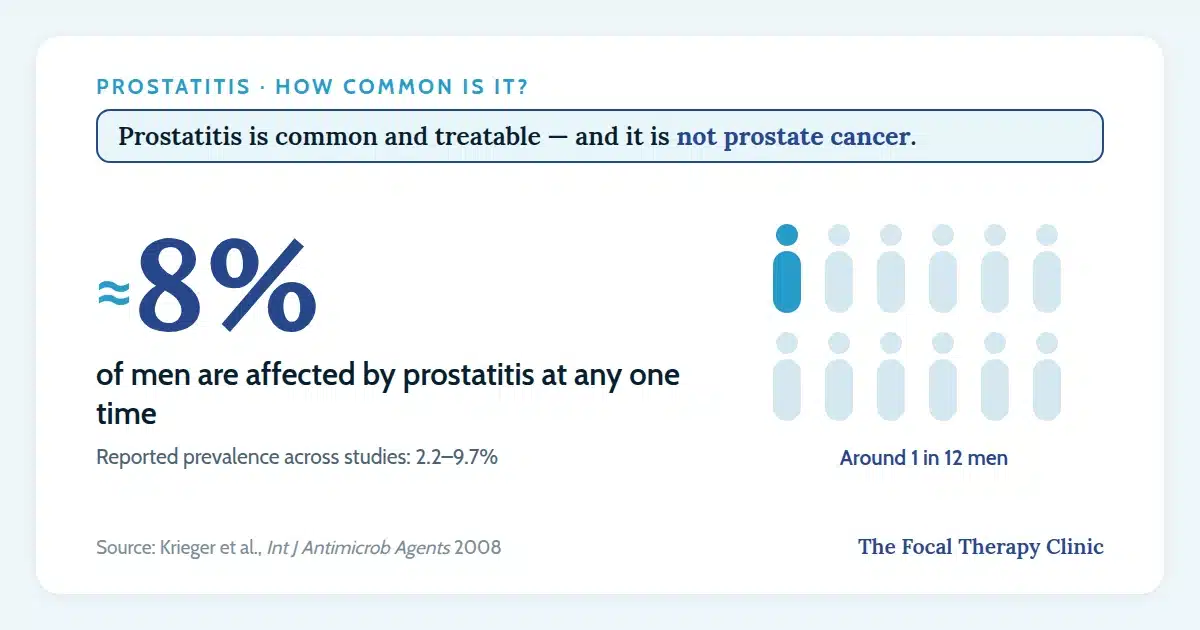
Prostatitis is inflammation of the prostate, a gland below the bladder that surrounds the urethra. It can cause pelvic pain, painful or frequent urination, and pain on ejaculation. Around 8% of men are affected by prostatitis symptoms (Krieger et al., 2008), and it accounts for around 8% of visits to urologists (Collins et al., 1998). Most cases are not infections, and prostatitis is not prostate cancer or a cause of it.
Is Prostatitis Prostate Cancer?
No. Prostatitis is inflammation, not malignant cell growth, and there is no evidence that it causes prostate cancer. The conditions are often confused because both can cause urinary changes and raise concerns about prostate health.
Prostatitis can raise the result of a PSA test, which may send a man into the same referral pathway used for suspected cancer. Urinary symptoms can also overlap, although the early symptoms of prostate cancer are often absent because localised disease commonly causes no symptoms. Prostatitis may affect the wider gland, while about 70% of prostate cancers begin in the peripheral zone near its outer edge (68% in McNeal’s classic series).
Prostate inflammation allows more PSA to leak from prostate cells into the bloodstream. Acute bacterial prostatitis can push PSA to strikingly high levels, and the result usually falls after the infection and inflammation settle. A PSA that returns to normal after antibiotics does not rule out an underlying cancer, because studies have found cancer even after a substantial PSA reduction. Imaging is needed when cancer remains a concern, as explained in the diagnosis section below.
What Are the Symptoms of Prostatitis?
Prostatitis symptoms vary greatly by type, and the pattern and speed of onset help distinguish a medical emergency from a chronic pain condition.
Pain symptoms:
- Perineal pain between the scrotum and rectum
- Pain in the lower back, lower abdomen, penis, testicles or rectum
- Pain during or after ejaculation
- Pain or burning when passing urine
Urinary symptoms:
- Frequency and urgency
- A weak or interrupted stream
- Hesitancy when starting
- Nocturia, or waking at night to urinate
- A feeling that the bladder has not emptied fully
Systemic symptoms suggesting acute bacterial infection:
- Fever
- Chills or rigors
- Nausea
- General malaise
Sexual symptoms:
- Painful ejaculation
- Erectile difficulty
- Reduced libido
- Blood in the semen
Clinicians may measure chronic prostatitis symptoms with the NIH Chronic Prostatitis Symptom Index, which scores pain, urinary problems and quality of life to track whether treatment is working.
The Four Types of Prostatitis
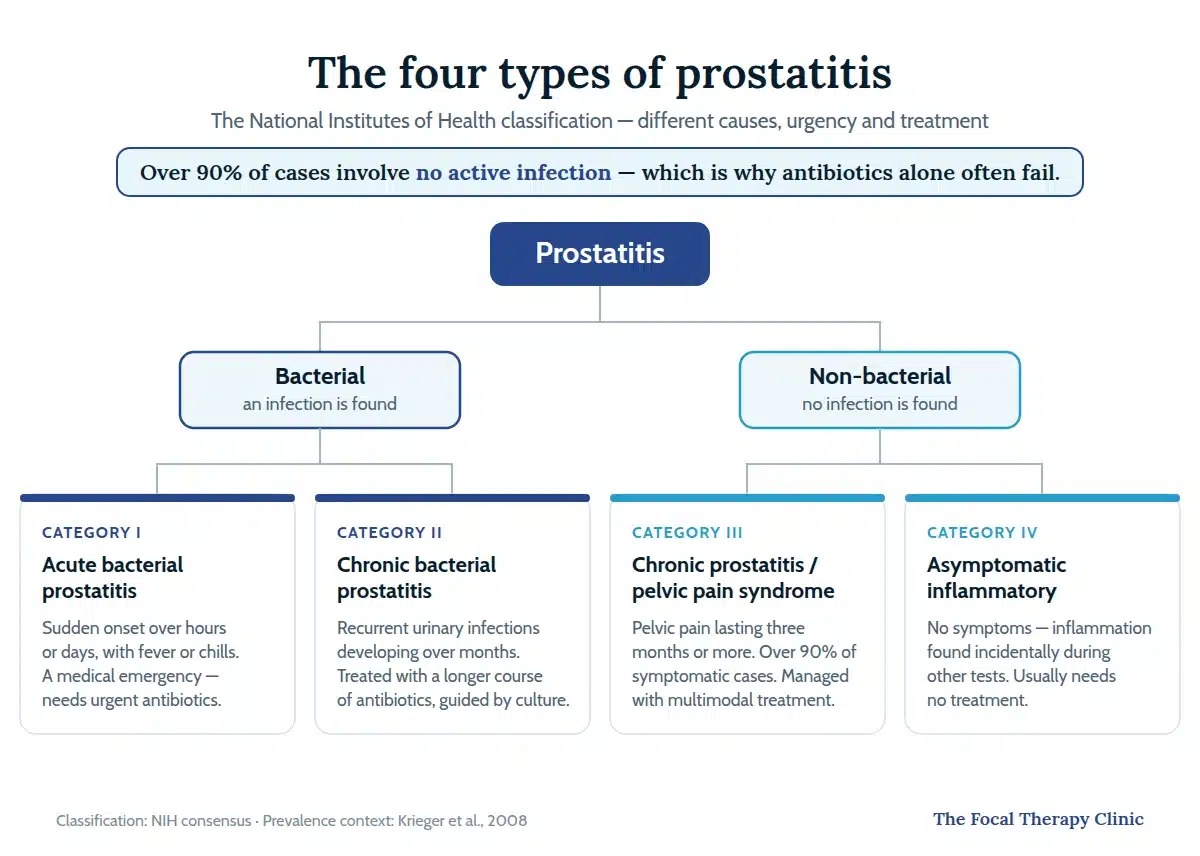
Prostatitis is not one condition. The National Institutes of Health divides it into four categories with different causes, levels of urgency and treatments. More than 90% of symptomatic cases are category III chronic prostatitis or chronic pelvic pain syndrome, where no bacterial infection is found.
| Type | Also called | Infection present | Onset | Typical treatment |
|---|---|---|---|---|
| Category I | Acute bacterial prostatitis | Yes | Sudden, over hours or days | Urgent antibiotics; hospital care if severe |
| Category II | Chronic bacterial prostatitis | Yes | Recurrent or gradual over months | Longer antibiotic course guided by culture |
| Category III | Chronic prostatitis/chronic pelvic pain syndrome | No detectable bacterial infection | Pain lasting at least three months | Multimodal symptom treatment |
| Category IV | Asymptomatic inflammatory prostatitis | No symptoms; inflammation may be present | Incidental finding | Usually no treatment |
Acute bacterial prostatitis
Category I acute bacterial prostatitis is a sudden prostate infection and the only type that is a medical emergency. Symptoms develop over hours or days and may include fever, rigors, severe perineal or rectal pain, difficulty passing urine and complete urinary retention. The infection can spread into the bloodstream and cause sepsis. The red flags below require urgent assessment rather than a routine appointment.
Chronic bacterial prostatitis
Category II chronic bacterial prostatitis is a persistent or recurring infection marked by repeated urinary tract infections caused by the same organism. Symptoms are usually milder than in category I and may come and go over several months. A man can feel well between flares because bacteria remain in the prostate and act as a reservoir for reinfection. This category accounts for only a small minority of prostatitis cases.
Chronic pelvic pain syndrome
Category III chronic prostatitis/chronic pelvic pain syndrome (CP/CPPS) means pelvic pain lasting three months or longer without a detectable bacterial infection. It accounts for more than 90% of symptomatic prostatitis; across population studies, prostatitis symptoms affect between 2.2% and 9.7% of men (around 8% overall — Krieger et al., 2008), and prostatitis is more commonly diagnosed in men aged 36 to 65 than in younger men (Collins et al., 1998). Category IIIA is inflammatory, with white blood cells found in urine or expressed prostatic fluid, while IIIB is non-inflammatory.
Population studies consistently find around 3 to 5 new cases of prostatitis per 1,000 men each year, and the risk rises through midlife rather than old age: a Finnish population study found the risk 1.7 times greater in men aged 40 to 49 and 3.1 times greater at 50 to 59 than in men aged 20 to 39 (Mehik et al., 2000), while the mean age at diagnosis of type III prostatitis in a US community cohort was 52.9 years (Clemens et al., 2005).
The term chronic prostatitis cpps describes a genuine chronic pain condition, not an imagined or minor problem. Men may spend years seeking a diagnosis while pain, urinary symptoms and sexual difficulties disrupt work, sleep and relationships. Persistent pain is strongly associated with anxiety and low mood, which often follow the burden of the symptoms rather than explain the condition. Stress can still amplify pain signalling, so care should address both physical symptoms and their wider impact without suggesting that the condition is psychosomatic.
Asymptomatic inflammatory prostatitis
Category IV asymptomatic inflammatory prostatitis causes no symptoms and is usually found by chance during a biopsy or an investigation for raised PSA or infertility. It generally needs no treatment.
What Causes Prostatitis?
The cause depends entirely on the category, so there is no single answer to what causes prostatitis. Categories I and II are commonly caused by gut bacteria such as E. coli reaching the prostate through the urethra or through urinary reflux. Risk rises after a urinary tract infection, catheterisation, prostate biopsy or with a urethral stricture.
The cause of category III is not fully understood. Current models involve pelvic floor muscle dysfunction, sensitised nerves, previous infection or inflammation that has resolved but left altered pain signalling, and psychosocial factors that can increase pain intensity. This multifactorial pattern explains why chronic prostatitis treatment must be tailored rather than standardised.
When Should You Seek Urgent Help?
Some prostatitis symptoms need emergency care, while persistent but stable symptoms need a planned medical assessment.
Seek immediate medical attention through A&E or call 999 for:
- Fever with rigors or shaking chills
- Severe perineal, rectal or lower abdominal pain
- Complete inability to pass urine
- Confusion, rapid breathing or a racing heart, which may indicate sepsis
Pelvic pain, urinary changes or pain on ejaculation lasting more than a few days warrants a GP appointment — most prostatitis is first diagnosed in primary care, where 78% of new diagnoses were made in a US community cohort (Clemens et al., 2005). Symptoms that continue for three months or longer warrant referral to a urologist. Any unexplained raised PSA should be investigated rather than assumed to come from prostatitis.
How Is Prostatitis Diagnosed?
Diagnosis has two jobs: identifying the prostatitis category and excluding conditions that can mimic it, mainly prostate cancer, urinary tract infection and benign enlargement.
Assessment may include:
- A history of symptoms, their duration and any previous infections
- The NIH-CPSI score for chronic pain, urinary symptoms and quality of life
- A digital rectal examination; a very tender, boggy gland can suggest acute bacterial prostatitis, but vigorous examination should be avoided
- Urine dipstick and mid-stream urine culture
- PSA testing after inflammation settles where possible, because prostatitis can distort the result
- Imaging when cancer, an abscess or another structural cause needs to be excluded
Under NICE guideline NG131, mpMRI is the first-line investigation when localised prostate cancer is suspected. MRI scans for prostate cancer are reported on a five-point Likert or PI-RADS scale, and a low score can make clinically significant cancer unlikely enough for some men to avoid an immediate biopsy. When tissue is needed, a transperineal biopsy has a lower infection risk than a transrectal biopsy, which is particularly relevant after prostate infection.
The modern prostate cancer diagnostic pathway combines PSA, MRI, risk factors and targeted biopsy where needed. Benign prostatic hyperplasia can also cause urinary symptoms and raise PSA, but it is non-cancerous enlargement rather than inflammation. A specialist interprets these findings together rather than relying on one result.
Get Expert Advice & The Latest Research
Subscribe to our newsletter to receive the latest updates, expert insights, and breakthrough research on prostate cancer-delivered straight to your inbox.
Treatment Options for Prostatitis
Prostatitis treatment depends entirely on the category, and the most common error is treating category III as if it were a bacterial category II infection.
Treating bacterial prostatitis
Categories I and II are bacterial infections treated with antibiotics chosen for their ability to enter prostate tissue. NICE NG110 lists ciprofloxacin as a usual first-line oral option for acute bacterial prostatitis, with treatment reviewed after 14 days and stopped or continued for another 14 days according to symptoms, examination and test results. Severe illness, sepsis risk, vomiting or urinary retention may require hospital admission and intravenous antibiotics. Chronic bacterial prostatitis usually needs a longer culture-guided course, commonly four to six weeks under current NICE Clinical Knowledge Summary guidance.
Managing chronic pelvic pain
Category III has no infection to eradicate, so treatment aims to control the symptom domains affecting each man. Specialists may use UPOINT, which assesses urinary, psychosocial, organ-specific, infection, neurological or systemic, and muscular tenderness domains. Two men with the same diagnosis may therefore receive different treatment plans.
Options can include:
- Alpha-blockers such as tamsulosin for urinary symptoms
- Pelvic floor physiotherapy for muscular tenderness and overactivity
- Neuropathic pain medicines such as amitriptyline or pregabalin for nerve sensitisation
- Psychological support or cognitive behavioural methods as pain-management tools, not because the pain is imagined
- Heat, regular gentle movement and breaks from prolonged sitting
- Limiting bladder irritants such as caffeine and alcohol when they trigger flares
A combination of approaches generally works better than one treatment used alone.
Why antibiotics often fail
Antibiotics fail in most men because most prostatitis is not caused by bacteria. More than 90% of symptomatic cases are category III, where no organism is present and an antibiotic cannot treat muscle dysfunction or sensitised nerves. Antibiotics are still prescribed because symptoms overlap with infection and cultures may not have been taken before the first course. If two courses have not helped, the next step should be reassessment and culture rather than an automatic third course. Repeated unnecessary treatment promotes resistance and side effects, while fluoroquinolones carry rare but serious tendon and neurological risks.
Can Prostatitis Be Prevented?
In most cases, no. Category III has no established cause, so no proven prevention method exists. Some practical measures may reduce bacterial risk or help men with CP/CPPS experience fewer flares, although evidence for lifestyle measures remains modest.
- Treat urinary tract infections promptly.
- Stay well hydrated unless a clinician has advised fluid restriction.
- Choose a transperineal prostate biopsy where available.
- Avoid long periods of sitting during a flare.
- Limit caffeine and alcohol when they worsen symptoms.
- Manage stress and maintain regular gentle exercise.
The lower infection risk of transperineal biopsy is supported by randomised evidence, while the lifestyle measures above should be viewed as symptom-management options rather than guarantees.
Frequently Asked Questions
Is prostatitis a serious condition?
It depends on the type. Acute bacterial prostatitis is a medical emergency that can progress to sepsis and needs immediate treatment, while chronic pelvic pain syndrome is not dangerous but can be debilitating and long-lasting. Neither condition is cancer, and neither causes prostate cancer.
What is the main cause of prostatitis?
There is no single cause. Bacterial prostatitis is usually caused by organisms such as E. coli reaching the prostate through the urinary tract. More than 90% of symptomatic cases are chronic pelvic pain syndrome, where no infection is found and likely drivers include pelvic floor dysfunction, nerve sensitisation and previous inflammation.
Can ejaculating help prostatitis?
Possibly, for some men with chronic pelvic pain syndrome. Regular ejaculation may ease pelvic muscle tension or congestion for some, while others find it painful, especially during a flare. Evidence is limited, and ejaculation is not a treatment for bacterial prostatitis, which requires antibiotics.
Can prostatitis go away on its own?
Acute bacterial prostatitis will not safely resolve without antibiotics and can become dangerous if left untreated. Chronic pelvic pain syndrome often fluctuates, with symptoms easing for weeks or months before returning, and some men recover fully over time. Among men who have already had one diagnosed episode, however, the chance of further episodes rises with age — reaching around 50% by age 80 in a US community study (Roberts et al., 1998). Persistent pelvic pain lasting three months or longer warrants urological assessment.
Does prostatitis raise your PSA level?
Yes. Inflammation can cause prostate cells to leak more PSA into the blood, and acute prostatitis may raise the result substantially before it falls as inflammation settles. A PSA that returns to normal after antibiotics does not exclude underlying prostate cancer, so an unexplained rise may still need MRI assessment.
Can prostatitis lead to prostate cancer?
No. Prostatitis is prostate inflammation, while prostate cancer is malignant cell growth, and evidence does not show that one causes the other. Confusion arises because both can raise PSA and produce overlapping urinary concerns, leading to some of the same initial investigations.
Why haven’t antibiotics helped my prostatitis?
The most likely reason is that no bacterial infection is present. More than 90% of symptomatic prostatitis is chronic pelvic pain syndrome, which cannot respond to antibiotics because its drivers include pain signalling and pelvic floor dysfunction. After two unsuccessful courses, ask for reassessment, culture and a CP/CPPS-focused plan rather than another automatic prescription.
Get Your Raised PSA Investigated Properly
Prostatitis is not cancer, but it can raise PSA, and an abnormal result needs an explanation rather than an assumption. The Focal Therapy Clinic uses an MRI-first diagnostic pathway with MRI-ultrasound fusion imaging, and a low PI-RADS score can allow selected men to avoid biopsy. When investigation confirms localised prostate cancer, the clinic offers HIFU and NanoKnife focal therapy as tissue-preserving options, and our consultants have carried out more than 2,500 focal therapy procedures. Book a diagnostic consultation to review the PSA result and decide what should happen next.
References
References verified via PubMed / official sources, 26 August 2026.
- Krieger JN, Lee SW, Jeon J, et al. Epidemiology of prostatitis. Int J Antimicrob Agents 2008;31(Suppl 1):S85–90. PMID 18164907.
- Collins MM, Stafford RS, O’Leary MP, Barry MJ. How common is prostatitis? A national survey of physician visits. J Urol 1998;159(4):1224–8. PMID 9507840.
- McNeal JE, Redwine EA, Freiha FS, Stamey TA. Zonal distribution of prostatic adenocarcinoma: correlation with histologic pattern and direction of spread. Am J Surg Pathol 1988;12(12):897–906. PMID 3202246.
- National Institute for Health and Care Excellence. Prostatitis (acute): antimicrobial prescribing. NICE guideline NG110. 2018. https://www.nice.org.uk/guidance/ng110
- NICE Clinical Knowledge Summaries. Prostatitis — chronic. https://cks.nice.org.uk/topics/prostatitis-chronic/ (accessed August 2026)
- Medicines and Healthcare products Regulatory Agency. Fluoroquinolone antibiotics: must now only be prescribed when other commonly recommended antibiotics are inappropriate. Drug Safety Update, January 2024. https://www.gov.uk/drug-safety-update/fluoroquinolone-antibiotics-must-now-only-be-prescribed-when-other-commonly-recommended-antibiotics-are-inappropriate
- Mehik A, Hellström P, Lukkarinen O, Sarpola A, Järvelin M. Epidemiology of prostatitis in Finnish men: a population-based cross-sectional study. BJU Int 2000;86(4):443–8. PMID 10971269.
- Clemens JQ, Meenan RT, O’Keeffe Rosetti MC, Gao SY, Calhoun EA. Incidence and clinical characteristics of National Institutes of Health type III prostatitis in the community. J Urol 2005;174(6):2319–22. PMID 16280832.
- Roberts RO, Lieber MM, Rhodes T, Girman CJ, Bostwick DG, Jacobsen SJ. Prevalence of a physician-assigned diagnosis of prostatitis: the Olmsted County Study of Urinary Symptoms and Health Status Among Men. Urology 1998;51(4):578–84. PMID 9586610.
This information is for educational purposes and does not replace professional medical advice. All treatment decisions should be made in consultation with a qualified healthcare professional.