
At a Glance
IMRT (intensity-modulated radiotherapy) is an advanced form of external beam radiotherapy that uses computer-guided dose shaping to target the prostate precisely while reducing radiation to the bladder and rectum. It is a well-established treatment for localised and locally advanced prostate cancer (NICE NG131) and is usually given as an outpatient — typically 20 sessions over four weeks in England.¹ Men with localised disease may also wish to discuss focal therapy, which The Focal Therapy Clinic’s consultants have delivered across 2,500+ procedures.
Key takeaways:
- What it is — IMRT varies radiation beam strength from multiple angles to deliver a high dose to the prostate while protecting nearby organs.
- Who it suits — men with localised or some locally advanced prostate cancer, often combined with hormone therapy for higher-risk disease.
- Main benefits — strong cancer-control evidence, no surgery or incisions, outpatient treatment, reduced dose to the bladder and rectum.
- Common side effects — urinary frequency, bowel irritation and fatigue during treatment; longer-term urinary, bowel or erectile changes are possible.
- Compare your options — men with localised disease may also be suitable for active surveillance, focal therapy (HIFU, NICE HTG667, or NanoKnife, NICE HTG688) or surgery; a multidisciplinary review helps weigh all options.
What is IMRT?
Dr Christos Mikropoulos explains what radiotherapy for prostate cancer is and how it treats the gland.
IMRT stands for intensity-modulated radiotherapy (sometimes written intensity-modulated radiation therapy). It is a type of external beam radiotherapy: the radiation comes from a machine outside the body, directed at the prostate to damage cancer cells and stop them growing.
The main difference from older radiotherapy is how carefully the dose can be shaped. IMRT lets the treatment team vary the strength of the beam across different areas — a higher dose to the prostate, a lower dose to nearby organs.
That matters because the prostate sits close to the bladder, the rectum and the nerves involved in erections. Careful planning treats the cancer while reducing avoidable side effects.
How does IMRT work?
Before IMRT starts, the radiotherapy team creates a treatment plan, usually built on a planning CT scan; some centres also use MRI to define the prostate and surrounding tissues more clearly.²
The plan maps exactly where the radiation should go — and the areas where the team wants the dose kept as low as possible, such as the bladder and rectum.
During treatment the machine moves around the body, delivering radiation from different angles. You do not feel the radiation itself. Each session is checked carefully so the prostate lines up accurately.
Modern IMRT is usually combined with image-guided radiotherapy (IGRT): scans taken before sessions confirm the prostate’s position, because it can shift slightly day to day depending on bladder and bowel filling.
Why is IMRT used for prostate cancer?
Prostate cancer needs a carefully planned radiation dose to treat effectively, and IMRT shapes that dose more accurately than older methods.
IMRT may be used when the cancer is still inside the prostate, when it has started to grow just outside it, or when nearby lymph nodes need to be included in the treatment plan.
Some men have IMRT alone. Others have it with hormone therapy, which makes prostate cancer cells more sensitive to radiotherapy and can improve cancer control — most commonly for intermediate-risk, high-risk or locally advanced disease.¹
The decision depends on several factors:
- PSA level and cancer grade — how active the cancer appears
- Stage, MRI and biopsy findings — where the cancer sits
- Urinary symptoms and previous treatments
- General health and other medical conditions
- Personal priorities about side effects and recovery
What are the benefits of IMRT?
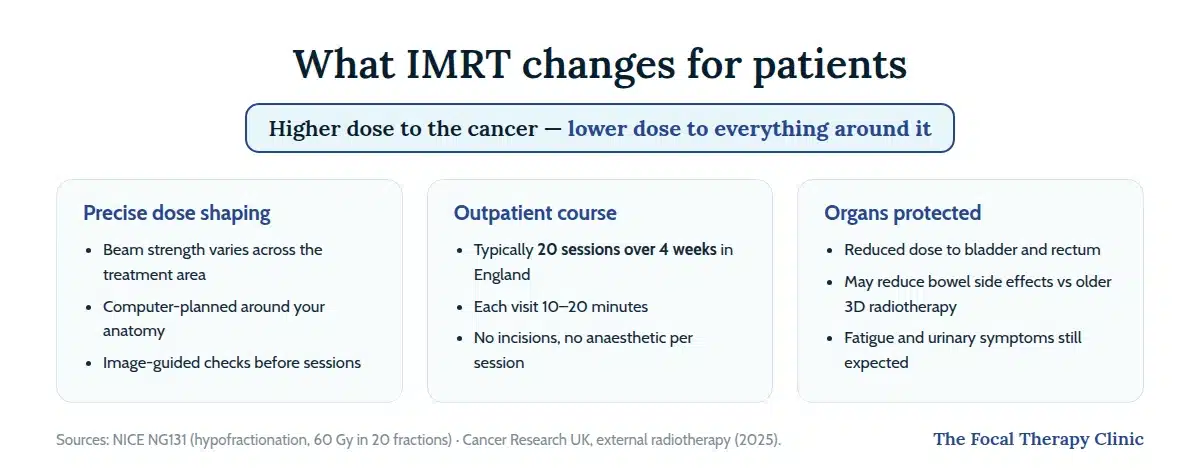
The main benefit is improved dose control — shaping the radiation around the prostate more carefully than older external beam techniques.
- No operation — no surgical cuts, no general anaesthetic for treatment sessions
- Outpatient treatment — most men go home the same day, every day
- More accurate dose shaping than older radiotherapy techniques
- Reduced dose to nearby healthy tissue, which may reduce some bowel-related side effects compared with 3D conformal radiotherapy³
- Strong evidence base — external beam radiotherapy is a standard curative option for suitable men in UK guidance¹
IMRT does not remove all risk of side effects. It is still a whole-prostate treatment in most cases, and nearby tissues can still be affected. Many men continue some usual activities during treatment, though tiredness and urinary or bowel symptoms can build as the course goes on.
What are the side effects?
Like all prostate cancer treatments, IMRT can cause side effects, and they vary from person to person. Some appear during treatment or soon after; others months or years later.
Short-term effects may include:
- Tiredness — often building through the course
- Urinary changes — passing urine more often, urgency, mild burning, getting up at night
- Bowel changes — loose stools, irritation or urgency
Longer term, urinary changes, bowel symptoms or erectile difficulties can develop. In the UK ProtecT trial, which followed men treated for localised prostate cancer, bowel symptoms were more common after radiotherapy than after surgery or active monitoring, while sexual function declined in all active-treatment groups — patterns men should weigh when comparing options.⁴
Tell your treatment team about symptoms early: urinary, bowel and sexual side effects are routine topics in radiotherapy clinics, and support is available.
How IMRT compares with older radiotherapy
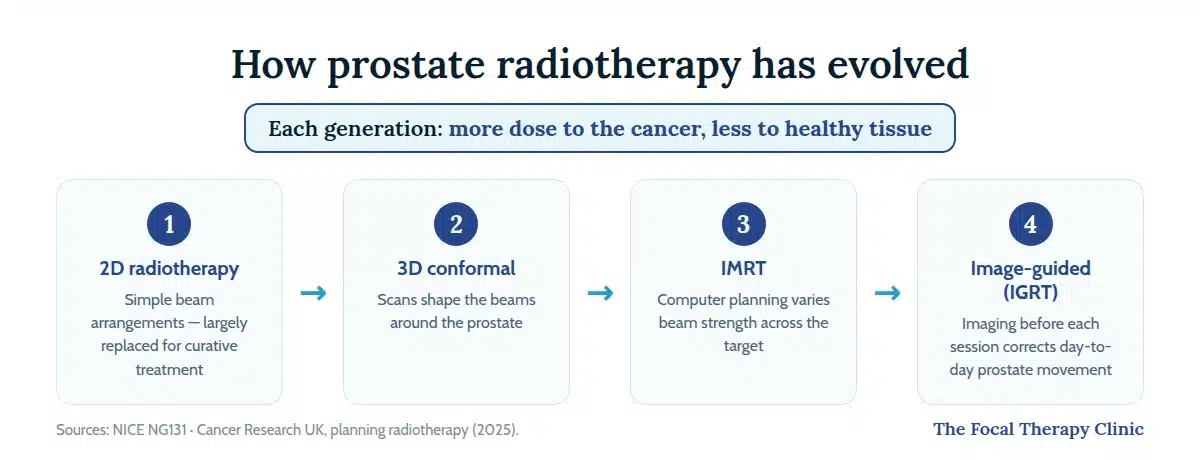
| Treatment type | How it works | Typical role |
|---|---|---|
| Older 2D methods | Simpler planning and beam arrangements | Largely replaced for curative prostate treatment |
| 3D conformal radiotherapy | Scans shape beams around the prostate | More precise than 2D |
| IMRT | Computer planning varies and shapes the dose | Modern standard for many men having external beam radiotherapy |
| Image-guided (IGRT) | Imaging checks before/during treatment | Improves day-to-day positioning accuracy |
Each step in this evolution has meant more dose to the cancer and less to healthy tissue.
What happens before treatment starts?
The team reviews the cancer details and your general health — PSA, biopsy results, MRI findings and any other scans.
A planning CT scan maps the prostate, bladder, rectum and nearby tissues.² You may be asked to follow bladder and bowel instructions — for example attending with a comfortably full bladder and an empty bowel, which keeps the prostate in a more consistent position.
Some men have small fiducial markers placed in the prostate to help line up treatment; not every patient needs them. The team will also explain how many sessions are planned, whether hormone therapy is needed, and who to contact if symptoms become difficult.
Get Expert Advice & The Latest Research
Subscribe to our newsletter to receive the latest updates, expert insights, and breakthrough research on prostate cancer-delivered straight to your inbox.
What does a typical treatment session involve?
Most sessions are straightforward. You lie on the treatment couch in the same position each time; the team checks alignment, often taking images to confirm the prostate’s position, then the machine moves around you delivering radiation from different angles.
Treatment is painless — you cannot feel or see the radiation. A session takes around 10–20 minutes, most of it positioning and safety checks; the radiation itself takes only a few minutes.
In England, most men having radical external beam radiotherapy for localised prostate cancer are treated with 60 Gy in 20 sessions over four weeks (NICE-recommended hypofractionation).¹ Some men need a different schedule depending on their cancer, previous treatment and local practice.
Is IMRT right for everyone?
No single treatment suits every man. Suitability depends on:
- Cancer location — within or beyond the prostate
- Stage, grade, MRI and biopsy findings
- Previous prostate treatments — prior pelvic radiotherapy changes the options
- Existing urinary symptoms and general health
- Personal priorities around side effects and recovery
Men with localised disease may also wish to compare focal approaches. Whole-gland radiation treats the entire prostate; targeted ablation treats only the cancerous area in selected cases. In the largest UK series of focal HIFU (625 men), failure-free survival was 99% at one year, 92% at three years and 88% at five years.⁵ Our comparison guide, How focal therapy outcomes compare with surgery and radiotherapy, covers the trade-offs in detail. A multidisciplinary review helps you understand the pros and cons of each route before deciding.
How The Focal Therapy Clinic can help
The Focal Therapy Clinic provides specialist support for men exploring treatment after a prostate cancer diagnosis. Our multidisciplinary team reviews each case in detail and discusses all suitable options — surgery, radiotherapy including IMRT, and focal therapy — so you understand the benefits and limitations of each.
Our consultant urological surgeons have 75+ years of combined focal therapy experience across 2,500+ procedures, operating at 8 hospital sites across six UK cities. Selected men with localised disease may be suitable for HIFU (NICE HTG667) or NanoKnife (NICE HTG688), which treat only the cancerous area while preserving healthy tissue — in FTC’s audited series of 265 men, 97% maintained urinary continence and 90%+ preserved sexual function.
We also offer second opinions for men considering IMRT or other treatments, based on your clinical findings, scan results and personal priorities — helping you decide with confidence. Learn more about focal therapy or our fees.
Frequently Asked Questions
How many IMRT sessions will I need?
In England, most men having curative external beam radiotherapy for localised prostate cancer receive 20 sessions over four weeks, following NICE-recommended hypofractionation (60 Gy in 20 fractions).¹ Your schedule may differ depending on your cancer, previous treatment and local practice.
Does IMRT hurt?
No. You cannot feel or see the radiation, and nothing touches your body during treatment. Each session takes around 10–20 minutes, most of it spent on positioning and safety checks.
Can I keep working during IMRT?
Many men continue working through treatment, especially with flexible hours — sessions are short and outpatient. Fatigue tends to build over the four weeks, so plan for lighter commitments towards the end of the course.
What happens if cancer returns after IMRT?
Treatment options after radiotherapy are more limited than after other first treatments, because irradiated tissue heals less well — but options exist, including salvage therapies in specialist centres. This is one reason to review all first-line options carefully; our team provides second opinions for exactly these decisions.
Is IMRT better than surgery or focal therapy?
No option is “best” for every man. In the UK ProtecT trial, deaths from prostate cancer were low and similar across monitoring, surgery and radiotherapy at 10 years — what differed was the side-effect profile.⁴ Radiotherapy carries more bowel risk, surgery more urinary and sexual risk, while focal therapy aims to preserve function by treating only the cancerous area in suitable men.⁵ A multidisciplinary review matches the treatment to your cancer and priorities.
This content is not intended to be a substitute for professional medical advice, diagnosis, or treatment. Always seek the advice of your urologist or other qualified health provider with any questions you may have regarding a medical condition.
References
- National Institute for Health and Care Excellence. Prostate cancer: diagnosis and management (NG131). 2019, updated 2021. https://www.nice.org.uk/guidance/ng131
- Cancer Research UK. Planning radiotherapy for prostate cancer. 2025. https://www.cancerresearchuk.org/about-cancer/prostate-cancer/treatment/radiotherapy/external-radiotherapy/planning-radiotherapy
- Cancer Research UK. Having external radiotherapy for prostate cancer. 2025. https://www.cancerresearchuk.org/about-cancer/prostate-cancer/treatment/radiotherapy/external-radiotherapy/radiotherapy-treatment-external-for-prostate
- Hamdy FC, Donovan JL, Lane JA, et al. 10-Year Outcomes after Monitoring, Surgery, or Radiotherapy for Localized Prostate Cancer. N Engl J Med. 2016;375(15):1415–1424. (Patient-reported outcomes: Donovan JL, et al. N Engl J Med. 2016;375(15):1425–1437.)
- Guillaumier S, Peters M, Arya M, et al. A Multicentre Study of 5-year Outcomes Following Focal Therapy in Treating Clinically Significant Nonmetastatic Prostate Cancer. Eur Urol. 2018;74(4):422–429.
- Prostate Cancer UK. External beam radiotherapy. 2022. https://prostatecanceruk.org/prostate-information-and-support/treatments/external-beam-radiotherapy