
At a Glance
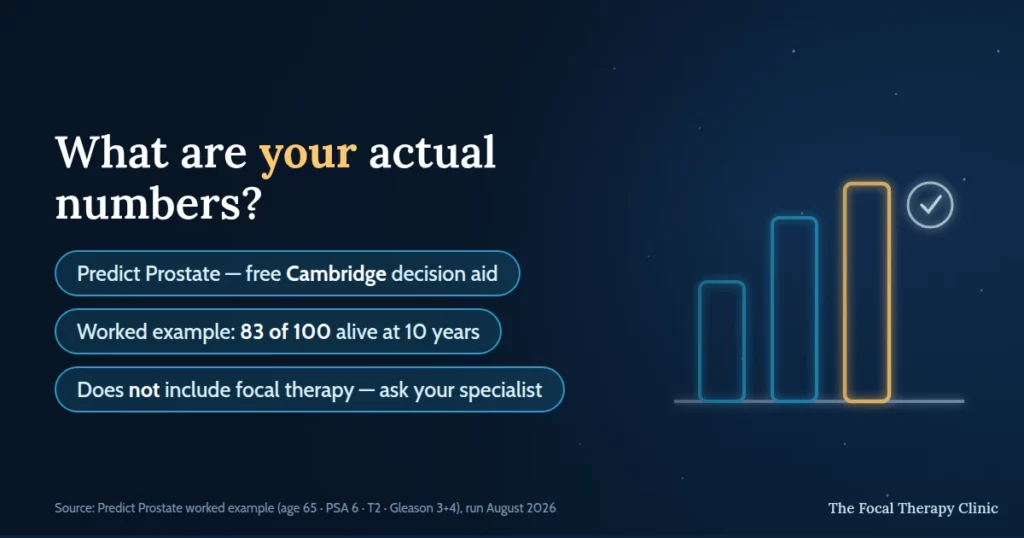
Predict Prostate — a free University of Cambridge online decision aid — shows each man his individualised 10- and 15-year survival outlook with and without radical treatment, helping many realise that immediate radical therapy is rarely as urgent as fear suggests. One important limit to know from the start: the tool compares conservative management, surgery and radiotherapy only — it does not include focal therapy — so use it to understand your risk, then discuss the full range of options with your specialist.
- Fear distorts decisions — as Mr Marc Laniado observes, most patients assume a cancer diagnosis means imminent death, driving choices toward maximum treatment regardless of actual benefit
- A worked example tells a different story — for a 65-year-old with PSA 6, T2, Gleason 3+4 disease, the tool estimates 83 of 100 similar men alive at 10 years with initial conservative management; of the 17 deaths, only 5 are from prostate cancer
- Treatment harms are quantified too — the tool presents ProtecT-trial rates for incontinence, erectile dysfunction and bowel problems alongside the survival figures, so benefit and cost can be weighed together
- Simple to use — a browser-based calculator using routine data points (age, PSA, grade, stage, biopsy cores) that patients can run themselves and print for family discussions
- A conversation starter, not a verdict — the tool is designed for use with your GP or specialist, and men whose risk is low often go on to consider active surveillance or focal therapy
The Overtreatment Problem
Mr Alan Doherty answers how likely it is that a man on active surveillance will eventually need treatment — the numbers behind the overtreatment debate.
Mr Marc Laniado identifies a fundamental disconnect between patient perception and statistical reality in prostate cancer care:
“Most patients when you tell them they’ve got cancer, they’re going to die from it immediately.” — Mr Marc Laniado
That fear drives decisions. In Mr Laniado’s interview account, a man with favourable intermediate-risk disease who assumes the worst will ask for “whatever treatment you can give me” — yet when he walks the same man through the actual numbers, the picture changes:
“So that means you’d have to treat 50 men to get one extra man alive at ten years. So 50 men have to have treatment for one extra man to be alive. And yet of those 50 men, a significant proportion might get side effects, and so the benefit to side effect ratio, many men might think, isn’t that great?” — Mr Marc Laniado
Patient psychological challenges:
- Initial shock and disbelief following diagnosis
- Assumption of immediate life threat requiring maximum intervention
- Difficulty processing complex survival statistics under emotional stress
- Desire for maximum treatment regardless of actual benefit
This creates scenarios where men with favourable intermediate-risk disease choose radical treatment when active surveillance or focal therapy would let them keep their quality of life.
How Predict Prostate Works
Predict Prostate (prostate.predict.cam) is a validated, browser-based model developed at the University of Cambridge, for men without metastatic disease where conservative management and radical treatment are both realistic options. It turns abstract cancer risk into personalised survival estimates using readily available clinical parameters, with treatment-harm rates drawn from the UK ProtecT trial.
Required data points:
- Patient age
- PSA level at diagnosis
- Gleason score / ISUP grade group (1–5)
- Clinical stage (T-category)
- Number of positive and negative biopsy cores
- Digital rectal examination findings
- Significant medical comorbidities (e.g. recent serious hospital admission)
Visual presentation features:
- Colour-coded charts showing survival probabilities
- Icon arrays of 100 “men” making statistics easy to grasp
- Conservative management vs radical treatment comparisons
- 10- and 15-year overall-survival estimates
- Printable reports for family discussions and second opinions
Clinical integration: Mr Laniado demonstrates real-time use in consultations — “I just google Predict Prostate… it’s very easy” — putting the patient’s own numbers on screen while the conversation happens. The model’s development and external validation are published in PLoS Medicine (Thurtle et al., 2019).
A Worked Example
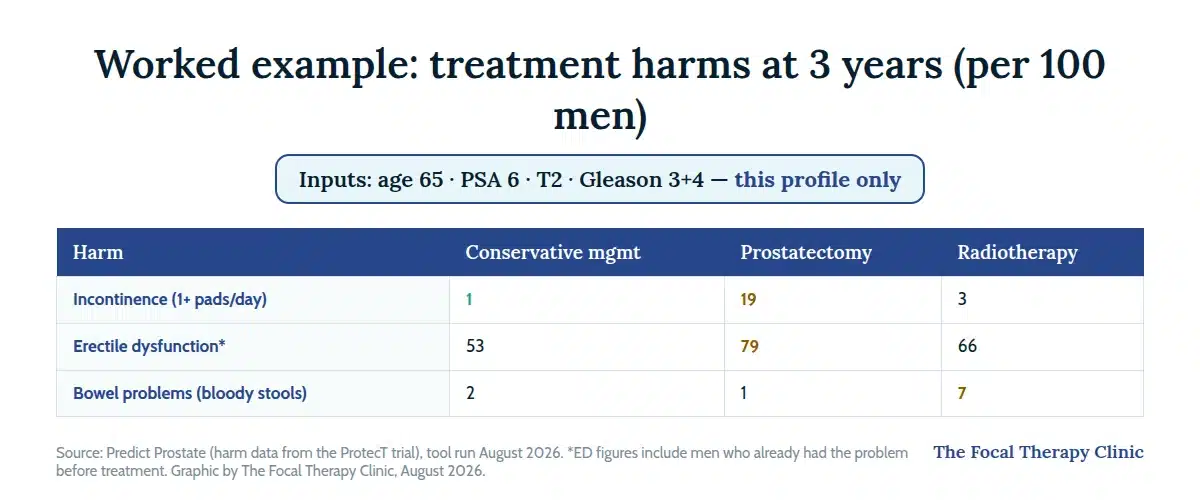
The figures below are a genuine run of the tool (August 2026) for one specific set of inputs — a 65-year-old man, PSA 6, clinical stage T2, Gleason 3+4 (Grade Group 2), 4 of 12 biopsy cores positive, no BRCA mutation, no recent serious hospital admission. They are a worked example for exactly that profile, not general outcomes; your own inputs will give different numbers.
Survival outputs (initial conservative management):
- 83 of 100 men with this profile are alive at 10 years (88% when deaths from other causes are excluded); 64 of 100 at 15 years
- Of the 17 men who die within 10 years, 12 die of other causes — only 5 of prostate cancer
Treatment-harm outputs at 3 years (from the ProtecT trial, per 100 men):
| Harm | Conservative management | Prostatectomy | Radiotherapy |
|---|---|---|---|
| Incontinence (using 1+ pads/day) | 1 | 19 | 3 |
| Erectile dysfunction* | 53 | 79 | 66 |
| Bowel problems (bloody stools) | 2 | 1 | 7 |
*The erectile dysfunction figures include men who already had the problem before treatment — the baseline rate in this age group is substantial, which is why the conservative-management column is 53, not 0.
The decision transformation: understanding these numbers shifts the question from “maximum treatment” to “optimal treatment.” In Mr Laniado’s experience, many men looking at this kind of output conclude, “Well, I should go onto active surveillance” — or ask whether a focal treatment could control the cancer while preserving function.
What Radical Treatment Adds
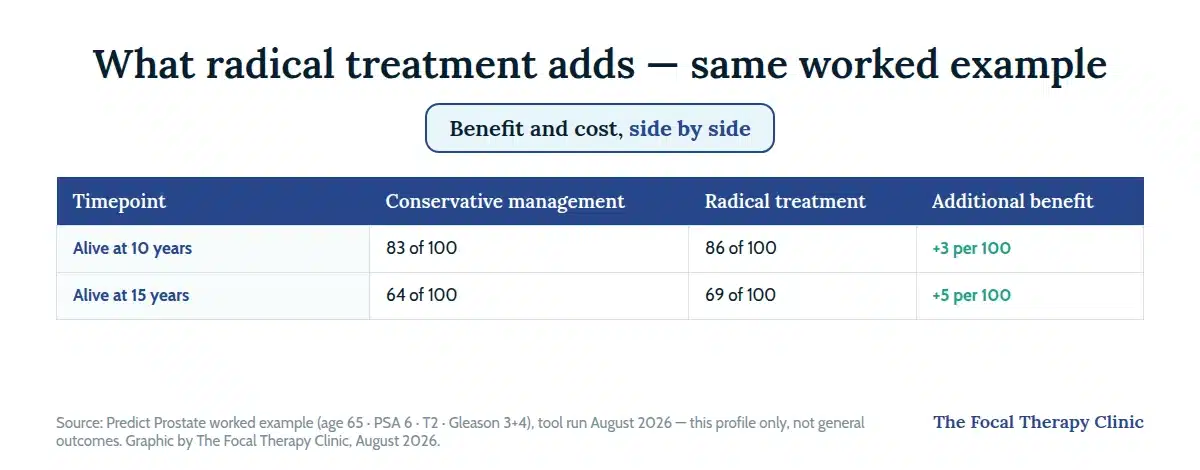
The tool can also display the radical-treatment arm alongside conservative management for the same worked example (same inputs, run August 2026):
| Timepoint | Conservative management | Radical treatment | Additional benefit |
|---|---|---|---|
| Alive at 10 years | 83 of 100 | 86 of 100 | 3 more men per 100 |
| Alive at 15 years | 64 of 100 | 69 of 100 | 5 more men per 100 |
Even at 15 years, 74 of 100 men with this profile would still be alive if no one died of prostate cancer at all — which is the ceiling any treatment can reach. These are the numbers behind Mr Laniado’s point in the interview: for favourable intermediate-risk disease, many men must undergo radical treatment for one man to gain — and every one of them faces the side-effect risks in the table above. Seeing benefit and cost side by side is precisely what turns “give me maximum treatment” into an informed choice.
As throughout this article, these figures are a worked example for these exact inputs, not general outcomes — your own numbers will differ.
What the Tool Doesn’t Cover
Predict Prostate does not include focal therapy. Its comparison covers conservative management, radical prostatectomy and external-beam radiotherapy only. That matters in both directions:
- The survival outputs still do their job — they show how threatening (or not) the cancer itself is for a man’s profile
- But the treatment menu on screen is not the full menu. For suitable men with MRI-visible, localised disease, focal therapy (HIFU or NanoKnife) offers active treatment with function preservation — an option the tool cannot display
So use the tool for what it does brilliantly — honest, individualised risk — and then ask your specialist the question it cannot answer: “Given this risk profile, am I a candidate for focal therapy?”
Get Expert Advice & The Latest Research
Subscribe to our newsletter to receive the latest updates, expert insights, and breakthrough research on prostate cancer-delivered straight to your inbox.
Using the Tool Well
Prepare before using Predict Prostate:
- Biopsy quality: “Was my biopsy MRI-targeted, for better staging accuracy?”
- Complete staging: “Do I have my ISUP grade group as well as my Gleason score and T-stage?”
- Comorbidity assessment: “Have we factored in other conditions that could affect my life expectancy more than the cancer?”
- Treatment comparison: “Can we review conservative management and radical treatment outcomes together using the visual displays?”
- Alternative options: “Based on my results, am I a candidate for focal therapy?”
- Family discussion: “Can I print the report to share with family and for second opinions?”
Step-by-step usage guide:
- Gather your data: PSA, T-stage, Gleason/ISUP grade, biopsy core counts, major health conditions
- Access the tool: visit prostate.predict.cam on a laptop or phone
- Review the graphs together: ask your clinician to translate the percentages into plain English
- Explore scenarios: adjust inputs to understand how different factors affect the outputs
- Discuss the full menu: including surveillance and focal options the tool doesn’t model
- Document decisions: print reports for family discussions and specialist consultations
Frequently Asked Questions
Is Predict Prostate an official tool?
It was developed at the University of Cambridge, has been available through NHS-linked domains, and is widely cited by UK cancer centres as a risk-communication aid for men with newly diagnosed, non-metastatic disease. Its development and validation are published in the peer-reviewed literature.
Can Predict Prostate replace a doctor’s advice?
No. It complements — but does not override — clinical judgement. The tool’s own guidance is to use it as a discussion aid with your GP or specialist, and always to review results with a urologist or the MDT before making treatment choices.
Does Predict Prostate include focal therapy?
No. It compares conservative management, radical prostatectomy and external-beam radiotherapy only. If its outputs suggest your cancer is not immediately life-threatening, that is exactly the situation in which asking about focal therapy — active treatment with function preservation — makes sense.
What if my results change during surveillance?
Re-enter your new numbers; the output updates instantly. Re-running the tool after surveillance tests helps track whether the balance between treatment benefit and harm is shifting over time.
How accurate is this tool for my specific situation?
It provides statistical estimates based on large UK datasets, not individual guarantees. It is most informative for men with complete staging information and localised disease — and the harm figures come from a trial population, so your own risks depend on your baseline function and your surgeon’s or oncologist’s outcomes.
About the Expert
Mr Marc Laniado is Consultant Urological Surgeon at The Focal Therapy Clinic and Prostate Cancer Lead at Wexham Park Hospital, Frimley Health. A pioneering advocate for evidence-based decision tools, he has integrated Predict Prostate into routine clinical practice to transform cancer-diagnosis anxiety into informed choice.
His approach emphasises data transparency and patient empowerment, demonstrating how validated tools can dramatically improve treatment alignment with individual risk profiles. Mr Laniado’s experience is that honest risk presentation reduces rather than increases patient anxiety while enabling optimal treatment selection.
Clare Delmar
Hello and welcome to OnFocus. Brought to you by The Focal Therapy Clinic, where we connect you with issues facing men diagnosed with prostate cancer that are little known, less understood, often avoided, or even ignored. Prostate cancer is the most commonly diagnosed cancer amongst men in the UK. And with this sombre fact comes a multitude of challenges and opportunities. I’m Clare Delmar. Joining me today is Marc Laniado, consultant urologist at The Focal Therapy Clinic and a leading innovator in imaging led diagnostics and targeted treatments for prostate cancer.
Marc has been a dedicated practitioner and vocal advocate for the rights of patients to be informed about their treatment choices, from his base at Frimley Health. He is prostate cancer lead at Wexham Park Hospital. He’s here today to talk with me about how patients can be supported through decision tools. And he’s going to talk specifically about one that he uses with his own patients. Marc, thank you for coming. I’m really excited to hear about you empowering your patience with some of these interesting tools. So thanks for joining me.
Marc Laniado
Thank you. Thanks, Clare, for having me back again. It’s always good to be with you.
Clare Delmar
Yeah, we’re getting used to this now, aren’t we? So, Marc, before we go into what the tools are, I just want to set the stage a little bit and ask you about this mental state that your patients are typically in when they come to you for consultation following a prostate cancer diagnosis.
Marc Laniado
Well, often they come to me to get the diagnosis, so they don’t even have it. Obviously, as you can imagine, they’re a bit anxious, sometimes very quiet, sometimes contemplative. When I start talking about the results of biopsies I usually give patients a bit of a warning shot to try and make them aware that maybe there’s some serious information coming for them to understand. That always focuses their attention a bit more. And then when we deliver the sad news that someone has prostate cancer, obviously, that’s quite a shock to people. So even though most of them will have been coming through a diagnostic pathway where actually we’re trying to work out whether prostate cancer is there or not – many men and their families are still somewhat shocked or surprised when they actually hear they do have prostate cancer. With it comes sometimes a bit of denial or disbelief or the words go through their ears, but it doesn’t seem to make any sense at that point. And it’s difficult sometimes for people to take it in. So this is quite a difficult time for patients when they get the news.
Clare Delmar
I mean, one of the things I guess I was alluding to when I said about following a diagnosis is because often they come to you for a second opinion. So I guess I was thinking about some of those, too, but I think you’ve addressed this. And as you say, it’s a difficult time. And I guess that’s one of the reasons why it’s difficult to actually give this information and to have it sort of processed quickly.
Marc Laniado
So, when I’ve told them and maybe they’ve come back a second time, but men are very obviously anxious at that point. Most people want to know they’re going to live their lives out as long as possible. They want to try and avoid side effects of treatment if they need treatment. And they often want the treatments that sometimes are less accessible. They want treatments which maximise that ratio of benefit to harm. That have the maximum amount of goodness, like the least amount of badness. And so there’s a picture of hope. There’s a mixture of sometimes desperation, sometimes there’s sadness, too. But mostly it’s hope and a gusto for trying to get something done with the least amount of potential carnage as a consequence of that treatment.
Clare Delmar
So one of the things that I’m hearing a lot from a lot of our patients is that when they have received a diagnosis elsewhere, they’re sort of handed a whole packet full of brochures and other things. And I think for some men, they can find this overwhelming. I think when you’ve told me about something called a decision tool, and specifically one that you use developed here in the UK, called Predict Prostate, you’ve said that that can really change the process of making a decision. Can you talk a bit about that?
Marc Laniado
Sure. So when a man is told he has prostate cancer, often he asks, how long have I got to live? Am I going to be around this Christmas? Next year? What’s my outlook? And traditionally, we’ve been, as doctors, not been able to tell people exactly how well they’ll do just by no treatment, how well they’ll do with treatment. And what are the potential side effects from the treatment that they might receive? So there’s been some fantastic work in developing the prostate tool available on the NHS online to all people who want to go to it. That tool really empowers men when they’re deciding about what sort of treatment they’re going to have? How much treatment they’re going to tolerate? So, for example, you can imagine if you’re told that you’ve got cancer and you may have a year or two to live or something of that nature, you might say, well, I’ll take whatever treatment you can give me, as drastic as it may be, to give me the maximum amount of life expectancy that’s possible. But your attitude might be slightly different if it turns out that, well, actually, the chance of dying from this disease in the next ten or 15 years is actually relatively low. And so armed with that knowledge, that the disease perhaps may not be as threatening as you first thought, you might think of things or think of common treatments in a slightly different way. And you might be more willing or open to consider other options that could come up.
Clare Delmar
How does it work? We use the word tool and you mentioned doing it online in some of your descriptors, but can you talk me through how you actually use this with a given patient.
Marc Laniado
Yeah, well it’s very easy. A patient comes to see me with a diagnosis, as you say. So we have bits of information that we can use which go into the calculator. So a man comes to see me. I have the information. I just google Predict Prostate. So you need to know the patient’s age, the PSA value, the Gleason score, the number of cores with cancer if you have it, the number of cores without cancer. You need to know also whether the patient has any other serious health conditions, like having had a heart attack or been in hospital in the last two years for some serious condition. What the prostate feels like. And you need a few other bits about the pathology. For example, if there’s something of crib or form pattern present. A few things like that. But the data are readily available to most people who’ve recently had diagnoses of prostate cancer. And so it’s very, very easy.
So, last week I remember a chap who is sixty four. His PSA was about five. He had prostate shot, probably normal, maybe slightly abnormal, but not overtly abnormal. He had no other significant health conditions. He hadn’t been in the hospital the last few years for anything at all. He had an MRI scan, followed by biopsies. The biopsy showed Gleason score three plus four equals seven. So for people who don’t know, tumours are graded by Gleason score or grade group with increasing severity. So Gleason score three plus four is actually grade group two, which on a scale of one to five. So it’s grade group two. So it’s not too bad. And most people given that diagnosis, and that information would think, well, actually, I need to rush into treatment, have treatment that’s fairly soon, not realising, in fact the chance of dying; I don’t have a calculator right in front of me now, but chance of dying is probably around 4% or 5% at ten years. Probably not much more than that. And even if you have treatment, the impact isn’t that great as much as people might think anyway.
So if you take 100 men, that means of those 100 men, four might die from prostate cancer, maybe another ten or 15, maybe less, would die from some other cause. But most men would still be alive. And if you have treatment, that’s radical treatment, I mean, surgery, radiotherapy, it doesn’t actually give you 100% cure. It still seems that about half the men who have the treatment, unfortunately still succumb to the disease.
So radical treatment is not a guarantee of a cure if you like. So, how do men feel about that? Well, if you’re thinking, should I have a really radical treatment, like a surgery to remove the prostate or six weeks of radiotherapy and hormonal therapy for a disease in which you take 100 people like me, only four or five of them might die from it. And then only two out of those 100 men who get treated might actually benefit from it. So that means you’d have to treat 50 men to get one extra man alive at ten years. So 50 men have to have treatment for one extra man to be alive. And yet of those 50 men, a significant proportion might get side effects, and so the benefit to side effect ratio, many men might think, isn’t that great? They might think this isn’t fantastic. Isn’t there a way of having some form of treatment which hopefully pertains most of the benefits yet doesn’t have so much toxicity, so much side effects.
And that’s why people tend to actually start thinking, well, maybe focal therapy, partial ablation, maybe focal therapy is the way to go, because you can then get treatment to the tumour, yet you can avoid most of the side effects associated with treatment.
Clare Delmar
That’s interesting, so are you suggesting that for men that have the relatively stage two, the grade two lower Gleason scores, localised cancer, that this tool is a way to avoid over treatment. Is that a fair statement?
Marc Laniado
Yeah, well, lots of men when they look at those numbers say, Well, I should go onto active surveillance. That is post monitoring. I’m not saying that this is a blanket statement for every man I can describe right now should definitely have no treatment. That’s not what I mean. It’s really about putting it into perspective, and the numbers will vary. The proportion of men who die or live will vary depending on some other factors as well. But the main point of this is that for most men who have intermediate risk or favourable intermediate risk prostate cancer, they’re not that likely to die from it, certainly not in the near term. And it’s worthwhile looking at some of the other options that can be used to treat people who have prostate cancer. So if you have a small focal cancer, cancer in one part of the prostate, why not just ablate or destroy that area realistically and do that alone rather than treatment to the whole prostate?
Clare Delmar
Absolutely. I guess what I’m driving at, though, is that a patient could reach that conclusion and make that choice based on a straightforward conversation with you on his own. But what I’m interested in is how the tool helps that decision.
Marc Laniado
Well, it helps that decision because most patients when you tell them they’ve got cancer, they’re going to die from it immediately. If you can show this, the good thing about the tool is it gives you great graphical ways of looking at the data. Several ways of looking at the outcome. You can show graph, figures et cetera so easily transmissible information. So it’s a good way of communicating the information to a patient. You can print it out. The patient can take it away. All the patients can fiddle around with the data at home. They can do their own calculations and see how what they put in effects the outcomes.
Clare Delmar
That is fascinating. And something I wanted to share with you is maybe you’re aware of this, but I did some digging around before having this interview, and there’s actually been quite a number of studies looking at these decision tools. I mean, this is around the world, mainly in the United States as well as here in the United Kingdom, and one which I found, and for our listeners, I will put this on the programme notes. It compared these tools amongst men with localised prostate cancer, and it compared a few, and it showed that the ones that were the most simple actually led to choices of less aggressive treatment and also less treatment regret. But is that you’ve been your experience with Predict Prostate because that’s fascinating.
Marc Laniado
It’s definitely revealing for patients, and they certainly when they understand whether they have serious disease or not, and they can see it in terms of life expectancy relative to the cancer, but also to the other health conditions. Because what I didn’t say is that if you’ve got a lot of other health conditions, maybe prostate cancer is low down on the list of things that might cause you, unfortunately, to die. So yes, it does make a big difference to patients, certainly helps a lot.
Clare Delmar
So something else that I’m just picking up from what you’re saying is that patients can access this themselves. They can go online, as you say, go onto the Predict Prostate website. Do you find that that’s as effective in terms of ultimately their choice and their treatment, or is it something that you encourage doing sort of collaboratively as it were with you?
Marc Laniado
Well, I do it in the clinic with my patients anyway, so I put the data in and I go through the results with them. But there’s no reason why patients shouldn’t put in the data themselves at home. It’s constructed for patients to use. It’s meant to be usable for patients. Now it’s not to say it’s extremely simple, but you need some knowledge of how to go around the website, but the information is written in the way that patients can understand. So yes, I would strongly recommend that patients get their own data, go onto the website, plug it in and see the outcomes, and then use that information to decide on whether they want to have treatment, whatever treatment that is or they want to perhaps not have any treatment, but also to see that if their risk of dying is not high, then maybe consider either active surveillance or you can consider focal therapy, which will give you all the benefits of treatment without so many of the side effects.
Clare Delmar
So this is called Predict Prostate and it’s actually online at prostate.predict.cam. I will put this on the programme notes, but that’s really helpful, Marc, and often we hear clinicians tell us that when patients come to them armed with various information they’ve gathered online, it can serve as a double edged sword, but it sounds like in this case that’s not the reality at all. In fact, it actually leads to a very productive discussion.
Marc Laniado
It certainly does. It’s probably one of the more useful things that people can look at when they’re deciding what to do.
Clare Delmar
Well, on that note, I’m just going to say thank you so much for sharing that. As I said, I will put the information about Predict Prostate on the programme notes. And I think it’s been really helpful to talk about this and we’ll probably come back to talking about this again and maybe even using a patient example. So thanks for introducing me to it and for our listeners.
Marc Laniado
Thank you. It’s been great to be with you. Thanks again.
Clare Delmar
A transcript of this interview is available on our website, along with further information on diagnostics and treatment for prostate cancer and additional interviews and stories about living with prostate cancer.
Please visit www.thefocaltherapyclinic.co.uk and follow us on Twitter and Facebook at The Focal Therapy Clinic.
Thank you for listening and from me, Clare Delmar. See you next time.
References
- Predict Prostate — prostate.predict.cam (University of Cambridge).
- Thurtle D, et al. Individual prognosis at diagnosis in nonmetastatic prostate cancer: development and external validation of the PREDICT Prostate multivariable model. PLoS Medicine 2019.
- Hamdy FC, Donovan JL, et al. The ProtecT trial — treatment outcomes used within the tool’s harm estimates. NEJM Evidence 2023.
This content is not intended to replace professional medical advice. Always consult your clinical team about your individual circumstances.