
At a Glance
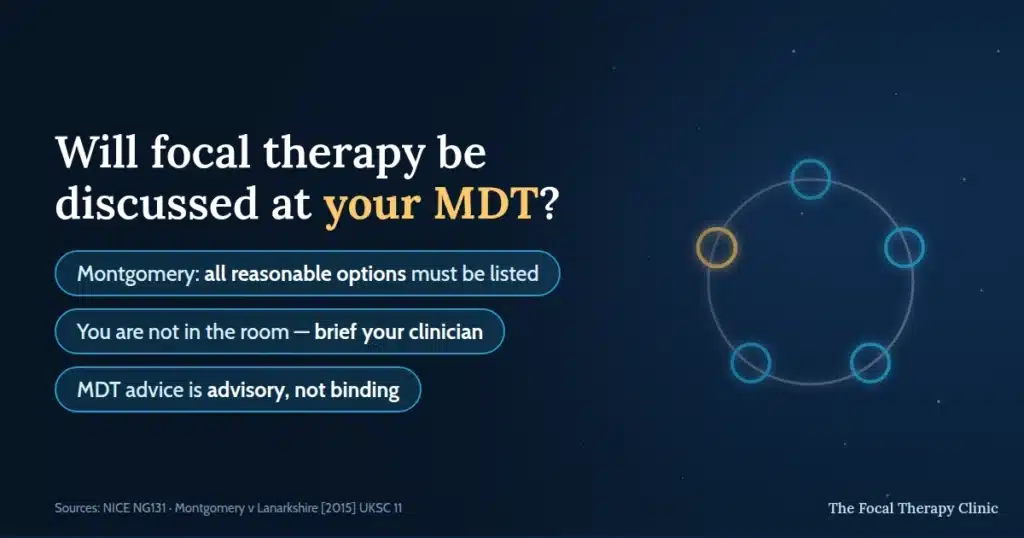
A multidisciplinary team (MDT) meeting brings together your urologist, radiologist, pathologist, and oncologist to review your MRI, biopsy, and medical history in a single session. Under the Montgomery ruling (2015), your MDT should list all reasonable treatment options — including focal therapy — not just locally available treatments. Understanding how MDTs work helps you advocate for comprehensive care.
- Multi-specialist error check — live review catches mismatched MRI and biopsy reports before treatment decisions are made
- All options must be listed — the Montgomery ruling requires MDTs to present every reasonable treatment, including HIFU (NICE HTG667) and NanoKnife (NICE HTG688)
- You are not present — communicate your priorities (sexual function, continence, lifestyle) to your clinician before the MDT meets
- Advisory, not binding — MDT recommendations guide but do not mandate your treatment choice; the final decision is yours
- Verification is essential — ensure your doctor independently reviews primary reports, not just the MDT summary
What Exactly Is an MDT?
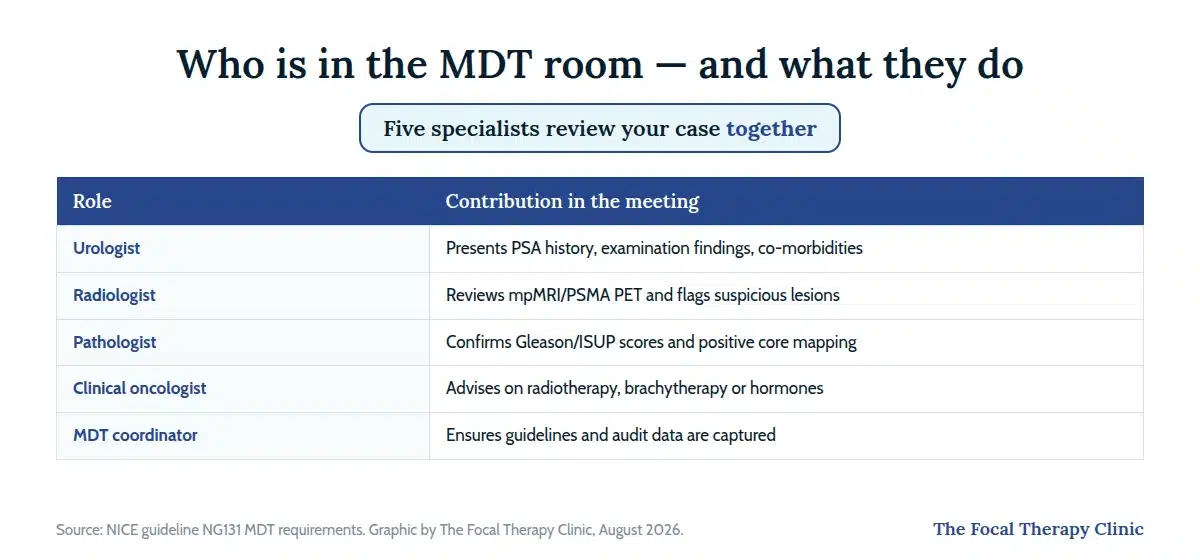
A multidisciplinary team (MDT) meeting is a formal, minuted session — now usually held over secure video — where a urologist, radiologist, pathologist, and oncologist review your MRI scans, biopsy results, and medical history together. Required under NICE guideline NG131, MDTs ensure no single clinician makes treatment decisions in isolation, and that all reasonable options are considered for your case.
| Role | Contribution in the meeting |
|---|---|
| Urologist | Presents PSA history, digital-rectal findings, co-morbidities |
| Radiologist | Scrolls through mpMRI/PSMA PET and flags suspicious lesions |
| Pathologist | Confirms Gleason/ISUP scores, positive core mapping |
| Clinical oncologist | Advises on external-beam, brachytherapy or hormones |
| MDT coordinator | Ensures guidelines and audit data are captured |
The information assimilation process
MDTs gather all relevant clinical information before your follow-up appointment. This typically happens before you have seen anyone with complete information available, driven by cancer pathway requirements for constant progress.
“We gather all the information about the patient’s case and it all comes together in the MDT for assimilation… we’ll look at the imaging, the history, the biopsy results, and basically work out what the diagnosis is.” — Mr Tim Dudderidge, Consultant Urological Surgeon (FRCS(Urol), GMC: 4505451)
Why Should Patients Care About MDTs?
Your MDT meeting directly shapes which treatment options you are offered. Under the Montgomery ruling (2015), the MDT must list all reasonable treatments — including focal therapy — not just those available at your local hospital. Understanding how your MDT works helps you verify that all options were genuinely considered.
- Error-check: Mismatched MRI and biopsy reports are spotted during live review
- Option generator: All curative treatments and focal therapy should be logged — the Montgomery ruling (2015) requires it
- Fast-track: Once options are agreed, referrals to surgeons or oncologists can be made immediately
The range vs single recommendation problem
Effective MDTs should convey “the range of options” rather than single recommendations, because “especially in prostate cancer, it’s very rare that there’s one recommended treatment, and nothing else should be considered at all.”
Critical quality point: MDTs should include “treatments that the body of doctors present may not necessarily recommend, but they might accept is within the range of reasonable discussion.” This is particularly important for focal therapy consideration, including HIFU (NICE HTG667) and NanoKnife IRE (NICE HTG688).
When MDTs can get it wrong
Despite being “crucial” overall, “in an individual patient’s case, the MDT, like anything else, can get it wrong.” Understanding this reality helps you advocate for verification and second opinions when appropriate.
Real risk warning: Mr Tim Dudderidge, Consultant Urological Surgeon (FRCS(Urol), GMC: 4505451), has been “involved as an expert witness in cases where somebody simply conveyed the MDT outcome without checking any of that and things got completely mistaken.” Always ensure your doctor verifies primary reports independently.
Common Gaps — and How to Plug Them
The most common MDT gap is the omission of focal therapy options when no one in the room offers them. Because MDTs typically recommend only treatments available at their own hospital, NICE-approved options such as HIFU (HTG667) and NanoKnife IRE (HTG688) may not be discussed unless you specifically request it.
| Potential pitfall | How to protect yourself |
|---|---|
| Focal therapy ignored because no one in-house offers it | Ask: “Was HIFU (NICE HTG667) or NanoKnife IRE (NICE HTG688) suitability discussed? Is a referral possible?” |
| Assumptions about sexual activity or continence priorities | Tell your clinician before MDT exactly what matters most (e.g., “Potency preservation is critical to me”) |
| Clerical error (wrong PIRADS, wrong side) | Request a copy of the MDT summary and double-check data against your own reports |
The controversial treatment challenge
“Generally speaking, the MDT fails patients in that people’s biased opinions might say, we recommend surgery and be pretty bold about that. But actually, of course, the other options get squeezed out.”
Specialty representation requirements
Comprehensive MDTs require proper specialist representation:
- Oncologists essential: Ensures radiotherapy is “properly explored”
- Focal therapy awareness: Need surgeons who understand which cases are suitable for HIFU or NanoKnife
- Patient interest advocacy: Someone must advocate for patient priorities in controversial cases
Innovation response: Recognition of these gaps led The Focal Therapy Clinic to develop a specialist focal therapy MDT — bringing together experts including Mr Tim Dudderidge (FRCS(Urol), GMC: 4505451) and Dr Clare Allen (FRCR, GMC: 3108389) — ensuring comprehensive option discussions for appropriate candidates.
Making Your Voice Heard: Patient Priorities in MDT Decisions
You are not present at your MDT meeting, which means your priorities — sexual function, urinary continence, recovery time, lifestyle — must be communicated to your clinician beforehand. Without this, MDTs may make assumptions about what matters to you based on age or other factors, potentially narrowing the treatment options presented.
The missing patient problem
MDTs are “not very good at making sure that the patient’s voice is heard,” explains Mr Tim Dudderidge, Consultant Urological Surgeon (FRCS(Urol), GMC: 4505451). This creates a fundamental challenge where decisions are made without understanding individual priorities and circumstances.
Essential pre-MDT information gathering
Effective clinicians should assess key factors early in your pathway:
“Are you sexually active? Is your sex life important to you? What do you do for a living? Do you do sports? How active are you? Just things that might be important down the line.” — Mr Tim Dudderidge, Consultant Urological Surgeon (FRCS(Urol), GMC: 4505451)
Age and assumption challenges
MDTs frequently make incorrect assumptions about priorities based on age. “Many men in their 70s and even 80s… there’s no age determination on this issue… People say that they don’t need to worry about that. And that’s wrong.”
The breast cancer parallel
Understanding treatment evolution helps frame current discussions: “Wide local excision of breast cancer is now by far and away the most frequently undertaken procedure and radical mastectomy is really reserved for special cases.” Prostate cancer treatment is following similar principles toward less invasive approaches, including focal therapy.
Patient empowerment principle: “Patients are very prepared to accept a reduction, even a modest reduction perhaps in the long-term success rate in order to have a more acceptable treatment.” Your preferences for this trade-off should drive MDT recommendations.
Three Actions Before Your MDT Is Held
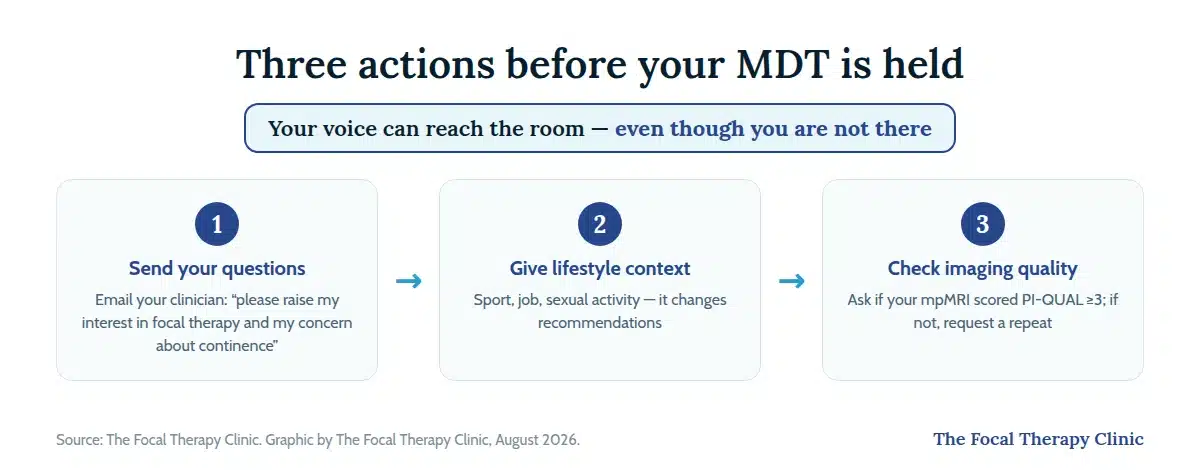
You can significantly improve your MDT outcome by communicating your priorities, checking your imaging quality, and keeping copies of all reports before the meeting takes place. These three steps ensure your voice reaches the room even though you are not present.
Pre-MDT preparation checklist
- Send your questions — Email your clinician the day before: “Please raise my interest in focal therapy and my concern about continence”
- Provide lifestyle context — Sport, job, sexual activity; it changes recommendations
- Check imaging quality — Ask if your mpMRI scored PI-QUAL ≥3; if not, request a repeat at a specialist site
Detailed priority communication
Be explicit about what matters most to you, as this information must be clearly documented to influence MDT discussions:
- Functional priorities: Sexual function, continence, recovery time importance
- Lifestyle factors: Work demands, sports participation, family responsibilities
- Risk tolerance: Willingness to trade cancer control for functional preservation
- Treatment preferences: Day-case procedures, avoiding radiation, minimising recovery time
Information verification preparation
Ensure you have copies of all reports for comparison with MDT summaries:
- Original MRI report with PI-QUAL scoring
- Pathology report with core-by-core mapping
- PSA history and progression data
- Any additional imaging or test results
Get Expert Advice & The Latest Research
Subscribe to our newsletter to receive the latest updates, expert insights, and breakthrough research on prostate cancer-delivered straight to your inbox.
Quick Reference: Post-MDT Clinic Visit Guide
After your MDT meeting, your follow-up appointment should cover what was discussed, what was recommended, and crucially, what was not discussed. Use the table below to prepare follow-up questions based on the recommendation you receive.
| If you hear… | It means… | Your follow-up question |
|---|---|---|
| “Surgery is recommended” | MDT felt it gives best long-term control | “What continence & potency rates at this hospital? Was focal therapy unsuitable for my lesion?” |
| “Active surveillance is reasonable” | Low-risk cancer or uncertain MRI | “How often will PSA, MRI and targeted biopsy be repeated?” |
| “Radiotherapy plus short-term hormones” | Disease extends near capsule or nerves | “Will I receive a rectal spacer and image-guided planning?” |
Post-MDT consultation essentials
The follow-up appointment should include comprehensive verification and individualisation:
- Primary report review: Doctor reviews imaging, biopsy, and history independently — not just the MDT summary
- MDT verification: Ensures everything tallies between reports and recommendations
- Individual contextualisation: Applies your specific circumstances to treatment options
- Written summary: Clinic letter and standardised information sheets provided
- Follow-up planning: Time to process information and additional consultation opportunities
Frequently Asked Questions
Can I attend my MDT meeting?
NHS MDTs are clinician-only for confidentiality and efficiency, but you are entitled to a written summary and can submit questions in advance.
What if the MDT got my pathology wrong?
Ask for a second pathology review at a regional uro-pathology centre; MDT conclusions can be revised once new data arrive.
Is the MDT decision legally binding?
No. It is advisory. Under the Montgomery ruling (2015), the final choice is yours once you understand all reasonable options and their risks.
How can I ensure focal therapy is discussed in my MDT?
Email your clinician before the MDT expressing specific interest in focal therapy evaluation. HIFU (NICE HTG667) and NanoKnife IRE (NICE HTG688) are NICE-approved options that should be considered for suitable patients. If not discussed, ask why and request specialist referral if appropriate.
What should I do if my doctor only conveys MDT outcomes without checking reports?
Directly ask: “Have you personally reviewed my original reports?” Mr Tim Dudderidge, Consultant Urological Surgeon (FRCS(Urol), GMC: 4505451), has served as an expert witness in malpractice cases where MDT outcomes were conveyed without verification — making this check essential for your safety.
How do virtual MDTs affect image quality review?
Digital technology has improved specialist access and real-time image sharing with contouring, potentially providing better review quality than traditional in-person meetings. The Focal Therapy Clinic’s specialist MDT brings together experts from across the UK via secure video to review cases collaboratively.
About the Expert
Mr Tim Dudderidge, Consultant Urological Surgeon (FRCS(Urol), MD, MBBS, GMC: 4505451), practises at University Hospital Southampton and The Focal Therapy Clinic. He has extensive experience in both traditional NHS MDT processes and innovative focal therapy MDT development.
Mr Dudderidge developed a specialist focal therapy MDT that brings together national experts — including Dr Clare Allen (FRCR, GMC: 3108389) — ensuring patients receive comprehensive option discussions regardless of local institutional capabilities. His work as an expert witness in MDT-related malpractice cases provides unique insight into both the value and risks of multidisciplinary decision-making.
His advocacy for transparent MDT processes emphasises the critical importance of doctor verification of primary reports and the need for patient voice integration in multidisciplinary cancer care planning.
And if the recommendation still doesn’t sit right, one patient’s story shows the advantage of a prostate cancer second opinion.
References
- NICE guideline NG131 — Prostate cancer: diagnosis and management.
- NICE HealthTech guidance HTG667 (HIFU); HTG688 (NanoKnife IRE).
- Montgomery v Lanarkshire Health Board [2015] UKSC 11.
- NHS Cancer Care Standards and Improving Outcomes Guidance.
This content is not intended to replace professional medical advice. Always consult your clinical team about your individual circumstances.