
At a Glance
Over the next 3–5 years, prostate-cancer care in the UK will be reshaped by high-quality mpMRI, PSMA PET-CT, AI-assisted reporting, data-driven focal therapies and smarter radiotherapy add-ons such as rectal spacers — all underpinned by national registries that track real-world outcomes and speed NHS rollout.
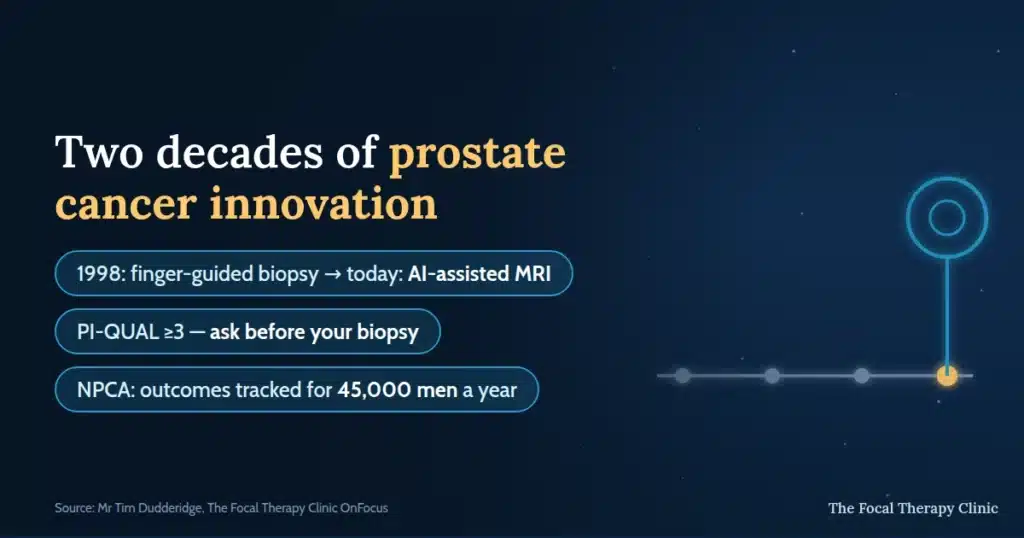
- Transformational imaging evolution — from finger-guided biopsies in 1998 to PSMA PET-CT and AI-assisted MRI interpretation, imaging advances enable all other prostate cancer innovations
- PI-QUAL quality standards — national adoption of PI-QUAL ≥3 minimum scores would standardise MRI quality across the NHS, giving focal therapy teams confidence to act on imaging results
- PSMA PET-CT integration — new tracers detect micro-metastases that MRI may miss, with major UK trials guiding earlier, targeted treatment decisions
- National registry acceleration — the National Prostate Cancer Audit tracking 45,000 men annually could soon incorporate focal therapy, accelerating NHS innovation adoption
- Treatment technology portfolio — HIFU, NanoKnife (IRE), laser ablation and rectal spacers offer alternatives to radical surgery with superior functional outcomes
- Patient advocacy essential — men must actively request PI-QUAL ≥3 MRI, PSMA PET-CT when appropriate, and focal therapy consultations to access cutting-edge care
The Innovation Revolution in Prostate Cancer
Mr Marc Laniado on innovation and hope in prostate cancer — how advances in diagnostics, imaging and focal therapy keep improving what treatment can offer.
Mr Tim Dudderidge reflects on the dramatic technological transformation witnessed throughout his career, from primitive manual techniques to sophisticated AI-assisted precision medicine.
“The first prostate biopsy I did was in 1998. This was a finger guided Tru Cut biopsy using this metal gadget to drive the needle into the prostate and I just think how things have changed.” — Mr Tim Dudderidge, Consultant Urological Surgeon (FRCS(Urol), GMC: 4505451)
Current comprehensive technology ecosystem:
- Advanced imaging: Multiparametric MRI, PSMA PET-CT with new tracers (⁶⁸Ga-PSMA-11, ¹⁸F-DCFPyL)
- AI integration: Machine learning-assisted MRI interpretation and reporting standardisation
- Robotics evolution: Surgical precision enhancement and single-port procedures enabling same-day discharge
- Focal ablation expansion: HIFU, NanoKnife (IRE) and — at some centres — cryotherapy and laser ablation, with tissue-sparing precision
- Radiation advances: Image-guided radiotherapy with rectal spacers halving acute GI toxicity
- Computer guidance: AI-assisted fusion biopsy replacing manual targeting techniques
“Everything else that we’re doing now with prostate cancer flows from having really accurate information about the location, the extent and even the biology of the tumour.” — Mr Tim Dudderidge
This precision information enables all subsequent innovations, from focal therapy planning to personalised treatment selection.
Next-Generation Imaging Technologies
Modern imaging represents the foundational technology enabling all other prostate cancer innovations, with specific quality standards and emerging modalities reshaping diagnosis.
Multiparametric MRI standardisation:
- NICE confirmation: mpMRI now first-line for raised PSA, stratifying risk better than biopsy alone
- Quality crisis: “We’re not seeing a consistent level of performance across the health economy”
- PI-QUAL v2 implementation: Standardised scoring from 1 (poor) to 5 (optimal) with ≥3 required for diagnostic confidence
PSMA PET-CT integration value: New tracers detect micro-metastases that MRI may miss, providing crucial staging information for treatment planning. Major UK trials are under way testing whether enhanced imaging can guide earlier, targeted interventions.
AI-assisted reporting advancement: Machine learning supports radiologists through:
- Automated lesion detection: Consistent identification across different operators
- Standardised reporting: Uniform format with key image selection
- Quality assurance: PI-QUAL compliance and protocol verification
- Decision support: Risk stratification and treatment recommendation guidance
“The best time to ask that question is before you’ve had it, because once you’ve had a biopsy, you’ve sort of lost your chance to repeat the imaging if it wasn’t really good.” — Mr Tim Dudderidge
Data-Driven Medicine & National Registries
Large-scale data collection through national registries accelerates innovation adoption while addressing current NHS data sharing concerns through transparent, voluntary participation.
National Prostate Cancer Audit success: Currently benchmarks outcomes for 45,000 men annually and could soon incorporate focal therapy data, complementing dedicated registries like the HEAT Registry with properly resourced, standardised collection.
Registry integration benefits:
- Volume-outcome relationships: Proving hospital performance correlations
- Technology justification: Supporting equipment purchase decisions
- Quality standardisation: Benchmarking across different centres
- Innovation acceleration: Real-world evidence for regulatory approval
Patient trust requirements:
“We really have to have patients on board. Patients feel like something’s being stolen from them” — Mr Tim Dudderidge, on recent NHS data sharing proposals
Essential trust elements:
- Purpose transparency: Clear communication about data usage objectives
- Confidentiality protection: Absolute security guarantees for medical information
- Voluntary participation: Informed consent rather than mandatory extraction
- Value demonstration: Showing tangible benefits from registry participation
Emerging Treatment Technologies
Multiple technological innovations offer alternatives to radical surgery with superior functional preservation while maintaining oncological effectiveness.
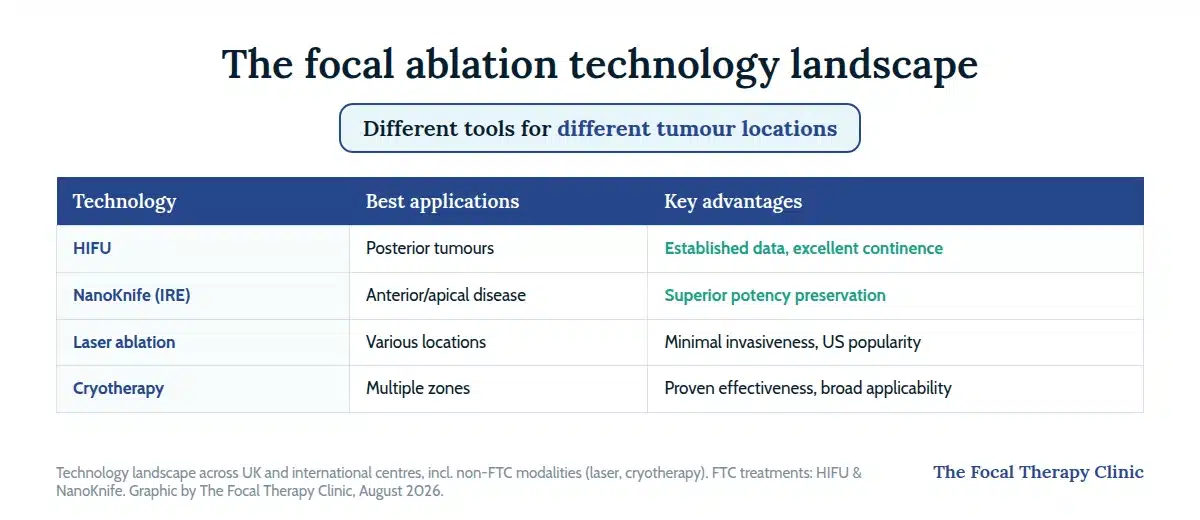
Focal ablation technology portfolio (the treatment landscape across UK and international centres):
| Technology | Best applications | Key advantages |
|---|---|---|
| HIFU | Posterior tumours | Established data, excellent continence |
| NanoKnife (IRE) | Anterior/apical disease | Superior potency preservation |
| Laser ablation | Various locations | Minimal invasiveness, US popularity |
| Cryotherapy | Multiple zones | Proven effectiveness, broad applicability |
Advanced radiotherapy integration:
- Image-guided precision: Latest targeting technology reducing margins
- Rectal spacers: Injectable hydrogel halving acute GI toxicity in randomised trials
- Hypofractionated protocols: Fewer treatment sessions with equivalent outcomes
- Proton beam consideration: Limited advantage over conventional IMRT despite marketing claims
“We need to start to recognise that there is sufficient data to say this is an option. We don’t know that it’s absolutely the same as surgery and radiotherapy in the long run, but we do know there are fewer side effects.” — Mr Tim Dudderidge
Patient Technology Access Guide
Specific guidance for men to advocate for optimal technology access throughout their prostate cancer journey, with actionable steps and quality indicators.
Pre-imaging optimisation (critical timing):
- Request mpMRI scored PI-QUAL ≥3 before any biopsy
- Seek specialised centres known for excellent prostate imaging protocols
- Understand when contrast enhancement is essential
- Timing matters: optimal imaging quality before tissue sampling
Advanced imaging access:
- PSMA PET-CT indications: When MRI is equivocal or PSA remains elevated post-treatment
- Staging enhancement: Detection of micro-metastases for treatment planning
- Trial participation: Access through research protocols when appropriate
Treatment technology checklist:
- Focal therapy MDT: Access to focal therapy consultations for localised Gleason 7 disease
- AI-assisted fusion biopsy: Confirm the centre uses computer-guided targeting
- Rectal spacers: Available when radiotherapy is planned
- Surgeon experience: Volume and expertise more important than technology type
Overseas treatment caution:
“Patients who rush off to Germany to have things done sometimes find that they are so disconnected with the rest of their medical team that they don’t really get a good experience.” — Mr Tim Dudderidge
Essential pre-treatment questions — print and ask:
- MRI quality standards: “What PI-QUAL score does your MRI achieve, and can you guarantee ≥3 for diagnostic confidence?”
- PSMA PET-CT access: “Is PSMA imaging available if my MRI is equivocal or for staging clarification?”
- Focal therapy consultation: “Can I speak with a focal therapy specialist before deciding on radical treatment options?”
- AI technology integration: “Do you use AI-assisted fusion biopsy and computer-guided treatment planning?”
- Radiotherapy enhancement: “Are rectal spacers available to reduce bowel toxicity during radiation treatment?”
- Registry participation: “Will my treatment data contribute to national registries improving future patient care?”
Get Expert Advice & The Latest Research
Subscribe to our newsletter to receive the latest updates, expert insights, and breakthrough research on prostate cancer-delivered straight to your inbox.
Technology Timeline: Next 3–5 Years
Immediate availability:
- PI-QUAL standardisation across NHS trusts
- Expanded PSMA PET-CT access through clinical trials
- AI-assisted MRI reporting implementation
- Focal therapy integration into national audits
Near-term expansion:
- Same-day discharge robotic surgery protocols
- Laser ablation introduction from US experience
- Enhanced rectal spacer adoption
- Registry-driven quality improvement initiatives
Future developments:
- Machine learning-guided treatment selection
- Combination focal therapy approaches
- Personalised risk prediction algorithms
- Integrated digital pathology platforms
Frequently Asked Questions
What PI-QUAL score should my MRI reach?
A PI-QUAL score of 3–5 is considered diagnostic; scans rated 1–2 risk missing significant cancer and should be repeated at a specialist centre.
Does PSMA PET-CT replace biopsy?
No — PSMA imaging refines staging and guides targeted biopsy but tissue is still needed to confirm Gleason grade before treatment.
Can I get focal therapy on the NHS?
Yes. Several NHS hospitals now offer HIFU within NICE governance frameworks, and referral pathways are expanding as data from national audits accumulate.
How do I access the latest technology for my prostate cancer treatment?
Request PI-QUAL ≥3 MRI before biopsy, ask about PSMA PET-CT for staging, seek focal therapy consultations, and confirm AI-assisted procedures at your treatment centre.
Should I travel abroad for newer prostate cancer treatments?
Be cautious — established focal therapies with proven data should be considered first through UK specialists to maintain care team integration and follow-up continuity.
About the Expert
Mr Tim Dudderidge is Consultant Urological Surgeon at University Hospital Southampton and The Focal Therapy Clinic, serving as Clinical Champion for Prostate Cancer UK. A focal therapy pioneer and technology innovation leader, he has co-investigated most clinical trials building the evidence base for focal therapy adoption across the NHS. His quarter-century career spans the complete technological transformation of prostate cancer management, from primitive finger-guided procedures to AI-assisted precision medicine. As an early adopter, clinical trial leader, and NHS innovation champion, Mr Dudderidge uniquely bridges cutting-edge technology development with practical healthcare system implementation.
Please find below a written transcript of the interview, and call The Focal Therapy Clinic today to discuss your prostate cancer treatment options: 020-7036-8870
Clare Delmar
Hello and welcome to OnFocus brought to you by The Focal Therapy Clinic, where we connect you with issues facing men diagnosed with prostate cancer that are little known, less understood, often avoided or even ignored. Prostate cancer is now the most commonly diagnosed cancer amongst men in the UK. And with this sombre fact comes a multitude of challenges and opportunities. I’m Clare Delmar. Joining me today is urology consultant Tim Dudderidge, who works with The Focal Therapy Clinic and is based at University Hospital in Southampton. Tim is an innovator in focal therapy and has co investigated most of the clinical trials and studies that have built the evidence base for focal therapy and advanced its adoption and practice. He’s recently been appointed as clinical champion for Prostate Cancer UK, which will give him even more impact on innovative clinical practices across the NHS. He’s here today to talk with me about some of the new technologies that are coming through that we can expect to see impacting the experience and outcomes for men with prostate cancer. Tim, thanks so much for joining me. Welcome once again. And many congratulations on your appointment from Prostate Cancer UK.
Tim Dudderidge
Thank you very much. It’s a pleasure to be here this morning. The Prostate Cancer UK project is really exciting because I get to work with some real leaders from all over the UK, not just urologists, but a whole range of health professionals. And we’re all going through this process together where we’re sort of spurring each other on, supporting each other so that all of our new projects can be successful. So I’m really looking forward to the next 18 months where we’ll see our projects come to life.
Clare Delmar
Well, we’ll keep in touch with those and we’ll look forward to hearing you report on in here, on the podcast, so look forward to hearing more. So let’s just jump right in on this whole area around technology, because we hear so much bad news. There’s this cancer backlog and not enough early screening, et cetera, et cetera. And I thought this is an opportunity to be a little bit more sort of forward thinking, as it were…
References
- NICE MRI fusion biopsy guidance; NICE guideline NG131.
- PI-QUAL v2 — standardised prostate MRI quality scoring.
- PSMA PET-CT UK trials.
- National Prostate Cancer Audit 2024.
This content is not intended to replace professional medical advice. Always consult your clinical team about your individual circumstances.