
At a Glance
Men newly diagnosed with prostate cancer often feel trapped between two fears: dying of cancer and living with incontinence or impotence. Focal therapy — precise ablation of the tumour only — preserves urinary and sexual function for most suitable men, offering a way to treat the cancer actively without the functional losses that drive so much treatment anxiety.
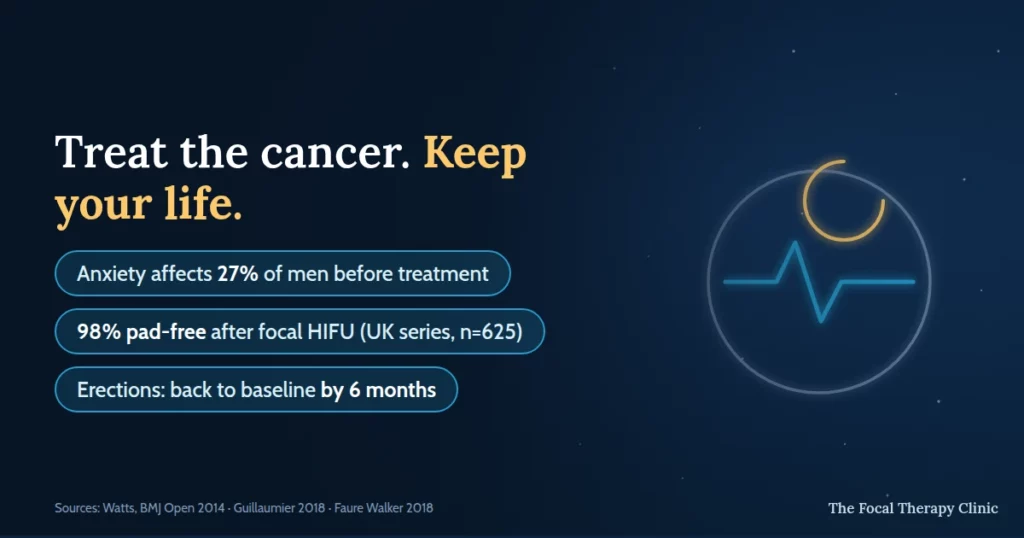
- The diagnosis carries the psychological load — a meta-analysis of 4,494 men found anxiety affects 27% of men before treatment and depression around 17%, whatever treatment follows (Watts et al., BMJ Open 2014)
- Male-specific barriers are real — men are often reluctant to discuss fears about sexual function and continence, and access healthcare less readily than women
- Precision diagnostics reduce uncertainty — multiparametric MRI and targeted transperineal fusion biopsy let clinicians say far more confidently where cancer is, how severe it is, and whether it needs treating at all
- Function preservation is the anxiety antidote — in the published UK focal-HIFU series (n=625), 98% of men remained pad-free, and validated erectile-function scores return to baseline by six months after focal HIFU
- A third option breaks the false choice — focal therapy offers active treatment with function preservation, for men who find radical treatment side effects and surveillance uncertainty equally hard to live with
The Mental Health Challenge in Prostate Cancer
Mr Marc Laniado explains how focal therapy addresses the mental-health burden that follows a prostate cancer diagnosis.
Mr Marc Laniado identifies profound psychological challenges facing men diagnosed with prostate cancer, recognising patterns that specialist clinics observe consistently across patient populations.
Common mental health presentations:
- Acute fear immediately after hearing the diagnosis word “cancer”
- Decisional conflict when weighing cure against quality-of-life preservation
- “PSA anxiety” cycling between surveillance blood tests and imaging
- Body-image concerns linked to sexual and urinary side-effect risks
- Depression and isolation as men withdraw from normal activities
The statistics behind the fear:
The psychological burden begins with the diagnosis itself. A meta-analysis of 4,494 men with prostate cancer found that anxiety affects 27% of men before treatment (15.1% during treatment and 18.5% afterwards), while depression affects around 17% before treatment (Watts et al., BMJ Open 2014). The diagnosis, not any one treatment, carries the psychological load — which is why fears about what treatment will do to urinary control and sexual function weigh so heavily on the decision that follows.
Male-specific communication barriers:
“Men are somewhat reticent. Men are usually quiet, and they don’t really open up their feelings very much.” — Mr Marc Laniado
This reluctance extends to healthcare engagement generally, with men accessing medical care less frequently than women and struggling to discuss treatment fears.
The “masculine identity” factor:
Central to anxiety is the perceived trade-off between cancer cure and — as Mr Laniado puts it in the interview below — men’s “mojo”: the sexual function and continence that many men feel define their sense of themselves.
In our interview, Dr Asanga Fernando explains why prostate cancer patients need access to mental health support as part of their care.
Diagnostic Precision Reduces Uncertainty
Advanced imaging and biopsy techniques have dramatically improved diagnostic confidence, reducing the psychological burden of uncertainty that previously characterised prostate cancer diagnosis.
Historical limitations that created anxiety:
- Blind, untargeted biopsies with a substantial chance of missing significant cancer
“In the past, when someone had a negative biopsy before, many years ago, they still had about a one in three chance of having significant prostate cancer.” — Mr Marc Laniado
- Limited knowledge of cancer location and severity
- Assumption-based treatment decisions without precision data
- High infection risk from transrectal biopsies adding procedure anxiety
Modern capabilities reducing uncertainty:
- Multiparametric MRI: “like having a digital finger” — examining all prostate regions and visualising cancer location precisely
- Fusion biopsies: MRI–ultrasound combination enabling targeted sampling
- Transperineal approach: through-the-skin technique with very little infection risk, reaching parts of the prostate the transrectal route could not
“Now, with precision MRI scans and precision biopsy procedures, we can say with almost 95 per cent certainty someone does not have prostate cancer if they are negative.” — Mr Marc Laniado
Psychological benefits of precision:
Enhanced diagnostic accuracy enables clear risk stratification, allowing men to understand whether they have low-risk disease “very unlikely to affect them in their lifetime” or high-risk disease requiring immediate intervention. This clarity dramatically reduces anxiety about the unknown.
Focal Therapy’s Psychological Benefits
Focal therapy addresses the fundamental psychological challenge in prostate cancer: the perceived forced choice between cancer cure and quality-of-life preservation.
Breaking the false dichotomy:
Traditional treatment narratives present men with apparent binary choices:
- Radical treatment: maximum cancer control with significant side-effect risks
- Active surveillance: function preservation with ongoing monitoring of a cancer that is still there
Focal therapy offers a psychologically attractive third option: active cancer treatment with function preservation.
Psychological advantages for patients:
“Many patients we see who will have significant disease but many, many years of life to live do not necessarily want to have a life where they’re constantly just being monitored. They’d rather take action.” — Mr Marc Laniado
- Taking control: an active intervention choice over surveillance uncertainty
- Function preservation: maintains sexual activity, continence, and physical capabilities
- Reduced ongoing worry: treats the diagnosed tumour while avoiding the cycle of waiting on the next test
- Lifestyle continuity: enables continued sport and physical activity without incontinence concerns
Focal therapy enables men to “deal with cancer and still keep your life pretty much as it was before,” addressing both cancer-related anxiety and treatment-related fears simultaneously. It is not suitable for every man — in Mr Laniado’s words, “at least a quarter of the men who have been diagnosed with early prostate cancer are suitable for focal therapy.”
Clinical Evidence & Outcomes
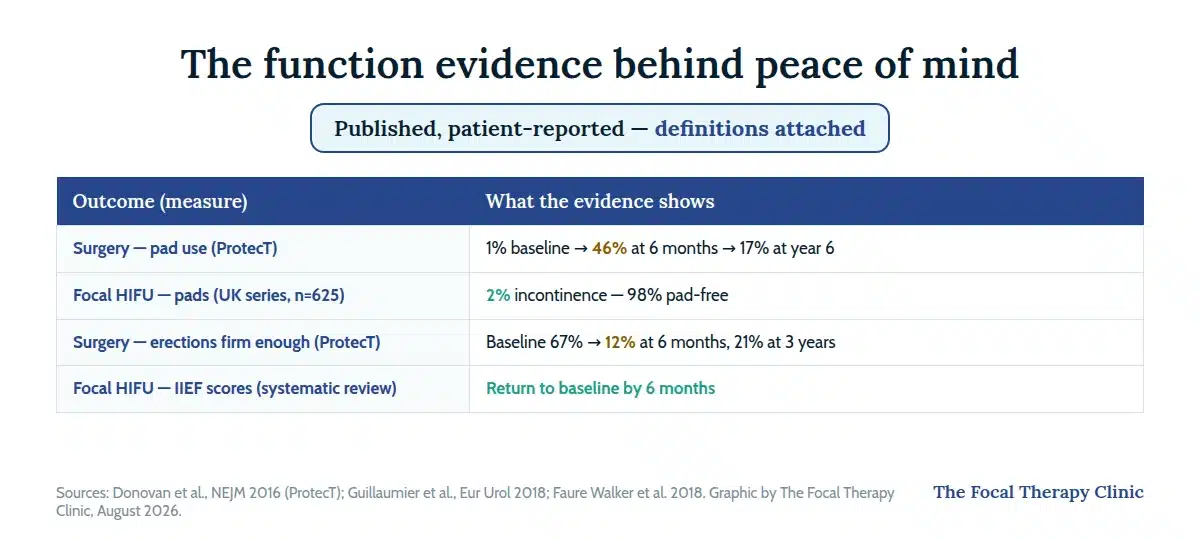
The mental-health case for focal therapy rests on published functional and cancer-control outcomes. The figures below come from the peer-reviewed literature; definitions and timepoints matter, so each is labelled.
Urinary continence (measure: use of absorbent pads):
| Evidence | Finding |
|---|---|
| Focal HIFU — Guillaumier et al., European Urology 2018 (UK, n=625) | Incontinence 2%; 98% of men pad-free |
| Surgery — ProtecT patient-reported outcomes (Donovan et al., NEJM 2016) | Pad use rose from 1% at baseline to 46% at six months after prostatectomy, settling to 17% at year six; active monitoring 4%→8%; radiotherapy 5%→4% |
Erectile function (instrument named per study):
- Focal therapy: validated IIEF questionnaire scores fall in the first month after focal HIFU and return to baseline by six months (Faure Walker et al., systematic review, 2018)
- Surgery/radiotherapy (ProtecT, “erections firm enough for intercourse”): from a baseline of 67%, the surgery arm fell to 12% at six months and 21% at three years; the radiotherapy arm recorded 22% at six months, though those men had also received 3–6 months of hormone therapy (Donovan et al., NEJM 2016)
- Unselected national data: 73% of men report erectile dysfunction one year after robot-assisted radical prostatectomy (Swedish national registry, n=4,298; Corsini et al., 2024)
Cancer control and safety (focal HIFU):
- Failure-free survival — freedom from radical or systemic therapy, metastases or cancer death — of 99% at one year, 92% at three years and 88% at five years (Guillaumier et al. 2018)
- In the 1,379-man HEAT registry: 69% treatment-failure-free survival at seven years, 100% metastasis-free survival, and serious complications (Clavien-Dindo >2) in just 0.5% (Reddy et al., European Urology 2022)
In our own clinic’s audited experience (n=265), 97% of men maintained urinary continence and over 90% preserved sexual function following treatment.
What this means psychologically: the ProtecT trial itself found no significant differences in anxiety or depression between its treatment arms over six years — the distress attaches to the diagnosis and to living with each treatment’s consequences. What focal therapy changes is the consequence profile: for suitable men, it removes the diagnosed tumour without the functional losses that men fear most.
Get Expert Advice & The Latest Research
Subscribe to our newsletter to receive the latest updates, expert insights, and breakthrough research on prostate cancer-delivered straight to your inbox.
Managing Treatment Anxiety
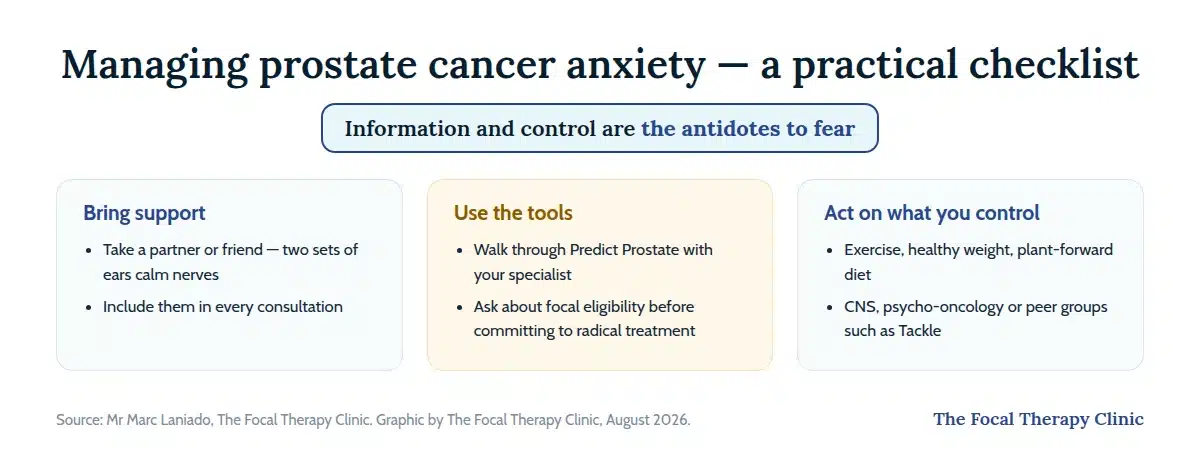
Mr Laniado emphasises information access and personal control as key psychological tools for managing cancer-related anxiety effectively.
Evidence-based anxiety-reduction strategies:
- Predict Prostate tool: the NHS-linked decision aid Mr Laniado recommends, where a man can input his own variables and see his outlook presented clearly
- Risk-stratification understanding: clear communication about disease severity and outcomes
- Treatment-option education: comprehensive knowledge about all available interventions
- Family involvement: partners provide crucial emotional support and information-processing assistance
Controllable factors for empowerment:
- Weight management: evidence-based impact on cancer risk and progression
- Dietary modification: reducing red meat, animal protein and dairy consumption
- Exercise: independently protective, for both body and mood
- Treatment choice: active participation in selecting interventions aligned with your values
Active surveillance and the testing cycle:
For men on monitoring protocols, worry often cycles around testing schedules. “That time leading up to the next blood test can be quite anxiety invoking,” Mr Laniado observes — with worry periods before each PSA result, MRI scan or repeat biopsy. Some men adjust well to surveillance over time; for others the cycle remains a continuous background stress, and that experience varies man to man.
Practical anxiety-management checklist:
- Bring support: take a partner or friend to consultations — two sets of ears calm nerves, and the second listener catches what the shock of the word “cancer” drowns out
- Use decision tools: ask your specialist to walk you through Predict Prostate with your own numbers
- Explore focal options: ask about focal therapy eligibility before committing to prostatectomy or radiotherapy
- Adopt healthy habits: exercise, a healthy weight and a plant-forward diet support both physical health and mood
- Seek professional support: urology clinical nurse specialists, psycho-oncology services, or peer groups such as Tackle Prostate Cancer
- Involve your family: include partners in consultations for emotional support and information processing
Frequently Asked Questions
How does focal therapy help with prostate cancer anxiety?
It addresses the fear at the heart of treatment decisions: the apparent forced choice between cancer control and quality of life. By treating the tumour while preserving function — 98% pad-free in the published UK series, with erectile-function scores returning to baseline by six months — it lets men act on the cancer without the losses they fear most.
Should I involve family in my prostate cancer treatment decisions?
Yes. The shock of a cancer diagnosis often stops men absorbing anything said afterwards. A partner or friend at consultations provides emotional support, asks the questions you forget, and helps process the information afterwards.
What mental health challenges do men face with prostate cancer?
Research suggests anxiety affects around a quarter of men before treatment and depression around one in six. Common experiences include initial shock, worry about side effects, concerns about sexual function and continence, and difficulty talking about any of it.
Can focal therapy really reduce my cancer-related anxiety?
Many men find it psychologically attractive because it treats the cancer actively while preserving function — avoiding both radical-treatment fears and the surveillance testing cycle. It is one option among several, suitable for appropriately selected men; discuss your eligibility with a specialist.
What if I’m currently on active surveillance but struggling with anxiety?
First, tell your clinical team — support is available, and large trials show most men cope well on surveillance. If the testing cycle remains hard to live with and your disease characteristics are suitable, focal therapy is worth discussing: many men prefer taking action to ongoing monitoring.
About the Expert
Mr Marc Laniado is Consultant Urological Surgeon at The Focal Therapy Clinic and Prostate Cancer Lead at Wexham Park Hospital, Frimley Health. Recognised for exceptional patient empathy and understanding, he has pioneered approaches integrating psychological support with advanced prostate cancer treatment.
His philosophy emphasises treating the whole person, not just the cancer, recognising that mental health significantly impacts treatment outcomes and quality of life. Mr Laniado’s advocacy for focal therapy extends beyond technical benefits to encompass the profound psychological advantages of function-preserving cancer treatment.
The interview below was recorded in July 2020 and is presented as broadcast; the Covid-era passages reflect that moment, and spoken figures are of their time (Cancer Research UK now puts prostate cancer deaths at around 12,300 a year in the UK).
Please find below a written transcript of the interview, and call The Focal Therapy Clinic today to discuss your prostate cancer treatment options: 020-7036-8870.
Clare Delmar:
Hello and welcome to The Focal Therapy Clinic. My name is Claire Delmar, and in this audio series, I’m going to introduce you to some issues facing men diagnosed with prostate cancer that are little known, less understood and almost never talked about. Prostate cancer is now acknowledged as the most commonly diagnosed cancer in the UK. And with this sombre fact comes a multitude of challenges and opportunities. In the third of our series, I’m speaking with Marc Laniado, consulting urologist at The Focal Therapy Clinic and a leading innovator in imaging-led diagnostics and targeted treatments for prostate cancer. Marc has been a vocal advocate for focal therapy from his base at Frimley Health, where he is prostate cancer lead at Wexham Park Hospital and has contributed to several pivotal clinical studies and trials on prostate imaging and focal therapy. Marc’s known for the exceptional levels of understanding and empathy he develops with his patients, and it’s for this reason we’re going to talk about the mental health challenges he helps his patients to manage. Marc, thanks for joining me.
Marc Laniado:
Hi, Clare. Great to be with you today. I’m pretty excited about this. Thank you. It’s a great topic to be talking about.
Clare Delmar:
Well, wonderful. And before we dive into mental health, specifically, can you tell our listeners what your journey was to becoming a leading practitioner and a champion of focal therapy?
Marc Laniado:
Well, many years ago, of course, I went to medical school like everyone else, and I wanted to be a doctor to understand the human body to be able to help people. And eventually I started investigating prostate disease, prostate cancer. I was very much involved in trying to understand why prostate cancer spreads from its local site in the prostate gland to going out into the bones. And then during my training, it seems like many years ago now, but we used to do lots of open operations to remove prostates and send patients for radiotherapy. And I was always struck by the seeming difference between the severity of the disease and the consequence of the treatments that they received. So I was always wondering how we could make our treatments fit the struggle or problem that the patients had. And so whilst I tried to improve my surgical delivery of treating prostate cancer through robotic prostatectomy, eventually, the keyhole way, there was always a feeling that I had that many of our patients probably could be helped by other means. And so I looked for treatments that could be focused literally on the cancer itself and an area around it rather than necessarily treating the whole prostate. So the basis has been trying to keep men as healthy as they are with their normal way of life, treat the cancer, but not to give them so many side effects as we had experienced in the past.
Clare Delmar:
And at that time, what was your sort of model of treating the disease rather than the gland or organ? Was there other treatments for other diseases and organs that you saw as sort of a beacon for this?
Marc Laniado:
Well, I mean, perhaps people have heard about breast cancer. You know, breast cancer many years ago used to be treated by removal of the whole breast and tissue around it. Then it became apparent that you could just actually remove the lump itself, and you get the same sort of outcomes after 10 to 15 years. That was really the paradigm that really made people think about maybe not treating the whole gland when treating cancer. And in our particular speciality, in urology, certainly when I grew up, I was taught to remove the whole kidney, for example, if someone had kidney cancer. But, you know, we now really try to just remove that part of the kidney where the cancer is itself and preserve the rest of the kidney when we do it. And, similarly other cancers is the same. We now try to remove the cancer plus say a margin around it and preserve the rest of the organ, if at all possible.
Clare Delmar:
And, of course, this is all made possible by vastly improved diagnostics.
Marc Laniado:
So, as you say, in the past, when we treated prostate cancer and many other cancers, we really didn’t know much about it. We’d have an idea that cancer was there, perhaps because prostate cancer because the PSA was high. We then would examine the prostate, make a guess, perhaps if prostate cancer is present based on that alone and then do biopsies that the biopsies usually were not targeted because we didn’t really know where the cancer was located. We had sort of an idea. It was there somewhere. And then, when we did the biopsies, we might make a diagnosis of cancer, but really, we didn’t know how much cancer was there. We certainly didn’t know where it was located in the prostate typically. And so we were really struck with the problem. We’d know the patient had cancer, we wouldn’t necessarily know how bad it was. But at the same time, we knew that patients could die from it. In this country, about 11000 men die from prostate cancer every year. So because we didn’t know the burden of the disease, we didn’t know how much disease is present, we really applied everything we could to deal with it, which would be usually either surgery or radiotherapy. So in recent times, that’s changed our ability to know where the cancer is located has improved dramatically since we’ve had the introduction of multi-parametric MRI. And these are like having a digital finger. So if you imagine when a doctor sees a patient, if he examines a prostate, he has to put a finger in the back passage to check it. But he can only feel one side of the prostate. That’s the side on the back. But an MRI scan or a multi-parametric MRI is like an enhanced digital finger. It can check the front of the prostate, the sides of the prostate, top end, the lower end, can look inside the prostate, and it can literally see where the cancer is located in the vast majority of cases. So with that, with our ability to see where cancer is located, we can then now target our biopsies very carefully so we can sample the areas that look abnormal with precision. In the past, when we did our biopsies, we used to put them in randomly. Now we can do what are called MRI fusion biopsies. That is, we can fuse the MRI scan with live ultrasound. And when we do that, we can then make sure that our needles go in the right place.
Clare Delmar:
So the fact that you have such precision biopsies and, therefore, a knowledge of exactly where the cancer is and how aggressive it is, that means you have better treatment options. Is that correct?
Marc Laniado:
Yes, absolutely. I’d just like to say one more thing about the biopsies. In the past, we always did transrectal biopsies which were biopsies through the back passage which carried a great risk of infection. Now, we almost always try to do transperineal biopsies. Those are biopsies done through the skin between the anus and the scrotum because there’s very little risk of infection, and we can reach parts of the prostate and couldn’t find before through the typical transrectal route.
Clare Delmar:
So that all sounds like there’s been some major improvements both in the technology and actually in the actual procedure. So I guess the question I really have is, does that actually help or in any way hinder the anxiety levels in your patients when they are told that they possibly have prostate cancer?
Marc Laniado:
Well, as you can imagine, yes, it has helped. In the past, when someone had a negative biopsy before, many years ago, they still had about a one in three chance of having significant prostate cancer. Now, with precision MRI scans and precision biopsy procedures, we can say with almost 95 per cent certainty someone does not have prostate cancer if they are negative. But we can also say how severe the cancer is compared to before. So now we can categorise into men who have low risk disease, which is very unlikely to affect them in their lifetime. And also classify men with high-risk disease with men who are likely to be affected by it. So, being able to stratify men into risk groups has helped men deal with the disease much better than before and also has opened up many more options for treatment as well.
Clare Delmar:
And in your own experience, what are the main mental health challenges that a man faces when he is diagnosed with prostate cancer?
Marc Laniado:
Well, although men come in with a suspicion that prostate cancer is present. Often, it’s a great surprise or a great shock that they find that prostate cancer has been diagnosed. As you can imagine, most of us like to believe were healthy, fit and well. And then, to be given a diagnosis of a cancer that essentially is life-threatening is a big shock to the system. Some men react to it with depression. They get sad, depressed, they isolate themselves. Some men take some time to recover and then want to react very strongly towards it and other men can cope quite well. It helps, though, when dealing with the disease when we are able to give much more precise information about how severe it is and what treatment options there are. Many men already had some knowledge about the treatments. Often, it was knowledge about treatments from the past, and they were very worried and anxious about the potential for problems such as urinary leakage or loss of erections. As you can imagine, men, their mojo, if you like, about being male, about getting erections and the thought of potentially losing that would be very worrying for lots of people to have.
Clare Delmar:
How willing are they to talk about this?
Marc Laniado:
As you can imagine, men are somewhat reticent. Men are usually quiet. And they don’t really open up their feelings very much. They certainly don’t seek access to healthcare as much as, for example, women do. So it has been an issue for many men.
Clare Delmar:
And do they often involve their families in some of these discussions and, ultimately, their decisions on treatment?
Marc Laniado:
Certainly, when I see a man who is at risk of prostate cancer and is coming back for diagnosis, I always ask them to bring a member of the family with them. It’s often that, you know, when you hear that you have cancer, that’s the only thing you hear, and you don’t listen to any more information that’s brought into the discussion. So bringing your family member is very helpful. So a wife or a loved one or some other supporter/partner of any kind is very helpful for that man dealing with a diagnosis. And so we do encourage that.
Clare Delmar:
And do you actually feel that that helps with various levels of anxiety?
Marc Laniado:
Yes, I certainly think it does. I mean, a problem shared is a problem halved. That’s a common statement. And I think it’s certainly true for this. You know, the person who hears the diagnosis often will be distraught. And then the loved one will be giving much support. So it is helpful to have someone with you at the time. It’s a very difficult time for many people. It’s often the other person will be thinking about more questions to ask. Establishing that person’s place with the diagnosis, with the clinician. So, yes, I would recommend that.
Clare Delmar:
So basically, the mental health challenges are around anxiety and depression. In your experience.
Marc Laniado:
So certainly. I mean. Yes. And that may be not manifest early on. It may come over time. So if a man is diagnosed with cancer, for example, and then he’s told that actually, we’re not going to necessarily treat it. So, if we try to explain to men that this is a low-risk disease, that in some cases, not always. And that we can monitor it with repeated blood tests, MRI scans and sometimes biopsies. That, for some men, can be quite difficult to deal with, especially early on. For other men, they find that they can cope with that quite well. And they find that as time passes, they get more used to surveillance. And they find that less of an issue. A lot of men find that that’s a continuous worry. You know, that time, if you imagine a man has to have a test, a blood test every three months or so initially in the beginning. It’s okay once you’ve had the blood test and it’s come back, say, normal or low. But that time leading up to next blood test can be quite anxiety invoking. And so there can be a lot of worry waiting to hear the next PSA result, and similarly, of all the other tests, we might need to do whilst we’re monitoring men, so they might need another MRI scan after a year, potentially more biopsies. And each of those interactions can lead to more anxiety.
Clare Delmar:
So it’s interesting, Marc because what I observe are two things with the patients we deal with. One is when men come to us, they’ve searched online. And how you present the information to them is almost more important than what you present because your state of mind and absorbing new information about your own situation, your own future is very much dictated by your state of mind. Shopping for a holiday or a car when you’re excited to spend is very different than looking for treatments for a disease that you are facing that is making you fearful. So that I find this is something that we deal with men with anxiety and how we help them absorb the information. And the second thing I observe is a lot of men really like to be in control. So you mentioned earlier about active surveillance and how some men actually would embrace that because they can schedule their tests when, where, how they’re going to receive them, maybe even do things like look at the data. So, I wonder how you see men managing some of this anxiety through their online searches and also through their choice of treatment.
Marc Laniado:
So, managing the anxiety, it helps to know more about the disease that they have and the likely impact of that disease. So what I often recommend patients do is to try and look at the site that gives probably the best idea of how well they’ll do over time. And there is a site called Predict Prostate in which a doctor or a patient can input his variables regarding the prostate cancer. So, for example, their age, their PSA, what was found in the prostate biopsies, stage of the disease and their general health. And then on that website, they’ll get information about the chance of dying from prostate cancer, chances of dying from some other cause, chance of surviving. And that’s presented in a very clear way to patients so that they can see, for example, if they have a significant chance of surviving the disease without problems or they’re more likely to get issues which will potentially cause problems for them over time. I often use that as a tool to help patients to see the likelihood of outcomes. And it also helps them make a decision about whether, for example, they want to have treatment now or later. I recommend often patients look at sites regarding wellbeing. It’s helpful to talk about mental strategies to deal with cancer. So that includes aspects of physical health as well. So making sure that they’re looking at a whole body, all aspects of their lives, a holistic approach to their health and those aspects of things make life much better. Prostate Cancer UK has plenty of information which patients can use also to help guide them through their journey. And in fact, Prostate Cancer UK does consider depression to be an important problem that men have to deal with when they’re diagnosed with prostate cancer. The most important thing about, I think, dealing with cancer and when people are anxious or concerned about it is trying to work out as much information or find as much information about the disease and how it’s relevant to them. And then to work out what strategies are likely to reduce their anxiety. So, for some people, it is lack of control. So if the problem is lack of control, then work out what aspects of that disease can I manage? Now, you can’t necessarily change what’s in the prostate gland itself. But what you can do is influence those factors that can alter the progression of the disease. So we know, for example, that weight is very important. So we need men to control that. So many of the patients I see are overweight or obese. It is important to get your weight down. So weight down through diet and also by exercise, both are independently important in reducing the risk for cancer overall, but also probably the progression for prostate cancer. Similarly, you can control what you eat. So we know that a diet rich in red meats and animal protein and dairy protein seems to increase the chance of prostate cancer development, but also the chance of it progressing, and possibly prostate cancer-related deaths. So that’s another thing you can control. So there’s weight, diet, exercise. And then there’s the various other components of diet that one can do. But also, you can choose or help to choose what form of management of the disease you can have. So, yes, you can choose active. But also you can choose treatment. Being informed about the various types of treatment can put you in a better position where you are controlling disease and disease is not controlling you.
Clare Delmar:
And you would probably place focal therapy in that space.
Marc Laniado:
Absolutely. So focal therapy is a treatment for prostate cancer that is effective. So early on in the disease – so many of the patients we see who will have significant disease but many, many years of life to live do not necessarily want to have a life where they’re constantly just being monitored. They’d rather take action. They’d rather deal with the problems there and then. So focal therapy enables you to destroy or get rid of that part of the prostate where the cancer is located, again with a small margin around it. And by getting rid of the cancer, you can deal with the anxiety relating to prostate cancer itself. You can reasonably be sure that you’re not going to suffer the problem again. But at the same time, by preserving your prostate, you can maintain those aspects of your life which are important. So, for example, sexual activity, but also being able to stay dry. I mean, one of the main problems with, for example, surgery of the prostate is that men leak urine afterwards, even though we’ve improved our techniques. And so by preserving the prostate, you can keep your erections, you can keep your bladder control. So if you play football or you like to cycle or you run, or you do heavy activities, then you can keep doing that as well. Worrying about having to wear a pad, for example, or you know what, having to change underwear multiple times during the day. So now, with focal therapy, we’ve reached a situation where you can deal with cancer and still keep your life pretty much as it was before. So that’s not to say that it fits all men with prostate cancer. You know, significantly, at least a quarter of the men who have been diagnosed with early prostate cancer are suitable for focal therapy. And for them, it gives them a great opportunity to really perhaps change their lives for the better and hopefully permanently.
Clare Delmar:
Yeah. I mean, you’ve made a very strong case linking how focal therapy also can reduce the anxiety associated with either end of the spectrum, more radical treatments and equally active surveillance. I mean, do you feel that many patients are counselled in that way?
Marc Laniado:
Currently, no, they’re not. And the reason they’re not is because there is still somewhat lack of awareness of focal therapy as a potential treatment. Also, the other reason, probably, is because most of us who are trained, are trained to operate or trained to give radiotherapy. And so most of the clinicians are not aware. And so they’re not naturally going to offer it. In fact, we often find that patients are the biggest drivers. Many of the patients who see need for it are people have looked out for alternative treatments for prostate cancer that can give them what they want. That peace of mind that they can have prostate cancer treated with less side effects and conditions we’re keen to offer.
Clare Delmar:
So one thing that’s been in the back of my mind, given the time we’re having this conversation, is that we hear about these large delays in both the diagnostics and treatment of all cancers, but prostate cancer is included in that. And that’s because of the diversion of resources to Covid. I mean, could you comment on the extent of the delays and how that’s affected prostate cancer diagnosis and treatment specifically and maybe link that back to levels of anxiety that patients may be feeling because they are on this kind of backlog, as it were?
Marc Laniado:
As you can imagine, if you’ve just been diagnosed with cancer, you want obviously to have the best diagnostics possible and be offered the best treatment that you can. And with the Covid crisis, of course, many patients have not been able to see their GPs in the way they normally would do. They probably haven’t had as many PSA tests or had any PSA tests. And then in hospitals, some of the hospitals were not offering MRI scans and were not offering prostate biopsies. So many patients were told, well, you know, I’m afraid you may be at risk of prostate cancer. But at the moment, we’re going to have to defer till the Covid-19 pandemic has really passed. And so, of course, again, that’s another troublesome situation for a man and his family to find that. Well, we’ve just been told you might have prostate cancer, but because your risk is not high enough, we’re not going to be able to do anything at this time, we going to have to defer things for several months. And similarly, we’ve had patients who’ve had a diagnosis of prostate cancer who have been told, well, we would normally treat you by surgery or radiotherapy, but at the moment we can’t do so. So what we’re going to do is can we suggest you go into hormonal therapy, which is called androgen deprivation therapy, and that means effectively, chemically castrating men, which means getting rid of the male hormone testosterone that can have quite profound side effects. I mean, men get hot flushes, they can lose muscle mass, and sometimes they can get muddled thinking, they put on weight, you know used for very long periods of time it can cause problems with bones. Not that that’s hopefully going to happen. And that changes many aspects of their lives. And, of course, with androgen deprivation comes loss of erections for most men who have it. So, yes, it has been very difficult. So the traditional treatments, like the big treatments, like surgery, radiotherapy, have been very difficult to deliver. But some other treatments like focal therapy have been more safely delivered because they’re if you like, less toxic insults on the human body so that they’re they’re easier to sustain. So a man having, for example, focal therapy by HIFU. He comes in, has his procedure, usually done as a day case nowadays. And he can go home and he doesn’t have to stay in hospital. So it is a treatment that we can deliver more easily during this time.
Clare Delmar:
But is it being delivered by the NHS?
Marc Laniado:
At the moment, very few treatments for prostate cancer have been delivered, although it has restarted in many areas now, but in very constrained circumstances. So, yes, there’s a big backlog of patients. I’ve heard some patients been told that they cannot have definitive treatment of any kind till probably the end of the year and that they’ll need to stay on hormonal therapy till that time.
Clare Delmar:
Yeah, that’s a terrible thing to impose on somebody, isn’t it?
Marc Laniado:
Absolutely. I mean, it’s a great worry for the patient’s family. And to know that during this time, that the cancer is being suppressed but not actually treated is really less than ideal.
Clare Delmar:
But the fact is that you and your colleagues at the focal therapy clinic are available to actually treat patients now in some dedicated private clinics.
Marc Laniado:
We are able to treat patients absolutely, so we can deliver focal therapy usually as a day case, as I said, so you come in and go out the same day with very high levels of protection to avoid any risk for infection, and then the treatment is given, patients go home, and then we see them again shortly afterwards. And again, it is something that could be done relatively safely compared to, for example, radical prostatectomy, which I also do. And so many patients have sought to have focal therapy for that reason.
Clare Delmar:
Marc, thank you so much for your insights. And I could talk to you for a very long time about this. And we do live in interesting times for certain. I look forward to speaking with you again soon. If you’d like to learn more about Marc’s work and about the focal therapy clinic, visit www.thefocaltherapyclinic.co.uk. And from me, Clare Delmar, see you next time.
References
- Watts S, et al. Depression and anxiety in prostate cancer: a systematic review and meta-analysis of prevalence rates. BMJ Open 2014 (n=4,494).
- Guillaumier S, et al. A multicentre study of 5-year outcomes following focal therapy in treating clinically significant nonmetastatic prostate cancer. European Urology 2018;74(4):422–429 (n=625).
- Reddy D, et al. Cancer control outcomes following focal therapy using HIFU in 1,379 men with nonmetastatic prostate cancer (HEAT registry). European Urology 2022;81(4):407–413.
- Donovan JL, Hamdy FC, Lane JA, et al. Patient-reported outcomes after monitoring, surgery, or radiotherapy for prostate cancer (ProtecT). NEJM 2016;375:1425–1437.
- Corsini C, et al. Patient-reported side effects after robot-assisted radical prostatectomy and radiotherapy — Swedish national registry (n=4,298). European Urology Oncology 2024.
- Faure Walker NA, et al. Sexual function outcomes following focal therapy: a systematic review. Urologic Oncology 2018.
- Predict Prostate — prostate.predict.cam (University of Cambridge / NHS-endorsed decision aid).
This content is not intended to replace professional medical advice. Always consult your clinical team about your individual circumstances.