
At a Glance
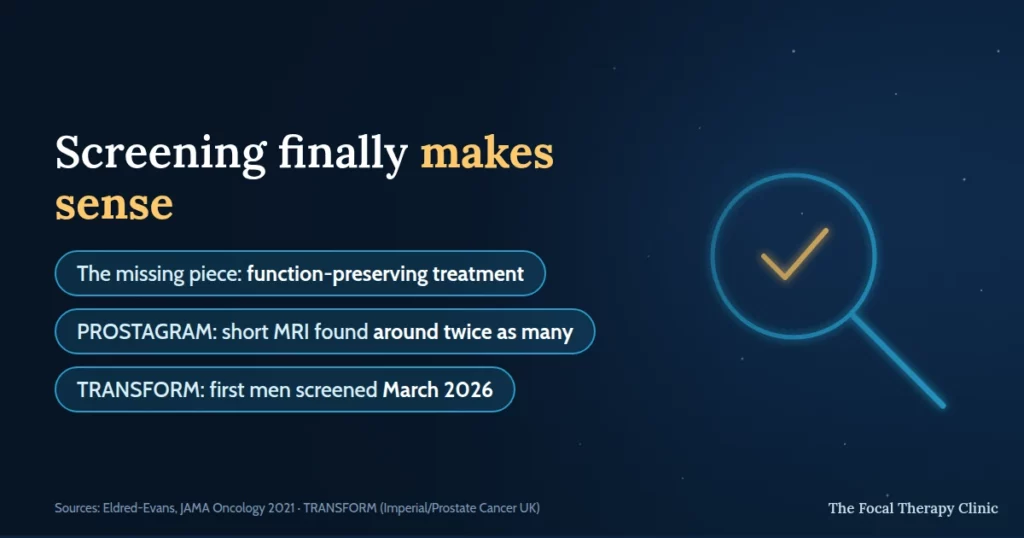
Highly targeted treatments (HIFU and NanoKnife) now control early tumours with far fewer side effects, removing the traditional fear that “finding cancer means losing function.” Modern mpMRI pinpoints lesions before biopsy, creating a smarter pathway — PSA → mpMRI → focal therapy where eligible — that could prevent late disease while avoiding mass over-treatment. And the question is no longer academic: the UK’s largest-ever prostate screening trial, TRANSFORM, invited its first men in March 2026.
- The screening trade-off has changed — the historical objection to PSA screening was that finding cancer forced men into radical treatment; focal therapy provides the missing middle option
- Function preservation is documented — in the published UK focal-HIFU series (n=625), 98% of men remained pad-free; validated erectile-function scores return to baseline by six months
- Imaging makes it reliable — 3T multiparametric MRI maps lesions before any biopsy, and MRI-fusion transperineal biopsy confirms grade and extent with minimal infection risk
- Doherty’s three pillars — transparent outcomes, certified mpMRI quality, and regional access to focal therapy are the conditions for an ethical screening programme
- TRANSFORM is under way — around 16,000 men in stage one (up to 300,000 in stage two), testing fast MRI, PSA and genetic risk scores against current NHS practice over ten years or more
Why Focal Therapy Changes the Screening Debate
Mr Marc Laniado explains why early diagnosis of prostate cancer matters — how catching it sooner keeps every treatment option open.
Mr Alan Doherty’s case is simple: if a small, clinically significant tumour can be precisely ablated in a short day-case procedure, with the man dry and functioning within days, the argument against finding that cancer early collapses.
The traditional screening trade-off problem:
- Past reality: PSA screening saved lives but forced large numbers of men into radical surgery or radiation
- Policy challenge: policymakers found the trade-off between life-saving and over-treatment unacceptable
- Missing element: no intermediate treatment option between monitoring and radical intervention
The focal therapy solution — the third path:
- Focal HIFU (heat): precise thermal destruction of the cancer focus
- Focal NanoKnife/IRE (electroporation): targeted cellular destruction using electrical pulses
- Principle: eliminate the significant tumour only, spare the rest of the gland
- Outcome: cancer control without life-changing side effects
What the published evidence shows (definitions and timepoints labelled):
| Outcome | Focal therapy (published evidence) | Radical treatment (published evidence) |
|---|---|---|
| Urinary continence (pad use) | Incontinence 2% — 98% pad-free (Guillaumier et al. 2018, UK focal HIFU, n=625) | ProtecT surgery arm: pad use 1% at baseline → 46% at six months, 17% at year six (Donovan et al., NEJM 2016) |
| Erectile function | Validated IIEF scores return to baseline by six months after focal HIFU (Faure Walker et al. 2018) | ProtecT (“erections firm enough for intercourse”): baseline 67% → 12% at six months after surgery; 73% report erectile dysfunction one year after robot-assisted prostatectomy in unselected Swedish national data (n=4,298; Corsini et al. 2024) |
| Serious complications | Clavien-Dindo >2 events in 0.5% (HEAT registry, n=1,379; Reddy et al. 2022) | Varies by centre and procedure |
In our own clinic’s audited experience, 85% of men return to work within two weeks of focal therapy.
The screening equation transformed: the “harm” side of the equation is dramatically shrinking. Early detection becomes beneficial rather than potentially harmful — and screening programmes finally become ethically justifiable.
Imaging Advances That Make Focal Therapy Reliable
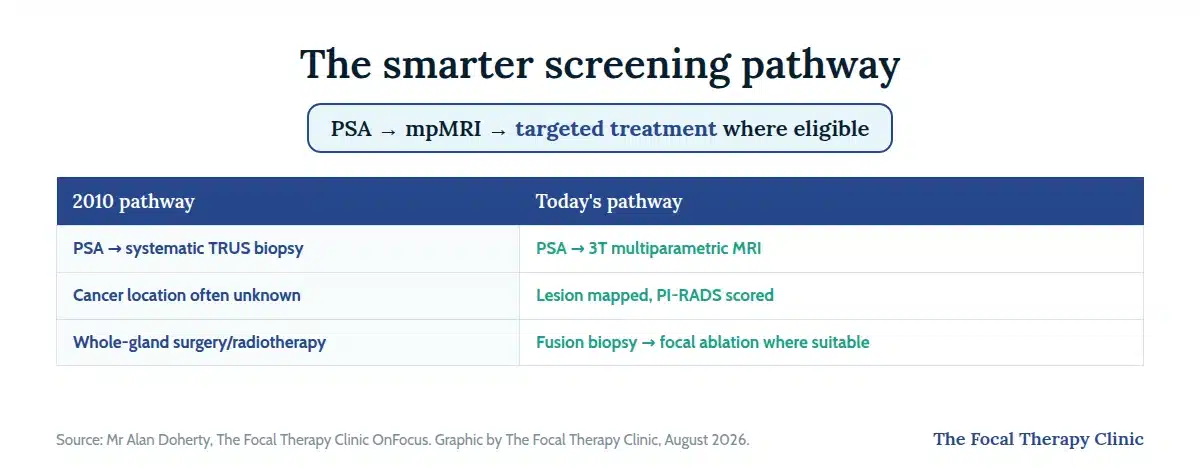
| 2010 pathway | Today’s pathway |
|---|---|
| PSA → systematic TRUS biopsy | PSA → 3T multiparametric MRI (mpMRI) |
| Cancer location often unknown | Lesion mapped, PI-RADS scored |
| Whole-gland surgery/radiotherapy | MRI–ultrasound fusion biopsy → focal ablation where suitable |
Quality assurance requirements: without dedicated prostate radiologists and transperineal fusion biopsies, focal therapy risks “treating the wrong spot.”
Doherty’s two essential quality checks:
- Dedicated prostate radiologist — low PI-RADS 3 rate and clear lesion mapping, with subspecialty expertise
- Transperineal fusion biopsy — confirms grade and extent with minimal sepsis risk and superior accuracy over the transrectal route
He is blunt about the variability problem for focal-therapy-grade imaging:
“I would say as many as 50% of them are substandard, and I suppose that’s not a very fair percentage in a way, because I get a very small group of people coming in for a focal therapy and the quality that you need for a focal therapy needs to be very high.” — Mr Alan Doherty
Modern diagnostic precision:
- 3T mpMRI capability: pinpoints clinically important lesions before any invasive procedure
- Fusion guidance: real-time MRI–ultrasound integration ensures accurate targeting
- Safety profile: transperineal access carries minimal infection risk compared with transrectal approaches
- Reliability standard: focal therapy success depends entirely on diagnostic accuracy
Active Surveillance vs Focal Treatment
The surveillance reality:
Active surveillance is a well-evidenced strategy for genuinely low-risk disease — but it asks a lot of the men on it. The monitoring burden is real: repeated PSA tests, scans and occasional biopsies, with worry cycling around each result. Over time, a substantial proportion of men leave surveillance for active treatment, whether because tests change or because living with an untreated cancer becomes hard to sustain. Delay can also narrow the “window of curability” for some men.
How the options compare:
| Factor | Active surveillance | Focal treatment |
|---|---|---|
| Cancer status | Known cancer remains untreated | Lesion ablated |
| Monitoring requirements | Regular PSA, MRI, repeat biopsies | Standard follow-up, reduced surveillance burden |
| Quality of life | Preserved, but with the testing cycle | Preserved function with the tumour treated |
| Future options | May require radical treatment later | Maintains the window for additional interventions |
“Patients don’t like to leave things once they know they’re there. They like to address it even if they know the problems a long way ahead. And so it makes sense to me that if you find something that is treatable with a focal therapy why would you just leave it and monitor it?” — Mr Alan Doherty
Ideal focal therapy candidates:
- MRI-visible lesions: clear PI-RADS 4–5 findings with precise localisation
- Biopsy-proven disease: confirmed grade and extent through targeted sampling
- Localised cancer: disease confined to a treatable area without extensive spread
- Patient preference: desire for active intervention over ongoing monitoring
Three Pillars for 21st-Century UK Screening
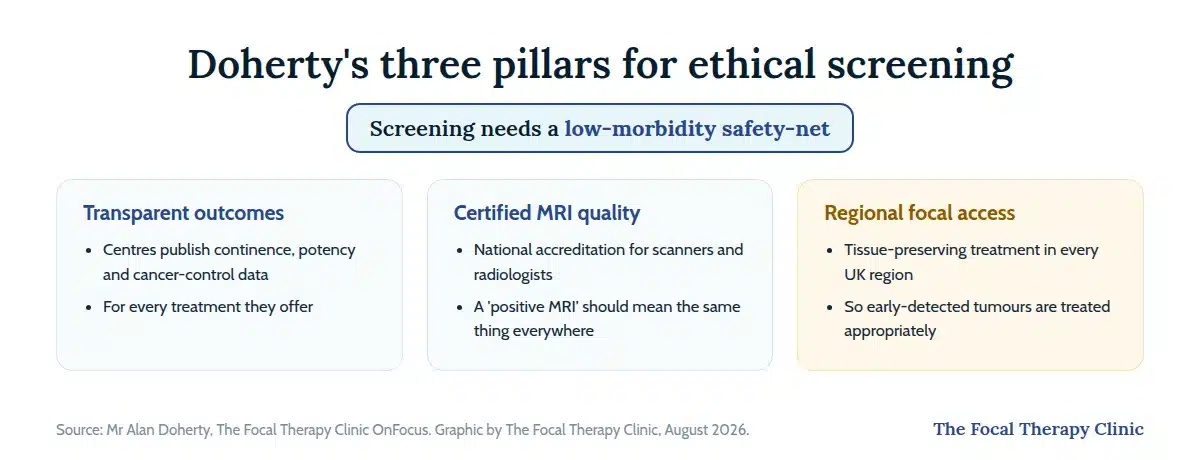
Doherty’s position is that screening without a low-morbidity treatment safety-net is not ethical — and that with modern focal tools, the equation flips in favour of testing.
Doherty’s three-pillar framework:
- Transparent outcomes — centres must publish continence, potency and oncological data for every treatment they offer
“Transparency of outcome has always been something which I think is not there, and it should be there because a lot of these treatments are skill based and it’s very hard to interpret outcomes and so not enough work has been done on that. So patients can be misled on what they are likely to get from treatments.” — Mr Alan Doherty
- Certified mpMRI quality — national accreditation for scanners and reporting radiologists, so a “positive MRI” means the same thing everywhere
- Access to tissue-preserving treatment in every region — in his framework, that means focal technologies (HIFU and NanoKnife among them) available wherever early-detected tumours are found, so they can be treated appropriately rather than radically or not at all
Implementation requirements: regional pilots with quality standards; MRI standardisation; radiologist and clinician certification programmes; and long-term outcome data collection.
Get Expert Advice & The Latest Research
Subscribe to our newsletter to receive the latest updates, expert insights, and breakthrough research on prostate cancer-delivered straight to your inbox.
TRANSFORM: The Screening Question Goes to Trial
When this interview was recorded, Mr Doherty noted he had “not heard of any potential screening studies in the pipeline.” That has now changed — in exactly the direction he argued for.
The evidence that MRI could lead screening: the PROSTAGRAM study found that short MRI could detect around twice as many clinically significant prostate cancers as PSA testing (408 men aged 50–69; at its stricter threshold, MRI flagged a similar number of men for biopsy as PSA and did not increase overdiagnosis). It was an early feasibility study, not powered to prove the detection difference at scale — that is TRANSFORM’s job.
The TRANSFORM trial — the UK’s largest prostate screening trial, led by Chief Investigator Prof Hashim Ahmed of Imperial College London — invited its first men in Ealing in March 2026. Stage one enrols around 16,000 men, comparing fast biparametric MRI, PSA testing and genetic (polygenic) risk scores — alone and in combination — against current NHS practice; stage two extends to up to 300,000 men, with follow-up of ten years or more and funding of around £60 million. Its purpose: population-scale evidence for the UK National Screening Committee on whether an MRI-based pathway can safely screen millions, save lives, and avoid excess biopsies and treatment.
If fast MRI joins national screening, more cancers should be found while still small and localised — potentially increasing the number of men suitable for focal treatment. The safety-net Doherty called for, and the screening programme it would justify, are finally being tested together.
Frequently Asked Questions
How do focal therapies change the screening debate?
They remove the traditional fear that “finding cancer means losing function.” In the published UK focal-HIFU series, 98% of men remained pad-free and erectile-function scores returned to baseline by six months — against the documented functional cost of radical treatment. When early detection leads to function-preserving treatment rather than forced radical intervention, screening’s benefit-harm balance changes fundamentally.
What makes modern imaging essential for focal therapy?
3T multiparametric MRI pinpoints lesions before biopsy, while MRI-fusion guided transperineal biopsies confirm grade and extent with minimal sepsis risk. Without dedicated prostate radiologists and fusion technology, focal therapy risks “treating the wrong spot.”
Why choose focal treatment over active surveillance?
For men with MRI-visible, biopsy-proven disease who find the monitoring cycle hard to live with, focal therapy treats the lesion while preserving quality of life — ending the surveillance treadmill while keeping future treatment options open. Surveillance remains a sound choice for genuinely low-risk disease; the right answer is individual.
What would an ideal screening programme include?
Doherty’s three pillars: transparent centre-specific functional and oncological outcomes; certified mpMRI quality with national accreditation; and regional access to focal therapy so early-detected cancers can be treated appropriately.
What is the TRANSFORM trial?
The UK’s largest prostate screening trial, launched with its first men screened in March 2026 under Prof Hashim Ahmed. Around 16,000 men in stage one and up to 300,000 in stage two will test whether an MRI-led pathway can screen safely at population scale, over at least ten years.
Why hasn’t PSA screening been implemented already?
Historic trials used PSA alone to decide who to biopsy, and the resulting over-diagnosis and over-treatment made the trade-off unacceptable to policymakers. The MRI-led diagnostic pathway and function-preserving treatment have changed that equation — which is precisely what TRANSFORM is now testing.
About the Expert
Mr Alan Doherty serves as Clinical Director at Birmingham Prostate Clinic and joined The Focal Therapy Clinic to advance precision treatment expertise. Voted one of the UK’s top 10 prostate cancer specialists in a national poll of consultant urologists, he has pioneered both HIFU and NanoKnife (IRE) focal therapies with exceptional patient outcomes. His advocacy for screening programme reform stems from direct experience of how minimally invasive treatments transform the screening benefit-harm equation.
Further Reading & Contact
📞 020 7036 8870 · 🌐 thefocaltherapyclinic.co.uk/podcasts
Arrange an MRI second opinion or focal therapy consultation with leading specialists including Mr Alan Doherty.
Clare Delmar
Hello and welcome to On Focus, brought to you by the Focal Therapy Clinic, where we connect you with issues facing men diagnosed with prostate cancer that are little known, less understood, often avoided or even ignored. Prostate cancer is the most commonly diagnosed cancer amongst men in the UK, and with this somber fact comes a multitude of challenges and opportunities. I’m Clare Delmar. Joining me today is Alan Doherty, Clinical Director at the Birmingham Prostate Clinic, who was recently voted one of the UK’s top ten prostate cancer specialists in a national poll of consultant urologists published in the Daily Mail. Alan has been an innovator advocate and dedicated practitioner of precision treatments for prostate cancer and he joined the Focal Therapy Clinic last year to develop his expertise in delivering focal therapy. In addition to HIFU focal therapy, Alan has embraced IRE or NanoKnife focal treatments with great success for his patients, which has reinforced his views on early diagnosis and in particular, prostate cancer screening. He’s here today to speak with me about how advancements in and success with focal therapy change the discussion around screening. Alan, thanks for joining me today. I’m really looking forward to this conversation.
Alan Doherty
Hi, Clare, so am I.
Clare Delmar
Good. Okay, well then let’s jump right in. And one of the reasons I wanted to have this conversation this week is because there’s been in the last few weeks a real sort of acceleration of discussion around screening. Because I guess evidence is building on both advanced diagnostics and focal treatments and the whole argument about the harm of over or under diagnosis is actually being challenged quite significantly. What is your view on this?
Alan Doherty
I think screening has been controversial ever since I started in urology 30 years ago, and the population studies have been somewhat conflicting and they never really showed that the benefits were hugely better than the harms which came with the diagnostic process and the treatments. And that probably explains why there isn’t a government screening programme for prostate cancer. And the use of PSA is really driven by individuals or groups of maybe charities, but not really by the NHS or by any government policy. And I can understand why that is. It’s really important that we understand what screening is. And I think sometimes that helps to clarify the situation with prostate cancer in particular. Because when somebody doesn’t have any symptoms, which is virtually by definition what screening is because what you’re trying to do is to identify a problem in the future, a potential problem in the future, because it’s not a problem now because you haven’t got any symptoms. And the problem in the future could be ten years away, it could be 20 years away, it could be 30 years away, and the size of the problem could vary from death to just having to take a few tablets. The difficulty we have in prostate cancer is to decide when we make a diagnosis. Well, first of all, is whether we should be making a diagnosis. But when we do make a diagnosis is to say, well, what is the potential problem in the future? How big is it? How far away is it? And we use rather basic instruments to make that guess. So we look at the level of PSA, we look at the imaging, we look at the Gleason score, and increasingly, we’re starting to use genetics. And so what we are trying to do is to get this looking glass into the future, to make an accurate assessment of what is coming your way. And if we think that what’s coming your way is a big problem and it’s not far away, then we’re going to obviously want to treat that. And patients are prepared to take on some side effects if they think that the benefit is worth it. Now, the trouble with prostate cancer is that so many of these cancers, and this has been shown in a number of studies, in particular, the ProtecT study, is that the natural history of a PSA detected, organ confined prostate cancer is really good. And so you’re very unlikely to die of that sort of cancer in the next ten years. So why would you take on a potential problem that’s miles away with a treatment that gives you a problem now? In a way, you can see why patients well, they don’t really understand it. I think the media have made patients hyper concerned about an early prostate cancer, and that means that they’re prepared to take on treatments which give them potential life changing side effects. And they’re prepared to take that because they probably wrongly think that the type of cancer that they’re going to, the effects of the cancer that they’ve been diagnosed is going to be much worse than the side effects of the treatment. And that’s not necessarily the case. And that’s your point about over treatment, but equally, you don’t want to under treat. And it struck me that when these screening studies were published, that there were still quite a few deaths from prostate cancer. And you would have thought that if you were doing a screening programme, you wouldn’t have any deaths, you might get harm, you might get side effects of treatments. It struck me that the studies were badly designed because the fact that there weren’t deaths at all in the prostatectomy group. So if you treat someone by removing the prostate, well, how can you die of prostate cancer? Well, the answer is either you don’t do it properly or the cancer has already spread before you take it out.
Clare Delmar
Yeah.
Alan Doherty
In other words, you’re screening people too late. So there’s another problem, what age group do you start looking at these things? Because I suspect the people who are going to die of prostate cancer have quite aggressive cancers that present very early, probably before the age of 50. So screening studies that use PSA and by the way that’s another important point that the screening studies so far published were using PSA only as their criteria on who they would go on to biopsy and treat. Now we’re far more sophisticated because we use the MRI scan to decide who we’re going to biopsy and treat. At least that’s the major factor. You can see that the jury is still out as to whether screening is good and I think the answers to whether it’s good or not will depend on how accurate we are at diagnosing it without harm and then whether the treatments cause any harm or not.
Clare Delmar
So on that point, I want to pick up on something I said in in introducing you earlier, which was that, you know, you’ve become a recent adoptee of of the NanoKnife with patients, and we’ve spoken to some of your patients, and I’ve spoken to you about this, and both you and they have been extremely positive. And how has this influenced your thinking about screening?
Alan Doherty
I think enormously. I think the focal therapies, and of course NanoKnife is one of the focal therapies, has allowed us to offer a treatment to patients with minimal harm being done. It’s not without risk and in fact, the more I’ve been involved in focal therapy the more I realise just how powerful these tools are. But the fact you can precisely destroy the cancer where you see it in the prostate is just such an advance and potentially for a patient that reassurance. Patients don’t like to leave things once they know they’re there. They like to address it even if they know the problems a long way ahead. And so it makes sense to me that if you find something that is treatable with a focal therapy why would you just leave it and monitor it? It doesn’t make sense to me at all. I mean there are some situations where you would say that removing the prostate or using radiation therapy is needed because of the type of cancer you’ve got. So I don’t think focal therapy is the answer to all men with all prostate cancer but if you’re going to pick up early prostate cancers that are likely not to harm you for years, then why would you just leave it if you can just treat it with minimal side effects? So I think as an alternative to doing nothing, the ProtecT study showed that even if you’ve got Gleason seven or eight or even worse, leaving it until it was obvious you needed another treatment sometime in the future did not compromise your survival at ten or 15 years. That’s quite powerful stuff. So I think what screening does is it picks up lots of early prostate cancers, which you don’t necessarily want to go in and cause harm with prostatectomy or radiation therapy, but you can control it with a focal therapy. To be fair to surgery and radiation therapy, and we should give a balanced view, is that the techniques have improved and so the amount of harm is reducing. In the radiation field, you have things like MR linac which allows the minimisation of collateral damage from the radiation. And the same with surgery is the development of nerve sparing techniques. So the trend is very much going towards minimising collateral harm and the focal therapies are right up there in delivering that. An effective treatment with minimal collateral damage. So if we’re going to start adopting screening, you have to have the focal therapy weapon up your sleeve.
Clare Delmar
Yeah, I mean, I think one question would be do you think that just the very existence of focal and getting the message out to men that if it’s caught early, it can be treated in a less harmful way that you’ve described, do you think that would be enough of an impetus to actually bring men forward so that they’re not afraid? And maybe asking it in a different way do you think men are afraid to come forward and request a PSA test because they’re simply just terrified of all the implications of much more interventionist treatment?
Alan Doherty
I think some are definitely terrified, but others now are terrified of dying of prostate cancer because in the news and celebrities are being highlighted as having it. I think it goes both ways. Some people are over scared of prostate cancer and other people are over scared of an early diagnosis and potentially impact on particularly the erectile function. So it is a complex issue. One of the things that is always going to play a part in all this is cost. Focal therapies require high-quality MRI scanning, and they require surveillance with MRI scans after the treatment. These are cost implications which I suspect will influence any government decision on implementing a screening programme.
Clare Delmar
Except on the other side of that, the very existence of those MRI scans and the precision interpretation of those is that it reduces the biopsies and potentially ultimately the treatment.
Alan Doherty
Absolutely.
Clare Delmar
I think it does work both ways. On that point, I wanted to ask you one of the arguments now in the last few months, few weeks even, and I know Prostate Cancer UK has shifted its view of it and they’ve published this on PSA screening and they specifically mentioned that they’ve done so in light of advancements in the MRI diagnostic pathway. So given that that’s all happened, that’s now accepted and granted there is way to go still. But why do you think the views have been so rigid? Why do you think that even in the presence, multiparametric MRI, which reduces the amount of biopsies by what, 30%, sometimes even more, why has it remained unchanged?
Alan Doherty
I think that now that I’ve left the NHS and I’ve sort of not doing the group think, you open your mind to other ideas and other concepts and I think the group think is to achieve cure at all cost.
Clare Delmar
Okay.
Alan Doherty
There isn’t this concept of a trade off between perhaps a lower cure rate, but less morbidity. If you’re going to do a curative treatment, it’s got to be curative. And this radical approach is, I think, fine for some people, and I think that’s the discussion you have with people, with your patients, but it’s not fine for a lot of people. And so it’s not really up for the consultant to put his views, say, these are the only views that you can consider, because that’s clearly not the case. There are other approaches and I think consultants need a bit of humility here to say there are other ways which you may or may not agree with, but you shouldn’t exclude them at all. I think the other point on the diagnostic side is that there’s still a long wait before MRI scans are done reliably enough that consultants can sort of confidently say, well, I’m not going to biopsy you because I think perhaps in the future with artificial intelligence. It’s relatively new that people are using MRI scan in this diagnostic way, maybe on average three or four years or something like that. Whereas people who’ve been advocating it have probably been around for 15-20 years.
Clare Delmar
That’s a really important point. And you and I have talked in the past, I think, on another podcast about the MRI and the advancements, and we’ve talked about this issue of uniformity, or you would put it potentially non uniformity, and the variation of the imaging that you see. Could you put any kind of metric on that? Would you say that of all the MRI scans done for prostates in this country, there’s a variability of what percent?
Alan Doherty
Clare, you give me a challenge on that and I’ll rise to it. I would say as many as 50% of them are substandard, and I suppose that’s not a very fair percentage in a way, because I get a very small group of people coming in for a focal therapy and the quality that you need for a focal therapy needs to be very high.
Clare Delmar
Yes, indeed.
Alan Doherty
I’m immediately critical because of that bit. But if you’re using MRI scans for other purposes, maybe just the diagnosis or just the staging, it’s probably much better than that. But for what we need it for…
Clare Delmar
Absolutely. I mean, that’s probably another conversation in itself. But as the consensus emerges on whether it’s PSA testing or combined with MRI, once that consensus and a screening programme maybe is developed, how would you foresee takeup? So, say, next week, suddenly we all agreed and there was a programme, but I read somewhere recently that in breast cancer screening, for example, there’s huge variation in take-up of it, and that’s a study in itself, and women from various ethnic backgrounds or income groups or locations don’t take it up. I mean, I realise this is something long into the future and it’s a nice problem to have if you have a screening programme, but would you see take up because of the time it’s taken to arrive at a programme and that all the information that’s come together maybe has been dispelled. Or would you see this as something that has to be worked on in its own right?
Alan Doherty
It’s a great question and I’m sure there are precedents out there from previous studies. And my experience with a ProtecT study was that the pickup was actually quite high, remarkably high, and it was driven by GPs, who were sort of calling patients in to have it. It was higher than I thought it would be. I can’t remember the exact percentage, but it was pretty high.
Clare Delmar
Yeah, interesting.
Alan Doherty
I think there is an appetite out there in the public for this. You can tell by the way, if a charity is putting on a free PSA test, the queues go around the street. So clearly people do want to know if their prostates are healthy or not. And of course, a lot of patients have urinary symptoms when they get to a certain age and it’ll be playing on their minds, thinking, well, perhaps these symptoms are to do with cancer. And so the opportunity to go and get checked out would be very tempting, rather than to make an appointment and seem like they’re worried well, we don’t want to do that. So I think a PSA programme would be good and I think if we are going to do a trial on whether it’s beneficial or not, it’s got to include a focal therapy. It’s surely it’s got to include it.
Clare Delmar
Or at least the information that this range of treatments is available and to take the fear factor away, as you said.
Alan Doherty
Well, I mean a sort of a proper government study, but the trouble with these studies, they take years to do and I’ve not heard of any potential screening studies in the pipeline.
Clare Delmar
So, final question and another challenge to you. If you were to run a PSA based screening programme, what three things would you focus on? I mean, you’ve mentioned a couple, but maybe you could sum it up in three points.
Alan Doherty
Transparency of outcome has always been something which I think is not there, and it should be there because a lot of these treatments are skill based and it’s very hard to interpret outcomes and so not enough work has been done on that. So patients can be misled on what they are likely to get from treatments. That’s one thing. I think the other thing I’d be quite keen on is obviously people being counselled properly about the implications of what they’re doing and that would be quite important. And the last thing would be to make sure that the MRI quality is up to scratch. I think those things that would be the ones that I focused in on if I was setting up a screening programme.
Clare Delmar
Okay, we’ll hold you to it when this all happens. But really interesting, I mean, I can see a follow on interview coming up in the near future. But as always, Alan, wonderful to chat with you and very enlightening. And thanks very much for coming and speaking with me today.
Alan Doherty
Pleasure.
Clare Delmar
Further information on Alan Doherty and his clinical practise is available on our website, along with the transcript of this interview, as well as additional interviews and stories about living with prostate cancer. Follow us on Twitter and Facebook at The Focal Therapy Clinic. Thanks for listening and from me, Clare Delmar, see you next time.
References
- Guillaumier S, et al. A multicentre study of 5-year outcomes following focal therapy in treating clinically significant nonmetastatic prostate cancer. European Urology 2018;74(4):422–429 (n=625).
- Reddy D, et al. Cancer control outcomes following focal therapy using HIFU in 1,379 men with nonmetastatic prostate cancer (HEAT registry). European Urology 2022;81(4):407–413.
- Donovan JL, Hamdy FC, Lane JA, et al. Patient-reported outcomes after monitoring, surgery, or radiotherapy for prostate cancer (ProtecT). NEJM 2016;375:1425–1437.
- Corsini C, et al. Patient-reported side effects after robot-assisted radical prostatectomy and radiotherapy — Swedish national registry (n=4,298). European Urology Oncology 2024.
- Faure Walker NA, et al. Sexual function outcomes following focal therapy: a systematic review. Urologic Oncology 2018.
- Eldred-Evans D, et al. Population-based prostate cancer screening with magnetic resonance imaging or ultrasonography: the IP1-PROSTAGRAM study. JAMA Oncology 2021;7(3):395–402.
- TRANSFORM trial — Imperial College London / Prostate Cancer UK (first men screened March 2026).
Medical disclaimer: this article is for education only and does not replace individual medical advice. Screening and treatment decisions should always be made in consultation with qualified healthcare professionals who can assess your specific risk factors and circumstances.