
At a Glance
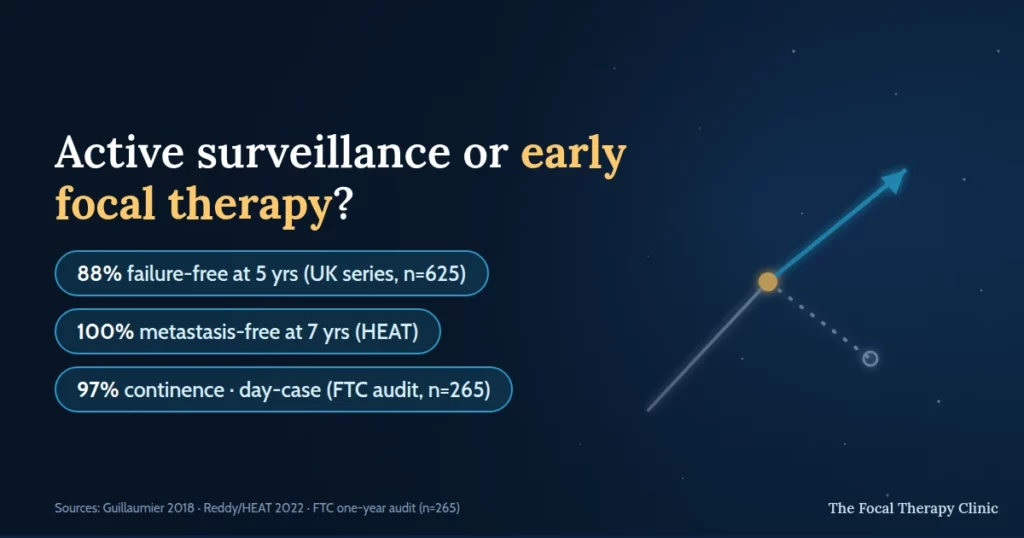
For men with localised prostate cancer and a visible lesion on MRI, the balance between watching and treating is shifting. Focal HIFU — NICE-approved under HealthTech guidance HTG667 — treats only the cancerous area as a day-case procedure, and UK evidence now runs to seven years: failure-free survival of 88% at five years in a 625-man UK series, and 100% metastasis-free survival at seven years in the HEAT registry. In our own audit of 265 patients, 97% maintained full urinary continence and 90%+ preserved sexual function. Active surveillance remains right for some men — but for many with a visible target lesion, there is now a genuine middle path between anxiety-laden monitoring and radical surgery.
- The balance has shifted — in Mr Alan Doherty’s clinic, most low-risk patients who once chose surveillance now opt for focal HIFU
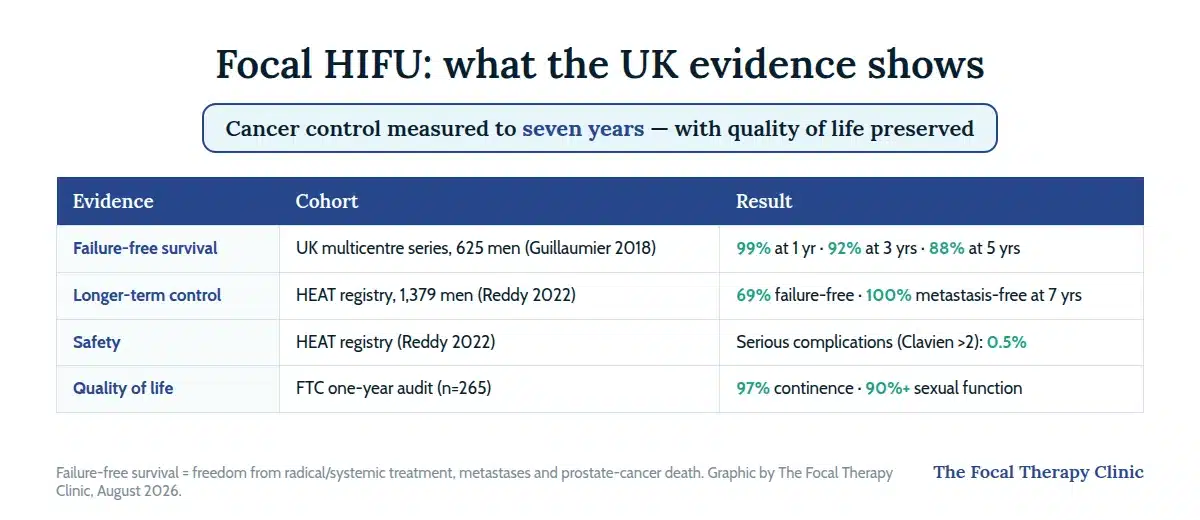
- The evidence has matured — failure-free survival 99% at 1 year, 92% at 3 years and 88% at 5 years (UK series, n=625); 69% at 7 years with 100% metastasis-free survival (HEAT registry, n=1,379)
- Monitoring is not risk-free — in the ProtecT trial, more men on active monitoring developed metastases than in the treatment arms, though deaths were rare in all arms
- Quality of life is preserved — 97% continence and 90%+ sexual function in our 265-patient audit; serious complications (Clavien grade >2) were 0.5% in the HEAT registry
- Surveillance still has a place — with no visible MRI target and very low-risk disease, monitoring remains a sound choice
Why the Balance Is Shifting Toward Treatment
Mr Alan Doherty answers how long you should stay on the active surveillance protocol — and when it is time to reconsider treatment.
Mr Alan Doherty, Consultant Urological Surgeon and Clinical Director at the Birmingham Prostate Clinic, has watched the change happen in his own clinic: where half of his low-risk patients once chose active surveillance, around three-quarters now opt for focal HIFU. Three things drove the reversal:
- Technology — high-intensity focused ultrasound can now be delivered with millimetre accuracy, sparing the nerves that control continence and erections
- Personalised care — men weigh cure probability, sexual function and anxiety differently; offering only surgery or radiotherapy ignores that spectrum
- Maturing evidence — UK outcome data now reaches seven years, with low complication rates and durable cancer control
“There’s more and more evidence to reinforce the fact that active surveillance shouldn’t exist anymore as a treatment option… the oncological outcomes you get with focal therapy, and this study supports them, are very good.” — Mr Alan Doherty, Consultant Urological Surgeon (FRCS(Urol), GMC: 3279241)
What the Evidence Actually Shows
An Imperial College-led study found similar cancer control between focal therapy and radical prostatectomy for selected men for up to eight years. Professor Hashim Ahmed reported that focal therapy can also reduce urinary and sexual side effects by up to ten-fold compared with radical treatment.
Mr Doherty urges care in how that study is read — it was descriptive rather than a true head-to-head comparison, and the two treatments offer different things. But the wider UK evidence base now stands on its own:
| Evidence | Cohort | Result |
|---|---|---|
| Failure-free survival | UK multicentre HIFU series, 625 men (Guillaumier 2018) | 99% at 1 year · 92% at 3 years · 88% at 5 years |
| Longer-term control | HEAT registry, 1,379 men (Reddy 2022) | 69% failure-free at 7 years · 100% metastasis-free |
| Safety | HEAT registry (Reddy 2022) | Serious complications (Clavien grade >2): 0.5% |
| Quality of life | FTC one-year outcome audit (n=265) | 97% full urinary continence · 90%+ sexual function preserved |
“Failure-free survival” means freedom from radical or systemic treatment, metastases and prostate-cancer death — a different measure from biopsy-confirmed cancer clearance.
What Radical Treatment Adds: Two Worked Examples
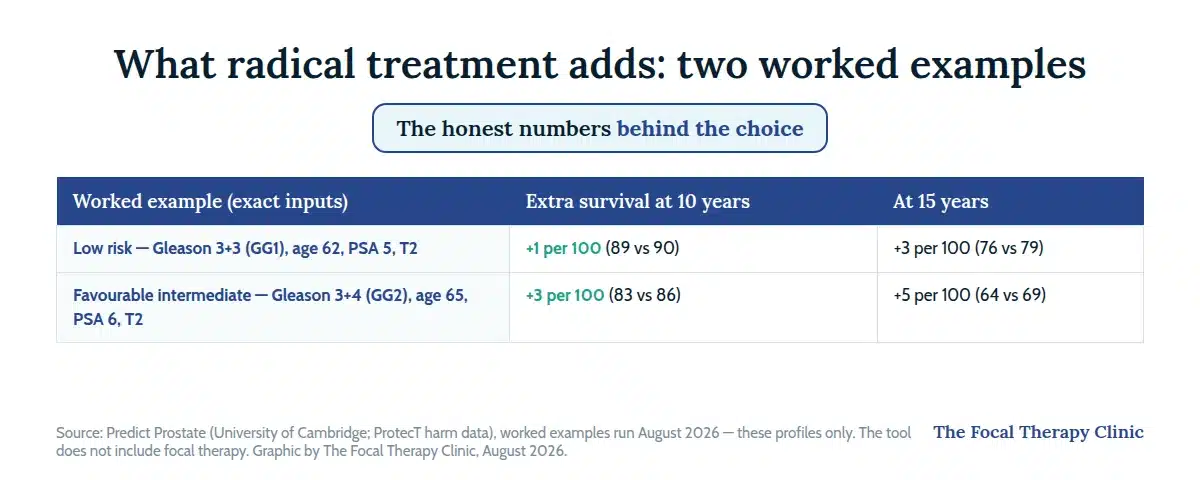
There is a second, equally honest way to see why the balance is shifting. Predict Prostate — the free University of Cambridge decision aid, with treatment-harm estimates drawn from the UK ProtecT trial — lets any man run his own numbers. Two worked examples (exact inputs shown, run August 2026):
| Worked example | Additional survival benefit of radical treatment at 10 years | At 15 years |
|---|---|---|
| Low-risk: Gleason 3+3 (grade group 1), age 62, PSA 5, T2 | 1 more man per 100 (89 vs 90) | 3 per 100 (76 vs 79) |
| Favourable intermediate: Gleason 3+4 (grade group 2), age 65, PSA 6, T2 | 3 more men per 100 (83 vs 86) | 5 per 100 (64 vs 69) |
Read together, these numbers make both halves of the modern argument. For genuinely low-risk disease, radical treatment adds almost nothing — surveillance is sound, exactly as the guidelines say. For intermediate-risk disease the survival gain from radical treatment is still modest, yet the cancer is real, MRI-visible and progressing in a substantial minority — which is why so many men in that position want action without the functional price of whole-gland treatment. That middle ground is precisely where focal therapy sits.
These are worked examples for those exact inputs, not general outcomes; the tool compares conservative management with radical surgery and radiotherapy only — it does not include focal therapy.
Your Three Options Compared
Active surveillance vs focal therapy in one sentence: active surveillance monitors localised prostate cancer with regular PSA tests, MRI scans and biopsies but leaves the cancer untreated, while focal therapy treats the cancerous area in a single day-case procedure — preserving urinary continence in 97% of men — and removes the burden of living with untreated cancer.
| Approach | What it involves | Side effects | When appropriate |
|---|---|---|---|
| Active surveillance | Regular PSA tests, MRI scans and biopsies — no treatment | Minimal physical burden, but ongoing monitoring and cancer anxiety | Very low-risk disease with no visible MRI target |
| Focal therapy (HIFU) | Targeted day-case treatment of the cancerous area only (NICE HTG667) | 97% continence and 90%+ sexual function preserved (FTC audit, n=265) | Localised cancer with a visible MRI target lesion |
| Radical prostatectomy | Complete removal of the prostate gland | Higher risk to continence and sexual function | Higher-risk or multifocal disease |
Sources: NICE HealthTech guidance HTG667; FTC one-year outcome audit (n=265).
“Active surveillance should virtually no longer exist. If there is a target lesion on MRI, then why would you just monitor it when you can successfully treat it?” — Mr Alan Doherty, Consultant Urological Surgeon (FRCS(Urol), GMC: 3279241)
The Game-Changer: Superior MRI and Precision Biopsies
Focal therapy is only as good as the map it is guided by. The diagnostic revolution of the last decade is what made the shift possible:
| Then | Now |
|---|---|
| Biopsy first, MRI sometimes later | mpMRI first — biopsy only if the scan shows a target (NICE NG131) |
| Random transrectal cores | Fusion-guided, transperineal biopsy that hits the lesion |
| Whole-gland treatment | Focal HIFU guided by the MRI map |
| Limited visualisation | High-quality 3T mpMRI that can rule significant cancer in or out |
The quality dependencies are non-negotiable: a 3-Tesla scanner with prostate-optimised protocols, specialist uroradiologist reporting, and MRI-ultrasound fusion targeting. The Focal Therapy Clinic is the only institution in the UK to use MRI-US fusion technology on all of its focal therapy cases — every case since 2020.
The Hidden Burdens of Active Surveillance
“AS is called ‘active’ for a reason – it’s a treadmill. HIFU can take you off that treadmill without the life-changing side-effects of radical surgery.” — Mr Alan Doherty
Surveillance means quarterly PSA tests where every rise triggers worry, repeat MRI scans, often repeat biopsies — and the psychological weight of living with a known, untreated cancer.
The ProtecT trial provides the honest long-term picture. Deaths from prostate cancer were rare in every arm — around 1% at a median of ten years, with no significant difference between monitoring and treatment. But metastases were more common on active monitoring: 33 men (6.3 per 1,000 person-years) versus 13 (2.4) after surgery and 16 (3.0) after radiotherapy. Monitoring defers side effects; it does not remove the disease.
Get Expert Advice & The Latest Research
Subscribe to our newsletter to receive the latest updates, expert insights, and breakthrough research on prostate cancer-delivered straight to your inbox.
When Active Surveillance Is Still the Right Choice
We are transparent about this: not every man should be treated. Where mpMRI shows no target lesion and biopsy confirms very low-risk disease, surveillance is a sound, guideline-supported choice — and some men are more comfortable monitoring than treating. The decision should be made with complete diagnostics (high-quality mpMRI and targeted biopsy), a clear explanation of all three options, and your own priorities — cure probability, sexual function, anxiety — given real weight.
Five Questions to Take to Your Urologist
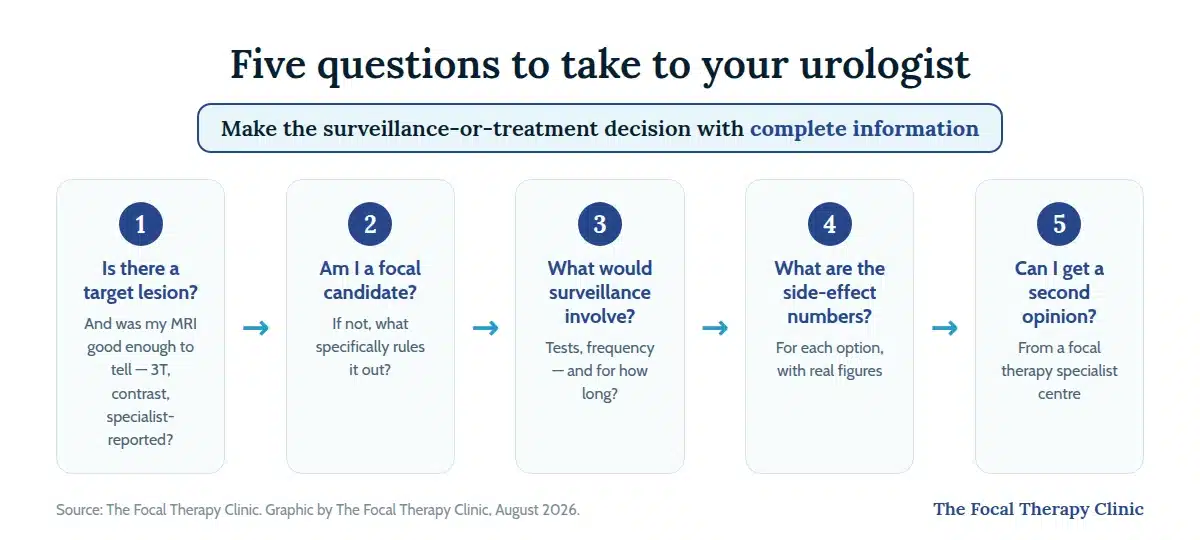
- “Is there a visible target lesion on my MRI — and was my scan good enough to tell?” (3T, contrast, specialist-reported)
- “Am I a candidate for focal therapy, and if not, why not?”
- “What exactly would surveillance involve for me — and for how long?”
- “What are the realistic side-effect profiles of each option, with numbers?”
- “Can I have a second opinion from a focal therapy specialist centre?”
Our consultant urological surgeons review referrals at no obligation across 8 hospital sites in six UK cities, with 2,500+ focal therapy procedures performed and 75+ years of combined focal therapy experience.
Frequently Asked Questions
Is active surveillance safe?
On survival, yes — in the ProtecT trial, prostate-cancer deaths were around 1% at a median of ten years in all arms. But more men on monitoring developed metastases than in the treatment arms, and monitoring carries its own psychological burden. Safety depends on excellent imaging and genuinely low-risk disease.
What results does focal HIFU achieve?
In the UK’s largest published series (625 men), failure-free survival was 99% at one year, 92% at three years and 88% at five years. The HEAT registry (1,379 men) shows 69% failure-free survival and 100% metastasis-free survival at seven years, with serious complications at 0.5%.
Does focal therapy preserve quality of life?
In our audit of 265 patients, 97% maintained full urinary continence and 90%+ preserved sexual function. It is a day-case procedure — home the same day.
Can I have focal therapy while on active surveillance?
Often, yes. Many of our patients come from surveillance after an MRI shows a visible target. Suitability always requires specialist review of your mpMRI and biopsy.
What if my cancer comes back after focal therapy?
Focal therapy preserves future options: the treatment can be repeated, and surgery or radiotherapy remain available afterwards. Follow-up is structured — PSA checks and MRI at set intervals — so any recurrence is caught early.
Why do some hospitals not offer focal therapy?
It requires 3T mpMRI, fusion-biopsy capability and trained specialists, which not every centre has. NICE approved HIFU (HTG667) and NanoKnife IRE (HTG688) for localised prostate cancer; a specialist referral is the route to assessment.
About Mr Alan Doherty
Mr Alan Doherty is a Consultant Urological Surgeon (FRCS(Urol), GMC: 3279241) and Clinical Director at the Birmingham Prostate Clinic, and one of the UK’s most experienced prostate cancer surgeons. At The Focal Therapy Clinic he assesses men for focal therapy suitability with mpMRI and targeted biopsy review.
References
- NICE HealthTech guidance HTG667 — Focal therapy using high-intensity focused ultrasound for localised prostate cancer.
- Guillaumier S, et al. A multicentre study of 5-year outcomes following focal therapy in treating clinically significant nonmetastatic prostate cancer. European Urology 2018;74(4):422–429.
- Reddy D, et al. (HEAT registry). European Urology 2022 — 7-year outcomes, n=1,379.
- Shah TT, et al. Focal therapy compared to radical prostatectomy for non-metastatic prostate cancer: a propensity score-matched study. 2021.
- Hamdy FC, Donovan JL, Lane JA, et al. 10-year outcomes after monitoring, surgery, or radiotherapy for localized prostate cancer (ProtecT). N Engl J Med 2016;375:1415–1424.
- NICE guideline NG131 — Prostate cancer: diagnosis and management.
- The Focal Therapy Clinic one-year outcome audit (n=265).
This content is not intended to replace professional medical advice. Always consult your clinical team about your individual circumstances.
Clare Delmar:
Hello and welcome to The Focal Therapy Clinic. My name is Clare Delmar. And in this audio series, I’m going to introduce you to some issues facing men diagnosed with prostate cancer that are little known, less understood and almost never talked about.
Earlier this year, prostate cancer was acknowledged as the most commonly diagnosed cancer in the UK. And with this sombre fact comes a multitude of challenges and opportunities. In the fourth of our series, I’m speaking with Alan Doherty, one of the UK’s most renowned prostate cancer specialists and clinical director at the Birmingham Prostate Clinic. Alan has completed one of the largest caseloads of prostatectomies in the UK, undertaking more than 3000 operations. He’s recognised for his expertise in nerve-sparing techniques, reducing the risk of erectile dysfunction and incontinence from prostate cancer surgery, and has published extensive results from his nerve-sparing procedures. Recently, he was voted one of the UK’s top ten prostate cancer specialists in a national poll of consultant urologists published in The Daily Mail. Alan, thanks for joining me.
Alan Doherty:
Hi, Clare.
Clare Delmar:
Wonderful to have you on our audio series. I’m going to dive right in with a little bit of irony. I mean, having just described you as a leader and innovator in radical prostatectomies and other so-called invasive procedures, it’s kind of amusing that I’ve asked you to chat with me today about non-invasive procedures like focal therapy and active surveillance. So, can you tell me how you came to embrace focal therapy into the treatments that you offer your patients?
Embracing focal therapy treatment
Alan Doherty:
Well, it’s a really good question. Good point. I think prostate cancer has such a multitude of different pathways, and patients differ in how they value various outcomes. And it’s not for me as a clinician to just offer one form of treatment, it’s for me to offer a range of treatments which will be appropriate to the patient and their problem. So it would seem wrong to me to just be a specialist in one thing. And I think focal therapies have some advantages but also some disadvantages.
Clare Delmar:
And why has focal therapy in your practice become more popular? If I could use that word but do correct me if that’s not the right word.
Alan Doherty:
I think it’s because focal therapies, particularly HIFU, which stands for high-intensity focused ultrasound is evolving, and we are getting a better understanding of how it works and how we can deliver it and the benefits and the risks involved. So my patients are now able to perhaps understand what the advantages and limitations are a bit better. I mean, I have been doing HIFU for well, gosh, must be seven or eight years that we’ve been I’ve been involved in HIFU.
I think the treatment was offered to perhaps too broad a spectrum of people. It was before the day of MRI scanning, and we can now perhaps better identify where the cancer is. And we used to treat the whole gland. And I think the disadvantage of that was that it did actually cause quite a few problems. So the early use of HIFU was perhaps not quite as good as we seem to have it now. So my enthusiasm has increased as we’ve got better understanding of it.
Clare Delmar:
So, better imaging has clearly led to better diagnostics. And we can now see where prostate cancer lesions are and even measure how aggressive they are. Is that correct?
Improving diagnostic imaging
Alan Doherty:
Well, I think that is absolutely right. And I think the people who are enthusiasts of focal therapy do put a lot of value on the MRI scan. Of course, it’s going to be a good MRI scan, and there are various levels of quality to an MRI scan. They assume that the machine is the machine and the answer is the answer.
I think a really high-quality MRI scan where you can identify the higher-grade cancer does open up this whole chapter of focal therapy to allow you to pinpoint destruction of the cancer and yet not causing a lot of collateral damage, which is what essentially gives the side effects to most treatments.
Clare Delmar:
So, as well as opening up for focal therapy it, the better the MRI, the better we can see this cancer. It also opens up opportunities for active surveillance. Does that mean now that it’s a real option for some men and that we can literally watch them or surveil them, as the term suggests, regularly and closely?
Alan Doherty:
Well, that’s very true. And yet you can also argue that if you have a treatment such as HIFU with very little co-morbidity, then why just watch the cancer go from a situation where it’s not particularly dangerous to one where it is dangerous when you could alter the natural history and at worst delay the progression or at best cure them? And I think people forget with active surveillance, the monitoring does involve quite a lot of… the reasons it is called active surveillance because it is an active process.
You have regular PSA blood tests, which of course can be stressful if the PSA is going up. You have numerous MRI scans which can be expensive and then sometimes you need repeat biopsies and so there is a strong argument that, you know, instead of putting people on active surveillance, well, you should consider treating the abnormal area. I think if the MRI scan picks up an abnormality. You think, well, why not treat that abnormality?
I can see why, if the treatments available are potentially going to make your life miserable, that you might want to just monitor it. But if the treatments don’t do that, then, you know, why not have it treated?
Clare Delmar:
We often find that patients come to us who are on active surveillance, and it kind of comes to them a bit late in the game that the active, as you suggest, this is on their part as well as the clinician.
Alan Doherty:
Well, I think people forget with active surveillance that, you know, what are we waiting for? Are we waiting for it to go from a curable to an incurable cancer? People think that we have this amazing ability to know when that’s gonna happen. We don’t. It’s a probabilities game.
You go from a very high likelihood of being cured to a lower probability of being cured. The question is, what percentage are you comfortable with? Are you comfortable with a 90 per cent chance of being cured? Are you comfortable with a 70 per cent?
So, in other words, the higher the PSA goes, the lower the likelihood of you being cured is. So it’s all very well and good being monitored, but you have to understand the consequences of the monitoring. And the fact that it isn’t quite as scientific as you might think – this is very much looking at a window of curability, which is closing the longer you monitor it for. Now, that doesn’t mean that you necessarily will die of prostate cancer if you missed the window of cure, because we can control cancers very well with hormone treatments, radiotherapy, chemotherapy and lots of new treatments that are coming out.
So, you know, when people see you’re not going to die of prostate cancer if you go on to active surveillance. That’s probably true. But you may end up having lifelong treatments, which had you gone for a curative treatment, that wouldn’t be the case.
Clare Delmar:
Yeah. That’s interesting. So while you have this technology to spy literally on the cancer. There’s a lot of activity and other options that needs to be considered. Some people often have told us, too, that one of the challenges they face under active surveillance are more behavioural or psychological. Can you comment on that?
The anxiety of active surveillance vs focal therapy
Alan Doherty:
Oh, yes, very much so. I think the average time people can stomach active surveillance is about two years.
Clare Delmar:
Have there been studies on that, or is that your observation?
Alan Doherty:
Observation, but also from studies, so if you look at studies like the ProtecT trial, it’s within the first two years that you tend to get that change. It’s around two years where people just seem to have had enough of it and they say, well, fair enough, let’s have treatment. So it’s I suppose it’s more observational than anything else.
But certainly, in the studies I’ve been involved with, I’m not surprised seeing patients at about two years saying enough’s enough, the PSA has gone up, and it’s got into my head. PSAs tend to fluctuate up and down. And so, you know, sometimes people get sort of relief that the PSA has gone down a bit or was stable.
But if the PSA doesn’t and it’s sort of slowly climbing up, which it tends to do over a two year period, you know, people just sort of say enough’s enough, let’s have treatment.
Clare Delmar:
So, like, let’s just assume this two year period is an average of sorts. Would you say that there is a risk if you wait two years that, you know, the curative treatment that you mentioned might have to be more invasive? Is that something to warn someone about?
Alan Doherty:
Yeah, it’s not only more invasive but also more prolonged in that you’ve missed the opportunity to go for a curative intervention, and instead, you’re getting a sort of controlling intervention. And, of course, we’ve never come across a cancer ever that’s gone away. And it tends to grow slowly.
And the question is, what’s the speed of progression? And nobody knows that for sure. So every now and then, you’re going to have someone who you thought was going to progress slowly, who progresses more aggressively. And that’s where this window of curability starts to close in terms of percentage likelihood of cure.
Clare Delmar:
So you will suggest to patients that focal therapy is a real alternative for active surveillance?
Alan Doherty:
That’s very much my philosophy, which is if you are prepared to monitor it, then, you know, why wouldn’t you want to go for a treatment that could potentially cure you? Almost certainly will delay the progression of it in that if you kill the majority of it, that’s surely going to be helpful.
Clare Delmar:
And do most of your patients agree with that and take that action?
Alan Doherty:
Most of my patients will sort of get that. There are patients who worry about HIFU, partly because it’s not available widespread. And I think as I mentioned at the beginning when it was used probably incorrectly and in too widespread a fashion, it’s made some people wary.
Certainly, other urologists are a little bit wary of it, and I think patients pick up on that. But I think the tide’s changed. I think because of better imaging, as we said at the beginning, HIFU is going to become a bigger player.
Clare Delmar:
So a slight shift from this, but picking up on this whole idea of having to wait. And you know that the psychological and the clinical aspects of that. How are the delays in the diagnostics and treatment for prostate cancer based on Covid-19 in the last few months? How have those delays impacted your practice and your patients’ treatment?
COVID-19 pandemic delays and its consequences
Alan Doherty:
I think there are patients who were halfway along the diagnostic pathway and it all suddenly came to an end. And in that group, you know, I’ve seen patients who really got quite stressed by it because they didn’t get to the stage where we were able to tell them whether this was an aggressive tumour or not or if they did have an MRI scan and it suggested that it was aggressive, they weren’t able to go and have the biopsies to confirm it. So I think what’s interesting is that a lot of patients won’t have had their PSA blood test.
Now, as you know, PSA is the way that we assess the risk of having prostate cancer. It’s a prostate health check, in a way. And the charities that used to do the PSA measurements, the GPs that would have done it as part of the sort of symptoms assessment. And then there’s the BUPA health checks, the health assessments. They haven’t been done. So there are probably people who just don’t even know they’ve got a high PSA who will no doubt be found in the next few months or so. And I suspect that’s quite a big cohort of people.
So we’ve definitely had a big effect, the Covid. And it’s ongoing because the NHS is catching up now. And I think that the whole process can be expensive for a self-funder if you include MRI scanning and biopsies and the like.
Clare Delmar:
So are you optimistic that the NHS will be able to pick up some of this? Or, how would you advise somebody listening to this who has an early-stage diagnosis and has been delayed?
Alan Doherty:
First of all, I think these sorts of interviews are really helpful to patients to sort of understand the issues. And I think you’ve got to understand the issues. And you can be very clear on what questions you’re trying to ask when when you have a PSA blood test. You know, what is it you want to know? And then we have an MRI scan. What how are you going to act on it? And then when you have a biopsy, what treatment are you likely to have or not have? I mean if you really think about it, the active surveillance group shouldn’t really exist because, you know, if you have an MRI scan that is normal, you know, why we biopsying them?
And if a patient is found to have a cancer and then you say we’ll leave it alone, well again, that doesn’t make sense, because before you biopsy them, you should say to them, what are you going to do if I find a cancer? And you say the likelihood is if I finally cancer with a normal MRI scan is that it’s not gonna be an aggressive one. So why am I biopsying you?
So I think patients really need to be first of all clear on what they’re asking and what they’re going to find. But if they decide that they do want to proceed.
Am I optimistic that the NHS will catch up? Well, I have found in my experience that the NHS will not tend to have specialists who do nothing else but report MRI scans. So the quality of their MRI is variable. It’s very hard to put value on it. And then when they do the biopsies, they don’t necessarily do them in a way that I would say minimises false negatives.
I think they’re more obsessed about doing it in a way that is quick, easy. And for example, there are different ways and taking biopsies, you can do it through perineum but through one or two holes rather than through 20 holes. So, I think maybe, perhaps nobody’s looking at the efficacy of the interventions and what they are trying to find.
So, yes, I think patients need to ask that question to the urologist saying, how do you know the MRI scan’s up to scratch? Will it serve my purpose?
Clare Delmar:
It’s almost like a supply chain, you know, audit.
Alan Doherty:
Yeah.
Clare Delmar:
There are these key stages, as you say, that have a massive impact on the sequential stage.
Alan Doherty:
Absolutely right. People often get to the end of the pathway without even thinking about what they’re gonna do with the information or how valid the information is.
Clare Delmar:
Alan, I really want to thank you for your insights. I think this has been incredibly helpful, certainly for me, but especially for our patients who are listening.
If you’d like a consultation with Alan Doherty, please contact us at The Focal Therapy Clinic.
And if you’d like to learn more about focal therapy and engage with patients who have chosen to undergo focal therapy instead of active surveillance, please visit our website at www.thefocaltherapyclinic.co.uk. And from me, Clare Delmar, see you next time.