
At a Glance
HIFU (High-Intensity Focused Ultrasound) focal therapy is a NICE-approved treatment (HTG667) that is particularly well suited to older men with localised prostate cancer. At The Focal Therapy Clinic, our consultants have collectively performed 2,500+ procedures, and our patient data shows that age alone is not a barrier to treatment. In our clinic’s experience, men in their 70s, 80s, and even late 80s have undergone HIFU as a day-case procedure and returned to normal activities within days — avoiding the prolonged recovery associated with radical surgery. Peter Hall, aged 87 at the time of this interview, shares his story below.
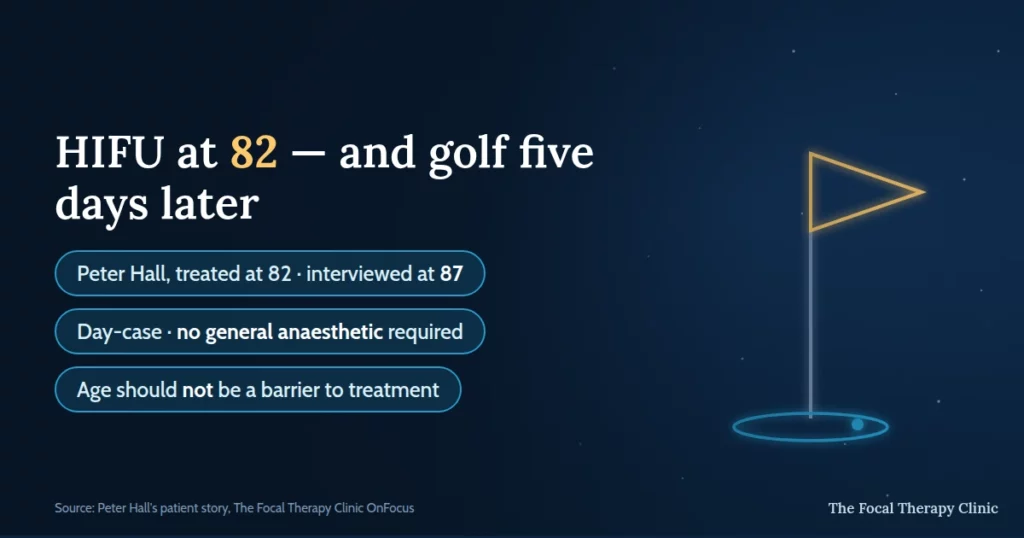
- Treated at 82, golfing five days later — Peter’s HIFU procedure was booked within a week of diagnosis, and he was back on the course within days
- Recurrence handled without surgery — when a small cluster of cells returned two years later, a second focal treatment resolved it; his PSA settled at 1
- Age was never mentioned — “My age never, ever occurred to me and Tim never mentioned it”
- His advice — establish regular PSA testing, know your options, and if you’re told age rules out treatment, remember it should not; see our guide on age and treatment access
A Discussion with Focal Therapy Patient Peter Hall on Enjoying Life at 87
- Peter shares his positive experience with focal therapy treatment and his quick recovery from the procedure
- He explains the hurdles of opening up conversations about prostate cancer amongst older men and the impact this can have on awareness and education about the disease
- He stresses the importance of getting a PSA and encourages men to talk to their doctors about the various treatment options available, including focal therapy treatment
Peter Hall is 87 years young and joins OnFocus to share his experiences with focal therapy for prostate cancer and to encourage older men to seek PSA testing.
Please find below a written transcript of the interview, and call The Focal Therapy Clinic today to discuss your prostate cancer treatment options: 020-7036-8870.
Clare Delmar
Hello and welcome to OnFocus, brought to you by The Focal Therapy Clinic, where we connect you with issues facing men diagnosed with prostate cancer that are little known, less understood and often ignored. Prostate cancer is now the most commonly diagnosed cancer in the UK, and with this sombre fact comes a multitude of challenges and opportunities. I’m Clare Delmar. Today, I’m speaking with Peter Hall, a recent HIFU patient, about his experience with prostate cancer. In particular, we’re going to talk about how his age played a role in the treatments offered to him and what his experience suggests for older men. Peter, thank you so much for joining me today.
Peter Hall
It’s a great pleasure, Clare.
Clare Delmar
Wonderful. So, Peter, let me ask the biggest question that’s probably on all of our listeners’ minds. How old are you?
Peter Hall
I am 87. I will be 88 in May of next year.
Clare Delmar
Wonderful. Okay. So and Peter, to tell us a little bit about your lifestyle, are you fit and active and what sort of things do you enjoy doing?
Peter Hall
Well, fortunately, through the treatments that I have had, I’m extremely fit. And as a consequence of that, I’m very happy. In my retirement, I enjoy painting because I trained at art school. And so that’s usually a summer thing, I do painting. In the winter, my wife and I enjoy the great outdoors because we live in a small market town in the Black Down hills of Somerset, and it’s great to get outside.
My Prostate Cancer Diagnosis
Clare Delmar
So, Peter, tell us a little bit about what happened when you were initially diagnosed with prostate cancer.
Peter Hall
Well, it was in 2015 and I was then 82. And I suddenly experienced a surge in my PSA figures cause I have an annual PSA, and they went 4, 6, 8. Now that is very bad news. So I requested a referral to a consultant. I did my homework on the internet, of course. There’s a vast amount of information and knowledge, and I was referred to a urological surgeon who was a specialist in something that was very new at the time, which was Focal therapy, which is HIFU. And the guy who I saw was Tim Dudderidge, a leader in his field. And after examination, he confirmed that I had an early diagnosis of prostate cancer, which… that’s a bit of a setback. But he was a nice man, a very kind man. He sat me down, and we discussed options, and he explained to me what HIFU focal therapy was. So having that understanding, we agreed that he would actually treat me with HIFU. This was carried out quite quickly within a matter of seven days of his diagnosis. What happened afterwards was surreal and because of the speed at which it happened. I had the treatments during the morning or late afternoon, I stayed overnight in hospital to demonstrate that I could actually urinate, and then I came home with a catheter and a bag strapped to a leg.
Clare Delmar
Yeah.
Peter Hall
It was uncomfortable but irrelevant.
Clare Delmar
Indeed.
Peter Hall
And this was removed after about three days. Now this is what it really is unbelievable.
Clare Delmar
Okay.
Peter Hall
But this is what happened. Two days later. So we’re talking about five days in total. Having had the procedure, a friend and I played seven holes of golf using a buggy to get around. And then we went into the clubhouse and the winner paid for lunch.
Clare Delmar
Okay. And who was that?
Peter Hall
Yeah, uh, me.
Clare Delmar
Right.
Peter Hall
So I paid for lunch. Amazingly, I had no ill effects. I’m as fit and healthy as I’ve ever been, and that lasted for two years. Then the unbelievable thing happened.
Clare Delmar
Which was?
Peter Hall
The cancer returned.
Cancer Recurrence: Where to Go from Here
Peter Hall
It was a small cluster of cells. And Tim said to me they’re in a difficult place to access, and therefore, I can’t do HIFU again. I said, okay, what do you propose? He said there is another focal therapy treatment available too which I’m recommending and it’s called cryotherapy. So I said, well this sounds a bit like spacewars, you know. Tell me about cryotherapy. What the hell is that?
Clare Delmar
Yeah, indeed.
Peter Hall
He said, well, cryotherapy focuses on each cell and freezes it solid without damaging the surrounding tissue. He said all cells have water in them. Freezing them destroys them utterly. Like HIFU, this was very successful. And then, once again, after demonstrating I could actually urinate, I was free to go. And my current PSA reading, which was done, you know, a few months ago, is a staggering 1.
Clare Delmar
Wow.
Peter Hall
I mean, a newborn baby is probably 1. So these new treatments for prostate cancer are extremely effective, and they have extraordinary success rates. Availability and access to them is another matter.
Clare Delmar
So that’s what I wanted to ask you. I mean, before you went to explore and ultimately receive both of these different focal therapy treatments, did you have other recommended treatments offered to you?
Peter Hall
The answer is as far as the NHS is concerned, because, I mean, my GP works for the NHS, and he said to me, the NHS will offer you treatment, of course, it will, and it will be surgery, he said, and there are other options available. I said, I am aware of that and I don’t know much of the detail. I said, but I do have private insurance. Whilst I was working, I worked for Allied Domecq, a French company which spans the globe. Now the package for a director and senior management on retirement, was as well as getting a pension, you got private health care.
Clare Delmar
Right.
Peter Hall
So I was able to say to my doctor, I’m very lucky. I’ve got private health care. I leave it to you to decide who you’re going to refer me to. He said, well, with that in mind, I said I’m going to refer you to Tim Dudderidge.
Clare Delmar
Right, right. Well, boy, you were fortunate in that.
Peter Hall
Very, very lucky boy.
The Hurdles of Age and Prostate Cancer Treatment
Mr Tim Dudderidge answers whether you can be too old for prostate cancer treatment — why age alone should not rule out effective options.
Clare Delmar
Yeah, and when you first engaged with him, you never felt that your age was in any way an obstacle or a hindrance in any kind of treatment.
Peter Hall
It never occurred to me that my age would be an obstacle. It was only later when I realised that once you got to the age of 70 and I was 82, when you got to the age of 70, as far as the NHS was concerned, life could be very difficult.
Clare Delmar
How do you mean?
Peter Hall
Getting any kind of treatment.
Clare Delmar
Yeah. Is that something that you picked up…?
Peter Hall
It’s a watershed.
Clare Delmar
Did you pick that up from your own experience or from…?
Peter Hall
I only picked it up fairly recently, to be truthful. My age never, ever occurred to me and Tim never mentioned it.
Clare Delmar
So how did you pick it up recently?
Peter Hall
On the Internet.
Clare Delmar
Right. I see. OK, and what about any friends or any of your golfing colleagues?
Peter Hall
Well, all golf clubs are filled with people like me. They really are.
Clare Delmar
Maybe not as lucky as you…
Peter Hall
Elderly people, elderly males, who’ve played golf probably most of their life. And once they retire, they can play three or four times a week and they can escape the winter by going overseas and Spain, particularly, and Portugal and go for three months of the winter and, you know, have a really nice time.
Clare Delmar
And have you talked with them about their own experiences?
Peter Hall
The answer is yes but in a guarded way. It’s a sensitive subject, you know, as far as men are concerned, particularly as they get older.
Clare Delmar
Yeah.
Peter Hall
But if in conversation, you know, in the club, somebody casually mentions that their PSA has going a bit wobbly, I’ve taken the opportunity to say, look, go on the Internet, look at HIFU, look at people who are offering it. There are many, many options. It all depends on what kind of cancer you have got, particularly prostate cancer. Prostate cancer in the UK kills 23 males every day of the week.
Editorial note: Peter’s interview was recorded in 2020, and his figure reflects the information he had at the time. Cancer Research UK’s current statistics record around 12,300 prostate cancer deaths a year in the UK.
The Importance of Screening and PSA Testing
Clare Delmar
Yeah, yeah. It’s a shocking statistic.
Peter Hall
They are shocking. Well, it’s equally shocking in my view, is that the government for years and years and years have put into place and quite rightly, circumstances where women can have tests to make sure that they pre-empt cancer.
Clare Delmar
Yeah. So you’re referring to mammography for example.
Peter Hall
Yeah. Yeah, yeah. There’s a three or four very serious cancers which are killers of women.
Clare Delmar
Yeah, ovarian, cervical and breast cancer. Definitely.
Peter Hall
Yeah. And there are screening processes for them.
Clare Delmar
Yes.
Peter Hall
And that’s very helpful.
Clare Delmar
Yes.
Peter Hall
There is zero screening processes for male cancers and particularly prostate cancer. There is nothing.
Clare Delmar
That’s true. No, you are entitled, as you know, to request a PSA test and clearly, as you stated earlier, you’ve been doing that anyway. But you’re right. I mean, you have an entitlement to ask, but many men don’t know or choose not to ask.
Peter Hall
That entitlement has reappeared recently. If you go back 8 to 10 years, it was withdrawn by the General Medical Council. I had been having a PSA test from the age of 40. So I turned up one day when I’m 82, or something like that, to my doctor and say I’ve come to my annual PSA test. They said that’s a problem. What problem? He said the General Medical Council have withdrawn it. I said, okay, what happens now? He said, as far as you’re concerned, nothing. Roll up your sleeve.
Clare Delmar
So you received it anyway?
Peter Hall
Yeah, yeah. But I wasn’t given. This has now been re-established.
Clare Delmar
Yes, it has. You’re right. You’re quite right.
Peter Hall
The argument for the PSA as far as the General Medical Council is concerned, is that there was no solid medical evidence of it actually having efficacy, that it actually worked, but at the same time, they didn’t have anything else to put it in place.
Clare Delmar
Yeah, yeah.
Peter Hall
And so to this day, if you have any form of cancer as a male. Yeah. You have treatment no matter what the treatment is. The first signal that they look for, that the treatment has worked is they give you a test, and that’s it.
Clare Delmar
So you had a quite a fortunate experience and that you actually had your PSA test, and that’s what led you ultimately to your successful treatment both times?
Peter Hall
When I had the PSA test that revealed that I had early signs of prostate cancer, that was, as I was concerned, purely routine. If I had not taken that test, I would have just gone on and on and on, like so many men. Eventually, it would have killed me.
Get Expert Advice & The Latest Research
Subscribe to our newsletter to receive the latest updates, expert insights, and breakthrough research on prostate cancer-delivered straight to your inbox.
Why HIFU Is Well Suited to Older Men
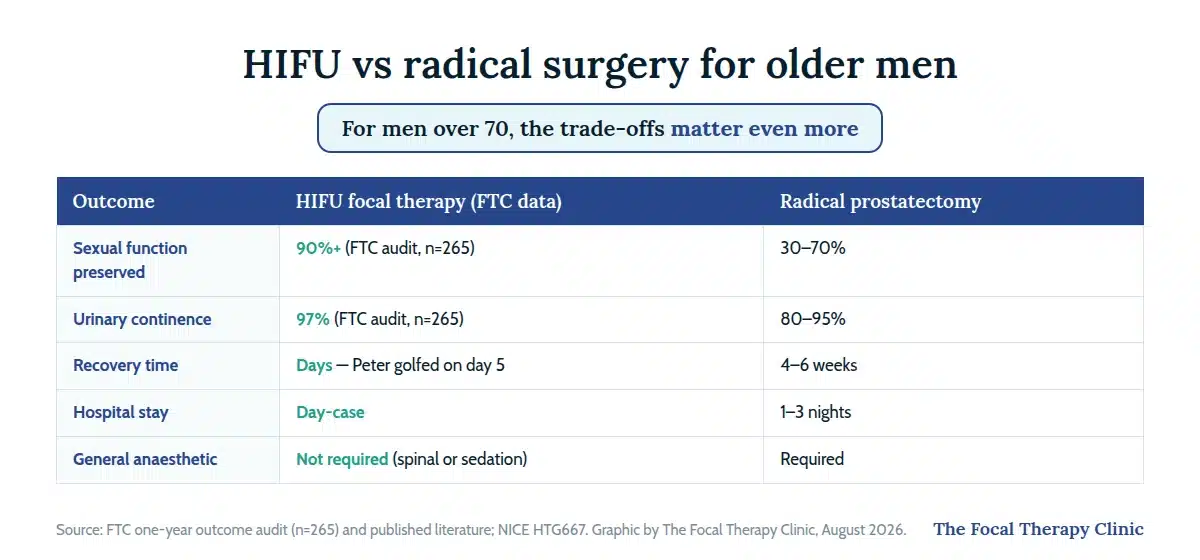
For men over 70 or 80, the side effects of radical treatment can significantly impact quality of life. HIFU focal therapy (NICE HTG667) offers a minimally invasive alternative. Based on our clinic’s outcome data, here is how HIFU compares to radical prostatectomy for older patients:
| Outcome | HIFU focal therapy (FTC data) | Radical prostatectomy |
|---|---|---|
| Sexual function preserved | 90%+ (FTC audit, n=265) | 30–70% |
| Urinary continence | 97% (FTC audit, n=265) | 80–95% |
| Recovery time | Days (Peter played golf 5 days later) | 4–6 weeks |
| Hospital stay | Day-case (home same day) | 1–3 nights |
| General anaesthetic required | No (spinal or sedation) | Yes |
| NICE status | Approved (HTG667) | Standard care |
Source: FTC one-year outcome audit (n=265) and published literature. Individual outcomes vary; suitability depends on cancer grade, location, and overall health.
As Mr Tim Dudderidge, Consultant Urological Surgeon (FRCS(Urol), GMC: 4505451), explains: “We often schedule procedures for the late afternoon, and even if treated late, most patients can still go home that evening.” For older men like Peter, who was 82 at his first HIFU procedure and 87 at the time of this interview, the ability to avoid a prolonged hospital stay and general anaesthetic is a significant advantage.
If you have been told you are too old for treatment, our guide to age and prostate cancer treatment access explains your rights and options. To find out whether HIFU may be suitable for you, visit our medical suitability page or book a consultation with one of our GMC-registered consultant urologists.
My Advice for Seeking Treatment for Prostate Cancer
Clare Delmar
So what then, Peter, do you suggest if you were to give some advice to older men like yourself who are diagnosed with prostate cancer? How would you advise them to seek the best advice and the best treatment?
Peter Hall
I have these conversations quite frequently with men in my age group, you know, cause it’s not a taboo subject by any means. And I say, look, the first thing you’ve got to do is to establish a regular PSA test in your life. And at your age, annual isn’t good enough. You really need to have a PSA test every six months. I say now if then you’re unlucky or lucky, whichever way you want to put it…
Clare Delmar
Yeah.
Peter Hall
…is that there are new treatments for prostate cancer. It’s not just a matter of having surgery. Yeah. And having your prostate removed or cut away or whatever. You can avoid that because the advances that have been made in the treatment of prostate cancer are huge. HIFU being one of the principal things. And you should really seek out a practitioner who will actually discuss with you whether HIFU is suitable. I said, at the end of the day, if you’ve got cancer and you’re going to have treatment for it, you need to know what kind of cancer you’ve got and how extensive it is, and then discuss with the expert what kind of treatment would suit you best. And if you’re comfortable with that, go for it.
Clare Delmar
Yeah, another question you mentioned earlier when you were discussing how this has come up with some of your friends, and you mentioned that this conversation often happened on the golf course or at the golf club.
Peter Hall
Yeah.
Clare Delmar
Do you think that golf clubs like yours are places where there can be more of, I don’t mean to say official, but, you know, a more of a scaleable information campaign to actually help men understand exactly the kinds of things that you’re suggesting?
Peter Hall
The answer is yes. At least 10 years ago in the men’s toilets, official posters appeared advising them in fairly straightforward English, cause this is men only, about the dangers of ignoring the first signs of a problem of urinating because that can be an early indicator that there’s something wrong. And the poster said do something about it because you may have prostate cancer, and they’re still there to this day. The subject to now is more open as far as men are concerned.
Clare Delmar
I think you’re right, but it’s interesting to hear you say that, and especially within, you know, groups of older men like yourself, that it’s not something to be afraid of. Yeah, well, you’ve had a really good experience.
Peter Hall
I’ve been very, very, very, very lucky all the way through.
Clare Delmar
Yeah, I can hear that. Well, I just want to thank you for joining me today and speaking with me very openly about your experience. I mean, you really are quite an inspiration for other men and very keen for older men to understand that they do have options, and those are very real. So thank you very much, Peter.
Peter Hall
Well, I’m very grateful to have had the opportunity, and I hope my tiny contribution just helps some poor guy down the road who doesn’t quite know what to do.
Clare Delmar
Wonderful. A transcript of this interview is available on our website. If you’re interested in learning more about HIFU in older men and how we approach it at The Focal Therapy Clinic, visit our Web site at www.thefocaltherapyclinic.co.uk, where you can access additional interviews with both patients and clinicians about their experiences with prostate cancer. Thanks for listening and from me, Clare Delmar. See you next time.
What the Numbers Say About Age and Treatment
Peter’s experience — treated at 82 with age “never mentioned” — is backed by the arithmetic of treatment decisions. The Predict Prostate decision aid (University of Cambridge; harm estimates from the UK ProtecT trial) shows what radical treatment actually adds for the same cancer at different ages. Worked examples with identical inputs — Gleason 4+3 (grade group 3), PSA 12, stage T2 — run August 2026:
| Age at diagnosis | Alive at 15 years — conservative management | Alive at 15 years — radical treatment | Additional benefit of radical treatment |
|---|---|---|---|
| 70 | 45 of 100 | 51 of 100 | 6 more men per 100 |
| 78 | 16 of 100 | 19 of 100 | 3 more men per 100 |
The radical-surgery margin narrows with age — which is not a reason to deny older men treatment, but the reason day-case, function-preserving treatment like HIFU matters more with every added year: it controls the cancer without asking an 80-year-old to pay a major-surgery price for a shrinking statistical gain. For the full picture on age and treatment access, see our guide: Too Old for Prostate Cancer Treatment? When Doctors Say No Because of Age.
For the clinic’s published results with this approach, see our one-year MRI-fusion HIFU outcomes.
Worked examples for those exact inputs, not general outcomes; the tool does not include focal therapy.
References
- NICE HealthTech guidance HTG667 — Focal therapy using high-intensity focused ultrasound for localised prostate cancer.
- Cancer Research UK — Prostate cancer statistics.
- The Focal Therapy Clinic one-year outcome audit (n=265).
This content is not intended to replace professional medical advice. Always consult your clinical team about your individual circumstances. Patient experiences are individual; outcomes vary.