
At a Glance
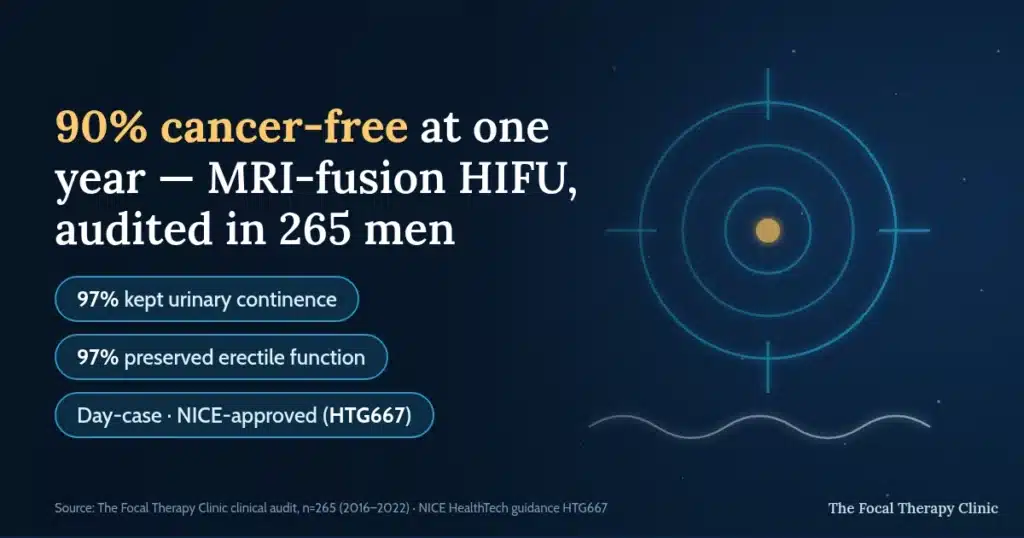
In our clinical audit of 265 men treated with MRI-fusion HIFU (NICE-approved, HTG667) at The Focal Therapy Clinic between 2016 and 2022, 90% remained cancer-free at one year. Critically, 97% maintained full urinary continence and 97% preserved erectile function under the audit’s strict definition — demonstrating that effective cancer control need not come at the cost of quality of life.
Key takeaways:
- 90% cancer-free — 238 of 265 patients showed no evidence of significant cancer at one-year follow-up biopsy (FTC audit, n=265).
- 97% continence preserved — only 7 men (2.6%) required pads; 1 required sling surgery at one year.
- 97% erectile function preserved — under the audit’s strict definition (needing more than oral medication at one year), only 8 men (3%) required intracavernosal injections and none experienced complete erectile dysfunction.
- Significant PSA reduction — mean PSA fell from 6.6 to 2.0 ng/mL, indicating effective tissue ablation.
- Retreatment options preserved — of the 10% needing further treatment, half were managed with repeat focal therapy.
What Did Our One-Year Audit Find?
In our clinical audit of 265 consecutive men treated with MRI-fusion HIFU (High-Intensity Focused Ultrasound, NICE-approved under HTG667) at The Focal Therapy Clinic between June 2016 and December 2022, 90% remained cancer-free at one year, 97% preserved urinary continence, and 97% preserved erectile function under the audit’s strict definition. These outcomes were achieved in carefully selected men with localised prostate cancer assessed by our multidisciplinary team (MDT).
Why This Matters for Patients
Traditional whole-gland treatments such as radical prostatectomy and radiotherapy can carry significant side-effect risks to urinary and sexual function. Focal therapy targets only the cancerous area while preserving surrounding healthy tissue. NICE supports focal HIFU under special arrangements with outcome collection and audit (HTG667), reflecting a growing evidence base that our audit data contributes to.
What Is MRI-Fusion HIFU?
Mr Marc Laniado explains MRI-ultrasound fusion technology and how precision imaging underpins focal therapy’s success rates.
MRI-fusion HIFU is a NICE-approved focal therapy (HTG667) that overlays your pre-treatment MRI scan onto live ultrasound during treatment, allowing the surgeon to target cancerous tissue with greater precision while preserving surrounding healthy structures. At The Focal Therapy Clinic, this approach contributed to our audit outcomes of 90% cancer control with 97% preservation of continence and erectile function (FTC audit, n=265).
The Technology in Brief
In our programme, expert uroradiologist Dr Clare Allen (FRCR) performs MRI contouring of the tumour, which is then transferred to the Sonablate HIFU system using MIM Symphony software. This assists the treating surgeon in aligning the treatment zone precisely with the MRI-defined target.
How It Differs from Standard HIFU
Standard HIFU relies on TRUS (transrectal ultrasound) guidance and the operator’s cognitive alignment of MRI findings to real-time ultrasound. Software-based MRI-US fusion is a technical refinement designed to improve registration accuracy and reproducibility across different operators and treatment sessions.
How Was the Audit Conducted?
This retrospective clinical audit reviewed 265 consecutive men with localised prostate cancer treated with MRI-fusion HIFU at The Focal Therapy Clinic between June 2016 and December 2022. All patients were assessed by our MDT, which includes four consultant urological surgeons (FRCS(Urol)) and an expert uroradiologist, before proceeding to treatment.
Patient Selection Criteria
All 265 patients underwent comprehensive evaluation including:
- Multiparametric MRI — scanning and expert contouring by Dr Clare Allen (FRCR)
- Targeted and systematic biopsies — to confirm cancer grade and location
- MDT review — multidisciplinary team discussion of suitability
- Expert uroradiologist contouring — precise tumour mapping for treatment planning
Treatment Protocol
- Device: Sonablate HIFU system
- Software: MIM Symphony for MRI-ultrasound fusion
- Margins: 6–10mm around identified lesions
- Setting: Day-case procedure under general anaesthetic
- Follow-up: PSA at 3, 6, 9, 12 months; MRI at 12 months
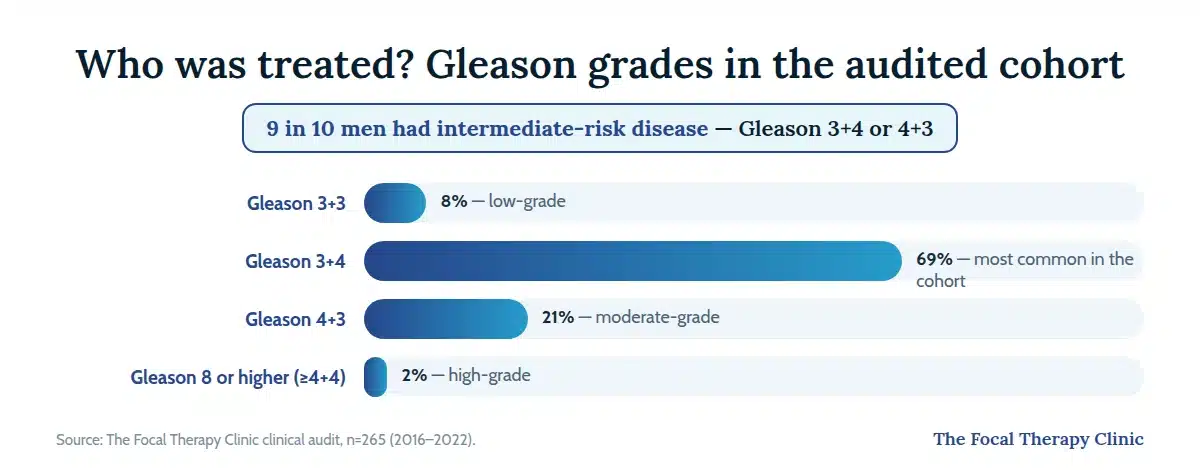
Gleason score distribution:
| Gleason score | Share of cohort |
|---|---|
| Gleason 3+3 | 8% |
| Gleason 3+4 | 69% |
| Gleason 4+3 | 21% |
| Gleason 8 or higher (≥4+4) | 2% |
What Were the Cancer Control Results?
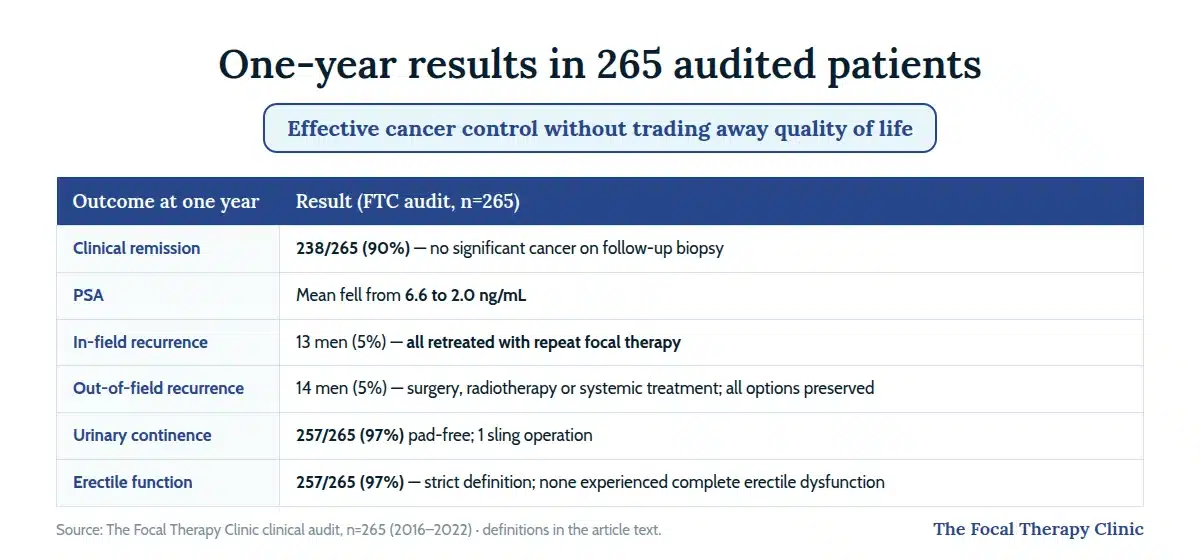
In our audit of 265 patients treated with MRI-fusion HIFU at The Focal Therapy Clinic, 90% (238/265) were in clinical remission at one year — consistent with the cancer control rates supporting NICE approval of focal HIFU (HTG667). Mean PSA fell from 6.6 to 2.0 ng/mL.
Oncological Outcomes at One Year
- 238/265 (90%) — patients in clinical remission at one year (FTC audit, n=265)
- Mean PSA reduction: from 6.6 to 2.0 ng/mL (mean reduction 4.6)
- No biochemical recurrence: 90% of patients
Further Treatment (27/265, 10%)
- In-field recurrence: 13 patients (5%) — all retreated with repeat focal therapy
- Out-of-field recurrence: 14 patients (5%)
- 7 underwent radical prostatectomy
- 4 received radiotherapy + ADT
- 3 received ADT +/- chemotherapy
An important advantage of focal therapy is that it preserves all future treatment options. Of the 10% who needed further treatment, half were successfully managed with repeat focal therapy alone.
Dave, a Focal Therapy Clinic patient, tells the story of his HIFU treatment — from diagnosis through recovery — in his own words.
Functional Outcomes at One Year
One of the primary advantages of focal therapy over whole-gland treatments is preservation of urinary and sexual function. In our audit of 265 patients, 97% maintained continence and 97% preserved erectile function at one year — outcomes that compare favourably to published radical prostatectomy data.
Continence
- 257/265 (97%) — continent without pads (FTC audit, n=265)
- 7 patients (2.6%) — using pads at one year
- 1 patient (0.4%) — required sling surgery
Erectile Function
- 257/265 (97%) — maintained erectile function (FTC audit, n=265; strict definition)
- 8 patients (3%) — required intracavernosal injections
- 0 patients — experienced complete erectile dysfunction
Definitions: incontinence = pad use or surgery at one year; erectile dysfunction = need for interventions beyond oral medication at one year. Note: this is a single-centre audit. Results depend on patient selection, technique, and follow-up protocol.
What Does This Mean for Patients?
If You Have Been Newly Diagnosed with Localised Prostate Cancer
Our audit data shows that MRI-fusion HIFU at The Focal Therapy Clinic achieved 90% cancer control at one year with 97% preservation of both continence and erectile function (FTC audit, n=265). For men with localised, MRI-visible prostate cancer, this offers a treatment option that balances effective cancer control with quality-of-life preservation.
Outcomes depend on individual disease characteristics and centre expertise. Our results were achieved through careful MDT-led patient selection and specialist imaging — not all centres offer MRI-fusion HIFU with this level of experience.
If You Are on Active Surveillance
Treatment may become appropriate when there is evidence of progression — for example, biopsy upgrading to clinically significant disease, concerning MRI changes, or rising PSA. At that point, focal therapy offers a step between continued monitoring and radical treatment.
Importantly, focal therapy preserves all future treatment options. In our audit, the 10% who needed further treatment retained access to surgery, radiotherapy, and systemic therapies.
Results like these are protected by structured follow-up — see how focal therapy patients are monitored for long-term safety.
How Does MRI-Fusion HIFU Affect Quality of Life?
Our 97% continence and 97% erectile function preservation rates mean the vast majority of men treated with MRI-fusion HIFU at The Focal Therapy Clinic returned to their normal daily lives without significant side effects. The procedure is performed as a day case under general anaesthetic, with most men returning to normal activities within one to two weeks.
Study Limitations and Strengths
Transparency about the scope and limitations of our data is essential. This was a single-centre retrospective audit — not a randomised controlled trial — and our results reflect the specific expertise and patient selection of our programme.
Strengths
- Large consecutive series — 265 patients treated with a consistent MRI-fusion protocol
- 100% follow-up — complete one-year data for all patients
- Clearly defined endpoints — objective measures for continence and erectile function
- Expert-led programme — all patients assessed by our MDT including four consultant urological surgeons (FRCS(Urol))
Limitations
- Single-centre data — findings may not generalise to all centres or settings
- Retrospective design — not a randomised controlled trial
- One-year follow-up — longer-term outcomes are still being collected
- Selection effect — outcomes reflect careful patient selection and dedicated MDT expertise
Ongoing data collection: We are currently collecting 5-year outcome data and participating in the national HEAT registry, which encourages prospective data capture across UK focal therapy centres.
Get Expert Advice & The Latest Research
Subscribe to our newsletter to receive the latest updates, expert insights, and breakthrough research on prostate cancer-delivered straight to your inbox.
Frequently Asked Questions
How does MRI-fusion help HIFU targeting?
MRI-fusion overlays your pre-treatment MRI onto live ultrasound during the procedure, allowing the surgeon to align treatment precisely with the MRI-defined tumour target while preserving surrounding structures. At The Focal Therapy Clinic, expert uroradiologist Dr Clare Allen (FRCR) contours each patient’s MRI, which is transferred to the Sonablate system via MIM Symphony software. Our one-year audit results — 90% cancer-free with 97% functional preservation — are consistent with effective, organ-sparing treatment within this specialist programme.
Why did 10% of patients need additional treatment?
Of the 27 patients (10%) requiring further treatment, approximately half (13 patients) had in-field recurrences that were successfully managed with repeat focal therapy. The remaining 14 patients developed out-of-field disease and underwent radical prostatectomy, radiotherapy, or systemic treatments. An important advantage of focal therapy is that it preserves all future treatment options.
How were functional outcomes measured?
We used strict, objective definitions: incontinence meant requiring pads or surgery at one year (not temporary post-procedure symptoms), and erectile dysfunction meant needing intracavernosal injections or other interventions beyond oral medications at one year. These rigorous definitions help ensure our 97% continence and 97% erectile function preservation rates (FTC audit, n=265) are clinically meaningful and comparable.
Which patients achieved the best outcomes?
Patients with Gleason 3+3 and 3+4 cancers achieved the highest success rates (over 92%). However, even patients with Gleason 4+3 disease achieved excellent outcomes in our series. The key factors for successful treatment were: localised cancer visible on multiparametric MRI; PSA under 15 ng/mL, indicating organ-confined disease; cancer confined to zones accessible by HIFU; and careful selection by our multidisciplinary team.
How durable are results beyond one year?
This audit reports one-year outcomes. In the largest published UK focal HIFU series (625 men), failure-free survival — freedom from radical or systemic therapy, metastases and prostate-cancer death — was 99% at one year, 92% at three years and 88% at five years.² In the national HEAT registry (1,379 men), metastasis-free survival was 100% at seven years.³ We are continuing to collect our own longer-term data and contribute to the national HEAT registry.
Clinical Implications and Expert Commentary
Our audit was conducted and reviewed by the clinic’s consultant team. Here, three of the co-authors reflect on the findings and their clinical significance.
“Our experience validates our approach of using advanced imaging fusion for every HIFU treatment. The 90% remission rate with minimal side effects demonstrates that we don’t have to choose between cancer control and quality of life.”
— Mr Tim Dudderidge, Consultant Urological Surgeon (FRCS(Urol), GMC: 4505451)
“The precision of MRI-fusion technology, combined with expert contouring, ensures we’re treating all the cancer while preserving healthy tissue. This is why our functional outcomes exceed those typically reported with focal therapy.”
— Dr Clare Allen, Consultant Radiologist (FRCR, GMC: 3108389)
“What’s remarkable is the consistency of results across different Gleason grades. Even our intermediate-risk patients achieved excellent outcomes, expanding the potential pool of men who could benefit from this approach.”
— Mr Marc Laniado, Consultant Urological Surgeon (FRCS(Urol), GMC: 3343931)
Next Steps for Patients
Am I Suitable for MRI-Fusion HIFU?
MRI-fusion HIFU (NICE-approved, HTG667) is typically suitable for men with localised, MRI-visible prostate cancer, PSA under 15 ng/mL, and no evidence of disease spreading beyond the prostate. In our audit, the majority of patients had Gleason 3+4 (69%) or 4+3 (21%) disease. Suitability is confirmed by MDT review after MRI and targeted biopsies.
How to Access This Treatment
- Request a suitability assessment — we review your existing MRI and biopsy results free of charge
- Book a consultation — meet with one of our consultant urological surgeons (in person or virtual)
- MDT review — your case is discussed by our multidisciplinary team
- Treatment planning — expert MRI contouring and fusion preparation
- Day-case procedure — treatment under general anaesthetic with same-day discharge
For details on treatment costs, see our fees page.
Contact Information
Phone: 0207 036 8870 · Email: info@thefocaltherapyclinic.co.uk · Locations: 8 hospital sites across six UK cities, including London, Southampton and Guildford — see our locations page for full details.
This content is not intended to be a substitute for professional medical advice, diagnosis, or treatment. Always seek the advice of your urologist or other qualified health provider with any questions you may have regarding a medical condition.
References
- Ahmed HU, Hindley RG, Dickinson L, et al. Focal therapy for localised unifocal and multifocal prostate cancer: a prospective development study. Lancet Oncol. 2012;13(6):622–632. doi:10.1016/S1470-2045(12)70121-3
- Guillaumier S, Peters M, Arya M, et al. A Multicentre Study of 5-year Outcomes Following Focal Therapy in Treating Clinically Significant Nonmetastatic Prostate Cancer. Eur Urol. 2018;74(4):422–429. doi:10.1016/j.eururo.2018.06.006
- Reddy D, Peters M, Shah TT, et al. Cancer Control Outcomes Following Focal Therapy Using High-intensity Focused Ultrasound in 1379 Men with Nonmetastatic Prostate Cancer: A Multi-institute 15-year Experience. Eur Urol. 2022;81(4):407–413. doi:10.1016/j.eururo.2022.01.005
- National Institute for Health and Care Excellence. Focal therapy using high-intensity focused ultrasound for localised prostate cancer. HealthTech guidance HTG667. 2025. https://www.nice.org.uk/guidance/htg667
- Hamdy FC, Donovan JL, Lane JA, et al. Fifteen-Year Outcomes after Monitoring, Surgery, or Radiotherapy for Prostate Cancer. N Engl J Med. 2023;388(17):1547–1558. doi:10.1056/NEJMoa2214122
- Rokan N, Reddy D. Focal therapy in prostate cancer: Development, application and outcomes in the United Kingdom. BJUI Compass. 2025;6(2):e70000. doi:10.1002/bco2.70000
- Yee CH, Chiu PK, Teoh JY, et al. High-Intensity Focused Ultrasound (HIFU) Focal Therapy for Localized Prostate Cancer with MRI-US Fusion Platform. Adv Urol. 2021;2021:7157973. doi:10.1155/2021/7157973
- MIM Software. MIM Symphony Dx | Prostate mpMRI and Radiology. https://www.mimsoftware.com/nuclear-medicine/mim-symphony-dx
About This Audit
This is a retrospective clinical audit/service evaluation at The Focal Therapy Clinic (June 2016 to December 2022), reviewed via our clinical governance processes and conducted in line with Good Clinical Practice in data handling and audit. Authors are clinicians/researchers at the clinic; data contribute to ongoing national outcome efforts (e.g. HEAT).
Disclosure: This audit was funded by The Focal Therapy Clinic. The programme is delivered by consultants with subspecialist expertise in focal therapy. Individual outcomes vary.