
At a Glance
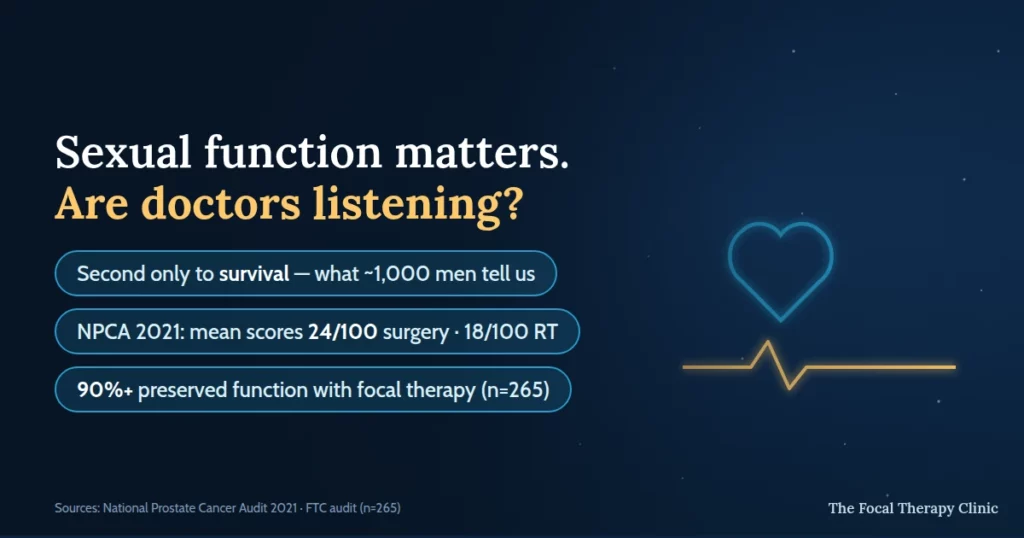
From our conversations with almost 1,000 men who have approached The Focal Therapy Clinic, we know most consider preserving their sexual function, identity and relationships second only to survival itself — yet the subject is often discussed only in narrow functional terms, or not at all. The published evidence on radical treatments is sobering, but with honest conversations, specialist support and treatment choices that preserve function, it is not doom and gloom.
- What men tell us — sexual function, identity and relationships rank second only to survival in treatment decisions
- What the audit shows — the 2021 National Prostate Cancer Audit reported generally poor average sexual function scores after radical treatment (quoted below)
- What helps — specialist psychosexual support, involving partners in conversations, and treatment options that preserve function: in our audit of 265 patients, 90%+ of men preserved sexual function after focal therapy
From our conversations with almost 1,000 men who have approached the Focal Therapy Clinic about prostate cancer treatment, we know that many, if not most of them, consider the preservation of their sexual function, sexual identity and sexual relationships second only to the preservation of life itself in considering their treatment options.
They also tell us that, despite its importance to them, the impact of prostate cancer and treatment on their sex life is usually discussed from a purely functional perspective — and sometimes not at all. Most welcome a conversation about what to expect in terms of all aspects of their sex life so that they can understand, share with their partner, and make a treatment decision they won’t regret.
Why is this, and how can we help these men?
What the Evidence Shows
Evidence abounds on the sexual impacts of prostate cancer treatments, and it’s often grim for men undergoing radical procedures. The National Prostate Cancer Audit published in 2021 reported that:
“following radical prostatectomy, the mean sexual function score was generally poor at 24 on a scale of 0-100, an improvement of 1 point compared with the previous round of reporting in 2018” — National Prostate Cancer Audit, 2021
And:
“following radical radiotherapy, the average sexual function score was generally poor at 18 on a scale of 0-100, an improvement in 1 point compared with 2018” — National Prostate Cancer Audit, 2021
One doesn’t need much more evidence than this to understand how these treatments will potentially impact his life, but it can be hard to take in when a man and his partner are under stress or when they have questions about how to manage these possibilities and don’t know where to find answers.
Treatment choice matters here: minimally invasive focal therapy preserves the nerves and structures that control erections — in our audit of 265 patients, 90%+ of men with normal pre-treatment function preserved sexual function. Our guide to prehab and recovery support covers how to prepare and protect sexual health through treatment.
Get Expert Advice & The Latest Research
Subscribe to our newsletter to receive the latest updates, expert insights, and breakthrough research on prostate cancer-delivered straight to your inbox.
Where to Find Support
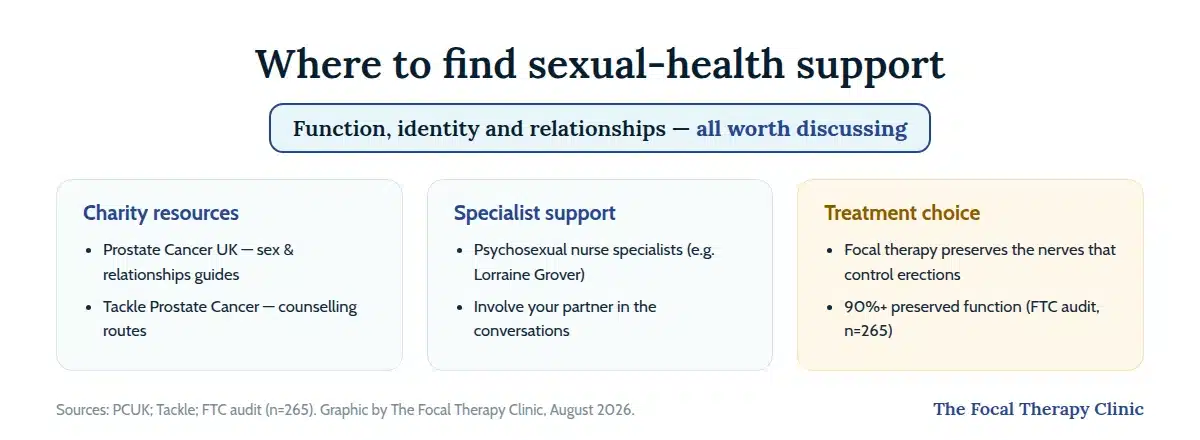
Prostate cancer charities provide some support. Prostate Cancer UK provides a range of resources to help men, and their partners answer questions on the impact of their diagnosis and treatment on sex and relationships.
Tackle Prostate Cancer also addresses issues around sexual function and discusses how to seek psychological and sexual counselling.
Two Advocates Worth Knowing
We’ve gotten to know two individuals who are dedicated to advocating for and supporting men going through prostate cancer treatment on their sexual needs and concerns.
Lorraine Grover is a nurse with over 35 years of experience working with urologists and urology patients. She qualified as a sex therapist in 2003 and has helped many men and their partners discuss and understand what is happening or likely to happen with a prostate cancer diagnosis.
“A lot of men have said to me over the years that they would rather be sexually potent, whatever that definition is to them and alive, being sexually active, than not being sexually active and having their cancer cured because of the effect of the treatments of managing prostate cancer, which is so sad to hear when actually if the subject was raised with them, they would know that there are lots of things to be considering about sexuality and prostate cancer. I think we’ve still got a long way forward.” — Lorraine Grover, psychosexual nurse specialist
She feels strongly that men are too often counselled around sexual function and not sexual relationships:
“It’s been very much the surgical patient; the man having the radical prostatectomy historically will have some discussion about it’s going to impact on your sex life, and it can be as simple as that. And that can be quite shocking for the patient to hear and nothing else is discussed. The focus can be all about the erectile function. It’s not just the only part of sex having an erection.” — Lorraine Grover
Lorraine emphasises the importance of involving sexual partners in these discussions:
“It’s crucial for women to have the opportunity to talk to somebody about the impact of prostate cancer has had on the man in their life’s personality, their health, their fear, that opens up all sorts. It also allows a discussion to take place. And there have often been sexual issues occurring anyway. It could be, I’m seeing a patient in their 50s where their partner may be in the menopause or premenopausal or has had her own ill health, has never had an opportunity to talk about sex with anybody. And suddenly their male partner has been diagnosed with prostate cancer. And I’m part of that team, hopefully, and I address it and they go, wow, I’ve never had this opportunity to talk about things.” — Lorraine Grover
Lorraine feels these discussions can have very positive impacts on a couple’s sexual relationship and often improve it:
“I’ve had couples go since I’ve had my prostate cancer diagnosis, I’ve now got a better sex life. I’ve seen you, and you’ve never believe that, would you really now? I’ve had people say I’ve still got an active sex life since my diagnosis 10 years ago because we’ve changed things. We’ve introduced things. I probably would have just thought sex has gone off our radar as we got older, if I hadn’t have had access to know about this information. So it’s not doom and gloom.” — Lorraine Grover
Sam Evans would agree it’s definitely not doom and gloom. She’s in the business of promoting sexual health and pleasure through toys and products, many aimed at cancer patients. Her blog series addresses the needs and experiences of cancer patients in a refreshingly direct and honest way, and she provides much-needed support to men and their partners through a wide network on social media.
What is so encouraging about Lorraine and Sam is their positivity and proactive approach to supporting men in their sexual life while diagnosed with prostate cancer. All have a deep understanding of the problems and challenges these men face but also have constructed approaches to not only preserving sex as is but to making it better. All are active campaigners on social media and producers of content to share with men and their partners.
Lorraine Grover is at @lekgrover. Sam Evans is at @SamTalksSex.
If you’d like to talk to us and learn more, please get in touch.
References
- National Prostate Cancer Audit — Annual Report 2021 (patient-reported sexual function scores).
- Prostate Cancer UK — Sex and relationships resources; Tackle Prostate Cancer.
- The Focal Therapy Clinic one-year outcome audit (n=265).
This content is not intended to replace professional medical advice. Always consult your clinical team about your individual circumstances.