
At a Glance
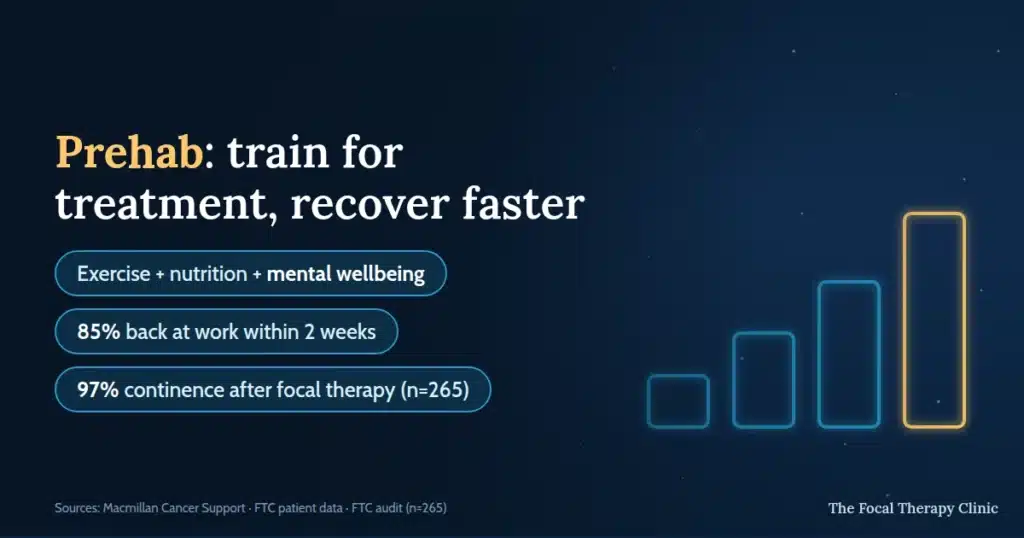
Prehabilitation (prehab) and rehabilitation (rehab) programmes combine exercise, nutrition, and emotional support to help men prepare for and recover from prostate cancer treatment. Research shows these programmes significantly improve physical fitness, mental wellbeing, and recovery times — and at The Focal Therapy Clinic, where 85% of focal therapy patients return to work within two weeks (FTC patient data), prehab can further enhance these already favourable outcomes.
- What prehab involves — Structured exercise, nutritional guidance, and psychological support before treatment begins
- Proven recovery benefits — Shorter recovery times, fewer complications, and improved physical and mental fitness
- Pelvic floor training — Targeted exercises that help maintain urinary continence and sexual function after treatment
- Mental health support — Group exercise programmes reduce anxiety and build confidence through peer support
- Focal therapy advantage — Minimally invasive focal therapy combined with prehab offers the best foundation for rapid, complete recovery
What Is Prehabilitation for Prostate Cancer?
Prehabilitation (prehab) is a structured programme of exercise, nutrition, and psychological support that helps men prepare physically and mentally for prostate cancer treatment. Research shows that prehab significantly improves recovery times, reduces complications, and enhances long-term wellbeing — making it a valuable complement to treatments such as focal therapy, where 85% of men already return to work within two weeks (FTC patient data).
An Australian study concluded that prehab interventions “played a key part in enhancing person-centred care” by optimising physical and psychological recovery. UK research confirmed that combining exercise with nutritional and psychological support can “significantly improve preoperative physical and mental fitness in preparation for surgery and beyond.”
These improvements extend beyond the treatment itself. Men who engage with prehab programmes often adopt healthier lifestyle habits at a time when they are most motivated to take control of their health.
How Does Prehab Improve Recovery After Prostate Cancer Treatment?
Mr Tim Dudderidge explains recovery after focal therapy — what to expect in the days and weeks after treatment, and how quickly most men return to normal life.
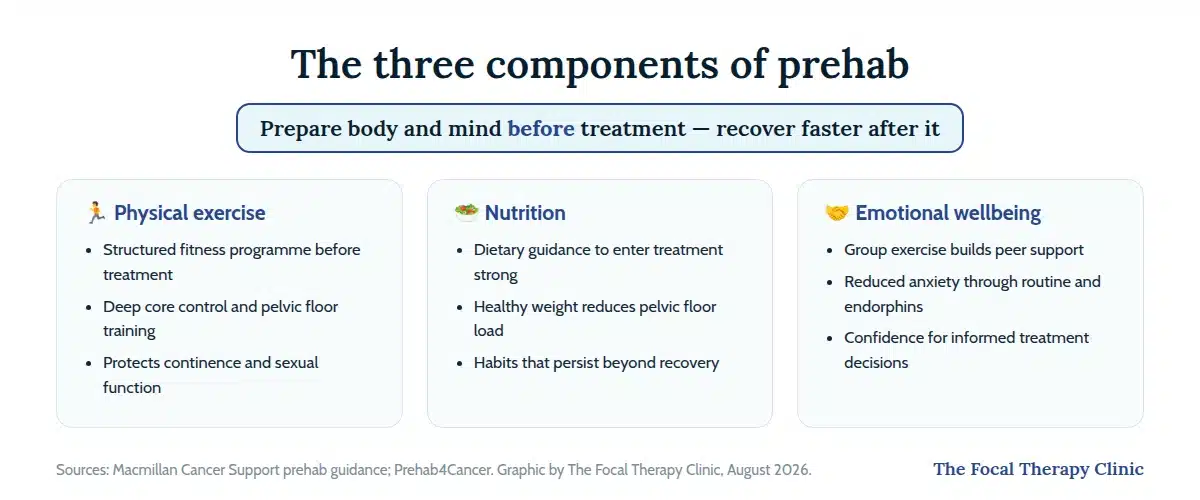
Prehab programmes typically combine three core components — physical exercise, nutritional guidance, and emotional wellbeing support — to prepare men for treatment and accelerate their recovery. Macmillan Cancer Support recommends prehab as part of the cancer care pathway.
We spoke with Prehab4Cancer, an initiative for cancer patients in Greater Manchester. Kirsty Rowlinson-Groves, who has been involved in the programme for many years, described the benefits:
“We all know that exercise releases happy hormones, so people get a buzz from that and feel better. But they also benefit from the peer support these groups provide. Men seem to talk more openly when they’re doing something active — they compare notes on their treatments and side effects and get peer support that way.” — Kirsty Rowlinson-Groves, Prehab4Cancer
She also described how physical confidence leads to broader improvements:
“When you are set an exercise challenge and you notice that your body can do it, it really improves somebody’s wellbeing. We also look at how exercise can help with side effects of treatment — deep core control and pelvic floor exercises can help with sexual health and urinary incontinence issues, so we build them into the programme.” — Kirsty Rowlinson-Groves, Prehab4Cancer
The key benefit is that prehab gives men a safe space to address the physical, sexual, and emotional impact of prostate cancer. It is important that men fully understand the “big three” side effects of prostate cancer treatment — urinary, sexual, and psychological — so they can make informed treatment decisions.
Recovery also depends heavily on which treatment you choose — see how treatment choice determines your recovery journey.
How Do Pelvic Floor Exercises Help During Prostate Cancer Treatment?
Pelvic floor exercises (also called Kegel exercises) strengthen the muscles that control urinary continence — and starting them before prostate cancer treatment gives men the best chance of maintaining bladder control afterwards. At The Focal Therapy Clinic, 97% of focal therapy patients maintain full urinary continence (FTC audit, n=265), and prehab pelvic floor training can further support this outcome.
For many men, a prostate cancer diagnosis is the first time pelvic health becomes a priority. The prospect of incontinence is understandably anxiety-inducing — yet many men make treatment decisions without fully understanding the impact on their pelvic health.
The good news is that with the right preparation and the right treatment choice, urinary side effects can be minimal. Minimally invasive treatments such as HIFU (NICE HTG667) and NanoKnife IRE (NICE HTG688) preserve surrounding tissue, significantly reducing the risk of incontinence compared with radical surgery.
What If Incontinence Does Happen After Treatment?
Even with good preparation, some men experience urinary leakage after prostate cancer treatment — most commonly stress incontinence, where urine leaks when coughing, sneezing or during physical activity. It happens because the pelvic floor muscles that support the bladder can be weakened or bruised during treatment, particularly radical prostatectomy. The reassuring news is that it is usually temporary: most men regain bladder control with consistent pelvic floor rehabilitation.
Continence nurse specialist Jane Simpson, author of The Pelvic Floor Bible and a specialist at The London Clinic for over 22 years, shared her practical advice for men recovering from prostate cancer treatment on our OnFocus podcast:
- Keep up daily practice — regular exercises strengthen the hammock of muscles running from the pubic bone to the coccyx that supports bladder control
- Avoid high-impact activity too soon — sports like tennis or running put downward pressure on a recovering pelvic floor and can delay progress
- Watch bladder irritants — caffeine and alcohol both increase urgency and frequency; switching to decaffeinated drinks can noticeably reduce symptoms
- Address constipation and weight — straining and excess weight both load the pelvic floor, and the bowel and bladder share the same muscle support system
- Consider electrical stimulation — for men whose leakage does not improve with exercises alone, devices such as Innovo shorts can help boost pelvic floor tone
If leakage persists beyond the expected recovery window, ask for specialist help. Continence nurse specialists and pelvic floor physiotherapists can assess your pelvic floor, tailor an exercise programme and monitor your progress — and your urological surgeon can advise whether any further intervention is needed.
Get Expert Advice & The Latest Research
Subscribe to our newsletter to receive the latest updates, expert insights, and breakthrough research on prostate cancer-delivered straight to your inbox.
Why Is Sexual Health Support Important for Men with Prostate Cancer?
Sexual function preservation is one of the most important concerns for men facing prostate cancer treatment. In our conversations with almost 1,000 men at The Focal Therapy Clinic, most consider preserving their sexual function, identity, and relationships second only to survival itself. With focal therapy, 90%+ of men with normal pre-treatment function maintain their erections (FTC audit, n=265).
Despite its importance, the impact of prostate cancer treatment on sexual health is often discussed only in functional terms — or sometimes not at all. Most men welcome an open conversation about what to expect across all aspects of their sex life, so they can share this with their partner and make a treatment decision they will not regret.
“If you had completely normal erections before treatment, most men find that their erections return within a few months after focal therapy. By one year, most men find their erections are normal or close to normal.” — Mr Marc Laniado, Consultant Urological Surgeon (FRCS(Urol), GMC: 3343931)
At The Focal Therapy Clinic, we discuss sexual health openly as part of the treatment planning process. Prehab programmes that include sexual health counselling help men and their partners prepare for any changes and feel confident in their choices.
How Does Prostate Cancer Affect Mental Health — and What Helps?
A prostate cancer diagnosis often brings significant anxiety and uncertainty. Many men experience periods of poor mental health — particularly during the waiting periods between diagnosis, testing, and treatment. For those on active surveillance, the psychological burden of living with untreated cancer can be especially challenging.
Prehab programmes use exercise as a gateway to broader mental health support. Physical activity reduces anxiety, builds confidence, and creates a peer support network where men can openly discuss their concerns about treatment and side effects.
- Reduced anxiety — Regular exercise releases endorphins and provides a structured routine during an uncertain time
- Peer support — Group exercise sessions create space for men to share experiences and compare notes on treatment
- Confidence building — Achieving physical goals helps men feel more in control of their health and decision-making
- Informed decisions — Addressing mental health alongside physical preparation leads to greater confidence in treatment choices
Incontinence deserves particular mention here. Jane Simpson describes it as “a brave new world” for men who have controlled their bladder all their lives — from anxiety about leakage at work to practical hurdles such as the lack of disposal bins in men’s public toilets. And while female incontinence is discussed openly, male incontinence remains largely taboo. Talking honestly with your healthcare team — and connecting with a prostate cancer support group — can markedly reduce the isolation many men feel.
At The Focal Therapy Clinic, we understand that mental health is a critical part of the prostate cancer journey. We support patients in accessing prehab and counselling resources alongside their treatment planning.
How Does Focal Therapy Complement a Prehab Programme?
Focal therapy treatments such as HIFU (NICE HTG667) and NanoKnife IRE (NICE HTG688) are minimally invasive, meaning they preserve healthy prostate tissue and cause significantly fewer side effects than radical surgery or radiotherapy. This makes them an ideal match for a prehab approach — men who are physically and mentally prepared for treatment can make the most of focal therapy’s already favourable recovery profile.
| Outcome | Focal therapy (FTC data) | Radical prostatectomy |
|---|---|---|
| Sexual function preserved | 90%+ | 30–70% |
| Urinary continence | 97% (FTC audit, n=265) | 80–95% |
| Return to work | 85% within 2 weeks | 4–6 weeks |
| Hospital stay | Day-case (home same day) | 1–3 nights |
Source: FTC one-year outcome audit (n=265) and published literature.
When combined with prehab, these outcomes can be further optimised. Men who enter treatment physically fit and emotionally prepared tend to recover faster and report greater satisfaction with their results.
To discuss your treatment options and how prehab could support your recovery, contact The Focal Therapy Clinic or call 0207 036 8870.
References
- NICE HealthTech guidance HTG667 — Focal therapy using high-intensity focused ultrasound for localised prostate cancer.
- NICE HealthTech guidance HTG688 — Irreversible electroporation for treating prostate cancer.
- Macmillan Cancer Support — Prehabilitation in cancer care.
- The Focal Therapy Clinic one-year outcome audit (n=265) and FTC patient data.
This content is not intended to replace professional medical advice. Always consult your clinical team about your individual circumstances.