

NanoKnife Treatment for Prostate Cancer
- NICE-approved (HTG688) non-thermal focal therapy for localised prostate cancer
- 97% continence preserved, 90%+ sexual function maintained (FTC audit, n=265)
- Treats anterior and lateral tumours that HIFU cannot reach — across 7 UK locations

Treatments Completed

90%+ Sexual Function

Fast recovery
Outpatient procedure with quick recovery time (2-3 days)

Fewer side effects
Low risk of incontinence and erectile dysfunction

Minimally invasive
No hormones, radiation or incisions
NanoKnife (irreversible electroporation, IRE) is a NICE-approved (guidance HTG688) non-thermal focal therapy for prostate cancer that is localised. At The Focal Therapy Clinic, our consultant urological surgeons — led by a NanoKnife-accredited trainer — use precise electrical pulses to destroy the tumour while sparing the nerves, urethra and healthy tissue, preserving urinary continence in 97% of men and sexual function in over 90% (our audit, n=265).
NanoKnife Irreversible Electroporation (IRE) is a NICE-approved (HTG688) non-thermal focal therapy for localised prostate cancer. It uses precisely controlled electrical pulses to destroy cancerous cells while preserving surrounding healthy tissue, including nerves, blood vessels, and the urethra. NanoKnife is particularly effective for anterior and lateral prostate tumours that are difficult to reach with other focal therapy methods such as HIFU.
NanoKnife has been used to treat prostate cancer since 2008 and received NICE approval for prostate cancer treatment in 2022. In our clinic's experience (n=265), 97% of patients maintain urinary continence and over 90% preserve sexual function after focal therapy.
Which Consultants Perform the Procedure?
At The Focal Therapy Clinic, our consultant urologists have performed over 2,000 focal therapy procedures collectively, including NanoKnife IRE treatments across seven UK locations. Our consultant uro-radiologist team prepares precise treatment plans for each patient based upon a detailed review of their MRI and biopsy results. The use of these treatment plans in theatre ensures enhanced cancer control and reduced risk of urinary or erectile function side effects.
NanoKnife is one of two focal therapy treatments offered at The Focal Therapy Clinic. For posterior prostate tumours, HIFU treatment for prostate cancer may be more suitable. In some cases, both NanoKnife and HIFU are used in combination therapy to treat tumours in multiple prostate regions.
Learn more about how NanoKnife works
| Feature | NanoKnife IRE |
|---|---|
| Treatment Type | Minimally invasive focal therapy |
| Temporary swelling | Common |
| Energy Used | Electrical pulses (non-thermal) |
| Hospital Stay | Outpatient (same day) |
| Cancer-free at 1 year | 90% (FTC audit, n=265) |
| Urinary Continence | 97% (FTC audit, n=265) |
| Sexual Function Preserved | 90%+ (FTC audit, n=265) |
| Repeatable Treatment? | Yes |
| Best for Tumour Location | Tumours located at the front (anterior) of the prostate |
| Suitability | Men eligible for focal therapy where tumour location is in the front of the prostate rather than the base of the prostate gland |
| Follow-Up Care | Regular PSA testing and occasional MRI scans |
“If you’re deemed suitable for [NanoKnife], it really is a no brainer. I think to go down this line first is the only way if you want to minimise your possible after effects.”
Brian Bishop
The Focal Therapy Clinic patient
Is NanoKnife right for me?
NanoKnife suits men with localised prostate cancer (Gleason 6–7, Grade Groups 1–3) that is clearly visible on multiparametric MRI. It is not recommended for high-grade (Gleason 8–10), multifocal or metastatic disease. Because it is non-thermal, NanoKnife is often chosen for anterior tumours or cancer near the urethra or nerves. At The Focal Therapy Clinic every case is MRI-reviewed by a consultant before treatment.
NanoKnife for Prostate Cancer is a minimally-invasive treatment for men with localised prostate cancer in parts of the prostate that are too hard for HIFU to reach. NanoKnife could be right for you if your prostate cancer is:

Early or intermediate stage

In the anterior or lateral parts of the prostate

Localised

Recurrent
It could also be the right choice if you are keen to avoid long-time side effects from prostate cancer treatment.
Read more about focal therapy eligibility.
Check your suitability

Why more men are becoming suitable for NanoKnife
Anterior prostate cancers — those at the front of the gland — were historically under-diagnosed, and Mr Marc Laniado, who has practised focal therapy for almost two decades, explains why: "We did transrectal biopsies through the back passage, so only ever sampled the back of the prostate. But with the advent of MRI and transperineal biopsies, which enable us to sample the front of the prostate more effectively, we're identifying more men with cancers at the front of the prostate. Hence the number of men potentially suitable for NanoKnife or similar technologies will increase."
In the past roughly 80% of detected cancers sat at the rear (posterior) of the gland and 20% at the front — a balance that is shifting now that MRI-first diagnosis finds anterior tumours that transrectal sampling missed, often for years. Early diagnosis gives men more treatment options.
Success rates
In The Focal Therapy Clinic's audit (n=265), 90% of men were cancer-free at one year with 97% continence maintained. Published Australian biopsy-monitored data on focal NanoKnife (IRE) report failure-free survival of 91% at three years and 84% at five years (Scheltema et al., St Vincent's Sydney, 2023). For cancer that returns after radiotherapy, salvage IRE achieved 78% local control (FIRE trial, 2023). The Focal Therapy Clinic's own consultants co-authored a major salvage focal-therapy study (Light et al., JAMA Oncology, 2026).
Cancer control (Scheltema et al., 2023)
91% failure-free survival at 3 years and 84% at 5 years (n=229, Australian biopsy-monitored cohort)
Urinary continence
97% maintained full urinary continence after focal therapy (FTC audit, n=265)
UK NanoKnife data (NEAT trial, Valerio et al., J Urol 2017, PMID 27697580) support 12-month safety and functional preservation, but UK 3- and 5-year NanoKnife outcome data are limited.
If the cancer is not fully treated or returns, NanoKnife can be repeated or followed by surgery or radiotherapy.
NanoKnife: Advantages and Disadvantages
Because NanoKnife is non-thermal, it can treat tumours close to the urethra, nerves and rectum that heat-based treatments must avoid — making it particularly suited to anterior tumours. In The Focal Therapy Clinic's audit (n=265), 97% of men stayed fully continent and over 90% preserved sexual function, and because the prostate is preserved the treatment can be repeated if needed.
Advantages
- Minimally invasive - No incisions, no radiation, no hormones
- Preserves sexual function & continence - spares nerves and urinary structures
- Outpatient procedure - Go home the same day. Rapid recovery
- Repeatable if needed - Can be combined with other treatments
- Effective cancer control - equivalent to radiotherapy or surgery at 8 years
Disadvantages
- Not suitable for all cancers - Best for localised, clearly visible tumours (Gleason 7 or lower)
- Follow-up monitoring required - Regular PSA testing and MRI scans needed
- Limited long-term data - NanoKnife is newer than traditional treatments, though 8-year outcomes are comparable
What to Expect Before, During, and After NanoKnife Treatment
- MRI and biopsy to confirm eligibility
- Pre-Procedure instructions (e.g. fasting)
Side effects & Risks
After NanoKnife, over 90% of men maintain sexual function and 97% remain fully continent (our audit, n=265).
| Symptom | Frequency | Duration |
|---|---|---|
| Urinary Catheter required | Always | 3-5 Days |
| Mild discomfort in perineum area | Common | 2-3 Days |
| Temporary swelling and bruising | Common | 2-3 Weeks |
| Blood in urine or semen | Common | Up to 8 weeks |
| Change in erectile function | Uncommon — over 90% of men maintain sexual function (FTC audit, n=265) | Usually temporary |
| Return to normal | Common | 3 - 7 days |

Questions to ask your doctor or nurse

Get Expert Advice & The Latest Research
Subscribe to our newsletter to receive the latest updates, expert insights, and breakthrough research on prostate cancer-delivered straight to your inbox.
Choosing Between NanoKnife & HIFU: Key Factors
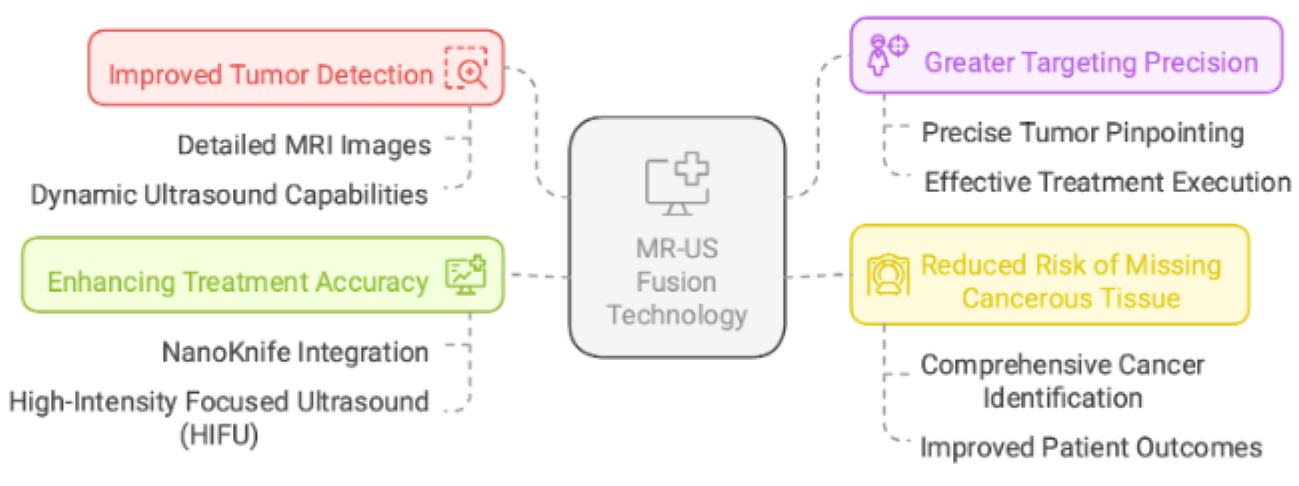
The Role of MR-US Fusion Technology in Treatment Accuracy
Benefits of MR-US Fusion Technology
- Improved Tumour Detection - More accurate than ultrasound alone
- Greater Targeting Precision - Helps specialists precisely pinpoint tumours
- Reduces Risk of Missing Cancerous Tissue - Ensures comprehensive tumour destruction
As Mr Alan Doherty puts it: "We use MRI contouring to position the treatment electrodes so that we can be confident about treating the area of cancer while we preserve healthy tissue."
Frequently asked questions
There are many factors to consider when choosing a treatment for your prostate cancer. Medical factors, such as your cancer stage and tumour location are important. However, your current and future quality of life is also very important.

Sources
Our outcomes are from The Focal Therapy Clinic's audit of 265 patients (1-year follow-up): 97% urinary continence, 90%+ sexual-function preservation, 90% cancer-free at one year.
Published NanoKnife (IRE) primary outcomes: Scheltema MJ, … Stricker PD. Median 5-year outcomes of primary focal IRE. BJU Int 2023;131(S4):6–13 (doi:10.1111/bju.15946; n=229; failure-free survival 91% at 3 yrs, 84% at 5 yrs, 69% at 8 yrs) — the primary long-term cohort; an earlier series (Blazevski A, … Stricker P. Eur Urol Oncol 2020;3(3):283–290; n=123) reported 96.75% at 3 yrs.
Salvage IRE: Blazevski A, … Stricker PD. FIRE trial. BJU Int 2023;131(S4):23–31 (doi:10.1111/bju.15947; 78% local control).
UK NanoKnife (12-month safety): Valerio M et al. NEAT trial. J Urol 2017;197(3):647–654. (Australian primary/salvage IRE data — not FTC-authored; UK long-term NanoKnife data are limited.)
FTC consultants' salvage research: Light A, … Dudderidge T, Nigam R, Laniado M, et al. JAMA Oncology 2026;12(4):364–373 (doi:10.1001/jamaoncol.2025.6448) — co-authored by FTC's Mr Dudderidge, Mr Nigam and Mr Laniado (HIFU/cryotherapy salvage).
Older men: Habashy D, … Nigam R, … Dudderidge T. J Urol 2023;210(1):108–116.
Regulatory: NICE HTG688 (2023); NG131 (2019, upd. 2021); EAU 2024.
Subscribe to our newsletter
Get expert advice & the latest prostate cancer research - straight to your inbox.