
At a Glance
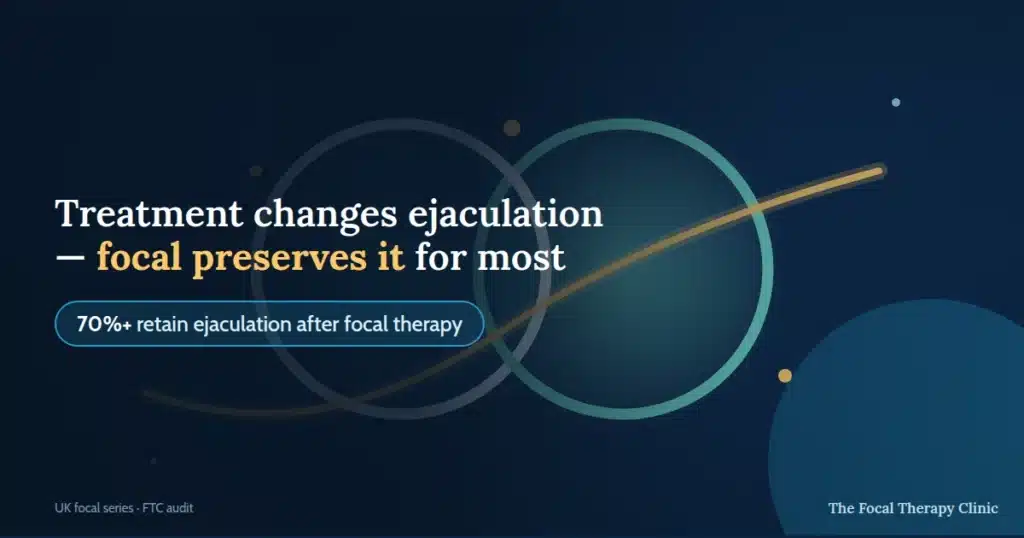
Prostate cancer itself rarely stops ejaculation — treatment usually causes the changes. Surgery ends ejaculation permanently, radiotherapy reduces semen volume gradually, and hormone therapy lowers libido and volume. Around 70% or more of men treated with true focal therapy retain normal, forward ejaculation, and 90%+ maintain sexual function in our audit of 265 patients.
Key takeaways:
- Dry orgasm after surgery — prostatectomy removes the structures that make semen; the sensation of orgasm usually remains.
- Radiotherapy changes are gradual — semen volume falls over months to years, sometimes to complete anejaculation.
- Focal therapy preserves ejaculation for most — around 70% or more retain antegrade (normal, forward) ejaculation; formal fertility outcomes after focal therapy are not yet well studied, so men who want certainty should bank sperm before any treatment.
- Sperm storage is yours to discuss — NICE NG131 says men should have fertility effects explained and be offered sperm storage before radical treatment; UK storage can now run up to 55 years.
- Support exists — climacturia and intimacy changes are recognised, manageable side effects, whatever your relationship or orientation.
Prostate cancer itself rarely stops ejaculation, but treatment for prostate cancer commonly does. Radical prostatectomy causes dry orgasms in virtually all men, radiotherapy gradually reduces semen volume, and hormone therapy can lower libido and ejaculate volume. Focal therapies like HIFU and NanoKnife aim to preserve ejaculatory function: around 70% or more of men treated with true focal therapy retain antegrade ejaculation, and approximately 90% of suitable patients maintained sexual function in the FTC audit of 265 men — two related but distinct measures.
Does prostate cancer affect ejaculation?
Prostate cancer itself rarely affects ejaculation directly, even in advanced stages, because the cancer arises within glandular tissue without immediately disrupting the muscular and neural mechanisms that produce orgasm and ejaculation. The prostate gland produces around 25–30% of seminal fluid, while the seminal vesicles produce around 60–70%. The neurovascular bundles beside the prostate control erections and also contribute to orgasmic sensation.
Changes linked to ejaculation and prostate cancer are almost always caused by treatment rather than the cancer itself. In rare cases, locally advanced tumours can affect the ejaculatory ducts by pressure or direct invasion, but this is uncommon. Understanding which treatments cause which changes is the most important conversation to have with a consultant before choosing a treatment pathway.
How does each treatment affect ejaculation?
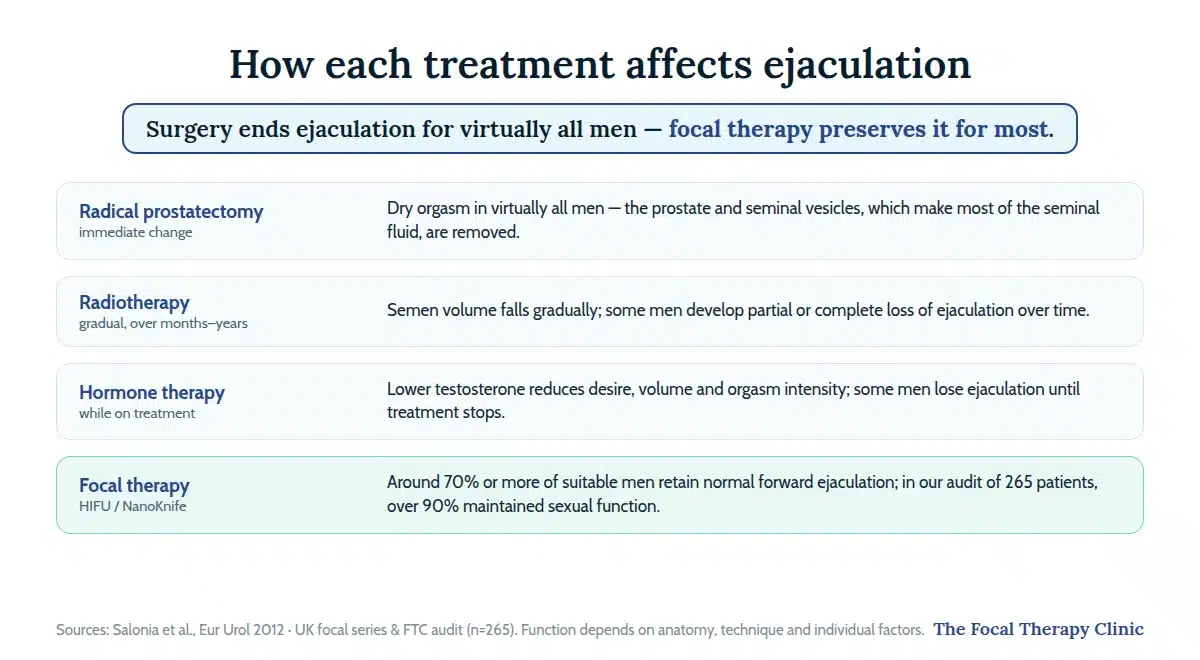
Each prostate cancer treatment affects ejaculation differently, with radical prostatectomy causing the most dramatic change and focal therapy preserving function in most suitable patients. Treatment choice should be guided by cancer control, but also by priorities around erections, orgasm, fertility, and quality of life. Men asking does prostate cancer stop you from ejaculating usually need to understand how each treatment changes sexual function before making a decision.
| Treatment Type | Impact on Ejaculation |
|---|---|
| Surgery (Radical Prostatectomy) | Causes dry orgasms in virtually all men because the prostate gland and seminal vesicles are removed; post-prostatectomy sexual dysfunction is common, according to Salonia et al., Eur Urol 2012. |
| Radiation Therapy | Gradually reduces semen volume over months or years by affecting the prostate and seminal vesicles. Some men develop partial or complete anejaculation. |
| Hormone Therapy | Lowers testosterone, which can reduce libido, erections, ejaculate volume, and orgasm intensity. Some men lose ejaculation completely while on treatment. |
| Focal Therapy (HIFU, NanoKnife) | Treats only the cancerous area and aims to preserve surrounding tissue. Around 70% or more of men retain antegrade ejaculation, and in the FTC audit of 265 men, more than 90% maintained sexual function. |
Focal therapy may be considered for carefully selected men with localised prostate cancer who want to preserve sexual and urinary function where possible.
Surgery and dry orgasms
Radical prostatectomy causes dry orgasms in virtually all men because the surgery removes the prostate gland and seminal vesicles, the structures responsible for producing approximately 90% of seminal fluid. A dry orgasm means a man reaches climax without releasing semen, although the sensation of orgasm often remains. During radical prostatectomy, surgeons may also disturb the neurovascular bundles that control erections and contribute to orgasmic intensity.
Most men still feel rhythmic contractions during orgasm, but the experience may feel shorter, weaker, or different. Nerve-sparing surgery aims to protect these bundles, but partial nerve damage can still occur even with experienced surgeons. Salonia et al., European Urology 2012, describes post-prostatectomy sexual dysfunction as a common and important issue after surgery.
Radiotherapy and semen volume
Radiotherapy gradually reduces semen volume over months to years by damaging the cells in the prostate and seminal vesicles that produce and transport seminal fluid. Changes often begin within months of treatment and may continue over one to three years. Some men develop partial or complete anejaculation over time.
External beam radiotherapy treats the prostate from outside the body, while brachytherapy places radioactive material inside or near the prostate. Brachytherapy can cause painful ejaculation in the first few months after treatment. These changes are usually gradual, unlike the immediate dry orgasm caused by surgery.
Hormone therapy and libido
Hormone therapy (androgen deprivation therapy) lowers testosterone to slow prostate cancer growth, which significantly reduces libido, ejaculate volume, and the intensity of orgasm, and sometimes causes complete loss of ejaculation. Testosterone plays an important role in sexual desire, erectile function, and ejaculatory drive. Changes often begin within weeks of starting treatment.
Some men recover sexual desire and ejaculatory function after stopping hormone therapy, but recovery is not always complete. Intermittent hormone therapy may allow more recovery during treatment breaks than continuous therapy. Hormone therapy is usually given alongside other treatments for advanced or high-risk localised disease, rather than as a sole treatment for early-stage prostate cancer.
Focal therapy and preservation
Focal therapies such as HIFU and NanoKnife are designed to preserve ejaculatory function by treating only the cancerous area while leaving the surrounding prostate tissue, seminal vesicles, and neurovascular bundles intact. Around 70% or more of men treated with true focal therapy retain antegrade (normal, forward) ejaculation. Formal fertility outcomes after focal therapy — semen studies and pregnancies — are not yet well studied, so men who want certainty should bank sperm before any treatment. Separately, in the Focal Therapy Clinic’s audit of 265 men, more than 90% maintained sexual function after focal therapy — a broader measure than ejaculation alone, and a marked contrast with the rates of sexual dysfunction reported after radical prostatectomy.
NICE-approved focal therapies include HIFU treatment under NICE HTG667 and NanoKnife/IRE under NICE HTG688. Focal therapy is not suitable for every man, and suitability depends on cancer features such as Gleason score, tumour location, and disease extent. This is why each case should be reviewed with high-quality MRI, biopsy results, and multidisciplinary input.
“If preserving ejaculatory function is a priority, focal therapy offers an alternative to radical surgery. In the unfortunate 5–10% of cases where cancer isn’t fully treated or returns in another prostate area, additional options remain available including another focal therapy session or traditional treatments.” — Mr Raj Nigam, Consultant Urological Surgeon (FRCS (Urol), GMC: 3265226)
Many men tell us these concerns were never properly discussed before treatment — read men with prostate cancer are keen to maintain their sexual function — are their doctors listening?
Will I still feel orgasm after treatment?
Yes, most men still experience orgasmic sensation after prostate cancer treatment, even when ejaculation itself is reduced or absent. Orgasm is the neurological and physical feeling of climax, while ejaculation is the release of seminal fluid. The rhythmic contractions of orgasm are controlled by pelvic floor muscles and the nervous system, which are not removed during prostatectomy.
Men often report that orgasms feel different rather than absent. They may feel shorter, drier, less intense, or more pelvic than penile in sensation. The question can a man still ejaculate after prostate cancer often overlaps with concerns about pleasure, and many men still adapt and enjoy intimacy after treatment. Hormone therapy is the treatment most likely to reduce orgasmic sensation itself because testosterone affects arousal and sexual response.
What is climacturia and how is it managed?
Climacturia is the involuntary leakage of urine during orgasm and is a recognised side effect of radical prostatectomy, reported by roughly one in five to one in three men (21–38% across studies) — published rates vary widely depending on how and when it is measured. It happens because surgery can disrupt the muscles and valves that control urinary flow. Leakage may be minimal for some men and more noticeable for others.
Climacturia often improves with time, pelvic floor rehabilitation, and specialist support. It can feel embarrassing, but it is a recognised treatment side effect and can be managed. Support should focus on practical steps and reducing anxiety around intimacy.
Practical steps to manage climacturia:
- Empty your bladder before sexual activity to reduce volume available to leak
- Pelvic floor exercises to strengthen the muscles that control urinary flow
- Specialist guidance from a continence nurse or pelvic floor physiotherapist for a tailored programme
- Open communication with your partner to remove anxiety around the issue
Climacturia is significantly less common after focal therapy because the surrounding urinary structures are preserved.
Can you have children after prostate cancer treatment?
Mr Alan Doherty answers the question every man asks — will treatment affect your sex life? — and explains how today’s options for early prostate cancer can protect it, depending on the treatment you choose.
Many prostate cancer treatments affect fertility, and men who may want children should discuss sperm banking with their consultant before treatment begins. Radical prostatectomy removes the prostate and seminal vesicles, which means there is no ejaculate and natural conception is no longer possible — although the testes usually continue to produce sperm. Radiotherapy and hormone therapy can damage sperm production, while focal therapy is more likely to preserve natural fertility but cannot guarantee it: formal fertility outcomes after focal therapy are not yet well studied, so men who want certainty should bank sperm before any treatment.
NICE guidance (NG131) says men should have the potential loss of ejaculation and fertility explained, and be offered sperm storage, before radical prostate cancer treatment. Since 1 July 2022, sperm can be stored in the UK for up to 55 years, with consent renewed every 10 years. Surgical sperm retrieval techniques, such as TESE or PESA, may be options for some men who did not bank sperm before treatment — success is possible but not guaranteed. NHS-funded sperm banking is available for cancer patients in many regions. Fertility planning should be a routine part of consent for men under 50, but it is often overlooked.
Get Expert Advice & The Latest Research
Subscribe to our newsletter to receive the latest updates, expert insights, and breakthrough research on prostate cancer-delivered straight to your inbox.
How does treatment affect same-sex relationships?
The physical changes after prostate cancer treatment, including dry orgasms, reduced ejaculate, and erectile changes, are the same regardless of sexual orientation. However, men in same-sex relationships may have additional considerations around sexual practices, roles, and intimacy after treatment. These conversations should be handled directly and without assumptions.
Support around sexual health after prostate cancer can help couples adapt to changes in erections, ejaculation, orgasm, and confidence. Prostate cancer and ejaculation concerns may feel harder to discuss, but specialist nurses, consultants, and sex therapists can offer practical guidance. Partners should be included in discussions when the patient wants that support.
- Open communication with partners about expectations and concerns is essential for adapting sexual expression after treatment
- Professional support from sex therapists, counsellors, and specialist nurses can offer practical guidance
- Anal sex considerations following surgery or radiotherapy may require recovery time and modified practices, so patients should consult their clinical team
- Fertility planning for couples considering surrogacy should include sperm banking before surgery
- Treatment choice matters because focal therapies preserve more sexual function than radical surgery — more than 90% of men maintained sexual function in the Focal Therapy Clinic audit of 265 men
Frequently Asked Questions
Does prostate cancer stop you from ejaculating?
Prostate cancer itself rarely stops ejaculation. However, treatments for prostate cancer commonly affect ejaculatory function. Radical prostatectomy causes dry orgasms in virtually all men, radiotherapy gradually reduces semen volume, hormone therapy lowers ejaculate and libido, and around 70% or more of men treated with true focal therapy retain normal, forward ejaculation.
How does prostate cancer affect you physically?
Early-stage prostate cancer often causes no physical symptoms. When treatment is needed, the most common physical effects depend on the treatment chosen. Surgery can cause dry orgasms, erectile dysfunction, and urinary incontinence, while radiotherapy may cause fatigue and urinary or sexual changes, and hormone therapy reduces libido and energy.
Does ejaculation prevent prostate cancer?
Some studies suggest frequent ejaculation may be associated with a slightly reduced risk of prostate cancer, but the research is not conclusive. Most healthcare professionals agree that a healthy sex life has several benefits. There is no guaranteed way to prevent prostate cancer through ejaculation frequency alone.
How long does it take for ejaculation to return after treatment?
Ejaculation does not typically return after radical prostatectomy because the structures that produce semen are removed. After radiotherapy or hormone therapy, semen production may partially recover over months to years if treatment is stopped. Focal therapy preserves antegrade ejaculation in around 70% or more of men, with minimal recovery time required.
Can I still have an orgasm without a prostate?
Yes, most men can still have an orgasm after their prostate is removed. The sensation of orgasm is controlled by pelvic floor muscles and the nervous system, neither of which is removed during prostatectomy. Orgasms typically feel different, usually dry and sometimes shorter, but the pleasurable sensation usually remains.
Does focal therapy preserve ejaculation?
For most suitable men, yes. Focal therapies including HIFU and NanoKnife treat only the cancerous area while leaving the surrounding prostate tissue, seminal vesicles, and neurovascular bundles intact, and around 70% or more of men retain antegrade (normal, forward) ejaculation. Formal fertility outcomes after focal therapy are not yet well studied, so men who want certainty should bank sperm before any treatment.
Should I bank sperm before prostate cancer treatment?
Yes, if you may want children in future, sperm banking before prostate cancer treatment is strongly recommended — NICE NG131 says men should be offered sperm storage before radical treatment. Radical prostatectomy ends natural conception, and radiotherapy and hormone therapy can damage sperm production. UK sperm storage can now run up to 55 years, and NHS funding is often available for cancer patients, so discuss it before treatment begins.
Speak to a Focal Therapy Specialist
If preserving ejaculatory and sexual function is a priority in your prostate cancer treatment decision, the Focal Therapy Clinic team can help you understand whether focal therapy is suitable for your case. The clinic offers consultations with leading UK consultant urological surgeons, and every case is reviewed by a multidisciplinary team. Not every man is a candidate for focal therapy, and the clinic is transparent about this by assessing each referral with mpMRI and targeted biopsy before recommending treatment.
Book a consultation to discuss prostate cancer ejaculation concerns, treatment suitability, and the options most likely to preserve quality of life.
References
References verified via PubMed / official sources, 26 August 2026.
- Salonia A, Burnett AL, Graefen M, et al. Prevention and management of postprostatectomy sexual dysfunctions. Part 1: choosing the right patient at the right time for the right surgery. Eur Urol 2012;62(2):261–72. PMID 22575909.
- Salonia A, Burnett AL, Graefen M, et al. Prevention and management of postprostatectomy sexual dysfunctions. Part 2: recovery and preservation of erectile function, sexual desire, and orgasmic function. Eur Urol 2012;62(2):273–86. PMID 22575910.
- Röscher P, Sathiram R, Milios JE, van Wyk JM. Mapping the prevalence and use of questionnaires to detect the neglected sexual side effects after prostate cancer treatment: a scoping review. Syst Rev 2022;11:12. PMID 34980265.
- Mykoniatis I, van Renterghem K, Sokolakis I, et al. Climacturia: a comprehensive review assessing pathophysiology, prevalence, impact, and treatment options. Int J Impot Res 2021;33(3):259–270. PMID 32203427.
- Alwaal A, Breyer BN, Lue TF. Normal male sexual function: emphasis on orgasm and ejaculation. Fertil Steril 2015;104(5):1051–60. PMID 26385403.
- Rider JR, Wilson KM, Sinnott JA, et al. Ejaculation frequency and risk of prostate cancer: updated results with an additional decade of follow-up. Eur Urol 2016;70(6):974–982. PMID 27033442.
- Kaltsas A, et al. Fertility preservation and prostate cancer treatment. J Pers Med 2025;15(8):360.
- Guillaumier S, Peters M, Arya M, et al. A multicentre study of 5-year outcomes following focal therapy in treating clinically significant nonmetastatic prostate cancer. Eur Urol 2018;74(4):422–429. PMID 29960750. (FTC co-authors: Mr Tim Dudderidge, Mr Raj Nigam)
- National Institute for Health and Care Excellence. Prostate cancer: diagnosis and management. NICE guideline NG131. https://www.nice.org.uk/guidance/ng131
- Human Fertilisation and Embryology Authority. Gamete and embryo storage limits (up to 55 years from 1 July 2022). https://www.hfea.gov.uk/
- National Institute for Health and Care Excellence. HealthTech guidance HTG667 (focal HIFU) and HTG688 (irreversible electroporation). https://www.nice.org.uk/guidance/htg667 · https://www.nice.org.uk/guidance/htg688
This information is for educational purposes and does not replace professional medical advice. All treatment decisions should be made in consultation with a qualified healthcare professional.