
At a Glance
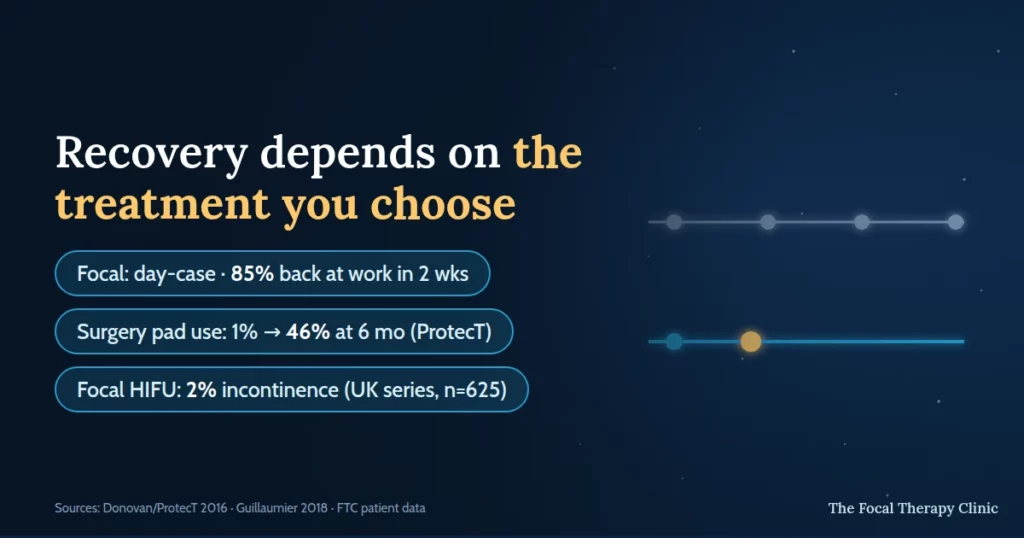
How you treat localised prostate cancer shapes how you recover from it. Day-case focal therapy (HIFU, NICE HTG667; NanoKnife, HTG688) preserves urinary continence in 97% of men and sexual function in 90%+ (FTC audit, n=265), with 85% back at work within two weeks. Radical surgery and radiotherapy can control cancer well but carry longer recoveries and heavier functional trade-offs — in the ProtecT trial, pad use in the surgery arm rose from 1% at baseline to 46% at six months, settling at 17% at year six. Knowing these timelines helps you choose the trade-off you’re comfortable with.
- Recovery reality check — treatments injure tissue in different ways: surgery removes the whole gland, radiotherapy inflames neighbouring tissue for months, focal therapy ablates only the MRI-visible tumour
- Continence, honestly stated — ProtecT (patient-reported): surgery-arm pad use 1% → 46% at 6 months → 17% at year 6; after focal HIFU, incontinence was 2% in the UK’s 625-man series (98% pad-free), and 97% of men in our audit kept full continence
- Erections, baseline first — in ProtecT, 67% of men had erections firm enough for intercourse at baseline; at 6 months that was 12% after surgery (21% at 3 years); after focal HIFU, function typically returns to baseline by 6 months (Faure Walker 2018)
- Timelines differ — focal therapy is a day-case with 85% back to work within two weeks (FTC data); surgery involves 1–3 nights in hospital and weeks of restrictions
- Optimise your recovery — MRI quality, centre volume, pelvic-floor training and infection control all speed recovery, whatever you choose
Why Recovery Time Differs by Treatment
Prostate cancer procedures injure tissues in fundamentally different ways, creating distinct recovery patterns and functional outcomes that patients must understand before making treatment decisions.
- Radical prostatectomy: Removes the whole gland; sphincter stretch and nerve damage delay continence and potency recovery
- External-beam radiotherapy (± hormones): Spares the sphincter but inflames bladder and bowel tissues for months
- Focal therapy: Ablates only the MRI-visible tumour, avoiding most collateral trauma to surrounding structures
“It’s extremely important that men having surgery are told about incontinence. It’s a very common risk after surgery… being truly pad free was actually at one year, 60 percent of men.” — Mr Tim Dudderidge, Consultant Urological Surgeon (FRCS(Urol), GMC: 4505451)
Understanding how long the catheter stays in, when pads can be ditched, and how quickly erections return enables men to balance cancer control with quality of life priorities.
Treatment Comparison: Recovery Metrics
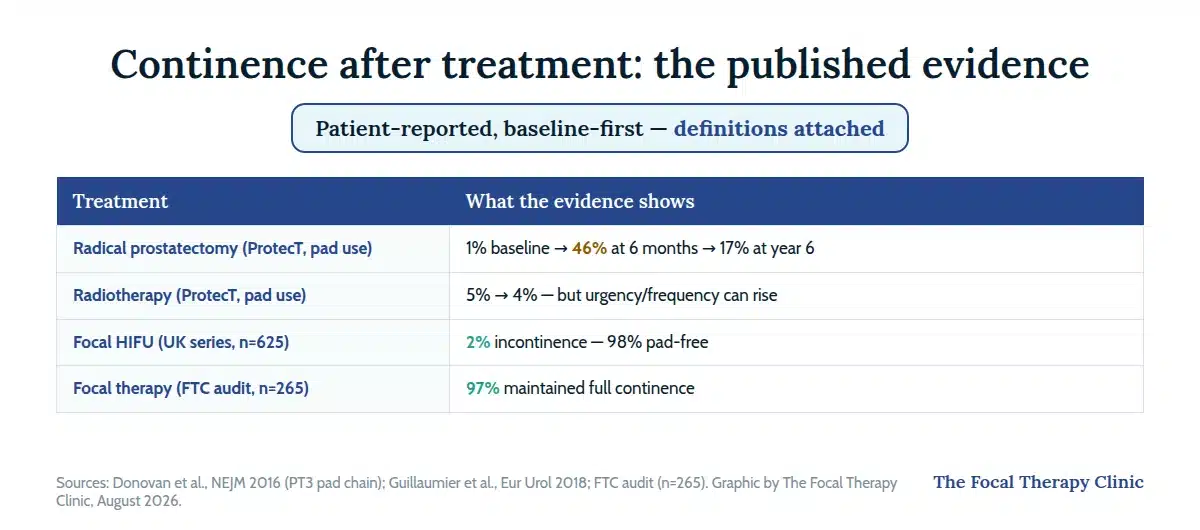
Direct comparison of the published, patient-reported evidence provides an objective framework for treatment decision-making — moving beyond marketing claims. Definitions matter: “pad-free” in some surgical series includes a “safety pad”, so always ask which measure is being used.
| Metric | Radical prostatectomy | Radiotherapy | Focal therapy (HIFU/NanoKnife) |
|---|---|---|---|
| Hospital stay | 1–3 nights | Outpatient course | Day-case (home same day) |
| Pad use (ProtecT, patient-reported) | 1% baseline → 46% at 6 months → 17% at year 6 | 5% → 4% | Incontinence 2% in the UK 625-man series (98% pad-free); 97% full continence in the FTC audit (n=265) |
| Erections firm enough for intercourse (ProtecT; baseline 67%) | 12% at 6 months; 21% at 3 years | 22% at 6 months (arm included 3–6 months’ hormone therapy — figures reflect that) | IIEF scores return to baseline by ~6 months after focal HIFU (Faure Walker 2018); 90%+ preserved in the FTC audit (n=265) |
| Return to normal activity | Several weeks of restrictions | Fatigue during and after the course | 85% back to work within two weeks (FTC data) |
Sources: Donovan et al., NEJM 2016 (ProtecT patient-reported outcomes); Guillaumier et al., Eur Urol 2018 (n=625); Faure Walker et al., 2018; FTC one-year outcome audit (n=265). Your outcome depends on age, baseline function and surgeon/centre volume.
The unselected picture: outside trials, national registry data are sobering — in an unselected Swedish registry of 4,298 men, 73% reported erectile dysfunction one year after robot-assisted radical prostatectomy (Corsini et al., 2024). Baseline function, definitions and selection explain much of the spread you will see between studies.
Focal Therapy Recovery Evidence
Dave, a Focal Therapy Clinic patient, tells the story of his HIFU treatment — from diagnosis through recovery — in his own words.
Published research provides objective validation of focal therapy’s functional outcomes, supporting clinical observations with multicentre data. In the UK’s largest published HIFU series (625 men — co-authored by our consultants Mr Tim Dudderidge and Mr Raj Nigam), incontinence affected just 2% of men, with 98% pad-free (Guillaumier et al., 2018). A systematic review of validated questionnaires found erectile function scores fall in the first month after focal HIFU and return to baseline by six months (Faure Walker et al., 2018).
Mr Dudderidge describes the leak-free continence findings from UK focal therapy follow-up:
“So incontinence is really not a problem. For this group of men, leak free continence… started off with 77 percent of men saying that they were leak free and after the treatment, that went down just to 72 percent.” — Mr Tim Dudderidge, Consultant Urological Surgeon (FRCS(Urol), GMC: 4505451)
Where a second focal treatment is needed, a multicentre study using the UK HEAT registry concluded that a repeat HIFU procedure causes minor, clinically acceptable effects on urinary and erectile function — evidence used to counsel men before their first treatment.
Key Factors That Speed Recovery
Understanding the factors that influence recovery enables optimisation strategies regardless of chosen treatment modality.
Technical factors:
- MRI quality & targeting: Better imaging means less collateral ablation and faster recovery
- Nerve-sparing grade (surgery) or index-lesion size (focal therapy) affects functional preservation
- Surgeon/centre volume: Higher volume correlates with better functional outcomes
Patient factors:
- Pelvic-floor training before and after catheter removal accelerates continence recovery — see our prehab guide
- Comorbidities: Diabetes and vascular disease hamper nerve healing processes
- Pre-treatment function: Baseline continence and erectile function predict recovery potential
Care optimisation:
- Early infection control: Careful catheter care and antibiotic protocols reduce UTI risk after focal therapy
- Realistic expectations: Understanding normal recovery patterns reduces anxiety
- Support systems: Family involvement and professional guidance enhance outcomes
Practical Timeline for Focal Therapy Patients
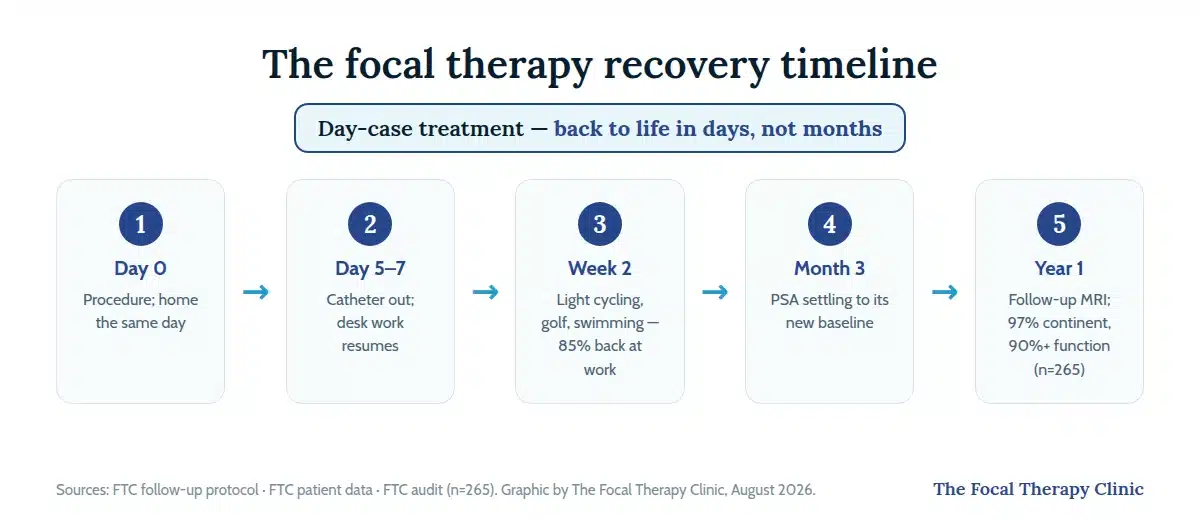
- Day 0: Procedure; home same day with minimal discomfort
- Day 5–7: Catheter removal; resume desk work
- Week 2: Light cycling, golf, swimming permitted — 85% of men are back at work within two weeks (FTC data)
- Month 1: Most pads discarded; erections often responsive to PDE5 inhibitors
- Month 3: PSA settling towards its new baseline; follow-up per protocol
- Year 1: Follow-up MRI; in our audit of 265 patients, 97% maintained full continence and 90%+ preserved sexual function
Get Expert Advice & The Latest Research
Subscribe to our newsletter to receive the latest updates, expert insights, and breakthrough research on prostate cancer-delivered straight to your inbox.
Essential Questions for Your Care Team
- Imaging quality: “What PI-QUAL score did my MRI achieve?” (≥3 is diagnostic)
- Nerve-sparing: “Is nerve-sparing feasible on one or both sides given my cancer location?”
- Focal candidacy: “Am I a candidate for focal ablation and, if not, why specifically?”
- Unit outcomes: “Which functional-outcome rates does your own unit publish for my treatment options?”
- Salvage options: “If I start with focal therapy, are surgery and radiotherapy still open later?” (Yes — both remain available)
- Recovery reality: “What percentage achieve true pad-free continence — not including safety pads — at 6 and 12 months?”
- Personal timeline: “Based on my specific case, what’s the realistic timeline for return to normal activities?”
Recovery planning essentials: arrange workplace flexibility for the recovery period and follow-ups; prepare home supplies and medication management; brief family on realistic timelines; and keep expectations realistic while staying optimistic — individual variation is normal.
Frequently Asked Questions
How quickly do men recover continence after focal therapy?
Most men use pads only briefly, if at all, after catheter removal. In the UK’s largest published HIFU series (625 men), incontinence affected 2% (98% pad-free); in our own audit of 265 patients, 97% maintained full urinary continence.
Can focal therapy be repeated or followed by surgery?
Yes. A second HIFU or NanoKnife session is possible if new lesions appear — with a multicentre HEAT-registry study finding minor, clinically acceptable functional effects from a second treatment — and radical prostatectomy or radiotherapy remain viable back-up options.
What if I already have urinary urgency from an enlarged prostate?
Radiotherapy can worsen urgency; focal therapy and surgery typically improve flow. Discuss combination approaches with your urologist.
Why do recovery statistics vary so much between studies?
Different definitions of success (a “safety pad” may count as pad-free in some surgical series), varying follow-up periods, trial-selected versus unselected populations, and baseline function all affect reported outcomes. Always ask which specific criteria are being used — and what the baseline was.
How do I prepare for the fastest possible recovery?
Start pelvic floor exercises before treatment, optimise general health, ensure high-quality pre-treatment imaging, and arrange proper support systems.
About the Expert
Mr Tim Dudderidge, Consultant Urological Surgeon (FRCS(Urol), MD, MBBS, GMC: 4505451), practises at University Hospital Southampton and The Focal Therapy Clinic. He is a co-author of the UK’s landmark five-year focal HIFU study (Guillaumier et al., European Urology 2018) and a leading advocate for honest, patient-reported outcome discussion in treatment decision-making.
References
- Donovan JL, Hamdy FC, Lane JA, et al. Patient-reported outcomes after monitoring, surgery, or radiotherapy for prostate cancer (ProtecT). N Engl J Med 2016;375:1425–1437.
- Guillaumier S, et al. A multicentre study of 5-year outcomes following focal therapy in treating clinically significant nonmetastatic prostate cancer. European Urology 2018;74(4):422–429.
- Faure Walker NA, et al. A systematic review of erectile function and men’s satisfaction after focal therapy. Urologic Oncology 2018.
- Corsini C, et al. Patient-reported side effects one year after radical prostatectomy or radiotherapy: national registry data. European Urology Oncology 2024.
- NICE HealthTech guidance HTG667 (HIFU); HTG688 (NanoKnife IRE).
- The Focal Therapy Clinic one-year outcome audit (n=265) and FTC patient data.
This content is not intended to replace professional medical advice. Always consult your clinical team about your individual circumstances.