
At a Glance
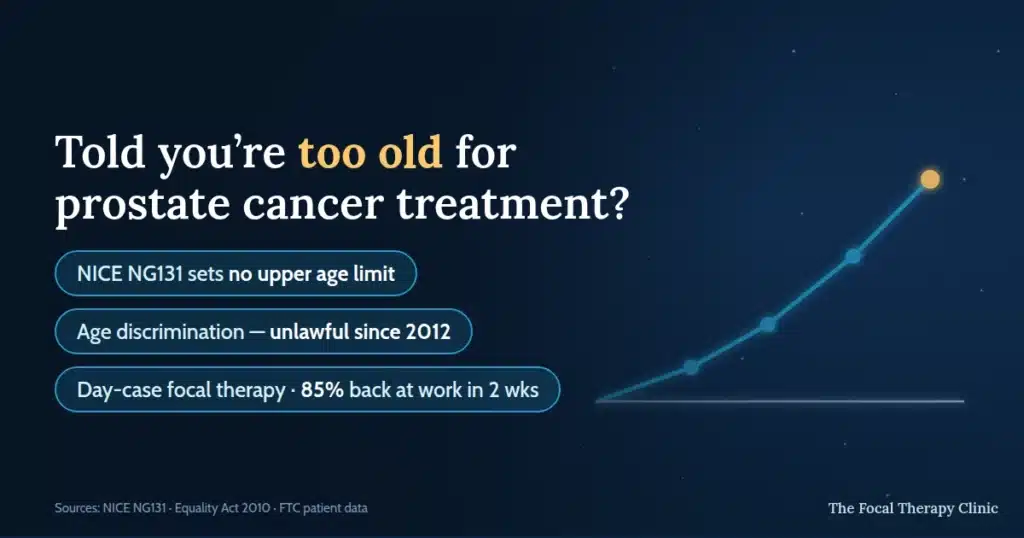
Age alone should never determine your prostate cancer treatment options. Many men over 70 are fit, active, and have decades of healthy life ahead — yet are routinely steered towards hormone therapy or indefinite monitoring without being offered curative alternatives. Unjustified age discrimination in NHS services has been unlawful since 2012 under the Equality Act 2010, and NICE guideline NG131 sets no upper age limit for curative treatment. At The Focal Therapy Clinic we assess every patient on their health, cancer characteristics and goals — not their date of birth. NICE-approved focal therapies — HIFU (HealthTech guidance HTG667) and NanoKnife IRE (HTG688) — are day-case procedures, with 85% of men in our patient data returning to work within two weeks.
- Age bias is real — many men over 70 report being offered only hormone therapy or “watchful waiting” without a full discussion of curative options
- Fitness matters more than age — biological age and overall health predict treatment outcomes far better than chronological age
- The law and guidance are on your side — age discrimination in NHS care has been unlawful since 2012, and NICE NG131 makes no age-based exclusion
- Minimally invasive options exist — focal therapy treats the cancer as a day-case procedure: in our audit of 265 patients, 97% maintained full urinary continence and 90%+ preserved sexual function
- Second opinions change outcomes — if you feel dismissed because of your age, a specialist second opinion can reveal options you were never offered
Podcast with Mr Raj Nigam, Consultant Urologist, Royal Surrey NHS Foundation Trust & The Focal Therapy Clinic
Is Age Discrimination a Real Problem in Prostate Cancer Care?
Yes. Many men over 70 are denied curative prostate cancer treatment based on age alone, rather than on their actual fitness, cancer grade, or personal treatment goals. At The Focal Therapy Clinic we regularly see patients who were steered towards observation or hormone-only approaches without ever hearing about minimally invasive alternatives.
“Ageism does exist… we are using chronological age as a surrogate for deciding on even whether we investigate people based upon their age, let alone treat them.” — Mr Raj Nigam, Consultant Urologist, Royal Surrey NHS Foundation Trust & The Focal Therapy Clinic
The bias shows up at every stage of the pathway:
| How age bias appears | Impact on patients |
|---|---|
| PSA tests withheld after specific birthdays | Delayed diagnosis and missed treatment opportunities |
| MRI and biopsy avoided in “elderly” patients | Incomplete cancer characterisation and staging |
| Curative treatments dismissed without assessment | Palliative-style care for potentially curable disease |
| “Watchful waiting” as the default for older men | Psychological distress and disease progression |
Despite legal protection — unjustified age discrimination in NHS services has been unlawful since 2012 under the Equality Act 2010 — chronological age still routinely overrides biological fitness in treatment decisions.
The Longevity Reality: What Life Expectancy Actually Looks Like
Modern longevity data undermines the assumptions behind age-based treatment limits. As Mr Nigam explains:
“Life expectancy has changed and has improved over the years… in the UK, for example, a man who lives to the age of 65 can expect to live another 19 years, a man who lives to the age of 75 can expect to live another 12 years. So we’re not talking about people who are necessarily going to die out in the 70s. In fact, the greatest number of deaths in the UK now happen in their 80s rather than in their 70s.” — Mr Raj Nigam
Watch: Mr Nigam on Longevity and Treatment Decisions
Understanding how modern life expectancy data should influence prostate cancer treatment decisions, and why chronological age alone fails to guide appropriate care.
A fit 75-year-old expecting more than a decade of active life deserves the same consideration of curative treatment as a younger man with the same cancer. Words like “ageing”, “elderly” and “vulnerable” carry assumptions that many of our patients simply reject: they tell us they are fitter and more focused than ever — for them, 70 is the new 50.
A Real Case: The 73-Year-Old CEO Told “Nobody Will Offer You Surgery”
Mr Nigam describes a patient he saw — 73 years old, very fit and well, still running substantial businesses — who had been told in his locality that nobody would offer him surgery at his age, and was steered towards hormone therapy instead:
“I’ve come across so many men where the side effects of such treatment were not even discussed. They were just told that, you know, you should have this.” — Mr Raj Nigam
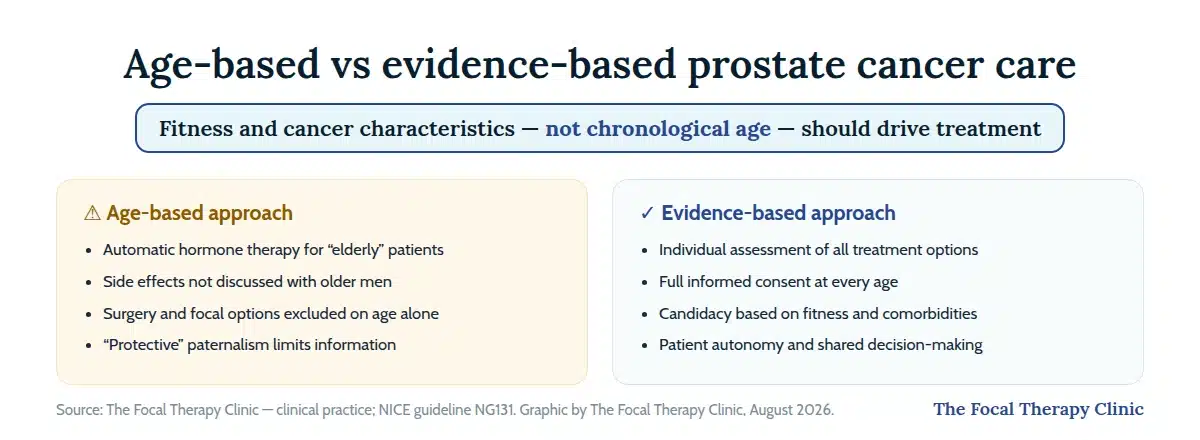
The pattern this case represents: potentially curable, organ-confined cancer managed palliatively because of a birthday. Hormone therapy has real side effects — fatigue, muscle loss, mood changes, sexual dysfunction — and offering it as the only option, without discussion, denies men both informed consent and the chance of cure.
| Age-based approach | Evidence-based approach |
|---|---|
| Automatic hormone therapy for “elderly” patients | Individual assessment of all treatment options |
| Side effects not discussed with older patients | Full informed consent regardless of age |
| Surgery and focal options excluded on chronological age | Candidacy based on fitness and comorbidities |
| “Protective” paternalism limiting information | Patient autonomy and shared decision-making |
Caught Between Undertreatment and Overtreatment
NHS backlogs and stretched resources leave many older men caught between undertreatment — indefinite active surveillance or watchful waiting — and overtreatment with hormone therapy that may not match their cancer risk or quality-of-life goals.
Minimally invasive focal therapy offers a middle path. In our clinic’s audit of 265 patients, 97% maintained full urinary continence and 90%+ preserved sexual function following treatment. Effective cancer treatment does not have to mean sacrificing quality of life — at any age.
| Approach | Typical use for over-70s | Limitation |
|---|---|---|
| Active surveillance | Monitoring without treatment | Cancer may progress; ongoing anxiety |
| Hormone therapy | Slows cancer growth | Side effects: fatigue, muscle and bone loss, sexual dysfunction, mood changes |
| Focal therapy (HIFU / NanoKnife) | Treats the tumour, preserves healthy tissue | Not suitable for every cancer; requires specialist assessment |
Sources: NICE guideline NG131; FTC one-year outcome audit (n=265).
“Not every patient is suitable for focal therapy, and we’re transparent about that. We assess every referral carefully with mpMRI and targeted biopsy before recommending treatment — but a patient’s age alone should never disqualify them.” — Mr Alan Doherty, Consultant Urological Surgeon (FRCS(Urol), GMC: 3279241)
What Should Guide Treatment Decisions Instead of Age
NICE guideline NG131 on prostate cancer diagnosis and management sets no upper age limit for curative treatment: decisions should rest on individual assessment. Proper evaluation looks at:
| Assessment domain | Key measures | Why it matters |
|---|---|---|
| Physical fitness | Exercise capacity, frailty score, muscle mass | Predicts treatment tolerance and recovery |
| Cognitive function | Decision-making capacity, comprehension | Underpins informed consent |
| Personal goals | Work plans, relationships, activities | Guides treatment selection |
| Comorbidity status | Managed conditions, medication interactions | Determines the safety profile of each option |
“Why can’t I be treated like a 50-year-old? Because I live life like a 50-year-old.” — the patient-empowerment approach Mr Nigam recommends
Modern diagnostics should be age-inclusive too: PSA testing, mpMRI and targeted biopsy give the complete picture of the cancer that any treatment discussion needs — whatever the patient’s age.
The Numbers Behind Individualised Decisions
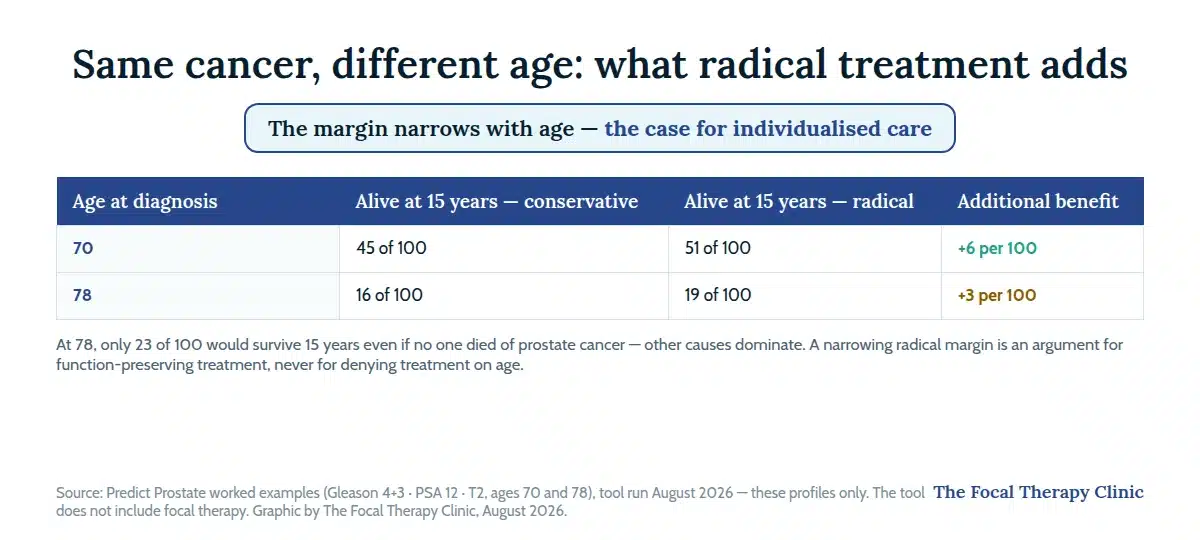
How much does age actually change the treatment equation? The Predict Prostate decision aid (University of Cambridge; harm estimates from the UK ProtecT trial) can show it directly. Two worked examples with the same cancer — Gleason 4+3 (grade group 3), PSA 12, clinical stage T2 — differing only in age (run August 2026):
| Age at diagnosis | Alive at 15 years — conservative management | Alive at 15 years — radical treatment | Additional benefit of radical treatment |
|---|---|---|---|
| 70 | 45 of 100 | 51 of 100 | 6 more men per 100 |
| 78 | 16 of 100 | 19 of 100 | 3 more men per 100 |
At 78, only 23 of 100 men with this profile would survive 15 years even if no one died of prostate cancer at all — at that age, other causes dominate the picture whatever happens to the cancer.
Read carefully, these numbers are the opposite of an argument for writing older men off. They show that the radical-treatment margin narrows with age — which is exactly why blanket “too old for surgery” verdicts and blanket over-treatment are both wrong, and why the honest answer is individualised assessment plus treatment options that control the cancer without demanding the recovery and side-effect price of whole-gland surgery. The question is never “how old is this man?” but “what does this man, with this fitness and this cancer, stand to gain and lose from each option?”
Worked examples for those exact inputs, not general outcomes; the tool compares conservative management with radical surgery and radiotherapy only — it does not include focal therapy.
Get Expert Advice & The Latest Research
Subscribe to our newsletter to receive the latest updates, expert insights, and breakthrough research on prostate cancer-delivered straight to your inbox.
Five Steps to Take If You Feel Dismissed Because of Your Age
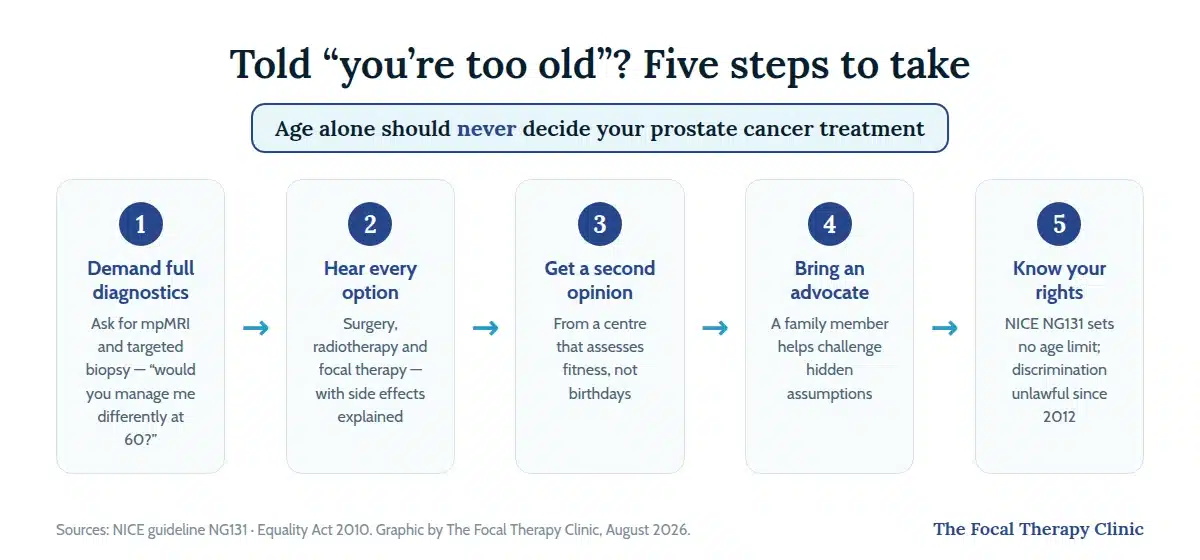
- Demand full diagnostics. Request a complete workup including mpMRI and targeted biopsy. Ask: “Would you manage me differently if I were 60?”
- Request all treatment options. Insist on a discussion of every suitable treatment — surgery, radiotherapy and focal therapy — with side effects explained.
- Seek a second opinion. Our consultant urological surgeons review referrals at no obligation, assessing biological age and fitness rather than birthdays. Ask for a copy of your mpMRI and biopsy reports first.
- Bring a support person. A family member or advocate helps challenge hidden assumptions and ensures nothing is left unexplained.
- Know your rights and the guidance. NICE NG131 sets no age limit for curative treatment, and unjustified age discrimination in NHS services has been unlawful since 2012.
Questions worth taking into any consultation:
- “Are you offering me the same diagnostic workup you’d give a 60-year-old?”
- “What specific medical evidence supports excluding me from curative treatment?”
- “Are you assessing my fitness and biological age, or just my date of birth?”
“A lot of my second opinions… it’s just a case of going over all of the information that I have, but that nobody has actually sat down with them to explain exactly what is available.” — Mr Raj Nigam
NICE-approved focal therapies — HIFU (HealthTech guidance HTG667) and NanoKnife IRE (HTG688) — are available as day-case procedures at our 8 hospital sites across six UK cities, with 2,500+ procedures performed by consultants with 75+ years of combined focal therapy experience. In our patient data, 85% of men return to work within two weeks.
Frequently Asked Questions
How widespread is age discrimination in UK prostate cancer care?
It is common enough that our consultants see it routinely: men over 70 offered fewer diagnostic tests and fewer treatment options than younger patients with identical cancer characteristics, despite legal protections in place since 2012.
What should I do if I’m told I’m “too old” for curative treatment?
Ask what specific medical evidence supports the exclusion, request the same diagnostic workup a younger patient would receive, and seek a second opinion from a specialist centre that assesses biological rather than chronological age.
Is there an official age limit for prostate cancer treatment?
No. NICE guideline NG131 sets no upper age limit for curative treatment. Decisions should be based on individual assessment of fitness, cancer characteristics and personal goals.
Do life-expectancy statistics really support treating older men?
Yes. As Mr Nigam notes, a UK man of 65 can expect around another 19 years, and a man of 75 around another 12 — and most UK deaths now occur in the 80s, not the 70s. A curable cancer left untreated has many years in which to progress.
What is a “nihilistic approach” to older patients?
Automatically assigning older men to monitoring or hormone therapy without individual assessment — withholding diagnostics, not discussing side effects, and excluding curative options on age alone.
Is focal therapy suitable for older men?
Often, yes — it is a day-case procedure with no upper age limit, assessed case by case on cancer characteristics and fitness. In our audit of 265 patients, 97% maintained full urinary continence and 90%+ preserved sexual function. Suitability always requires specialist mpMRI and biopsy review.
About Mr Raj Nigam
Mr Raj Nigam is Consultant Urologist at Royal Surrey NHS Foundation Trust and The Focal Therapy Clinic. He has extensive experience challenging age-based treatment limitations and provides second opinions for patients who have faced age discrimination. His practice prioritises biological age and individual circumstances over chronological assumptions.
Please find below a written transcript of the interview, and call The Focal Therapy Clinic today to discuss your prostate cancer treatment options: 020-7036-8870.
Changing narratives of ageing
Clare Delmar:
Hello and welcome to OnFocus brought to you by The Focal Therapy Clinic, where we engage you with issues facing men diagnosed with prostate cancer that are little known, less understood and often ignored. Prostate cancer is now the most commonly diagnosed cancer in the UK, and with this somber fact comes a multitude of challenges and opportunities. I’m Clare Delmar. Joining me today is Raj Nigam, consulting urologist at the Royal Surrey NHS Foundation Trust and The Focal Therapy Clinic. And we’re going to discuss how the changing narrative around ageing is impacting men’s experience with prostate cancer. Raj, welcome and thanks so much for joining me today.
Raj Nigam:
Good afternoon, Clare. Thanks for having me.
Clare Delmar:
You’re becoming quite the veteran in these discussions, so I’m just going to charge right in and I want to kick off by referencing a very impactful piece that was reported last week by The Times – for our listeners, The Times of London. And it was a big investigative study that basically showed that there was significant age discrimination of covid patients over the last year, which has brought ageism and care of the elderly into focus. I mean, the reaction to this was profound. I mean, even entering the chambers of parliament and other places where it was really, really talked about. So I want to ask you, do you think that this raised awareness that this investigative study has brought will have an impact on clinical practice?
Raj Nigam:
Yeah, I think you’re right. I think the covid pandemic, if anything, has magnified a situation that many of us felt already existed. The concept of ageism, as we have discussed, was effectively made unlawful back in 2012 through the National Health Service in the UK. And this is because there are prevailing attitudes towards increasing age, guiding our medical decisions and management. And it probably has not caught up with the fact that people are living longer lives and healthier lives. And yet we are using chronological age as a surrogate for deciding on even whether we investigate people based upon their age, let alone treat them. So I think you’re right that what covid has illustrated rather starkly in my view, that ageism does exist and that this is sanctioned at the highest level. I mean, when the pandemic was in full flow, we had sort of NICE guidelines, which are national bodies on how we should decide whether somebody gets a ventilator and so on. And obviously age, together with comorbidities related to age, played a huge role in that.
Clare Delmar:
Indeed. So, again, you’ve mentioned a few things that I want to pick up on in more detail. I mean, while the report was focused on covid patients, others have come forward as a response to describe similar practices and attitudes in other areas, including prostate cancer. And I know you and I have previously discussed this. So I’d like to ask if you can illustrate, if you can describe in some detail some of the patient situations that you’ve seen where ageism has compromised care. Do you think this is a moment to harness public interest and support around ageism and demand change?
Raj Nigam:
Yes. So obviously, the field that I’m in of prostate cancer, age or ageism, if you like, has played a significant role over the years in deciding management of such patients. And if you want to break it down, I would describe ageism in this field as a sort of nihilistic approach, really, which ignores the individual circumstances, their state of health, their outlook on life and so on. And we as doctors, we’re all guilty of it to some extent, insofar as we have developed a slightly parochial attitude towards elderly patients. And therefore these terms, such as watchful waiting and active surveillance, have come into being, i.e offering basically no treatment. And of course, I’ve come across several patient situations like this one, which I only saw last week with a chap of 73 years old, very fit and well, very active, who had been told in his locality, oh, nobody will offer you surgery at your age for prostate cancer. Of course surgery is one of the curative treatments. So he was effectively being put down the hormone therapy route, which would give him several side effects, which would limit his activities. He runs huge businesses still and is very active, yet he had been told on the grounds of his age, his chronological age, that he would be denied curative treatment.
Clare Delmar:
And I know you’ve said with regard to hormone therapy that this has been something you’ve seen, unfortunately, at a large scale during covid. Do you see it in any other ways, whether it’s surgical procedures or you mentioned watchful waiting…
Raj Nigam:
Covid pandemic time was obviously a highly specific time and was very unusual, of course, in that all surgery and all radiation treatments and all chemotherapy treatments were halted at that time, when we knew so little about the virus. And a surrogate for that was, in effect to try and buy time, was to place men on hormonal therapy. And I’ve come across so many men where the side effects of such treatment were not even discussed. They were just told that, you know, you should have this. So those patients who would have been suited for a radical treatment without any hormones were denied this. So that was a specific time. But even now, hormones are still being used as a marker of actually saying, well, all right, if you want treatment, this is what we’ll give you because you are elderly. But that denies them the chance of a curative treatment.
Clare Delmar:
And obviously compromises their lifestyle. Which actually leads me into some of the behavioural and attitudinal shifts we’ve seen. The covid experience has exposed, I think, attitudes towards ageing. I’m kind of putting these words in inverted commas, ageing, elderly, vulnerable. We hear them every day, which many of our patients view differently or in some cases even reject in their own lives. As you’ve indicated, this gentleman you were just referring to at 73 is thriving, deeply engaged in an active life when their prostate cancer is diagnosed, but yet they are treated as elderly or vulnerable – back to those terms. So how do we begin to address this disconnect?
Raj Nigam:
Those three words you’ve chosen are very interesting: ageing, elderly, vulnerable, but all of them, in my view, sort of carry negative connotations.
Clare Delmar:
Indeed.
Raj Nigam:
And certainly in the covid era, which we are still in, those would be words that would put fear into a slightly older population because they would fear being treated in a certain way. So I think that those words really do not resonate with a lot of men and women nowadays. I think we have to remember that life expectancy has changed and has improved over the years, although less so over the last 10 years or so. And in the UK, for example, a man who lives to the age of 65 can expect to live another 19 years, a man who lives to the age of 75 can expect to live another 12 years. So we’re not talking about people who are necessarily going to die out in the 70s. In fact, the greatest number of deaths in the UK, now happen in their 80s rather than in their 70s. So there’s been a shift in longevity…
Clare Delmar:
Indeed.
Raj Nigam:
… from that point of view and therefore these definitions of ageing, elderly and vulnerable are no longer valid for men and women who reach the age of 70.
Clare Delmar:
No.
Raj Nigam:
And all covid has done is really magnified this, I think, that this does go on in medical care, either subconsciously or consciously.
Clare Delmar:
Exactly and that’s why I wonder if this is a moment to really bring this out, because it is happening. This, as you say, it’s instilling fear. I think that you chose that word. And another word you just use is longevity or longevity. However, we choose to pronounce it. And there is a movement around this. And by that I mean a collection of both researchers and activists and campaigners who are using the term longevity to show that longer, better lives are possible through advances in medicine as well as shifts in attitudes, behaviours. Do you think something like that has a role to play in supporting men and ensuring that they get appropriate treatment for prostate cancer?
Raj Nigam:
Yeah, I absolutely agree. And although I’ve just quoted you some figures regarding life expectancy, we now recognise healthy years of life expectancy as well. And we know that those numbers are increasing as well. And so it’s not just the age that you live at. It’s how many healthy years you’re going to have beyond the age of 65 or 75.
Clare Delmar:
Is what you’re referring to, the QALY index or the QALY measurement? Is that what you’re referring to?
Raj Nigam:
I mean, there are lots of different measures in terms of measuring quality of life. QALYs are, if you like, a surrogate marker of people living quality, added life years, if you like. And those sorts of markers, are just as valid as the life expectancy is. There are some geographical variations in that and there are some ethnic and racial variations. So it’s not across the board. And even within the UK, we know that although health equality years are improving in most areas, there are one or two pockets geographically in the UK where that is not so obvious. But yes, you’re right, to come back to your point regarding the longevity movement and so on, I agree with you that this is a moment, coming out of covid, whereby we can apply it to other medical conditions such as prostate cancer. There are lots of charities for the elderly, prostate cancer charities, and so on, who should be perhaps harnessing this and advising their men who are over a certain age exactly what is available to them and what should be required of them when they have their consultations following their diagnosis.
Clare Delmar:
And really trying to address or indeed even cancel out this fear factor and instead giving men positivity that they are likely to live long lives based on certain metrics that you’ve referenced and that a prostate cancer diagnosis should be considered in that context.
Raj Nigam:
Totally, totally like several charitable organisations, there are other means of trying to improve this, not least, of course, patient empowerment, empowering patients to ask for certain things, say, look, I might be 70, I might be 71 or whatever, but, you know, why can’t I be treated like a 50 year old? Because…
Clare Delmar:
Absolutely.
Raj Nigam:
… I live life like a 50 year old and so on. And hopefully this will change in time. I think that there are several factors which may promote this change, not least of which is the extension of the retirement age. And I think as people continue to work for longer, which they will be required to do, well into their 60s and so on, then maybe certain attitudes will change and the definitions of terms like elderly should change.
Clare Delmar:
So a final question: could you sum that up in a piece of advice you might give to men over 70 about engaging with their doctors?
Raj Nigam:
I mean, I think the first thing that such men need to recognize that there are long held cultural attitudes within the medical profession and beyond regarding aging and so on, and some of the words that you’ve used will resonate with the medical profession, unfortunately, rather than with patients themselves. I think that waiting for cultural or behavioural change will take a long, long time. It will come, but it will take a long time. You can speed that up through legislation sometimes, but I think patient empowerment is the big key and patient knowledge. So if patients are aware that actually because I’ve reached 70, I may not be offered certain treatments, I may not be offered the opportunities for modern day diagnostics and so on, that a) I should learn about this and find out information about them and then absolutely demand say, look, I really do want to undergo investigation. I really want to have my MRI, I really want to have my biopsies. And sure if I do have the type of cancer that I’m just going to live with and die from, then I can make my judgment at that point in time. But I’d like to know that in the first place. And then, of course, if I’m in treatment, then I should be aware of all the treatment options, not just those which are widely available, which are often radical treatments, which is why certain doctors parochially sort of try and “protect”, in inverted commas, their patients from such radical treatments because they are deemed to be older than other patients. So I think that as long as they are given all that information, which does take time and it’s true that the NHS doesn’t always have that much time. A lot of my second opinions that I see, it’s just a case of going over all of the information that I have, but that nobody has actually sat down with them to explain exactly what is available. So I think that the quickest win is, if you like, patient empowerment and patient information and knowledge and being able to engage with their doctors appropriately.
Clare Delmar:
Raj, thank you so much for speaking to me today. I think this is an issue that’s certainly not going to go away. And I hope that we will be a force in bringing it out there and working in partnership with some of these organisations that you mentioned. So thanks again. It’s been a real pleasure.
Raj Nigam:
Pleasure. Thank you very much.
Clare Delmar:
A transcript of this interview is available on our website, where you can also access information and insight on living with prostate cancer. Thanks for listening and from me, Clare Delmar. See you next time.
References
- NICE guideline NG131 — Prostate cancer: diagnosis and management.
- NICE HealthTech guidance HTG667 — Focal therapy using high-intensity focused ultrasound for localised prostate cancer.
- NICE HealthTech guidance HTG688 — Irreversible electroporation for treating prostate cancer.
- The Focal Therapy Clinic one-year outcome audit (n=265).
- Equality Act 2010 (age discrimination provisions applied to NHS services from 2012).
This content is not intended to replace professional medical advice. Always consult your clinical team about your individual circumstances.