
At a Glance
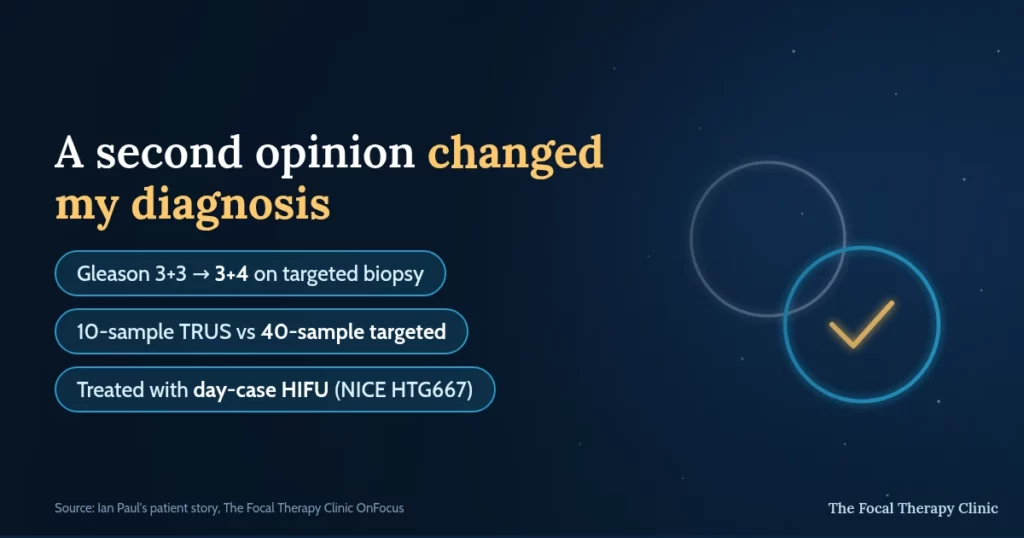
Seeking a second opinion on a prostate cancer diagnosis can change your treatment path entirely. Ian Paul’s original biopsy found low-grade cancer (Gleason 3+3) and recommended active surveillance — but a second opinion at The Focal Therapy Clinic revealed a higher-grade tumour (Gleason 3+4) that was treatable with HIFU focal therapy, a NICE-approved procedure (HTG667).
- Misdiagnosis risk — Ian’s original 10-sample TRUS biopsy under-staged his cancer; a targeted 40-sample biopsy under general anaesthetic revealed the true grade
- Better treatment options — HIFU focal therapy treated Ian’s cancer as a day-case procedure with no long-term side effects, preserving sexual function and continence
- MDT decision-making — A multidisciplinary team reviewed Ian’s case before recommending HIFU, giving him confidence in the treatment plan
- Post-treatment results — Ian’s follow-up MRI showed no evidence of cancer, and he recovered within two to three weeks
- Your right to ask — Patients are entitled to a second opinion and should question any diagnosis that doesn’t feel right
Seeking a prostate cancer second opinion can change your treatment path entirely. Ian Paul, a 58-year-old project manager, was originally told he had low-grade prostate cancer (Gleason 3+3) and was advised to go on active surveillance. A second opinion at The Focal Therapy Clinic — including a more thorough biopsy — revealed a higher-grade tumour (Gleason 3+4) that was successfully treated with HIFU (High-Intensity Focused Ultrasound) focal therapy, a NICE-approved procedure (HTG667).
In this episode of OnFocus, Ian shares his experience with host Clare Delmar — from the shock of misdiagnosis to the confidence he gained through multidisciplinary team (MDT) decision-making at The Focal Therapy Clinic.
Below is a written transcript of the interview. To discuss your prostate cancer diagnosis or treatment options, call The Focal Therapy Clinic: 020 7036 8870.
How Did Ian’s Prostate Cancer Journey Begin?
Ian Paul’s prostate cancer was initially detected through routine PSA blood tests carried out via his workplace insurance. After his PSA doubled from 4 to 7.5 over six months, his urologist recommended an MRI scan, which revealed an abnormality — leading to a biopsy in early January. What followed would highlight why a prostate cancer second opinion can be essential.
Clare Delmar
Hello and welcome to OnFocus, brought to you by The Focal Therapy Clinic, where we connect you with issues facing men diagnosed with prostate cancer that are little known, less understood, often avoided or even ignored. Prostate cancer is now the most commonly diagnosed cancer amongst men in the UK. With this sombre fact becomes a multitude of challenges and opportunities. I’m Clare Delmar.
Joining me today is Ian Paul, a recent patient at The Focal Therapy Clinic who came to the clinic seeking a second opinion following what turned out to be an incorrect diagnosis. Ian is 58, a divorced father of two with a partner of five years. He works as a project manager in the energy sector. Ian, welcome and thank you so much for joining OnFocus today.
Ian Paul
Hi, Clare. Nice to be talking to you today.
Clare Delmar
Let’s jump right in. Your experience began in what I might call almost an ideal setting — you were privately insured, routinely undertaking PSA tests through regular check-ups. Can you describe what happened when your PSA became elevated?
Ian Paul
Yeah, sure. Basically, I’d spent three years going through regular tests through my work-based insurance health checks. My PSA was around three and a half to four — relatively stable but probably slightly raised. The consultant said it’s pretty normal for someone of my age.
Then about February or March time last year, I had the regular six-monthly test and it was a four. Six months later, it suddenly jumped to seven. I’m a keen cyclist and I’d heard about how a hard saddle can aggravate the prostate and increase PSA. So I booked another test about two weeks later and it went up to seven and a half.
That was ringing alarm bells. I went to see the urologist and he suggested that because of such a sharp rise over a short period, I should have an MRI scan. I had that in December. In January, the results showed an abnormality, so he said we need to do a biopsy. I had the biopsy in early January.
What Went Wrong with Ian’s First Biopsy?
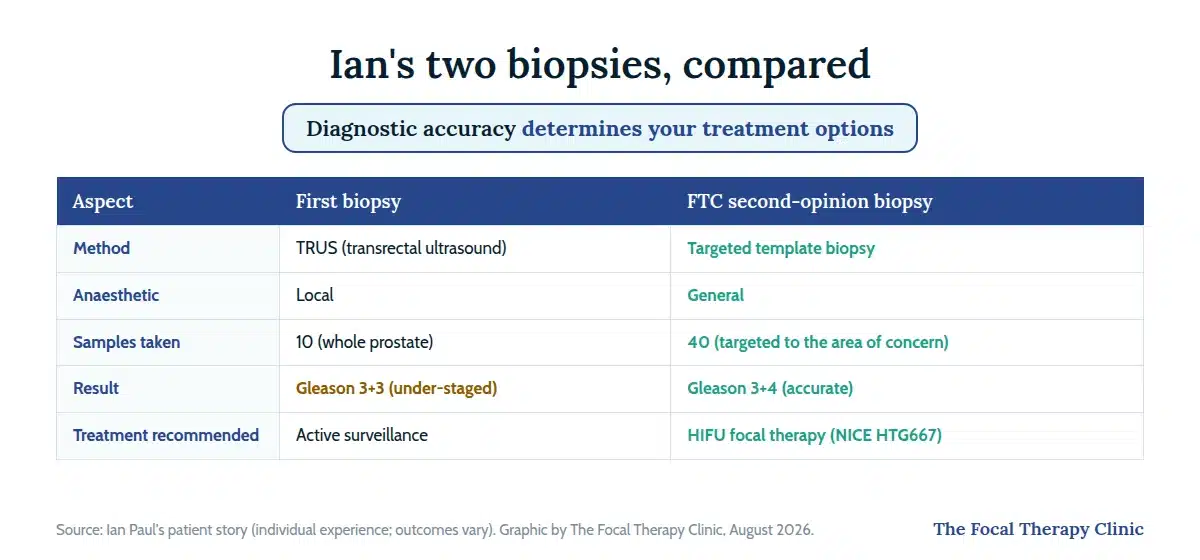
Ian’s first prostate biopsy was a transrectal ultrasound-guided (TRUS) procedure under local anaesthetic, taking just 10 samples. He describes it as unexpectedly painful and inaccurate — a stark contrast to the targeted template biopsy he later received at The Focal Therapy Clinic under general anaesthetic, which took 40 samples from the specific area of concern.
Clare Delmar
Were you briefed on the biopsy method that you underwent?
Ian Paul
I was told that it was going to be relatively straightforward. It would be under a local anaesthetic. I was told not to concern myself about it because it was going to be nothing more than going to the dentist. Although I have to say that nothing could be further from the truth.
Clare Delmar
How so?
Ian Paul
The local anaesthetic injections in that particular area of your body is really, really unpleasant. And then the actual needles going in to take the samples, even with the anaesthetic, was excruciatingly painful. The consultant took 10 samples altogether, but it took 25 minutes.
The one thing I was very conscious of was that I’m not sitting quietly and still because it was so painful. I knew I was shifting position and I’m thinking there couldn’t be an awful lot of accuracy if I’m shifting around. But I wasn’t expecting it and I certainly wasn’t warned for that level of pain.
| Aspect | Ian’s first biopsy | FTC second-opinion biopsy |
|---|---|---|
| Method | TRUS (transrectal ultrasound) | Targeted template biopsy |
| Anaesthetic | Local | General |
| Samples taken | 10 (whole prostate) | 40 (targeted to area of concern) |
| Result | Gleason 3+3 (under-staged) | Gleason 3+4 (accurate) |
| Treatment recommended | Active surveillance | HIFU focal therapy (NICE HTG667) |
Ian’s experience illustrates how diagnostic accuracy directly determines treatment options.
Why Did Ian Reject Active Surveillance?
After his initial 10-sample biopsy found one sample with 5% cancer cells (Gleason 3+3), Ian’s consultant recommended active surveillance — regular six-monthly PSA monitoring. Ian was presented with only two options: active surveillance or radical prostatectomy. He was not told about focal therapy, a NICE-approved alternative that treats the cancer while preserving sexual function and continence.
Ian Paul
I waited about a week and a half to get the results. The consultant told me that of the ten samples, one contained five per cent cancer cells. Low-grade cancer, nothing really to worry about. All we need to do is go through some active surveillance — regular six-monthly PSA tests.
I asked about other options. He said I could have a prostatectomy — removal of the prostate. But I’m only 58, I’m still sexually active and want to remain so. Everything I’d heard about prostate removal suggested erectile dysfunction and incontinence. I wasn’t prepared to go through that.
He mentioned brachytherapy and hormone treatment but didn’t recommend them. He said active surveillance was the route. I left his office unconvinced.
Driving home, I felt increasingly concerned. My PSA had doubled in six months. Who’s to say that during active surveillance it wouldn’t spread? I said to myself, this is not an option. The first thing I did when I got home was go on the Internet. Within five minutes I found The Focal Therapy Clinic. Reading through every page, every interview — it made me realise that there are so many more options out there and not every solution is suitable for everybody.
Clare Delmar
Why do you think active surveillance was recommended? Was the covid situation a concern, given that you’d have to be continuously monitored?
Ian Paul
Even though I was one of the lucky ones — I didn’t have to wait long for an MRI scan or appointments — I still had to wait a few weeks. That waiting played on my mind and it did have an impact on me.
“The first thing I did when I got home was go on the Internet. Within five minutes I found The Focal Therapy Clinic. It made me realise there are so many more options out there.” — Ian Paul, Focal Therapy Clinic patient
What Did Ian’s Second Opinion Reveal?
Mr Marc Laniado walks through what happens at a Focal Therapy Clinic consultation — what is reviewed, and how treatment decisions are reached with each patient.
When Ian sought a second opinion at The Focal Therapy Clinic, Mr Marc Laniado, Consultant Urological Surgeon (FRCS(Urol), GMC: 3343931), reviewed Ian’s original MRI and found it was not sharp enough for a precise diagnosis. A second targeted biopsy — 40 samples under general anaesthetic — upgraded the Gleason score from 3+3 to 3+4, meaning the cancer was more significant than first thought. After review by a multidisciplinary team (MDT), Ian was confirmed as a suitable candidate for HIFU focal therapy, a NICE-approved treatment (HTG667).
Ian Paul
Having found The Focal Therapy Clinic online, the first thing I did was complete their online questionnaire — details about me, my diagnosis, and why I was contacting them. Literally the following day, I received a response from Suki Cooper, one of the patient advocates. She was incredibly good at explaining things. Just having someone tell me about the different options was really eye-opening.
I’d read everything I could about HIFU (High-Intensity Focused Ultrasound) focal therapy, and it seemed ideal if I was a suitable candidate. Suki put me in touch with Mr Marc Laniado because he was local — within about 10 miles. I got an appointment within a few days.
Why was a second biopsy needed?
Ian Paul
Mr Laniado said in the first meeting that the original MRI scan was not 100 per cent sharp. He couldn’t provide a very precise diagnosis from it. The only way to get the diagnosis 100 per cent accurate was a second biopsy.
That worried me because of what I went through the first time. When I told him my concerns about having it done under local anaesthetic, he was surprised. He said, no — I’ll be doing this under general anaesthetic. I think he was surprised I’d had the original one under local.
I went into hospital as a day case, under general anaesthetic, and had 40 samples taken — specifically targeted around the area where the tumour was. A very in-depth biopsy.
When the results came back, Mr Laniado said it was actually worse than my original consultant had indicated. The Gleason score was 3+4, not 3+3. But the tumour was centred in one specific location, not spread around the prostate. In his opinion, I would be a candidate for HIFU therapy — but he had to take it through the multidisciplinary committee (MDT) that he chaired, where cases get discussed based on all the results, pathology, and MRI scans.
Fortunately for me, the MDT confirmed I was a suitable candidate for this therapy.
Clare Delmar
The MDT is a very powerful approach. I’m sure it gave you confidence to know that the treatment was going to be appropriate?
Ian Paul
Knowing that other people were assessing my case inspired me with exactly the kind of confidence I needed to know I was in the right hands.
“Mr Laniado said the original MRI wasn’t sharp enough. The second biopsy upgraded my Gleason from 3+3 to 3+4. The MDT confirmed I was suitable for HIFU. Knowing other people were assessing my case gave me the confidence I needed.” — Ian Paul, Focal Therapy Clinic patient, treated by Mr Marc Laniado, Consultant Urological Surgeon (FRCS(Urol), GMC: 3343931)
Get Expert Advice & The Latest Research
Subscribe to our newsletter to receive the latest updates, expert insights, and breakthrough research on prostate cancer-delivered straight to your inbox.
How Did HIFU Treatment Work for Ian?
Ian underwent HIFU (High-Intensity Focused Ultrasound) focal therapy with Mr Marc Laniado in early March. HIFU is a NICE-approved day-case procedure (HTG667) that treats localised prostate cancer by targeting the tumour with focused ultrasound waves while preserving surrounding tissue. In The Focal Therapy Clinic’s experience of 2,500+ procedures, 90%+ of men maintain sexual function and 97% maintain urinary continence (FTC audit, n=265). Ian’s follow-up MRI showed no evidence of remaining cancer.
Clare Delmar
You clearly learnt a lot in this whole process — the imaging quality, the type of biopsy, the pathology. You then underwent HIFU treatment with Mr Laniado. When was that?
Ian Paul
That was in early March.
Clare Delmar
And things have gone well since?
Ian Paul
I had a further MRI scan a week after. The results came back positive — no evidence of any further cancer cells. It was a good MRI.
Clare Delmar
And you’re feeling well generally?
Ian Paul
Took me about two or three weeks to get to a position where I felt comfortable again. It does take a while before some of the side effects wear away and disappear. But right now, I’m in the middle of May and I’m feeling absolutely brilliant.
Ian’s HIFU outcome: Follow-up MRI showed no evidence of cancer. Recovery took two to three weeks. In The Focal Therapy Clinic’s audit of 265 patients, 90% remain cancer-free at one year, with 90%+ preserving sexual function and 97% maintaining continence.
Why Did Ian’s Original Consultant Dismiss HIFU?
Many men with prostate cancer are not told about all available treatment options, including NICE-approved focal therapies such as HIFU (HTG667). Ian’s experience illustrates a common barrier: consultants who may not be familiar with newer treatments and therefore do not present them as options. Patients have the right to informed consent — meaning they should be told about all suitable treatments before agreeing to a management plan.
Ian Paul
We all tend to look at consultants as the font of all knowledge. But when I was presented with my first diagnosis and active surveillance was recommended, I went back to him. In the letter he sent to my doctor, he said he’d taken me through all the suitable treatments. But that’s not what happened — there are so many options out there. The more research I did, the more I realised that some might be suitable, some might not, but to have the information presented to me would have at least given me the right level of data to make a decision.
Clare Delmar
Indeed. We call that informed consent.
Ian Paul
I told him I’m keen to find out about HIFU therapy. My insurance company confirmed they would support it financially. But the consultant came back and said: “I wouldn’t recommend HIFU therapy to my relatives, let alone to you.” I asked why. He said there isn’t enough data to support it. I said, well, how on earth are these treatments ever going to make it into mainstream unless people are part of trials?
Editorial note: HIFU for localised prostate cancer is approved by NICE under HealthTech guidance HTG667, confirming sufficient evidence of safety and efficacy. At The Focal Therapy Clinic, our consultants have collectively performed 2,500+ HIFU and focal therapy procedures at 8 hospital sites across six UK cities. Ian’s interview was recorded in 2021; his reference to HIFU being “under trial” reflects the information he had at the time.
What Is Ian’s Advice to Other Men?
Ian’s core message is simple: question everything. If you are not satisfied with your prostate cancer diagnosis or treatment recommendation, you are entitled to seek a second opinion. A second opinion at The Focal Therapy Clinic includes detailed MRI review, targeted biopsy where needed, and multidisciplinary team (MDT) assessment — ensuring you receive a complete picture of your options, including NICE-approved focal therapy treatments.
Ian Paul
Question everything. If you’re not happy with what you’re hearing, say: I appreciate your opinion, but I’d like a second opinion. I’d recommend to anybody in my situation to just look on the Internet. You’ve only got to do a single search and you’ll find so many different organisations. The Focal Therapy Clinic is the one that comes up number one.
Yesterday I got a call from a colleague whose neighbour has just been diagnosed with prostate cancer. He wanted to know who I went to see, what the clinic was, what the treatment was. I sent him links to The Focal Therapy Clinic and other websites about the different options available. Being able to share the experience is brilliant.
Clare Delmar
It’s incredibly generous of you. I’m delighted you’ve had such a good outcome and been so generous in sharing your time and personal experience. Thank you for coming today.
If Ian’s story resonates, our second opinion service explains what we review and how the process works.
You can also read what happened when a doctor became a prostate cancer patient — and what it changed about his advice.
References
- NICE HealthTech guidance HTG667 — Focal therapy using high-intensity focused ultrasound for localised prostate cancer.
- NICE guideline NG131 — Prostate cancer: diagnosis and management.
- The Focal Therapy Clinic one-year outcome audit (n=265).
This content is not intended to replace professional medical advice. Always consult your clinical team about your individual circumstances. Patient experiences are individual; outcomes vary.