

HIFU Treatment for Prostate Cancer
- NICE-approved focal therapy (HTG667) that treats prostate cancer as a day case procedure.
- 90%+ sexual function preserved, less than 2% urinary incontinence (FTC audit, n=265).
- Over 2,000 procedures performed across seven UK centres by GMC-registered consultant urological surgeons.
- Most men return to work within two weeks — no surgical wound, no stitches, no radiation.

Procedures Performed

(FTC audit, n=265)

Same-day discharge
Most men go home the same day. 85% return to work within 2 weeks (FTC patient data)

90%+ function preserved
Over 90% of men maintain sexual function; less than 2% experience incontinence (FTC audit, n=265)

Minimally invasive
No incisions, no radiation, no hormones. Performed under general anaesthetic in 1-2 hours
HIFU (high-intensity focused ultrasound) is a NICE-approved focal therapy (guidance HTG667) for localised prostate cancer. At The Focal Therapy Clinic, our consultant urological surgeons use focused ultrasound to destroy the tumour while sparing healthy tissue — a day-case procedure, under general anaesthetic, that preserves sexual function in over 90% of men and urinary continence in 97% (our audit of 265 patients).
In our clinic's experience treating over 2,000 patients, HIFU effectively treats localised prostate cancer with 90%+ sexual function preservation and less than 2% risk of urinary incontinence (FTC audit, n=265). The Focal Therapy Clinic offers HIFU across seven UK centres, led by four GMC-registered consultant urological surgeons who assess every patient individually through detailed MRI review and multidisciplinary discussion.
Every patient case is reviewed at our weekly multidisciplinary team meeting (MDT) where your case is discussed in detail by our team of consultant urological surgeons, oncologists, and uro-radiologists. Our uro-radiology team, led by Dr Clare Allen, a prostate MRI and focal therapy pioneer, develops personalised treatment plans based on detailed review of your MRI images and biopsy results.
Learn more about how HIFU works
| Feature | HIFU |
|---|---|
| Treatment Type | Minimally invasive focal therapy |
| Energy Used | High-intensity focused ultrasound (thermal) |
| Hospital Stay | Outpatient (same day) |
| Urinary Incontinence Risk | Very low (<1%) |
| Erectile Dysfunction Risk | Low (~5-10%) |
| Repeatable Treatment? | Yes |
| Best for Tumour Location | Tumours near the base of the prostate gland |
| Suitability | Men eligible for focal therapy where tumour location is near the base of the prostate gland |
| Follow-Up Care | Regular PSA testing and occasional MRI scans |
“So I had the HIFU treatment…and the rest has been joyful and happy. I do not feel like a cancer sufferer.”
Perry Letcher
The Focal Therapy Clinic patient
Am I Suitable for HIFU Treatment?
HIFU suits men with localised, intermediate-risk prostate cancer (typically Gleason 6 or 7, PSA under 15–20) confined to the posterior or lateral prostate, with a life expectancy of at least 8–10 years. At The Focal Therapy Clinic every case is reviewed by MRI and multidisciplinary discussion, led by a GMC-registered consultant urological surgeon, before treatment is offered.
Most men with localised prostate cancer (Gleason 3+3 or 3+4, stage T1-T2) are suitable for HIFU treatment, particularly when the tumour is located in the posterior or base region of the prostate. Your suitability is assessed through mpMRI imaging and targeted biopsy, reviewed by your consultant in a multidisciplinary team discussion.
HIFU may be appropriate if your cancer is:

Localised (has not spread outside the prostate)

Intermediate risk (typically Gleason 6 or 7, PSA under 15-20 ng/mL)

Located in the posterior or lateral parts of the prostate

You have a life expectancy of at least 8-10 more years
HIFU is particularly effective for posterior tumours because the ultrasound probe is positioned in the rectum, giving direct access to the back of the prostate. For anterior tumours -- those at the front of the prostate, closer to the abdominal wall -- The Focal Therapy Clinic offers NanoKnife IRE treatment (NICE-approved under HTG688), which can reach areas that HIFU cannot.
Mr Alan Doherty, Consultant Urological Surgeon (FRCS(Urol), FEBU, GMC: 3279241), explains: "Not every patient is suitable for focal therapy, and we're transparent about that. We assess every referral carefully with mpMRI and targeted biopsy before recommending treatment."
It could also be the right choice if you are on the NHS Active Surveillance protocol and want to move to active treatment.
Check your suitability

Success rates
“Longer-term evidence is equally encouraging after 7-8 years of follow-up, failure-free survival rates for focal therapy are equivalent to surgery and radiotherapy — but with dramatically fewer side effects ”
Mr Tim Dudderidge
Consultant Urologist
HIFU is approved by NICE under Health Technology Guidance HTG667, confirming sufficient evidence of safety and efficacy for use in both the NHS and private practice.
In the 5-10% of cases where cancer is not fully treated or recurs, further treatment remains available. Mr Raj Nigam, Consultant Urological Surgeon (FRCS(Urol), FEBU, GMC: 3265226), notes: "In the unfortunate 5-10% of cases where the cancer is not fully treated or returns in another part of the prostate, additional options are available. You can undergo another focal therapy session or pursue traditional treatments such as radical prostatectomy or radiotherapy if needed."
This retreatability is a key advantage -- unlike radical prostatectomy, HIFU does not burn bridges.
How Does HIFU Compare to Surgery and Radiotherapy?
Because HIFU targets only the cancer, it dramatically reduces the side effects of whole-gland treatment. In The Focal Therapy Clinic's audit of 265 patients, over 90% of men preserved sexual function and 97% remained fully continent — compared with roughly 30–70% sexual function and 80–95% continence after radical prostatectomy or radiotherapy (ProtecT, NEJM 2023). Most men return to work within two weeks.
HIFU focal therapy offers a middle ground between active surveillance and radical whole-gland treatments. Where active surveillance means monitoring without treating, and radical prostatectomy or radiotherapy treats the entire prostate, HIFU targets only the cancerous tissue -- preserving quality of life while actively treating the disease.
| Outcome | HIFU Focal Therapy | Radical Prostatectomy | Radiotherapy |
|---|---|---|---|
| Sexual function preserved | 90%+ (FTC audit, n=265) | 30-70% | 50-70% |
| Urinary continence | 97% (FTC audit, n=265) | 80-95% (at 12 months) | 90-95% |
| Cancer control at 5 years | 88% failure-free survival (Guillaumier et al., 2018) | 90-95% | 85-90% |
| Procedure time | 1-2 hours | 3-4 hours | 20-37 sessions over weeks |
| Hospital stay | Day case (home same day) | 1-3 nights | Outpatient |
| Recovery to normal activity | 85% back to work within 2 weeks | 4-6 weeks | 2-4 weeks |
| Retreatment possible | Yes | No (prostate removed) | Limited |
| NICE status | Approved (HTG667) | Standard care | Standard care |
Source: FTC one-year outcome audit (n=265); five-year figure from Guillaumier et al., 2018. Radical prostatectomy and radiotherapy figures represent ranges from meta-analyses (ProtecT, NEJM 2023).
This comparison helps you understand the differences -- the right choice depends on your cancer's grade, stage, and location, as well as your personal priorities. Your consultant will discuss which options are most appropriate for your individual case.
What to Expect: The HIFU Procedure Step by Step
- Pre-treatment imaging (MRI/ultrasound) to pinpoint the cancer
- Blood tests (PSA levels, general health)
- Discussion of anaesthesia options
- Bowel preparation (as advised by your medical team)
What Are the Side Effects of HIFU?
After focal HIFU, over 90% of men maintain erectile function and fewer than 2% experience urinary incontinence (our audit, n=265) — because the treatment spares the nerves and sphincter that whole-gland surgery and radiotherapy damage. By contrast, radical prostatectomy and radiotherapy commonly report erectile dysfunction in 20–30% or more of men.
The most common side effects after HIFU are temporary and resolve within days to weeks. In our audit of 265 patients at The Focal Therapy Clinic, less than 2% experienced urinary incontinence, and over 90% maintained their sexual function. By treating only the cancerous tissue, HIFU avoids the widespread damage to nerves and muscles that causes side effects in whole-gland treatments.
| Symptom | Frequency | Duration |
|---|---|---|
| Temporary urinary catheter | Standard (all patients) | Typically 1-3 days |
| Increased urinary frequency or urgency | Common | 1-4 weeks |
| Mild perineal discomfort | Common | 2-3 days |
| Light blood in urine | Common in first few days | 1-3 days |
| Change in erectile function | 5-10% experience some change; 90%+ maintain function (FTC audit) | Usually temporary (most recover within months) |
| Urinary tract infection | Uncommon (<5%) | Treated with antibiotics |
| Urinary incontinence | Rare (<2%, FTC audit) | - |
| Retreatment required | 10-20% within 5 years | - |

Recovery After HIFU Treatment
Most men go home the same day as their HIFU procedure and return to normal activities within one to two weeks. Our patient data shows 85% of men return to work within two weeks of focal therapy at The Focal Therapy Clinic. There is no surgical wound, no stitches, and no prolonged bed rest.
Your recovery timeline:
- Day of treatment: Home the same evening in most cases
- Days 1-3: Rest at home. Temporary catheter in place. Mild discomfort managed with paracetamol and ibuprofen
- Days 5-7: Catheter removed (at GP surgery or by district nurse)
- Weeks 1-2: Gradual return to normal activities including work
- Week 6: Follow-up appointment with your consultant
- Month 3: First PSA blood test
- Month 12: Follow-up MRI scan to confirm treatment success
How Much Does HIFU Treatment Cost?
HIFU treatment at The Focal Therapy Clinic costs from £14,000, including VAT. This is an all-inclusive fee covering your consultant's time, anaesthetist, the procedure and the day-case facility.
What is included:
- Pre-operative assessment and MRI review
- Consultant urological surgeon performing the procedure
- General anaesthetic and anaesthetist fees
- Day-case facility and nursing care
- Post-operative catheter supplies
Insurance: HIFU is recognised by major UK private medical insurers including Bupa, AXA Health, Aviva, WPA and Vitality.
Questions to Ask Your Doctor About HIFU

Are You a Good Candidate for HIFU (High-Intensity Focused Ultrasound)?
- Your cancer is intermediate risk (usually Gleason 3+4 or 4+3).
- The cancer is localised (hasn’t spread outside the prostate).
- Your PSA is under 15–20 ng/mL.
- You are expected to live at least 8–10 more years.
- The cancer is in one main spot and small enough to target.
Note: HIFU is not usually used for very low-risk or very high-risk cancer. It aims to treat the cancer while keeping side effects like incontinence or erection problems low.
"I had the HIFU procedure with Tim Dudderidge and was very happy with the results... I have absolutely no incontinence and I'm fully sexually active without any side effects."
“Focal HIFU treats cancer with lower side effects.”
HIFU is available at the Focal Therapy Clinic in the UK. It is one of the leading centres for focal therapy, including HIFU, NanoKnife, and Cryotherapy. The team includes top urologists like Mr Tim Dudderidge (GMC: 4505451), Mr Marc Laniado (GMC: 3343931), Mr Raj Nigam (GMC: 3265226) and Mr Alan Doherty (GMC: 3279241) who have treated over 2,000 patients successfully.
Patient quote: "The team at The Focal Therapy Clinic made me feel very reassured. From the first consultation through to my HIFU treatment and follow-up, everything was explained clearly." — Perry Letcher, FTC HIFU patientHIFU targets only the cancerous area, not the whole prostate. This means significantly fewer side effects compared to surgery or radiotherapy. In our clinic's audit of 265 patients, 90%+ maintained sexual function and 97% maintained urinary continence after focal HIFU. NanoKnife IRE is also precise and may be preferred for anterior tumours that HIFU cannot reach.
"I have absolutely no incontinence and I'm fully sexually active without any side effects." — Graham Pipe, HIFU patient
"Focal HIFU treats cancer with minimal side effects. It preserves sexual function reliably." — Mr Alan Doherty, Consultant Urological Surgeon (FRCS(Urol), FEBU, GMC: 3279241)
HIFU can be safely repeated if the cancer comes back in the treated area. Around 10-20% of men may need a second treatment within five years, and it usually works well. Follow-up scans and biopsies help decide if another treatment is needed.
Urologist quote: “Focal HIFU lets us hit the cancer without harming the rest of the prostate.” – Mr Raj Nigam, Consultant Urological Surgeon (FRCS(Urol), FEBU, GMC: 3265226)For men with intermediate-risk, localised prostate cancer, published UK research reports 88% failure-free survival at five years (Guillaumier et al., 2018 — a study co-authored by our consultants Mr Tim Dudderidge and Mr Raj Nigam), meaning no need for surgery, radiation, or further treatment. Side effects are typically mild: less than 2% experience urinary incontinence, and 90%+ maintain sexual function (FTC audit, n=265), especially if function was good before treatment.
Urologist quote: “HIFU preserves sexual function reliably.” - Mr Alan Doherty, Consultant Urological Surgeon (FRCS(Urol), FEBU, GMC: 3279241)Patient quote: “I have no incontinence and full sexual function after HIFU.” - Nigel Harris, FTC patient
- PSA tests every 3 months for the first year
- MRI scan at 12 months
- Biopsy only if the MRI scan indicates an area of concern
- Regular checks for urinary or sexual function
This helps catch any signs of cancer coming back early.
Urologist quote: “Monitoring side effects and recurrence rates is a key part of our research” - Mr Marc Laniado, Consultant Urological Surgeon (FRCS(Urol), FEBU, GMC: 3343931)Get Expert Advice & The Latest Research
Subscribe to our newsletter to receive the latest updates, expert insights, and breakthrough research on prostate cancer-delivered straight to your inbox.
Choosing Between NanoKnife & HIFU
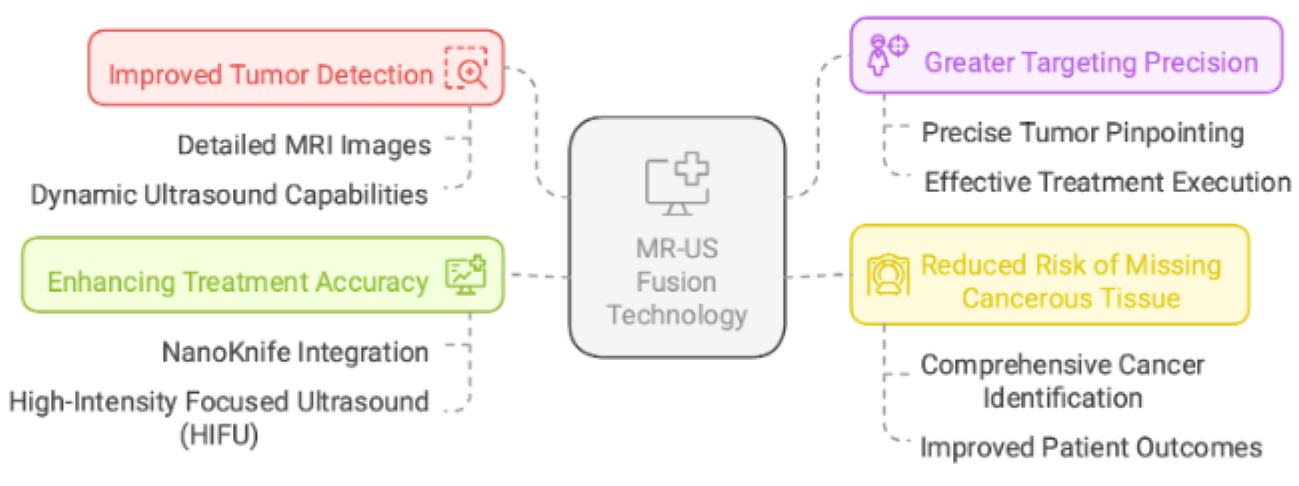
The Role of MR-US Fusion Technology in Treatment Accuracy
Benefits of MR-US Fusion Technology
- Improved Tumour Detection - More accurate than ultrasound alone
- Greater Targeting Precision - Helps specialists precisely pinpoint tumours
- Reduces Risk of Missing Cancerous Tissue - Ensures comprehensive tumour destruction
Frequently Asked Questions About HIFU

"HIFU for prostate cancer has been the subject of clinical research since the late 1990s, with UK university hospitals playing a leading role in clinical trials that established its safety and efficacy for focal treatment. "
Medical Reviewers
The clinical content on this page has been reviewed by the consultant team at The Focal Therapy Clinic:
- Mr Tim Dudderidge, Consultant Urologist (MB ChB, MSc, FRCS(Urol)) — GMC 4505451
- Mr Marc Laniado, Consultant Urologist (MD, FRCS(Urol), FEBU) — GMC 3343931
- Mr Raj Nigam, Consultant Urologist (MBBS, MD, FRCS, FRCS(Urol), FEBU) — GMC 3265226
- Mr Alan Doherty, Consultant Urologist (MBBS, BSc, MD, FRCS(Urol), FEBU) — GMC 3279241
- Dr Clare Allen, Consultant Uro-Radiologist (MBBS) — GMC 3108389
- Dr Christos Mikropoulos, Consultant Clinical Oncologist (MBBS, MSc, MD(Res), MRCP, FRCR) — GMC 4692210
- Dr Francesco Giganti, Consultant Uroradiologist (MBBS, PhD) — GMC 7471579
- Dr Aqua Asif, Urologist (MBChB, MRCS)
Reference List
Our outcomes are from The Focal Therapy Clinic's audit of 265 patients (1-year follow-up, Oct 2025): 90%+ sexual-function preservation, 97% urinary continence, 90% cancer-free at one year.
Five-year cancer control (failure-free survival 88% at 5 yrs, UK n=625) from Guillaumier S, … Dudderidge T, … Nigam R, et al. European Urology 2018 — co-authored by FTC's Mr Dudderidge and Mr Nigam.
Registry evidence: Reddy D, … Dudderidge T, Nigam R, et al. Cancer Control Outcomes Following Focal HIFU in 1,379 Men: A Multi-institute 15-year Experience. European Urology 2022;81(4):407–413. doi:10.1016/j.eururo.2022.01.005 — co-authored by FTC consultants Mr Tim Dudderidge and Mr Raj Nigam.
Older men: Habashy D, … Nigam R, … Dudderidge T. Outcomes Following Focal Ablative Therapy in Patients >70. J Urol 2023;210(1):108–116.
Regulatory: NICE HTG667 (2023); NICE NG131 (2019, upd. 2021); EAU Guidelines on Prostate Cancer (2024).
Subscribe to our newsletter
Get expert advice & the latest prostate cancer research - straight to your inbox.