
At a Glance
The National Institute for Health and Care Excellence (NICE) is the independent UK body that provides evidence-based guidance for healthcare. It reviews evidence to help patients and health professionals make the best decisions.
Key takeaways:
- NICE provides national guidance on health and care in the UK to ensure high standards and reduce variations in care.
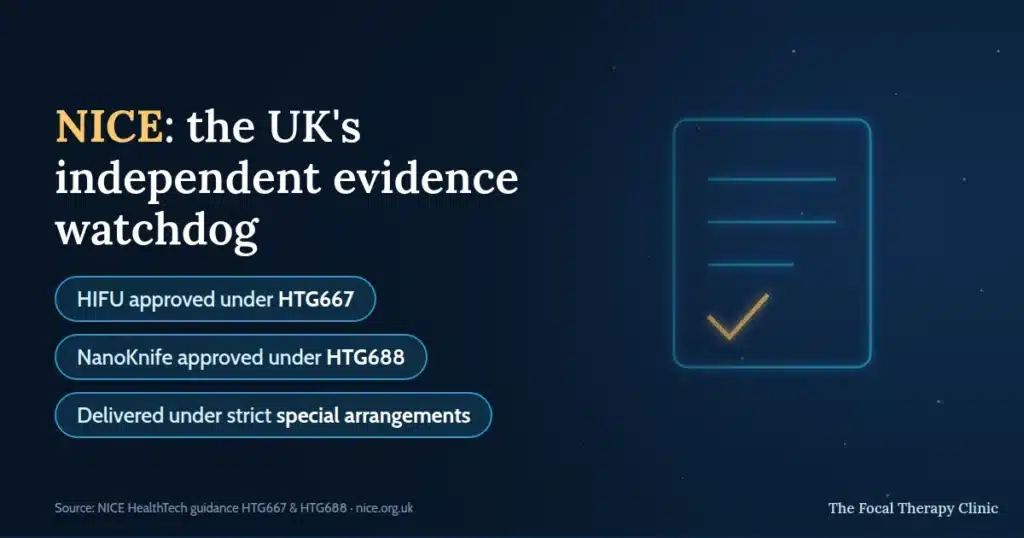
- Focal HIFU and NanoKnife are covered by NICE “HealthTech guidance” — HIFU under HTG667 and NanoKnife (irreversible electroporation) under HTG688. This programme absorbed NICE’s older Interventional Procedures programme, and this type of guidance does not include a funding mandate.
- NICE supports these focal therapies only under “special arrangements.”
- These “special arrangements” are a high standard for patient safety, mandating expert multidisciplinary team (MDT) selection, enhanced patient consent, and a formal audit of outcomes for every patient.
- The Focal Therapy Clinic’s process is built to meet these standards, demonstrated by our expert consultants and transparently published patient outcome data.
Understanding NICE and its role in UK healthcare
NICE was created in 1999 to reduce inequalities in healthcare across England. At the time, patients in different regions often had very different access to treatments. It provides consistent, science-based guidance for health and social care professionals.
Although NICE primarily operates in England, its recommendations are highly influential across the UK. Health bodies in Wales, Scotland, and Northern Ireland often use NICE guidance when making their own healthcare decisions. This makes the National Institute for Health and Care Excellence a key player in setting national standards.
Understanding NICE guidance
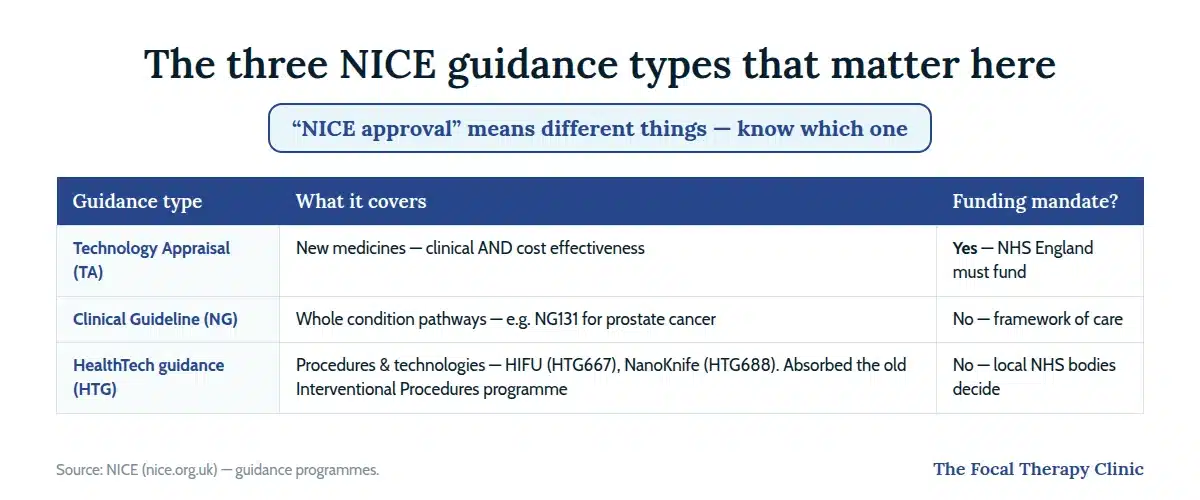
The term “NICE approval” can be confusing because NICE issues several different types of guidance.
Different types of guidance
NICE guidance isn’t a single stamp of approval. The main types you might encounter are:
- Technology Appraisals (TA): this is what most people think of as “NICE approval.” TAs are common for new medicines and assess both clinical effectiveness and cost-effectiveness (value for money). A positive TA comes with a mandatory funding directive, meaning the NHS in England is legally required to make the treatment available.
- Clinical Guidelines (NG): broad guides that cover the entire pathway for a specific condition, such as NG131 for prostate cancer. They recommend the standard framework of care, from diagnosis to managing established treatment options.
- HealthTech guidance (HTG): NICE’s programme for medical technologies and procedures — it absorbed the older Interventional Procedures programme. Focal HIFU (HTG667) and NanoKnife IRE (HTG688) sit here. HealthTech guidance assesses whether a procedure is safe enough and works well enough to be used; it does not carry a funding mandate.
What NICE guidance does not mean
Understanding what NICE guidance doesn’t mean is just as important.
- It does NOT guarantee NHS funding (in this case): because focal therapy is covered by HealthTech guidance rather than a Technology Appraisal, there is no mandatory funding. Local NHS bodies can decide whether or not to fund it, which is why availability is currently limited to a few specialist centres.
- It does NOT replace medical advice: NICE guidance is a tool to support your conversation with a specialist. It cannot replace the advice of an experienced doctor who understands your individual diagnosis and priorities.
Focal therapy and NICE guidance
Mr Raj Nigam explains how to think about whether your prostate cancer actually needs treatment now — the question behind every monitoring decision.
Focal therapy aims to treat only the part of the prostate affected by cancer, leaving healthy tissue untouched. This approach aims to reduce the risk of side effects, such as incontinence or erectile dysfunction, which are more common with whole-gland treatments like surgery or radiotherapy.
The Focal Therapy Clinic offers two key focal treatments:
- HIFU: High-Intensity Focused Ultrasound, which uses focused sound waves to destroy cancer cells (NICE HealthTech guidance HTG667)
- NanoKnife: Irreversible Electroporation (IRE), which uses short electrical pulses to disrupt cancer cells without heat (NICE HealthTech guidance HTG688)
Both sets of NICE guidance say that these procedures are safe and effective enough for use, but only when offered with “special arrangements”.
What ‘special arrangements’ mean for you
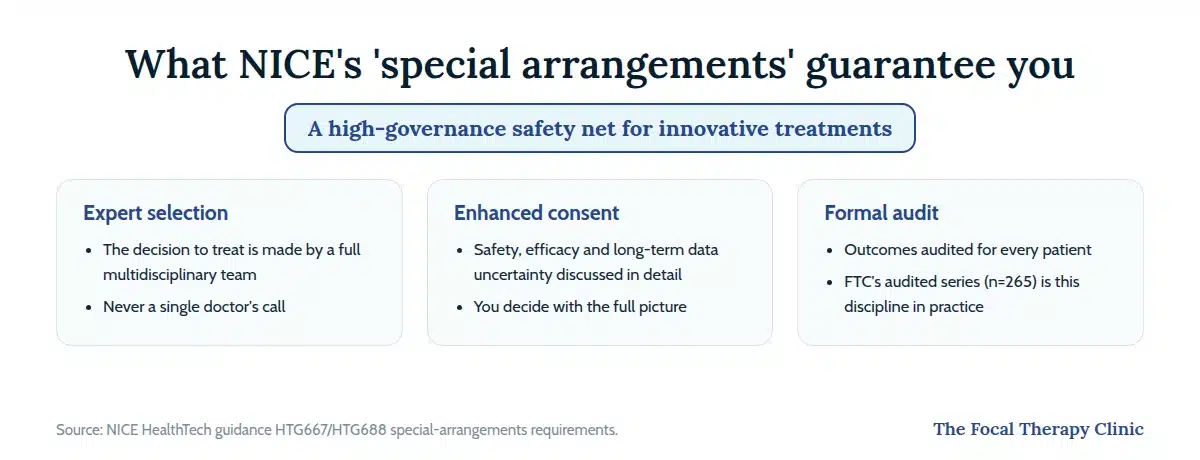
“Special arrangements” are not a minor detail; they are NICE’s high-level requirements to ensure patient safety and track long-term results for innovative treatments. This guidance mandates that clinics must have:
- Expert patient selection: the decision to treat, and the selection of the patient, must be made by a full multidisciplinary team (MDT), not just one doctor.
- Enhanced patient consent: your clinician must discuss the procedure’s safety, efficacy, and any uncertainties about long-term data with you in detail.
- Formal data collection: the clinic must audit and review clinical outcomes of everyone having the procedure.
This framework is designed to protect patients and ensure these advanced treatments are delivered only in high-governance settings that actively monitor their own performance.
Get Expert Advice & The Latest Research
Subscribe to our newsletter to receive the latest updates, expert insights, and breakthrough research on prostate cancer-delivered straight to your inbox.
Why this matters when choosing your treatment
When you’re diagnosed with prostate cancer, the choices can feel overwhelming. Treatments vary in how they work, how long recovery takes, and what the side effects might be. Understanding NICE’s framework empowers you to move beyond asking “Is this treatment an option?” and instead ask the more important question: “Does this clinic meet the high governance, audit, and MDT standards that NICE demands for this procedure?”
For the wider system picture, read the challenges facing NHS prostate cancer care.
The Focal Therapy Clinic and NICE standards
The Focal Therapy Clinic aligns closely with NICE’s approach to high-quality, patient-focused care. Every patient’s case is reviewed by a full multidisciplinary team (MDT), bringing together the expertise of world-class consultant urologists, a specialist uroradiologist, and a clinical oncologist to agree on the best possible path for you.
The clinic’s consultants include:
- Urologists with over 75 years’ combined experience in focal therapy
- Leading prostatectomy surgeons who understand both surgical and non-surgical options
- An expert in male fertility and andrology
- A world-class oncologist familiar with radiotherapy alternatives
With more than 2,500 focal therapy procedures delivered, and consistent outcomes that fulfil NICE’s audit standards (in our audited series of 265 men: 90% cancer-free at one year, 97% continence, 90%+ sexual function preserved), the clinic offers one of the most advanced focal therapy services in the UK. The Focal Therapy Clinic is also the only institution in the UK to use MRI-US fusion technology on all of its focal therapy cases — every case since 2020 — improving precision, helping preserve healthy tissue and reduce side effects.
Frequently Asked Questions
What is the National Institute for Health and Care Excellence (NICE)?
NICE is an independent organisation that provides national guidance on healthcare and treatments in the UK. It was established to ensure patients receive consistent, high-quality care based on the best available evidence.
What does it mean that focal therapy is NICE supported?
NICE has issued specific guidance for focal therapies. For HIFU (HealthTech guidance HTG667) and NanoKnife (HTG688), NICE recommends their use under special arrangements. This is a high level of oversight that requires expert MDT governance, enhanced consent and formal auditing of outcomes. Focal cryoablation is covered by separate guidance (IPG423); NICE’s older whole-gland cryotherapy guidance is IPG145.
Why is this important when choosing a prostate cancer treatment?
It shows the treatment has been independently evaluated for safety and effectiveness. Special arrangements provide reassurance that the procedure is delivered in a setting with strong clinical governance and transparent reporting of results.
Is focal therapy available on the NHS?
Some NHS centres offer focal treatments such as HIFU, although availability varies depending on local policy and funding. Many men choose private clinics to access treatment sooner and with greater flexibility.
Where can I find NICE’s official guidance on focal therapy?
The NICE website publishes full guidance on focal therapy procedures. Key documents include HTG667 for HIFU, HTG688 for NanoKnife (IRE) and IPG423 for focal cryoablation. Each outlines how the procedures should be used, in which patients, and what the current evidence shows.
This content is not intended to be a substitute for professional medical advice, diagnosis, or treatment. Always seek the advice of your urologist or other qualified health provider with any questions you may have regarding a medical condition.
References
- National Institute for Health and Care Excellence. About us. https://www.nice.org.uk/about-us
- National Institute for Health and Care Excellence. Focal therapy using high-intensity focused ultrasound for localised prostate cancer. HealthTech guidance HTG667. https://www.nice.org.uk/guidance/htg667
- National Institute for Health and Care Excellence. Irreversible electroporation for treating prostate cancer. HealthTech guidance HTG688. https://www.nice.org.uk/guidance/htg688
- National Institute for Health and Care Excellence. Prostate cancer: diagnosis and management (NG131). 2019, updated 2021. https://www.nice.org.uk/guidance/ng131