

At a Glance
Many men face difficult choices after receiving a prostate cancer diagnosis. Treatment decisions affect not just survival but long-term wellbeing and independence. da Vinci robotic prostate surgery has changed how prostate cancer is treated, offering men an option that is precise, less invasive, and focused on preserving quality of life.
Key takeaways:
- da Vinci surgery has largely replaced open surgery as the standard of care for prostate removal, using small “keyhole” incisions.
- High-definition 3D visualisation and motion scaling allow surgeons to perform delicate procedures with greater accuracy and control, especially around nerves and vital structures.
- Nerve-sparing capabilities help preserve bladder control and erectile function, reducing long-term side effects like incontinence and impotence.
- Shorter hospital stays, quicker catheter removal, and faster return to normal activities make robotic surgery a preferred choice for many men.
- Compared to open or laparoscopic surgery, da Vinci surgery consistently shows fewer complications, less pain, and improved surgical outcomes.
- It has become the standard of care in many countries, with growing adoption driven by clinical benefits and improved quality of life.
- Ongoing innovations, including the da Vinci 5 platform, are expected to further improve surgical precision, reduce trauma, and enhance patient outcomes.
The Focal Therapy Clinic and prostate cancer treatment
The Focal Therapy Clinic specialises in precision, minimally invasive alternatives that preserve function, such as HIFU (High-Intensity Focused Ultrasound) and NanoKnife. Our multidisciplinary team reviews every case to determine the best approach for the individual.
While we are pioneers in advanced focal therapy (aiming to treat just the tumour rather than the whole gland), we recognise that some men will require or choose whole-gland removal. In these instances, we support patients in understanding mainstream surgical options like robotic prostatectomy or combination hormone-radiotherapy treatments — ensuring they can weigh the clinical benefits against potential risks.
Our urologists have been pioneers in robotic prostatectomy procedures with many thousands of cases over the years. Mr Marc Laniado, FRCS (Urol) (GMC: 3343931) and Mr Tim Dudderidge, FRCS (Urol), MD (GMC: 4505451) bring extensive robotic surgery expertise to our multidisciplinary team, while Dr Christos Mikropoulos, Consultant Clinical Oncologist, MBBS, MSc, MD (Res), MRCP, FRCR (GMC: 4692210) is one of the UK’s leading clinical oncologists, offering MRI-guided radiotherapy and SABR (Stereotactic Ablative Radiotherapy) techniques.
From the video transcript: Radical prostatectomy is the surgical removal of the prostate to treat prostate cancer. It may be better described as total prostatectomy, as the goal is to remove the prostate while preserving neighbouring structures, such as the nerves and urethra. Unlike traditional cancer surgeries, where large margins of surrounding tissue are removed, robotic prostatectomy allows for precise dissection, preserving essential structures that improve continence and erectile function. Compared to open surgery, robotic prostatectomy offers several advantages: a minimally invasive approach using keyhole surgery; six small incisions, each less than 1 cm long; quicker recovery — most patients stay in the hospital for only one or two nights; faster return to normal activities, such as driving and sports; and better preservation of urethral length, helping maintain early post-operative urinary continence.
1. What is da Vinci robotic prostate surgery?
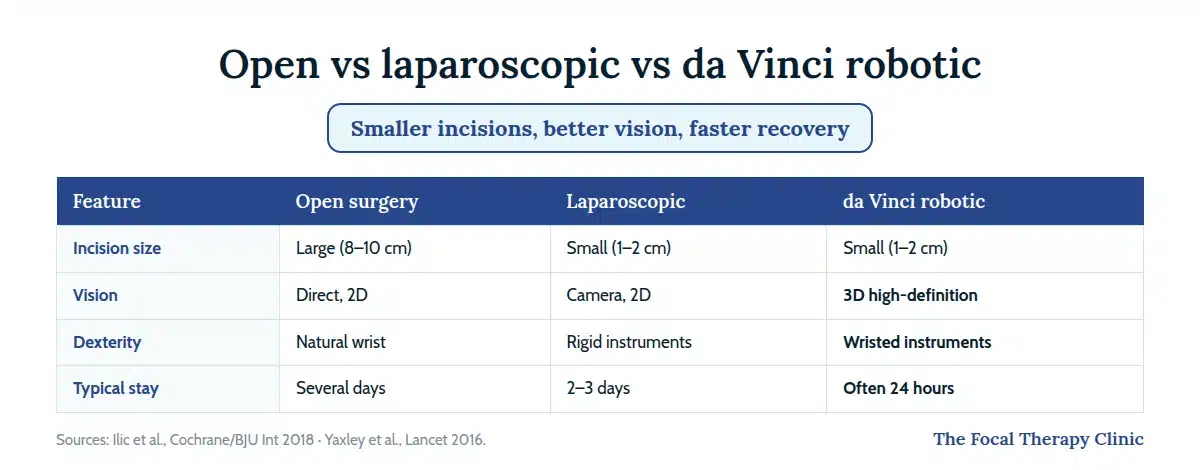
da Vinci robotic prostate surgery is a minimally invasive procedure that uses robotic technology to remove the prostate through small incisions. This approach offers enhanced precision, shorter hospital stays (often 24 hours), and faster recovery compared to open surgery.
Robotic prostatectomy involves the removal of the prostate using advanced robotic technology controlled by a surgeon at a console. It combines a surgeon’s expertise with robotic precision, using a system that includes a surgeon’s console, robotic arms, and a high-definition 3D camera. Compared to open or laparoscopic surgery, this method offers smaller incisions, greater accuracy, and quicker recovery times.
Comparison of surgical approaches:
| Feature | Open surgery | Laparoscopic | da Vinci robotic |
|---|---|---|---|
| Incision size | Large (8–10 cm) | Small (1–2 cm) | Small (1–2 cm) |
| Vision | Direct, 2D | Camera, 2D | 3D high-definition |
| Dexterity | Natural wrist movements | Rigid instruments | Wristed instruments |
| Typical hospital stay | Several days | 2–3 days | Often 24 hours |
2. Enhanced precision and visualisation with the da Vinci system
The da Vinci system gives surgeons a magnified, high-definition view of the surgical site, making it easier to identify and remove cancerous tissue. This enhanced visualisation improves accuracy and protects surrounding structures, such as nerves and blood vessels. With detailed imaging and better access, patients benefit from more precise treatment and reduced surgical trauma, which supports better robotic surgery outcomes.
These visual advantages also help determine medical suitability for different treatment types based on prostate size, location, and cancer stage. High-quality imaging plays a key role in making the right decision between surgical and focal approaches.
3. Minimally invasive surgery and smaller incisions
Robotic prostatectomy is a form of “keyhole” surgery. Instead of a large abdominal incision, the surgeon operates through five or six small incisions, each roughly 1–2 centimetres wide.
This approach significantly reduces trauma to the abdominal wall. Evidence shows that this leads to less intraoperative blood loss and a reduced need for blood transfusions compared to open surgery.² Reducing physical trauma is a core principle we also see in treatment options like focal therapy, where the goal is to minimise the physiological burden on the patient.
4. Nerve-sparing technology to preserve function
Mr Marc Laniado explains the side effects of a prostatectomy — what surgery can mean for continence and erections, and why that matters when weighing robotic surgery.
“Nerve-sparing” refers to the technique of carefully peeling the delicate nerves away from the prostate to leave them intact. The da Vinci’s wristed instruments, which can bend and rotate far beyond the human hand, allow surgeons to work in the tight, confined space of the pelvis with greater ease.
While no surgery carries zero risk, this precision aims to protect the nerves that control erections and the sphincter muscles that control urine flow. Successful nerve sparing is key to reducing the risk of long-term incontinence and erectile dysfunction, though outcomes still depend heavily on the surgeon’s experience and the extent of the cancer.
5. Advanced robotic hand movement and motion scaling
The da Vinci system features “motion scaling” technology. If the surgeon moves their hand five centimetres at the console, the robot may move the instrument only one centimetre inside the patient. This allows for microscopic precision.
Furthermore, the system filters out natural physiological tremors (slight hand shakes). For a surgeon performing a delicate anastomosis (reconnecting the bladder to the urethra), this stability is vital. Expert surgeons like Mr Tim Dudderidge utilise these features to perform complex reconstructions that support faster functional recovery.
Get Expert Advice & The Latest Research
Subscribe to our newsletter to receive the latest updates, expert insights, and breakthrough research on prostate cancer-delivered straight to your inbox.
6. Faster recovery and reduced postoperative pain
Because the incisions are smaller and the muscle trauma is reduced, recovery from robotic surgery is generally faster than open surgery. Based on outcomes from our urologists Mr Marc Laniado and Mr Tim Dudderidge, robotic prostatectomy patients return to normal activities significantly faster than those who have had open surgery. Many patients are discharged from the hospital within 24 hours.
Pain management is also improved, with patients typically requiring fewer painkillers post-surgery. Additionally, the catheter (a tube draining urine from the bladder) can often be removed sooner than in open cases, allowing men to return to normal activities more quickly. This reduction in downtime is a significant factor in reducing the anxiety associated with the treatment journey.
7. Growing adoption and standard of care in prostate cancer
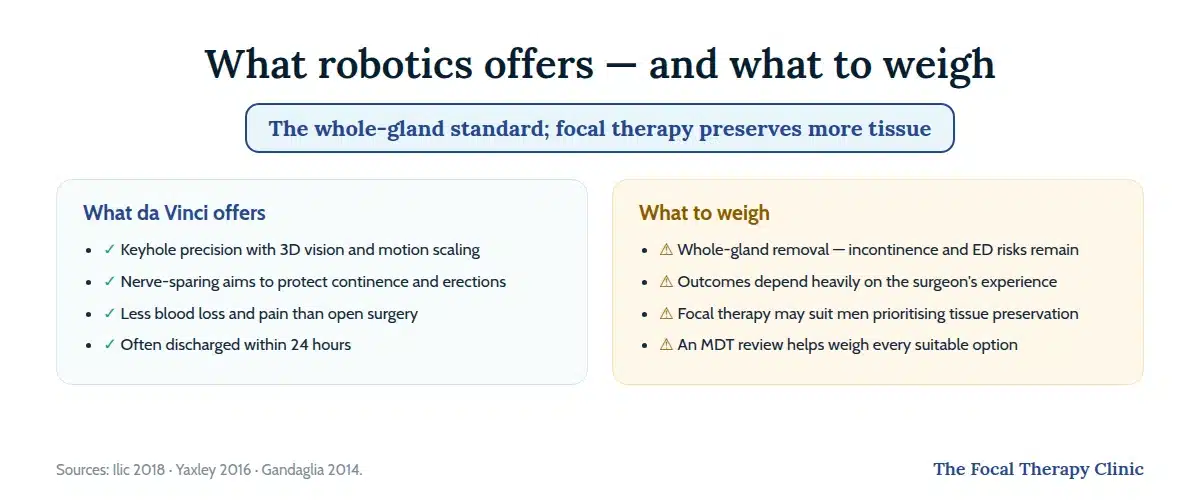
Robotic prostatectomy has become the dominant surgical approach in the UK and USA. Its widespread adoption is driven by the consistent reproducibility of results; it helps standardise outcomes across different hospitals.
While focal therapy remains an excellent option for tissue preservation in suitable candidates, for men requiring whole-gland removal, robotics is now the established standard. Patient stories often highlight that while the surgery is major, the robotic approach made the physical recovery manageable.
Future innovations in da Vinci robotic prostate surgery
Emerging systems, such as the da Vinci 5, are introducing force feedback (haptics), allowing surgeons to “feel” the tissue tension through the console. Future developments aim to make the surgery even less invasive, potentially utilising single-port entry points to further reduce scarring and improve cosmetic and clinical outcomes. Ongoing innovation in this area is also supported by active research and clinical trials, which continue to improve prostate cancer treatment.
Potential future benefits of robotic innovations:
- Shorter operations with improved accuracy
- Greater protection of healthy tissue
- Better surgical outcomes and faster recovery
Frequently asked questions
What is da Vinci robotic prostate surgery?
da Vinci robotic prostate surgery is a minimally invasive procedure where a surgeon uses robotic technology to remove the prostate gland with high precision through small incisions. The robotic system includes a console, robotic arms, and a 3D camera to guide the surgery. It allows for improved control and vision during the operation.
How does robotic prostate surgery improve recovery time?
Robotic prostate surgery speeds up recovery because it is performed with tiny incisions, causing less trauma and allowing most patients to leave hospital within a day and return to normal activities within weeks. Reduced bleeding and lower pain levels also help patients recover faster. The shorter catheter duration adds to improved comfort during healing.
What are the risks and potential complications of robotic prostate surgery?
Like all major surgeries, risks include bleeding, infection, and reaction to anaesthesia. Specific to prostatectomy, there are risks of urinary incontinence and erectile dysfunction, although robotic precision aims to minimise these compared to older techniques.
How does da Vinci surgery compare with other prostate cancer treatments?
da Vinci robotic prostatectomy provides effective cancer control with fewer side effects and a faster recovery compared to open surgery, but focal therapy may be preferable for men seeking to preserve more prostate function. Each approach has different benefits depending on cancer stage and patient goals. A multidisciplinary team can help patients explore all suitable options.
Can robotic surgery reduce the risks of impotence and incontinence?
The enhanced 3D vision and precision instruments allow for better preservation of the neurovascular bundles (nerves) and sphincter muscles. While it does not eliminate the risk entirely, it provides the surgeon with the best possible tools to spare these vital structures.
This content is not intended to be a substitute for professional medical advice, diagnosis, or treatment. Always seek the advice of your urologist or other qualified health provider with any questions you may have regarding a medical condition.
References
- Ilic D, Evans SM, Allan CA, et al. Laparoscopic and robot-assisted vs open radical prostatectomy for the treatment of localized prostate cancer: a Cochrane systematic review. BJU Int. 2018;121(6):845–853.
- Yaxley JW, Coughlin GD, Chambers SK, et al. Robot-assisted laparoscopic prostatectomy versus open radical retropubic prostatectomy: early outcomes from a randomised controlled phase 3 study. Lancet. 2016;388(10049):1057–1066.
- Gandaglia G, Sammon JD, Chang SL, et al. Comparative effectiveness of robot-assisted and open radical prostatectomy in the postdissemination era. J Clin Oncol. 2014;32(14):1419–1426.