
At a Glance
The British Association of Urological Surgeons (BAUS) is the main professional body for urologists in the UK. It exists to promote high standards in the diagnosis and treatment of urological conditions, including prostate cancer. For men considering options such as focal therapy at The Focal Therapy Clinic, knowing that their consultant is a BAUS member is a useful marker of training, accountability and ongoing commitment to best practice.
Key takeaways:
- BAUS is the UK’s national professional association for urologists, and a registered charity that exists to promote the highest standards of urological care through education, research and clinical excellence.
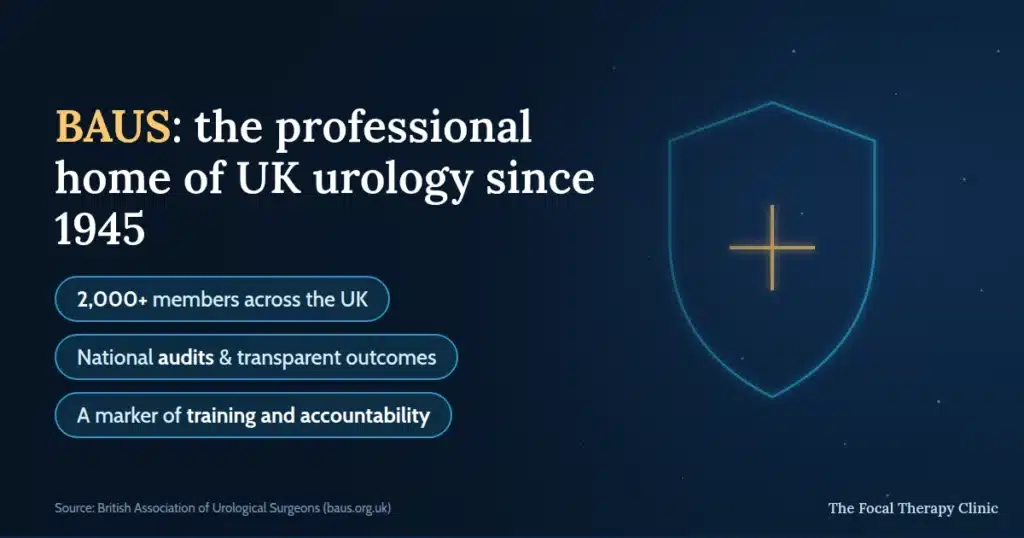
- Founded in 1945 by 37 consultant urologists, it now represents over 2,000 members across the UK, from consultants to trainees and allied professionals.
- BAUS supports high-quality prostate cancer care through education, national audit, patient information and by helping implement guidelines such as NICE’s prostate cancer recommendations.
- Focal therapy is not currently listed by BAUS as a standard treatment pathway. NICE guidance on focal HIFU (HTG667) and NanoKnife IRE (HTG688) states that evidence for safety is adequate but evidence on long-term cancer control is still limited, so it should be used with special arrangements for governance, consent and audit or research.
- Consultants at The Focal Therapy Clinic are BAUS members and also follow national frameworks such as NICE and international bodies like the EAU, using them to inform careful, imaging-led, minimally invasive treatment where appropriate.
- For patients, choosing a BAUS member offers reassurance that their surgeon is part of a regulated professional community, participates in audit and education, and is expected to practise transparently and ethically.
What Is the British Association of Urological Surgeons?
BAUS was formed in 1945, at a time when the NHS was just beginning to take shape. A group of 37 consultant urologists, led by Ronald Ogier Ward, came together to represent the growing specialty. Today, BAUS is a registered charity and professional body based at the Royal College of Surgeons in London.
Its stated mission is straightforward but ambitious: to promote the highest standard in the practice of urology for the benefit of patients, by fostering education, research and clinical excellence. BAUS now has over 2,000 members, largely in the UK, including consultant urologists, doctors in training, specialty and associate specialist doctors, medical students and allied health professionals involved in urological care.
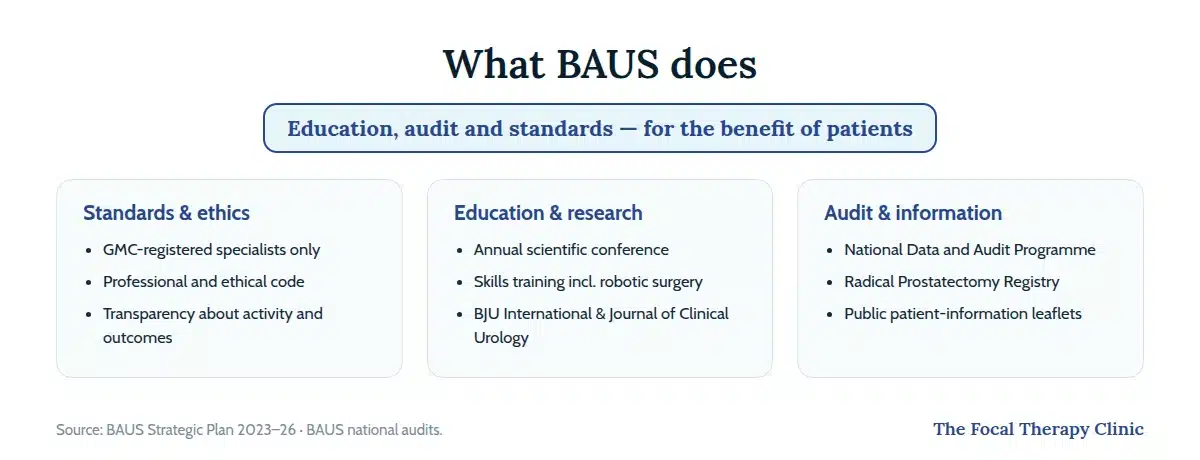
BAUS is also closely linked with the scientific community. Its official journals include BJU International and the Journal of Clinical Urology, which publish prostate cancer research, national audits and guideline summaries that ultimately influence day-to-day care. This presence reinforces its role as a leader in modern urological care.
BAUS membership and professional excellence
Being a BAUS member is a professional commitment to maintaining the highest standards of urological practice. Members must be fully registered with the General Medical Council, specialise in urology, and follow BAUS’ ethical and clinical standards. They also take part in ongoing training, peer review, and professional development.
Many of The Focal Therapy Clinic’s consultants are proud members of the British Association of Urological Surgeons. This reflects their dedication to safe, ethical, and highly specialised patient care. It also shows they value staying current with the latest advances in their field.
These consultants include experts such as:
- Mr Tim Dudderidge, FRCS (Urol) (GMC: 4505451) — a leader in focal therapy and robotic prostatectomy techniques
- Mr Marc Laniado, FRCS (Urol) (GMC: 3343931) — specialising in precision diagnostics and treatments, robotic surgery and focal therapy
- Mr Raj Nigam, FRCS (Urol) (GMC: 3265226) — expert in precision diagnostics, focal therapies, and male fertility and sexual function
- Mr Alan Doherty, FRCS (Urol) (GMC: 3279241) — a leading prostate surgeon with a deep interest in precision diagnostics and focal therapy
Each consultant brings extensive clinical experience and upholds the professional values promoted by BAUS.
The Focal Therapy Clinic and BAUS standards
At The Focal Therapy Clinic, BAUS principles are more than guidelines — they’re part of the clinic’s culture. Every patient’s care is shaped by ethical practice, clinical evidence, and careful personalisation. Consultants aim to provide the best outcome with the least disruption to a patient’s life.
Key ways the clinic reflects BAUS values:
- Patient cases reviewed by a multidisciplinary team
- Treatments based on up-to-date evidence and imaging
- Continuous participation in professional training and peer review
The clinic also publishes outcome data and tracks long-term patient health, just as BAUS does through its national audits. This culture of transparency ensures every patient receives safe, measurable, and ethical care. Our consultants have collectively performed more than 2,500 focal therapy procedures, with outcomes that reflect careful patient selection: in our audited series of 265 men, 90%+ maintained sexual function and fewer than 2% experienced urinary incontinence — dramatically better than traditional whole-gland treatments.
Many patients also benefit from seeking a trusted second opinion before committing to a treatment pathway.
Why BAUS membership matters for patients
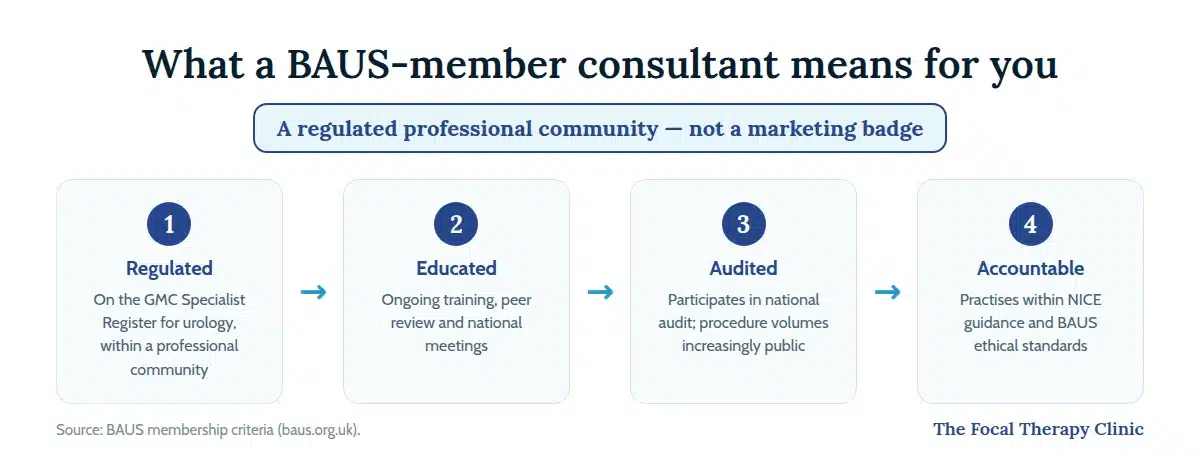
When choosing a consultant urologist, or seeking a second opinion, BAUS membership is a meaningful indicator of professional standards and accountability. It is not a guarantee of perfection, but it does mean:
- Your surgeon is part of a regulated professional community.
- They have access to high-quality education, national audit data and specialist meetings.
- They are expected to support transparency, including publication of procedure volumes and, increasingly, outcomes.
BAUS also gives patients some practical tools. Its public information leaflets help explain tests and treatments, and its surgeon-specific activity data can be a starting point for conversations about experience and caseload, particularly if you are considering major surgery.
If you are weighing up focal therapy against more traditional treatments, seeing a BAUS member who is also familiar with focal techniques can help you get a balanced view, grounded in national guidelines and in real-world experience.
Get Expert Advice & The Latest Research
Subscribe to our newsletter to receive the latest updates, expert insights, and breakthrough research on prostate cancer-delivered straight to your inbox.
How BAUS advances the field of urology
Beyond individual patient care, BAUS plays a leading role in developing the future of urology. Its annual scientific conference brings together professionals from around the world. These events focus on new techniques, cutting-edge technologies, and shared learning. Prostate cancer sessions often include updates on imaging, robotics, systemic therapies and evolving focal approaches.
BAUS also supports surgeons through:
- Skills-based training (including robot-assisted surgery)
- National webinars and courses led by expert sections
- A national Data and Audit Programme supporting research
- Partnership with journals and charities
BAUS runs national audits and “snapshot” studies on topics ranging from radical prostatectomy and nephrectomy to emergency urology. These projects provide granular UK-specific data that complement broader national work such as the National Prostate Cancer Audit.
Through its official journals and links with organisations like The Urology Foundation, BAUS supports research funding, trainee projects and dissemination of new evidence in prostate cancer and beyond.
Clinicians at The Focal Therapy Clinic engage with this academic and professional ecosystem, whether through trial participation, registry work or educational activities.
Final thoughts: expertise you can trust
When you are deciding how to treat prostate cancer, you want confidence that your consultant is properly trained, accountable, and working within evidence-based frameworks. You want to know:
- your consultant is properly trained and accountable
- their practice aligns with national guidance
- newer treatments like focal therapy are being offered within a sensible, audited framework, not as a gamble
BAUS is one of the organisations that helps keep those expectations realistic. It promotes high standards in urology, supports transparency and provides the professional community that most UK urologists depend on.
At The Focal Therapy Clinic, BAUS membership sits alongside alignment with NICE, the EAU and international bodies such as the American Urological Association. Together, these frameworks help ensure that any proposed focal therapy is grounded in evidence, carefully selected and delivered with the aim of preserving quality of life while maintaining strong cancer control.
If you’re weighing your treatment options, our BAUS-affiliated consultants bring extensive experience in both traditional and focal approaches. A consultation or second opinion can help you make an informed decision based on your specific diagnosis and quality-of-life priorities.
Frequently Asked Questions
What is the British Association of Urological Surgeons (BAUS)?
BAUS is the UK’s main professional association for doctors who treat conditions of the urinary tract and male reproductive system. Founded in 1945, it is now a registered charity at the Royal College of Surgeons in London. Its purpose is to promote the highest standards of urological care through education, research and clinical excellence.
Why is BAUS membership important for urologists?
BAUS membership provides a recognised professional home within the specialty, access to high-quality courses, conferences and guidelines, and participation in national audits and research networks. To become a full member, consultants must be on the GMC Specialist Register for urology and agree to follow BAUS’ professional and ethical standards. This encourages consistent, up-to-date practice and transparency about activity and outcomes.
Are Focal Therapy Clinic consultants members of BAUS?
The Focal Therapy Clinic’s core surgical team consists of senior consultant urologists who are BAUS members and also work in leading NHS and private centres. Clinicians such as Mr Tim Dudderidge, Mr Marc Laniado, Mr Raj Nigam and Mr Alan Doherty have extensive experience in prostate cancer diagnostics, nerve-sparing surgery and focal therapies like HIFU and NanoKnife.
How does BAUS support prostate cancer treatment?
BAUS supports prostate cancer care by promoting the implementation of NICE guidance on diagnosis and management, providing patient information leaflets on topics such as active surveillance and prostate biopsies, running national audits such as the Radical Prostatectomy Registry to understand real-world outcomes, and working with official journals like BJU International to publish key guidelines and research. These activities help ensure that prostate cancer care in the UK is based on good evidence and transparent reporting.
What does BAUS membership mean for patients?
For patients at The Focal Therapy Clinic, BAUS membership means their consultants are part of the main professional body for urologists in the UK, are expected to engage with education, audit and research, and align their practice with national guidance and international standards. When focal therapy is offered, it is done within a careful framework of imaging-led diagnosis, multidisciplinary review and ongoing audit, in line with NICE guidance that currently recommends focal HIFU (HTG667) and NanoKnife IRE (HTG688) only with special governance, consent and data collection, because long-term efficacy data are still developing.
This content is not intended to be a substitute for professional medical advice, diagnosis, or treatment. Always seek the advice of your urologist or other qualified health provider with any questions you may have regarding a medical condition.
References
- BAUS. History of BAUS. 2024. https://www.baus.org.uk/about/staff/history_of_baus.aspx
- BAUS. The British Association of Urological Surgeons Strategic Plan 2023–26. 2023. https://www.baus.org.uk/_userfiles/pages/files/about/governance/BAUS%202023%20-%202026%20Strategic%20Plan.pdf
- BAUS. BAUS Radical Prostatectomy Registry 2016–2019: National Summary Results. 2020. https://www.baus.org.uk/_userfiles/pages/files/publications/audit/Prostatectomy%202016%20to%202019%20National%20figures.pdf
- Cancer Research UK. High Intensity Focused Ultrasound (HIFU) for prostate cancer. 2025. https://www.cancerresearchuk.org/about-cancer/prostate-cancer/treatment/high-intensity-focal-ultrasound-hifu