
At a Glance
Targeted therapy drugs treat prostate cancer by attacking specific genetic or molecular features of cancer cells, rather than all fast-growing cells the way chemotherapy does. The two established classes are PARP inhibitors (such as olaparib, for men with DNA-repair gene faults like BRCA2 — NICE TA887)¹ and PSMA-targeted radioligand therapy (lutetium-177, Pluvicto®), which delivers radiation directly to cancer cells that carry the PSMA protein.² Genetic testing and PSMA PET scanning determine who is eligible. These are treatments for advanced disease — men with localised cancer are usually considered for local treatments such as surgery, radiotherapy or focal therapy instead.
Key takeaways:
- Precision over blanket effect — targeted drugs act on the specific “engine” driving a tumour: a gene fault or a surface protein.
- PARP inhibitors — olaparib and similar drugs are especially effective in men with DNA-repair gene defects such as BRCA1/BRCA2.¹ ³
- PSMA radioligand therapy — Pluvicto® (lutetium-177) delivers radiation to PSMA-expressing cells throughout the body, sparing most healthy tissue.²
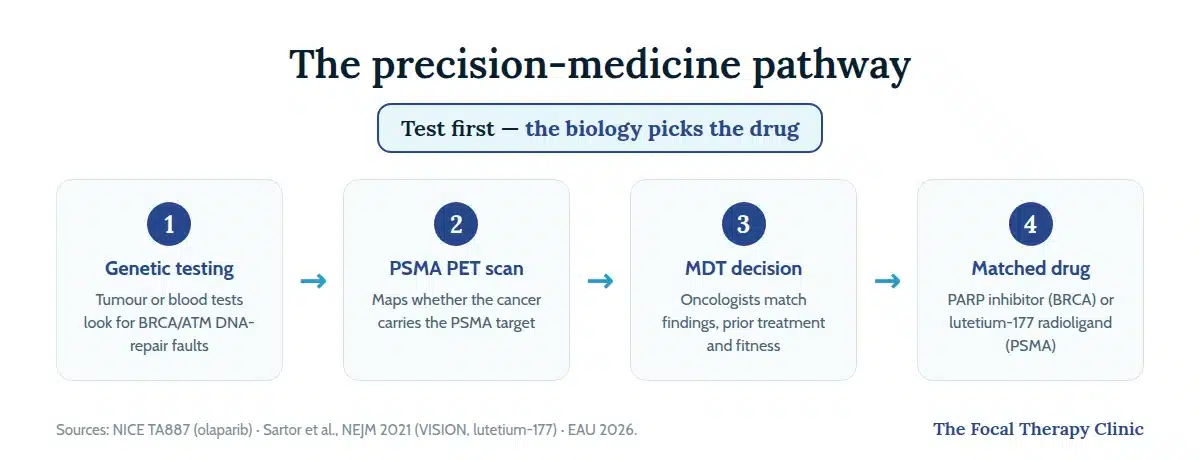
- Testing decides eligibility — genetic/molecular testing and a PSMA PET scan are the gateways to these treatments.
- Emerging classes — PROTACs and bispecific antibodies are in trials to tackle drug resistance.
Targeted therapy represents a significant shift in cancer care. Unlike traditional chemotherapy, which affects healthy and cancerous cells alike, targeted drugs are designed to identify and attack specific genetic or molecular features of cancer cells — looking at the unique “engine” driving a tumour, such as a gene mutation or a surface protein, and aiming to switch it off. For men with advanced or aggressive disease, this offers a way to control the cancer more effectively while protecting quality of life.
Types of targeted therapy drugs
Dr Christos Mikropoulos explains what advanced prostate cancer means — how doctors describe cancer that has spread beyond the prostate, and what that means for treatment.
| Drug class | Examples | How it works | Typical patient profile |
|---|---|---|---|
| PARP inhibitors | Olaparib, rucaparib, talazoparib | Blocks DNA repair in cancer cells, causing them to die | Men with BRCA or ATM gene mutations |
| PSMA radioligands | Pluvicto® (lutetium-177) | Delivers radiation directly to PSMA-expressing cells | Men with metastatic disease visible on PSMA PET |
| Emerging agents | PROTACs, bispecific antibodies | Degrade cancer proteins or engage the immune system | Experimental — overcoming resistance |
PARP inhibitors and their role
PARP inhibitors block cancer cells’ DNA-repair machinery. In tumours that already carry repair defects such as BRCA mutations, this double hit causes cancer-cell death. Olaparib is NICE-recommended for previously treated, BRCA-mutation-positive, hormone-relapsed metastatic prostate cancer,¹ and trials such as PROpel show PARP inhibitors being combined with hormonal drugs earlier in the disease course.³
PSMA-targeted radioligand therapy
Prostate-specific membrane antigen (PSMA) is a protein carried in high amounts on the surface of most prostate cancer cells. PSMA-targeted therapy uses a specialised molecule to dock onto this protein and deliver a radioactive payload — lutetium-177 — directly into the cell.
In the VISION trial of lutetium-177-PSMA-617, suitable men with metastatic castration-resistant prostate cancer lived longer and went longer without progression when the therapy was added to standard care.² Because the radiation is delivered to the cancer cells specifically, damage to surrounding organs is limited compared with broad external radiation. Eligibility requires a PSMA PET scan to map the disease first.
Emerging targeted agents
Researchers are investigating PROTACs (proteolysis-targeting chimeras), designed to break down cancer-driving proteins completely rather than just blocking them, and bispecific antibodies, which connect immune cells directly to tumour cells. Most remain in trials — potential future avenues for men whose cancer resists standard therapies.
The Focal Therapy Clinic’s approach
Our primary expertise is treating localised disease with precision, using HIFU (NICE HTG667) and NanoKnife (NICE HTG688) — 2,500+ procedures across 75+ years of combined consultant experience. But prostate cancer care is a journey that may need different tools at different times.
For localised disease, we use advanced diagnostics — multiparametric MRI and, where indicated, PSMA PET — to confirm suitability for focal treatment, preserving tissue and function. For men who present with or progress to advanced disease, we collaborate with medical oncologists, including our own Consultant Clinical Oncologist, to integrate systemic targeted therapies into the care plan — whether the right tool is physical ablation of a tumour or a molecular drug for systemic disease.
Selecting the right targeted therapy
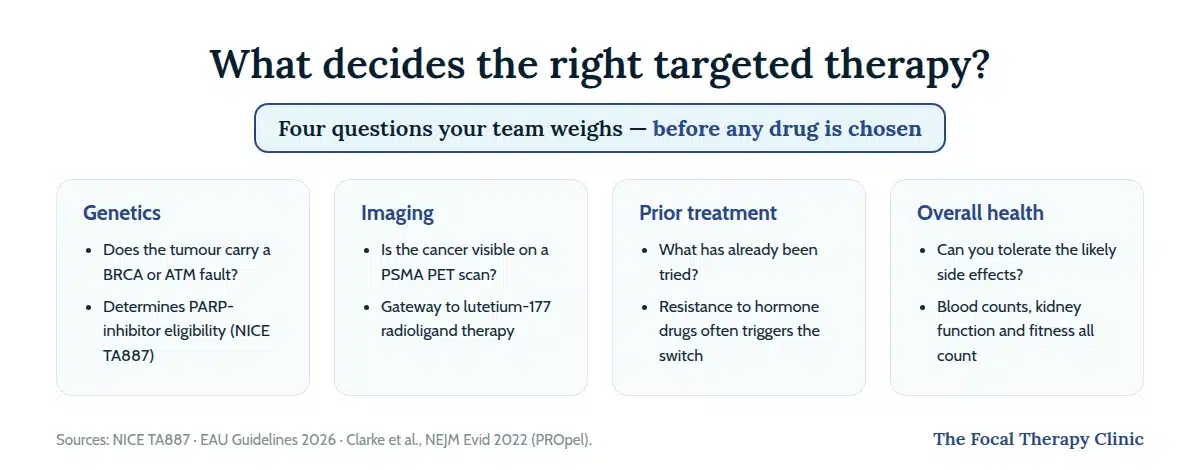
There is no single best treatment. The choice depends on stage, grade, spread, genetics, health and your preferences — balanced through multidisciplinary discussion under NICE and EAU guidance.¹ ⁴
| Factor | Impact on decision | Example |
|---|---|---|
| Metastatic status | Spread to bones/nodes usually needs systemic drugs | Lutetium-177 for widespread PSMA-positive disease |
| Genetic profile | Mutations determine drug compatibility | BRCA2-positive men are candidates for PARP inhibitors |
| Prior therapies | Resistance to hormone drugs may trigger a switch | Moving to targeted drugs after enzalutamide or abiraterone |
| Localisation | Cancer confined to the prostate | Suited to focal therapy (HIFU / NanoKnife) rather than systemic drugs |
Genetic and molecular testing
Testing of tumour or blood samples looks for mutations in DNA-repair genes (BRCA1/2, ATM and others), guiding drug selection — it identifies the men most likely to benefit from PARP inhibitors and other precision drugs. Our multidisciplinary team integrates results into a personalised plan and makes sure you understand every available option.
Combining targeted therapy with other treatments
Mr Tim Dudderidge explains the treatment options if prostate cancer returns after radiotherapy — including salvage focal therapy.
Combination strategies are increasingly supported by trial evidence: pairing a PARP inhibitor with a hormonal drug, for example, kept cancer under control longer than either alone in the PROpel trial.³ Targeted therapies may sit alongside hormone therapy, chemotherapy or radiotherapy depending on the case. Our urologists and oncologists review combinations to balance efficacy against lifestyle and tolerance.
Get Expert Advice & The Latest Research
Subscribe to our newsletter to receive the latest updates, expert insights, and breakthrough research on prostate cancer-delivered straight to your inbox.
Benefits and potential side effects
Targeted therapies offer real precision advantages, but they are not side-effect-free:
- PARP inhibitors — fatigue, nausea, and blood-count changes (anaemia) are the common issues.¹
- PSMA radioligands — dry mouth, fatigue, or temporary changes in blood-cell production.²
For many men these effects are more manageable than traditional chemotherapy — regular monitoring keeps quality of life in view throughout treatment.
Advances driving the future
Artificial intelligence is beginning to help interpret scans and genetic reports, supporting predictions about which patient will respond to which drug. Active clinical trials are testing lutetium-177 earlier in the disease, new bispecific antibodies and novel PROTACs; early-phase results show promising PSA responses. We provide guidance for patients interested in trial participation.
Frequently Asked Questions
How do I find out if I have a BRCA mutation?
Through genetic testing of a tumour sample or blood test, arranged by your specialist team when targeted therapy is being considered. Results guide whether PARP inhibitors are an option for you.¹
Who is eligible for Pluvicto (lutetium-177)?
Men with metastatic castration-resistant prostate cancer whose disease shows up on a PSMA PET scan, usually after other treatments. The scan “maps” whether your cancer carries enough PSMA for the therapy to dock onto.²
Is targeted therapy better than chemotherapy?
They do different jobs and are often sequenced or combined. Targeted drugs need a matching feature (a gene fault or PSMA expression) to work well; chemotherapy doesn’t. For many men, targeted-therapy side effects are more manageable — your oncologist will sequence what fits your cancer’s biology.
Are these drugs available on the NHS?
Olaparib is NICE-approved for specific BRCA-positive advanced prostate cancer,¹ and access to radioligand therapy is expanding. Availability depends on your cancer’s features and prior treatment — ask your oncologist what applies to you.
Can I have focal therapy and targeted therapy?
They address different situations — focal therapy treats cancer confined to the prostate; targeted drugs treat disease that has spread. Some men treated focally who later progress may become candidates for systemic options; that is exactly the kind of pathway our multidisciplinary team plans for.
This content is not intended to be a substitute for professional medical advice, diagnosis, or treatment. Always seek the advice of your oncologist, urologist or other qualified health provider with any questions you may have regarding a medical condition.
References
- National Institute for Health and Care Excellence. Olaparib for previously treated BRCA mutation-positive hormone-relapsed metastatic prostate cancer (TA887). 2023. https://www.nice.org.uk/guidance/ta887
- Sartor O, de Bono J, Chi KN, et al. Lutetium-177–PSMA-617 for Metastatic Castration-Resistant Prostate Cancer. N Engl J Med. 2021;385(12):1091–1103.
- Clarke NW, Armstrong AJ, Thiery-Vuillemin A, et al. Abiraterone and Olaparib for Metastatic Castration-Resistant Prostate Cancer. NEJM Evid. 2022;1(9):EVIDoa2200043.
- European Association of Urology. EAU Guidelines on Prostate Cancer. 2026. https://uroweb.org/guidelines/prostate-cancer
- Mateo J, Boysen G, Barbieri CE, et al. DNA Repair in Prostate Cancer: Biology and Clinical Implications. Eur Urol. 2017;71(3):417–425.