
At a Glance
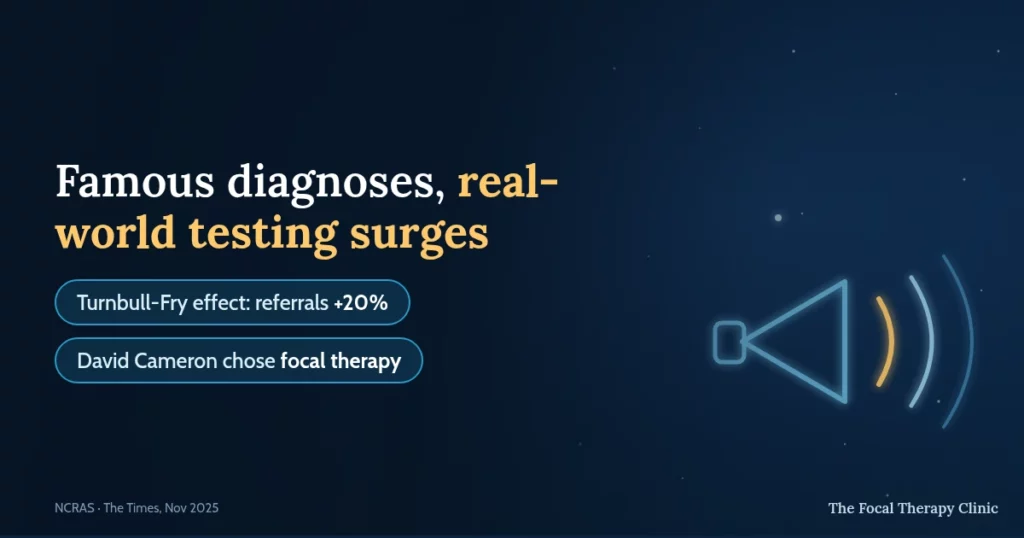
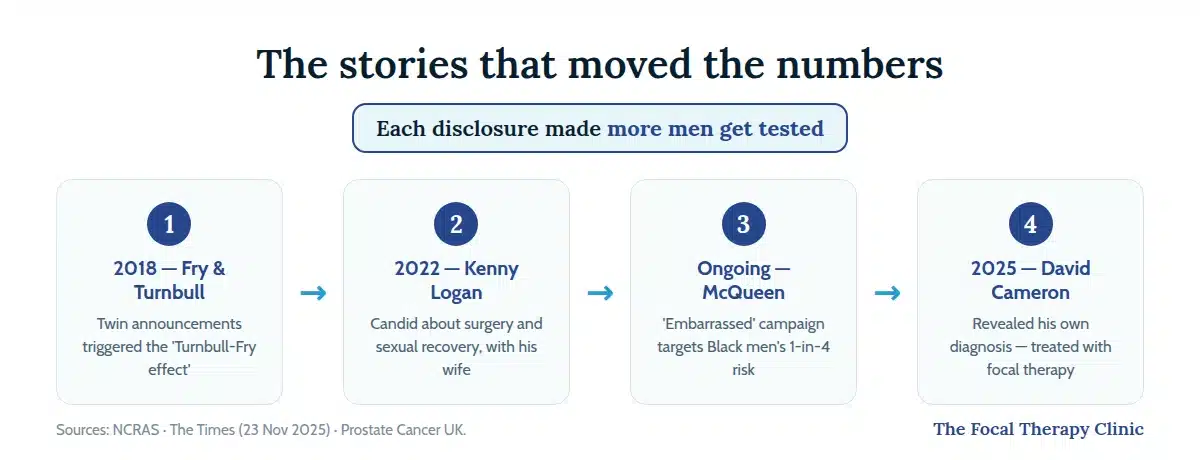
High-profile men who have shared their prostate cancer stories — Stephen Fry, Bill Turnbull, Kenny Logan, Paul Burrell, Sir Steve McQueen and, most recently, former Prime Minister David Cameron — have made a measurable difference to public health behaviour. After the 2018 “Turnbull-Fry effect”, the NHS reported a roughly 20% rise in urgent suspected-cancer referrals.¹ Cameron’s November 2025 disclosure went further still: he revealed that his own cancer, caught by a PSA test his wife urged him to take, was treated with focal therapy — and he is now campaigning for targeted national screening.²
Key takeaways:
- Celebrity disclosures reduce stigma and measurably increase PSA test requests.¹
- Early detection matters — most of these men had no symptoms at diagnosis; they were found through routine checks.
- Side effects are real but manageable — honest stories from Kenny Logan and Paul Burrell show recovery is a process.
- Black men face double the risk — Sir Steve McQueen’s “Embarrassed” campaign targets exactly that gap.³
- Tissue-preserving treatment is mainstream news — David Cameron’s choice of focal therapy put HIFU-and-IRE-class treatment on every front page.²
Why celebrity prostate cancer stories matter
Celebrity voices break through the stigma surrounding men’s health. Talking openly about prostate cancer encourages men to seek professional evaluation early, and draws attention to testing and diagnostic pathways — particularly vital while the UK still has no national screening programme.
These stories reduce the fear and embarrassment tied to prostate checks. For many men, hearing a familiar voice describe cancer is the nudge they need — it starts conversations in families and communities that would not otherwise happen. When well-known figures stress early testing, the data shows more men act.¹
Stephen Fry and Bill Turnbull
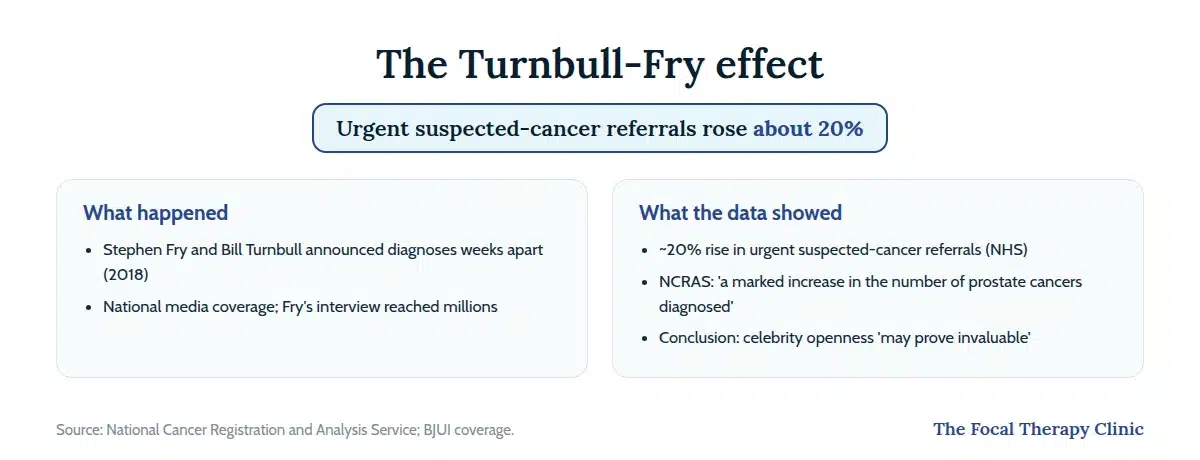
In 2018, Stephen Fry and Bill Turnbull revealed their diagnoses within weeks of each other. Fry spoke about the shock of a diagnosis after a routine check and his robotic surgery; Turnbull discussed the advanced stage at which his cancer was found — already in his bones — and urged men not to delay check-ups.
Their combined openness produced what researchers called the “Turnbull-Fry effect”: the NHS reported a roughly 20% increase in urgent suspected-cancer referrals. The National Cancer Registration and Analysis Service reported “a marked increase in the number of prostate cancers diagnosed from the time of Fry’s and Turnbull’s announcements” and concluded that celebrities publicising their diagnoses “may prove invaluable” in prompting men of similar age to check their risk.¹ Fry’s interview with his surgeon about the doctor–patient relationship won the BJUI Social Media Award, the journal noting his 12.7m Twitter followers carried the story worldwide. Bill Turnbull campaigned for earlier testing until his death from prostate cancer in 2022.
Kenny Logan
Former rugby international Kenny Logan shared his diagnosis in 2022 after a routine health check. He chose surgery and later spoke candidly — together with his wife — about recovery, including temporary erectile dysfunction, bringing rare honesty to how treatment affects intimate relationships. Men, he noted, are “notorious” for suffering in silence and skipping check-ups. His decision to share the details normalised conversations about sexual rehabilitation after surgery: recovery takes time, and it is a manageable process.
Paul Burrell
Paul Burrell opened up about the severe toll that hormone therapy and brachytherapy took on his physical and emotional wellbeing, including televised updates describing extreme fatigue and emotional swings. His transparency gave the public a realistic view of the trade-offs that multimodal cancer treatment can demand — and of the psychological support patients need through it.
Steve McQueen and the “Embarrassed” campaign
Oscar-winning director Sir Steve McQueen — himself diagnosed after proactive PSA testing — leads a campaign aimed at Black men, who face a 1 in 4 lifetime risk, roughly double that of other men.³ His short film “Embarrassed” features Idris Elba, Morgan Freeman, Chiwetel Ejiofor and Micheal Ward urging men not to let shame block early detection. “Don’t let embarrassment stop you from having this important conversation,” Freeman says. “You may save someone’s life,” adds Ejiofor. McQueen’s framing is the campaign’s power: “This is not about weakness. This is about strength.”
Get Expert Advice & The Latest Research
Subscribe to our newsletter to receive the latest updates, expert insights, and breakthrough research on prostate cancer-delivered straight to your inbox.
David Cameron: a Prime Minister’s focal therapy
In November 2025, former Prime Minister David Cameron revealed in an interview with The Times that he had been diagnosed with — and treated for — prostate cancer.² His wife Samantha urged him to get tested after hearing Soho House founder Nick Jones discuss his own diagnosis on the radio. A PSA test came back above the normal range; MRI and biopsy confirmed the diagnosis.
Cameron was treated with focal therapy — the tissue-preserving approach that targets only the affected area of the prostate — and has said he will use his platform in the House of Lords to push for targeted screening: “I’ve got a platform. This is something we’ve really got to think about, talk about, and if necessary, act on.”²
His story compresses this entire article into one case: a symptomless man, prompted to test, diagnosed through the modern MRI-led pathway, treated with a function-preserving therapy, now campaigning so other men are found as early as he was.
Patient stories from The Focal Therapy Clinic
Barry and his wife Jackie tell the story of his HIFU focal therapy at the clinic — from diagnosis to recovery — in their own words.
Real experiences from men treated at FTC tell the same story at ordinary scale: Steve chose the clinic after being advised to have surgery elsewhere and returned to normal life quickly; Dave moved from active surveillance to a less invasive treatment; Barry and his wife Jackie found focal therapy through a second opinion; Guy caught his cancer at a routine check and avoided major disruption with HIFU; Bruce’s cancer near the prostate edge was treated precisely; journalist Graham Ogilvy wrote about rejecting radical surgery for a minimally invasive approach. Each story shows what personalised, tissue-preserving treatment makes possible.
How these stories promote early detection and better choices
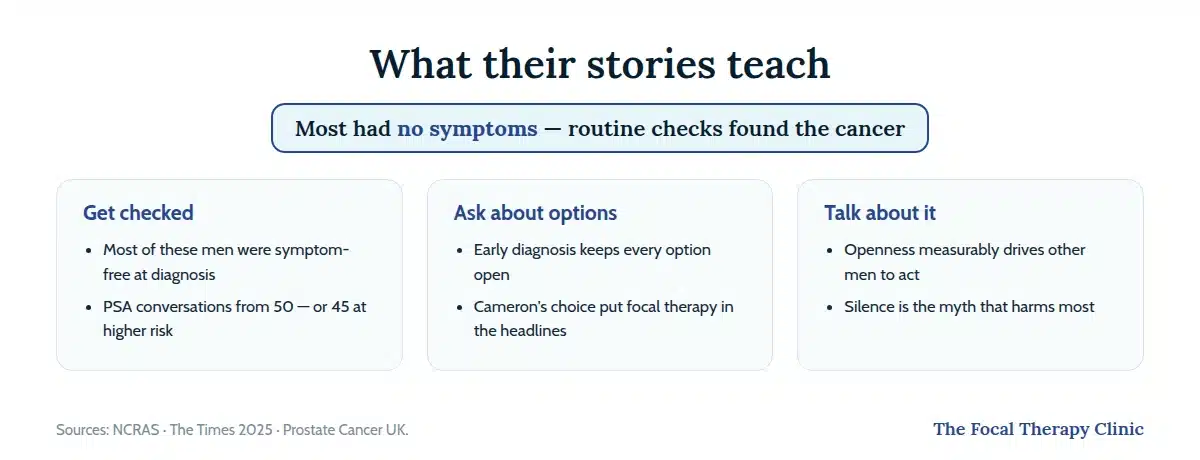
Engaging with healthcare early broadens the available pathways — and most of these men had no symptoms at diagnosis. Our consultants hear it first-hand: many patients tell us a celebrity speaking publicly about something so personal is what prompted them to seek advice.
Early diagnosis opens options. Carefully selected men with localised cancer may be eligible for HIFU (NICE HTG667) or NanoKnife IRE (NICE HTG688) — effective cancer control with lower risk of long-term functional side effects than radical surgery or radiotherapy: in FTC’s audited series of 265 men, 97% maintained continence and 90%+ preserved sexual function. Compare the approaches honestly, ask questions, and choose the strategy that fits your cancer and your life — our team can help.
Frequently Asked Questions
Did these celebrities have symptoms when they were diagnosed?
Mostly not — Fry, Logan and Cameron were all found through routine or prompted checks. Early prostate cancer is usually silent, which is why testing conversations matter more than waiting for symptoms.
What treatment did David Cameron have?
He has said publicly that he was treated with focal therapy after his cancer was confirmed by MRI and biopsy.² Focal therapy targets only the affected area of the prostate, aiming to preserve urinary and sexual function.
Why is Steve McQueen’s campaign aimed at Black men?
Because about 1 in 4 Black men in the UK will get prostate cancer — roughly double the risk of other men — and they are more likely to be diagnosed younger. Testing conversations are advised from age 45.³
Did the celebrity announcements really change anything?
Yes — measurably. After Fry’s and Turnbull’s 2018 announcements, urgent suspected-cancer referrals rose by roughly 20% and registered prostate cancer diagnoses increased markedly.¹
This content is not intended to be a substitute for professional medical advice, diagnosis, or treatment. Always seek the advice of your urologist or other qualified health provider with any questions you may have regarding a medical condition.
References
- National Cancer Registration and Analysis Service / BJUI reporting on the “Turnbull-Fry effect” (2018 referral and diagnosis rise).
- The Times. Interview with David Cameron, 23 November 2025 (prostate cancer diagnosis and focal therapy treatment); widely reported including CNN, 24 November 2025.
- Prostate Cancer UK. Black men and prostate cancer. https://prostatecanceruk.org/prostate-information-and-support/risk-and-symptoms/are-you-at-risk
- National Institute for Health and Care Excellence. HTG667 (HIFU); HTG688 (irreversible electroporation). https://www.nice.org.uk/guidance/htg667 · https://www.nice.org.uk/guidance/htg688
- European Association of Urology. EAU Guidelines on Prostate Cancer. 2026. https://uroweb.org/guidelines/prostate-cancer