
At a Glance
Choosing a prostate cancer treatment means balancing cancer control against side effects such as incontinence and erectile dysfunction. In our webinar, Mr Alan Doherty — a Consultant Urological Surgeon with 30 years’ experience — explained how a high-quality MRI, your Gleason grade and your own priorities shape the right choice, from active surveillance to focal therapy (NICE-approved HIFU, HTG667).
Key takeaways:
- Start with your priorities — continence, erections, recovery time and peace of mind belong in the consultation from the start.
- Insist on a quality MRI — treatment planning, especially focal therapy, depends on seeing the cancer clearly.
- Know your numbers — PI-RADS describes scan suspicion; Gleason grade describes biopsy findings; neither alone decides treatment.
- Focal therapy suits selected men — typically Gleason 7 (Grade Groups 2–3) with a clear MRI target; 2,500+ procedures performed at FTC.
- Ask about experience — outcomes depend on the treatment, the cancer and the team delivering it.
On this page: What matters most to you · Why a good-quality MRI comes first · Has the cancer spread? · Your treatment options compared · Who is suitable for focal therapy? · Your questions answered · Join our next webinar
When choosing prostate cancer treatment, understanding your diagnosis is only part of the decision. You also need to consider how treatment could affect everyday life, from bladder control and erections to recovery time. In our webinar, Consultant Urological Surgeon Mr Alan Doherty explained how to weigh those priorities alongside the need to control your cancer.
Mr Doherty has 30 years’ experience in prostate cancer care and specialises in focal therapy. Hosted by our founder Brian Lynch and patient advocate Eva Tomopoulou, the session covered scans, biopsies, treatment options and questions from men facing these decisions. Watch the recording below, or use this guide to explore the advice most relevant to you.
Mr Doherty consults and treats at the Harborne Hospital in Birmingham and the Wilmslow Hospital in Manchester — see our Wilmslow location page for appointment availability.
Start with what matters most to you
Men can face similar diagnoses and want different things from treatment. Some prioritise removing the prostate, while others want to minimise disruption to work, preserve sexual function or avoid a lengthy recovery. Mr Doherty encouraged men to make these priorities part of the consultation from the start.
Thinking about how treatment could affect your quality of life helps make the decision more personal.
For example, the risk of incontinence after treatment may concern you more than recovery time. Ask your clinician to explain both the likelihood and severity of possible side effects, including what support would be available.
You should also feel comfortable asking about your clinician’s experience and results. Mr Doherty stressed that outcomes depend on the treatment, the cancer and the person delivering care. Before deciding, ask yourself:
- Cancer control vs side effects — what balance feels right for me?
- Daily life — how would bladder problems or erectile dysfunction affect my work, sport and relationships?
- Hormone therapy — how would I feel about it if it were recommended?
- Monitoring — am I comfortable with regular tests and the possibility of further treatment?
- Your clinician — do I understand their recommendation and their experience with this treatment?
Why a good-quality MRI comes first
Mr Doherty explained why a high-quality MRI scan matters when planning treatment. It helps show suspicious areas, their size and their position within the prostate. That information is particularly important when considering a treatment that targets part of the gland.
Your MRI report may include a PI-RADS score from one to five. This describes how suspicious an area looks for clinically significant cancer: three is uncertain, four is likely and five is very likely. As Mr Doherty put it in an earlier discussion: “If it’s PI-RADS 4, I know that’s a 70 per cent likelihood of hitting a cancer” — and The Focal Therapy Clinic’s own biopsy audit bears that out, finding clinically significant cancer in 69.7% of PI-RADS 4 cases (426 patients). These are population figures, not fixed probabilities for an individual patient.
A Gleason score is different because it comes from examining biopsy tissue. It describes the cancer’s appearance and likely behaviour, rather than how suspicious it looks on a scan. MRI-fusion biopsy combines MRI information with live ultrasound to guide sampling into a target, helping the team relate the biopsy findings to its location.
In his practice, Mr Doherty usually recommends biopsy when there is a visible MRI lesion. He acknowledged exceptions, including concerns about PSA density or family history. A clear MRI therefore does not automatically mean a biopsy is unnecessary; the decision still depends on your overall risk. That said, good imaging spares many men an unnecessary procedure: Mr Doherty has estimated that 30–40% of men can avoid biopsy with high-quality imaging and expert reading — a view supported by the VISION analysis, where MRI triage allowed 32.2% of men to avoid biopsy,³ and the PROMIS trial, where 27% of men could safely have avoided a primary biopsy.⁴
Has the cancer spread?
Mr Doherty emphasised that “a negative scan cannot exclude microscopic spread”. MRI and PSMA PET can help assess disease, but deposits too small to detect may remain unseen. Your team considers what your PSA level can tell you alongside biopsy grade, examination and imaging, rather than relying on one reassuring result. He described a PSA below 10 as generally reassuring, while recognising that staging requires the full picture.
The ProtecT trial also helps explain the balance between treating and monitoring localised cancer: at 15 years, deaths from prostate cancer were uncommon and statistically similar in all three groups — 3.1% after initial active monitoring, 2.2% after surgery and 2.9% after radiotherapy — but metastases were roughly twice as frequent in the monitoring group (9.4% versus around 5%), many of whom later moved to treatment.²
Your treatment options compared
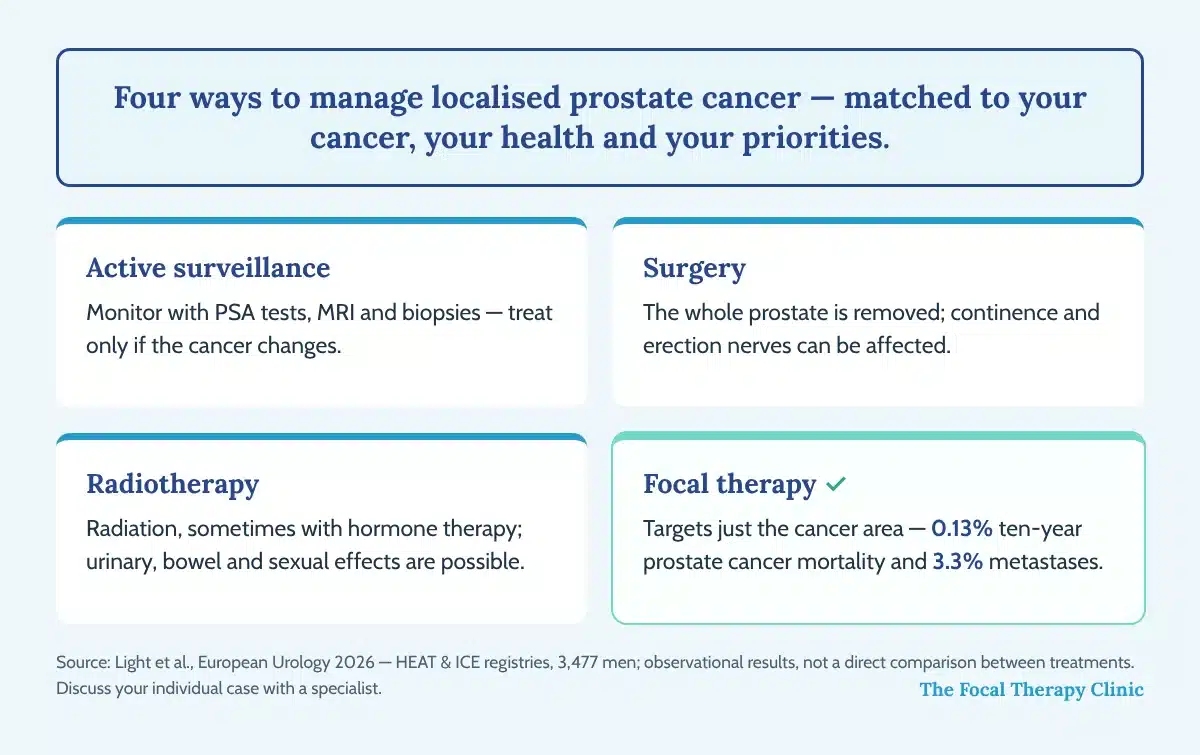
Your options depend on your cancer, overall health and personal priorities. Mr Doherty compared surveillance, surgery, radiotherapy and focal therapy, focusing on cancer control, side effects and recovery. Understanding these differences can help you prepare questions for your clinical team.
Active surveillance
For suitable men, usually with lower-risk cancer, surveillance can postpone or avoid treatment side effects. Understanding what active surveillance involves means knowing which PSA tests, scans and repeat biopsies are planned, and what findings would prompt treatment. Mr Doherty encouraged men to discuss whether monitoring fits both their cancer risk and their comfort with uncertainty.
Surgery
Radical prostatectomy removes the prostate and can be appropriate for cancer that is still localised. Mr Doherty explained that nearby structures involved in continence and erections can be affected, making surgical experience and nerve-sparing discussions important. Ask what recovery may involve and how your own cancer position, health and existing function affect the expected results.
Mr Doherty also encouraged men to discuss what they would do if a biopsy found cancer, particularly when the MRI showed no clear lesion. He described a “window of curability”, explaining that treatment options and the likelihood of lasting cancer control can change as disease progresses. For suitable low-risk cancer, active surveillance remains an appropriate option, with monitoring to identify changes that may warrant treatment.
Radiotherapy
Radiotherapy treats cancer with radiation and may be combined with hormone therapy, depending on the disease. Mr Doherty discussed improving techniques, including shorter courses for selected men, alongside potential urinary, bowel and sexual effects. Ask about the proposed course, longer-term risks and any additional effects of hormone treatment before comparing it with other options.
Focal therapy
Understanding how focal therapy works starts with its aim: treating the cancerous area and a surrounding margin while preserving more of the prostate. Techniques include HIFU, which uses focused heat (NICE-approved, HTG667), cryotherapy, which uses freezing, and NanoKnife, which uses electrical energy (NICE-approved, HTG688). Mr Doherty described relatively quick recovery and a low risk of some side effects in suitable men, with ongoing monitoring and possible further treatment remaining part of the plan.
Get Expert Advice & The Latest Research
Subscribe to our newsletter to receive the latest updates, expert insights, and breakthrough research on prostate cancer-delivered straight to your inbox.
Who is suitable for focal therapy?
Mr Doherty described a clear MRI target and room for an adequate treatment margin as central to suitability. He commonly considers Gleason 7 cancer, corresponding to Grade Groups 2–3, and described occasional, carefully selected Gleason 8 cases. Your team must check whether you’re suitable for focal therapy using your complete results; higher-risk disease often needs a different approach.
He discussed the long-term results of focal therapy from the HEAT and ICE registries — research co-authored by Mr Doherty and his Focal Therapy Clinic colleagues — covering 3,477 men treated with HIFU or cryotherapy.¹ Estimated ten-year outcomes included 0.13% prostate cancer mortality, 3.3% developing metastases and 33% undergoing local retreatment. These observational results do not establish that focal therapy is better than surgery, radiotherapy or surveillance.
Mr Doherty does not automatically regard another focal treatment as failure, particularly when a man has maintained good quality of life. He described follow-up in his practice as PSA testing every four months and an MRI at one year, with further assessment when needed. Agree your own schedule and understand that later surgery or radiotherapy may remain possible, although subsequent treatment can be more complex.
Your questions answered
Every question below was asked live by men attending the webinar, and the answers summarise Mr Doherty’s responses.
QUESTION 1 OF 18
Is it normal to move from active surveillance to watchful waiting as you get older?
It can be appropriate, but the decision depends on your health, life expectancy and cancer risk rather than an automatic age cut-off. Active surveillance monitors for changes that might require treatment, whereas watchful waiting focuses on managing symptoms if they develop. Mr Doherty explained that avoiding unnecessary treatment becomes especially important when a small cancer is unlikely to affect someone’s lifetime.
QUESTION 2 OF 18
On active surveillance, what PSA level means it’s time to treat?
There is no single PSA number that means everyone should start treatment. Mr Doherty explained that age, MRI findings, biopsy grade and prostate size all matter, including PSA density, which is the PSA level divided by the prostate’s volume. Ask how your results are changing together, rather than treating a PSA of 10 or 20 as an automatic trigger.
QUESTION 3 OF 18
If I delay treatment, could I miss my chance of focal therapy?
That is possible if the cancer grows into a position where an adequate treatment margin becomes difficult. Mr Doherty highlighted lesions near the prostate’s apex and the importance of checking when MRI findings seem more concerning than a low-grade biopsy suggests. Appropriate active surveillance includes reassessment, so ask what changes would narrow your options and when another biopsy might be needed.
QUESTION 4 OF 18
Can I have HIFU if I have an enlarged prostate (BPH)?
An enlarged prostate does not automatically rule out HIFU, but gland size and urinary symptoms need assessment. Mr Doherty described using medicines such as tamsulosin for temporary flow problems and, in selected cases, combining treatment with surgery for benign prostatic enlargement. Your team should explain whether a separate procedure is needed and how the proposed plan affects recovery and catheter use.
QUESTION 5 OF 18
Can weak urine flow years after HIFU be treated?
Often it can, once the cause has been identified. Mr Doherty described a urine-flow test, a bladder scan and a bladder diary as useful starting points, with further investigation when necessary. Enlargement of the prostate or narrowing in the urinary passage may contribute, so a new symptom should be assessed rather than assumed to be an inevitable consequence of HIFU.
QUESTION 6 OF 18
Could focal therapy be an option for an older man with Gleason 3+3 cancer?
Active surveillance is often appropriate for Gleason 3+3 cancer because treatment may bring more harm than benefit. Mr Doherty explained that a visible MRI lesion deserves careful review, including whether the biopsy has captured the most significant disease. Suitability for treatment depends on cancer findings, overall health and likely benefit, so age alone neither qualifies nor excludes you from focal therapy.
QUESTION 7 OF 18
Can HIFU be repeated if calcification limited the first treatment?
It depends on where the calcification lies in relation to the probe and the cancer. Mr Doherty explained that calcification in the ultrasound beam’s path can obstruct treatment, whereas calcification elsewhere may not prevent another HIFU procedure. The team needs to review imaging and follow-up findings before recommending retreatment, because a fall in PSA alone does not show that every area was successfully treated.
QUESTION 8 OF 18
Can I have focal therapy with Gleason 6 (3+3)?
Many men with Gleason 6 cancer are better served by surveillance than immediate treatment. Mr Doherty described targeting a visible lesion as his usual approach, while acknowledging selected situations where treating half or a quarter of the prostate might be discussed. A concerning scan with a low-grade biopsy may require further assessment before deciding whether treatment is justified or which approach fits.
QUESTION 9 OF 18
Can a recurrence after prostatectomy be treated?
Yes, radiotherapy to the prostate bed can be an option for some men whose PSA rises after surgery. Your team considers the PSA trend, original pathology and appropriate imaging to decide where recurrence may be and which treatment could help. Seek timely specialist assessment, because a clear PSMA PET scan does not rule out microscopic disease and treatment should not automatically wait for a particular PSA threshold.
QUESTION 10 OF 18
Is focal therapy suitable for high-risk cancer, such as Gleason 10?
Mr Doherty explained that Gleason 10 cancer would not be suitable for the focal approach he described. High-risk disease needs careful staging and discussion of treatments that address its extent, which may include radiotherapy and hormone therapy. Chemotherapy or other treatments may be appropriate in some circumstances, but a high Gleason score does not itself prove that the cancer has spread.
QUESTION 11 OF 18
Can I still have surgery after focal therapy?
Surgery can remain an option after focal therapy, which Mr Doherty summarised by saying “it doesn’t burn your bridges”. However, later surgery may be technically more complex, and its risks and expected outcomes need a fresh assessment. Ask about all subsequent options, including radiotherapy or further focal treatment where appropriate, before deciding how comfortable you are with this treatment pathway.
QUESTION 12 OF 18
Does diet make a difference?
A balanced diet can support your general health, weight and wellbeing during prostate cancer care. Mr Doherty emphasised heart and metabolic health rather than relying on individual foods or supplements to control cancer. Evidence does not establish that a particular diet prevents progression, so continue your recommended monitoring or treatment and ask for dietary advice if you need it.
QUESTION 13 OF 18
Can I get focal therapy on the NHS?
Some specialist NHS centres offer focal treatments, but availability is limited and referral criteria vary. Mr Doherty recommended asking about a team’s experience and treatment volume when considering where to receive care. Your urologist can discuss local referral options, whether the treatment is appropriate for you, and what follow-up and alternative treatments would be available through that service.
QUESTION 14 OF 18
Why might my PSA be high if my cancer is low grade?
PSA can rise because of benign prostate enlargement, infection or inflammation as well as cancer. Mr Doherty also explained that a biopsy can underestimate disease if it has not sampled the most significant area. Reviewing prostate size, PSA changes, scan quality and biopsy findings helps your team decide whether further investigation is needed, rather than assuming the PSA alone proves more aggressive cancer.
QUESTION 15 OF 18
What if my MRI doesn’t show the cancer?
A cancer diagnosis and an MRI with no visible target can occur together because MRI does not detect every cancer. Mr Doherty stressed the importance of scan quality and specialist review, with additional imaging such as PSMA PET considered in selected cases. Further assessment may clarify the findings, but another scan does not automatically make a cancer suitable for focal treatment.
QUESTION 16 OF 18
When should I consider moving from active surveillance to treatment?
Consider a review when your tests suggest a change in grade, extent or behaviour, rather than focusing on a single PSA result. Mr Doherty discussed significant Gleason 3+4 disease and a visible lesion as reasons to explore treatment, particularly when a man has a long life expectancy. Your team should explain how the amount of higher-grade cancer, MRI findings and PSA density affect that recommendation.
QUESTION 17 OF 18
Will HIFU near the nerves affect my erections?
It can, because heat close to the nerves involved in erections may affect their function. Mr Doherty explained that recovery depends on existing erections and the treatment area, and that medicines such as sildenafil may help some men. Discuss the possibility of lasting problems and support for protecting your sex life after treatment, rather than assuming good erections beforehand guarantee recovery.
QUESTION 18 OF 18
What does a new lesion after HIFU mean?
A new suspicious area needs assessment to establish whether it is in previously untreated tissue or represents persistent or recurrent cancer. Mr Doherty explained that some low-grade areas can be monitored, while other findings may warrant biopsy or further treatment. A PSA fall after a dietary change does not establish that cancer has improved, so keep the planned follow-up and discuss both the scan and PSA trend with your team.
Join our next webinar
Our webinars run every four to eight weeks, giving you another opportunity to hear from specialists and ask questions. Sign up to receive details of the next session. The Focal Therapy Clinic’s consultants have performed 2,500+ focal therapy procedures across seven UK cities — if you would like advice based on your own scans and biopsy results, book a consultation with one of our specialists.
References
1. Light A, et al. Oncological outcomes following focal HIFU and cryotherapy for treatment of nonmetastatic prostate cancer in the United Kingdom: an updated analysis of 3477 patients from the prospective HEAT and ICE registries. European Urology 2026. DOI: 10.1016/j.eururo.2026.05.007. PMID: 42431756.
2. Hamdy FC, et al. Fifteen-year outcomes after monitoring, surgery, or radiotherapy for prostate cancer. New England Journal of Medicine 2023. DOI: 10.1056/NEJMoa2214122. PMID: 36912538.
3. Kasivisvanathan V, et al. (VISION). European Urology 2024;87(5):512–523. PMID: 39232979.
4. Ahmed HU, et al. Diagnostic accuracy of multi-parametric MRI and TRUS biopsy in prostate cancer (PROMIS). The Lancet 2017;389:815–822. DOI: 10.1016/S0140-6736(16)32401-1. PMID: 28110982.
5. NICE NG131: Prostate cancer — diagnosis and management. https://www.nice.org.uk/guidance/ng131
6. NICE HTG667: Focal therapy using high-intensity focused ultrasound for localised prostate cancer. https://www.nice.org.uk/guidance/htg667
7. NICE HTG688: Irreversible electroporation for treating prostate cancer. https://www.nice.org.uk/guidance/htg688
This article is for general information and is not a substitute for medical advice from your own clinical team. Always discuss your diagnosis and treatment options with a qualified specialist.