
At a Glance
No — low testosterone does not appear to increase prostate cancer risk, and testosterone within the normal range does not fuel it. The saturation model explains why: prostate androgen receptors are largely saturated at low levels, so extra testosterone adds little stimulation. Age, Black ethnicity and family history remain the established risk factors.
Key takeaways:
- The old theory is outdated — pooled analyses of prospective studies show no clear association between circulating testosterone and prostate cancer risk.
- Low testosterone is not protective — very low levels may even accompany higher-grade disease when cancer is present.
- Symptoms overlap widely — fatigue, low libido and low mood have many causes; diagnosis needs two morning blood tests.
- PSA and testosterone interact — very low testosterone can suppress PSA, so results should be interpreted together.
- Testosterone questions after a cancer diagnosis belong with a specialist — discuss testosterone testing with your specialist as part of the wider plan.
No. Low testosterone does not appear to increase prostate cancer risk, although very low levels may be linked to more aggressive disease when cancer is present. The saturation model explains why testosterone above a low threshold does not keep stimulating prostate tissue, challenging the older belief that more testosterone automatically fuels cancer.
What Testosterone Is and Why It Matters
Testosterone is the main male sex hormone. It supports libido, erections, sperm production, muscle, bone, mood, and energy. Levels usually peak in the morning and tend to fall gradually with age.
Normal and low testosterone levels
A commonly quoted adult total testosterone range is roughly 10–35 nmol/l (about 300–1,000 ng/dl in the units used by US laboratories), although laboratory ranges differ. UK guidance treats levels below about 12 nmol/l as potentially low when symptoms are present, with values below 8 nmol/l providing stronger evidence. A low or borderline result should usually be repeated on another morning.
The main measurements are:
- Total testosterone: all testosterone circulating in the blood
- Free testosterone: the small proportion not bound to proteins
- SHBG: a protein that affects how much testosterone remains available
A man can have a borderline total result but low free testosterone because SHBG is raised. The reverse can occur when SHBG is low. A clinician should interpret the result with symptoms, medicines, weight, illness, and the sampling time.
What Is Prostate Cancer and Who Is at Risk?
Prostate cancer develops when cells in the prostate grow in an uncontrolled way. The established risk factors are age, Black ethnicity, and inherited or family risk, rather than testosterone level. Many prostate cancers grow slowly, while others need prompt treatment.
Main prostate cancer risk factors
Age is the strongest common risk factor, with most cases diagnosed after 50. Black men face a higher lifetime risk and may develop the disease younger. A close family history of prostate cancer also increases risk.
The main factors include:
- Being aged 50 or over
- Being Black, particularly from age 45
- Having a father or brother diagnosed with prostate cancer
- Having several affected relatives or a relative diagnosed young
- Carrying certain inherited gene changes, including some BRCA2 variants
Symptoms to watch for
Early prostate cancer often causes no symptoms. Possible later signs include a weak urine flow, difficulty starting, increased frequency, or getting up several times at night. Blood in urine or semen, persistent pelvic pain, or unexplained bone pain also need medical review.
Urinary changes commonly come from non-cancerous enlargement, so the early symptoms of prostate cancer cannot confirm a diagnosis. The question is low testosterone a sign of prostate cancer has a similar answer: fatigue, low libido, erectile difficulties, and muscle loss are not specific cancer signs. Hormone and prostate concerns still need separate assessment.
Is There a Link Between Low Testosterone and Prostate Cancer?
Current research does not support the belief that circulating testosterone directly causes prostate cancer. Low testosterone is not reliable protection, and higher levels within the normal range have not shown a consistent link with greater risk. The question does testosterone cause prostate cancer therefore needs a more careful answer than the old theory suggests.
What the key studies show
Huggins and Hodges showed in 1941 that lowering testosterone could shrink advanced prostate cancer. This established androgen deprivation as a treatment, but it was later interpreted too broadly as proof that more testosterone must cause cancer.
A collaborative analysis of 18 prospective studies found no clear association between total or free testosterone and later prostate cancer risk. Results from the placebo arm of the Prostate Cancer Prevention Trial also found no significant association between serum androgens, SHBG, and total, low-grade, or high-grade disease. These findings help answer does testosterone increase prostate cancer risk within the usual biological range.
A later analysis included 6,933 cases and 12,088 controls from 20 prospective studies. Men in the lowest tenth for free testosterone had fewer overall diagnoses, mainly because of fewer low-grade cancers, but showed a non-significant trend towards more high-grade disease. Detection bias may explain part of this pattern because very low testosterone can be linked with lower PSA.
Some cohorts link low testosterone at diagnosis with adverse tumour features, but this does not prove causation. The answer to can low testosterone cause prostate cancer remains no. Its possible relationship with grade and prognosis needs more study.
The saturation model explained
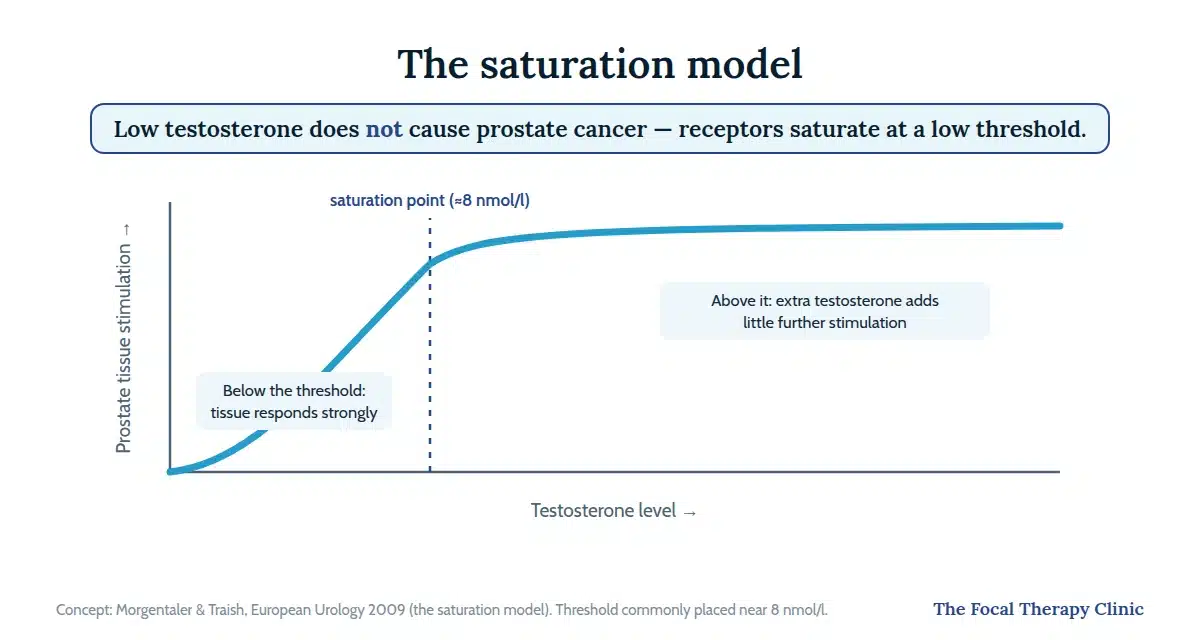
The saturation model proposes that prostate tissue responds strongly to testosterone only at very low levels. Androgen receptors become largely saturated at a threshold often placed near 8 nmol/l, so further increases produce little additional stimulation. This creates a curve that rises at low levels and then flattens.
The model explains why reducing testosterone to castration levels can slow advanced cancer while differences within the normal range do not show the same effect. Prostate testosterone levels also appear to change far less than blood levels during hormonal treatment. The old assumption that every blood-level increase causes equal prostate growth is not supported by this evidence.
Is Testosterone Replacement Therapy Safe?
Current evidence indicates that testosterone replacement therapy does not raise prostate cancer diagnoses in appropriately selected men without known disease. A large randomised study found low prostate-event rates and no significant difference between testosterone and placebo in carefully screened and monitored men. Its findings do not apply to every patient because men at high prostate cancer risk were excluded.
Men often ask does TRT cause prostate cancer or does taking testosterone increase risk of prostate cancer. The evidence is reassuring when TRT treats confirmed deficiency, but baseline prostate assessment and follow-up remain important. TRT may raise PSA towards the expected level and reveal a cancer that was already present rather than create a new one.
Men previously treated for prostate cancer need an individual decision. A 2026 British Society for Sexual Medicine consensus supports considering TRT in carefully selected men in remission, based on cancer risk, treatment history, PSA stability, and specialist monitoring. Evidence remains less complete for this group than for men without a cancer history.
TRT must be separated from hormone therapy for prostate cancer. TRT restores testosterone to treat deficiency, while androgen deprivation lowers or blocks testosterone to control hormone-sensitive cancer. The treatments have opposite aims and belong in different clinical settings.
Before TRT, clinicians commonly review:
- Symptoms and two morning testosterone results
- PSA and prostate risk factors
- Haematocrit and cardiovascular history
- Fertility plans, sleep apnoea, and current medicines
- Previous prostate imaging, biopsy, or cancer treatment
When to Get Your Testosterone Tested
Testing is appropriate when symptoms suggest deficiency or a clinician identifies related risk factors. Low testosterone symptoms in men overlap with stress, depression, obesity, poor sleep, diabetes, and medicine side effects. Blood testing helps separate possible causes.
Who should consider testing
Men should consider testing when symptoms persist and affect daily life. The more useful symptoms include reduced sexual desire, fewer morning erections, erectile difficulties, low energy, loss of strength, and unexplained low mood. Bone loss, infertility, reduced body hair, or changes in the testicles can also prompt assessment.
Testing may be relevant for men with persistent symptoms, obesity, type 2 diabetes, pituitary or testicular concerns, or medicines that suppress testosterone. It is also worth discussing when new deficiency symptoms develop after prostate cancer treatment — as part of a specialist review.
The phrase low testosterone symptoms in men describes a pattern, not one diagnostic sign. Several symptoms are common in people with normal hormone levels. A clinician should check other possible causes at the same time.
Available tests explained
The first test is usually total testosterone from an early morning blood sample. A low or borderline result should normally be repeated on another morning, ideally when the patient is well. Free testosterone and SHBG can help when total testosterone does not match the symptoms.
PSA testing may form part of a wider prostate assessment, particularly in older men or those with risk factors. PSA is not cancer-specific because benign enlargement, infection, inflammation, ejaculation, and recent procedures can affect it. Results should be interpreted with age, symptoms, examination, earlier values, and testosterone level.
Other tests may include luteinising hormone, follicle-stimulating hormone, prolactin, thyroid function, and a full blood count. These help identify whether the cause lies in the testicles, pituitary gland, medicines, or wider health.
Get Expert Advice & The Latest Research
Subscribe to our newsletter to receive the latest updates, expert insights, and breakthrough research on prostate cancer-delivered straight to your inbox.
Protecting Your Prostate and Hormone Health
A short explainer on how to weigh up the treatment options for prostate cancer.
No lifestyle plan can remove prostate cancer risk or guarantee normal testosterone. Healthy habits can still support weight, sleep, bone strength, mood, sexual function, and metabolic health.
Lifestyle changes that help
Regular resistance and aerobic exercise can support muscle, fitness, weight control, and wellbeing. Adequate sleep matters because disrupted sleep can affect hormone rhythms and energy. Men should limit heavy alcohol use and avoid anabolic steroids or unregulated testosterone products.
Practical steps include:
- Maintain a healthy weight
- Combine resistance training with aerobic activity
- Eat vegetables, fruit, pulses, whole grains, and suitable protein
- Limit processed meat and excess alcohol
- Stop smoking
- Treat sleep apnoea and persistent sleep problems
- Manage diabetes, blood pressure, and cholesterol
The clinic’s prostate cancer diet guide provides further practical information. Lifestyle changes may improve symptoms when obesity, inactivity, poor sleep, or alcohol contributes to low testosterone. They do not replace investigation when symptoms persist or PSA is abnormal.
When to seek specialist advice
Specialist advice is appropriate when symptoms continue, testosterone remains low on repeat testing, or PSA is outside the expected range. Men should also seek review for a prostate lump, blood in urine or semen, concerning imaging, or a previous cancer diagnosis. Hormone and prostate specialists may need to coordinate care.
Men with confirmed prostate cancer need treatment advice based on MRI, biopsy, PSA, grade, and tumour location. A specialist assessment for focal therapy suitability can establish whether a localised cancer can be treated with HIFU or NanoKnife while preserving healthy tissue. Testosterone decisions should then be considered within the wider cancer plan.
Most men with low testosterone do not have prostate cancer, and many men with prostate cancer have normal testosterone. Accurate testing clarifies which issue needs attention.
Frequently Asked Questions
Does low testosterone cause prostate cancer?
No, low testosterone does not cause prostate cancer. Large prospective studies have not shown that higher testosterone increases overall risk, while very low free testosterone may be linked with fewer diagnoses but a possible tendency towards higher-grade disease when cancer occurs. Age, Black ethnicity, and family history remain the established risks.
Does high testosterone increase prostate cancer risk?
No, naturally higher testosterone within the normal range has not shown a consistent link with increased prostate cancer risk. The saturation model suggests that prostate androgen receptors become largely saturated at a low threshold. Testosterone above that point appears to produce little additional stimulation of prostate tissue.
What is the saturation model?
The saturation model states that prostate tissue responds to testosterone mainly when levels are very low. Once androgen receptors are largely saturated, often near 8 nmol/l, further increases produce little extra effect. It helps explain why castration-level reduction treats advanced cancer but normal-range differences do not clearly alter risk.
Does low testosterone affect PSA?
Yes, very low testosterone can be associated with a lower PSA level. This is one reason hormone and prostate results should be interpreted together rather than in isolation. Any unexplained PSA change needs clinical review.
Is testosterone replacement therapy safe for the prostate?
Yes, TRT appears to carry a low prostate risk in carefully selected men without known cancer who receive structured screening and monitoring. Men previously treated for prostate cancer may also be considered after stable remission, but only following a specialist assessment. PSA and prostate checks are recommended before and during treatment.
Can men treated for prostate cancer have testosterone therapy?
In some cases, men treated for prostate cancer may receive TRT after specialist review. Decisions depend on cancer grade, treatment type, time since treatment, PSA stability, symptoms, and evidence that disease is controlled. Follow-up must include regular PSA monitoring and clinicians experienced in hormone and prostate care.
Should I get my testosterone tested?
Testing is worth discussing when fatigue, reduced libido, erectile difficulties, fewer morning erections, low mood, or loss of strength persists. Diagnosis usually needs two morning total testosterone tests, with free testosterone and SHBG where indicated. PSA and other blood tests may also be needed to assess prostate and general health.
Talk to a Specialist About Your Hormone and Prostate Health
Understanding testosterone and prostate health starts with accurate testing and expert interpretation. The Focal Therapy Clinic offers consultations in person, by telephone, or by video for men with prostate concerns, an existing diagnosis, or questions about testing. Specialists can review PSA, imaging, biopsy findings, testosterone results, and previous care.
A consultation can clarify whether further hormone tests, prostate imaging, or biopsy is appropriate. Men diagnosed with localised prostate cancer can also discuss focal therapy, surgery, radiotherapy, and active surveillance. Book a specialist consultation to review the available results and agree the next step.
References
References verified via PubMed, 26 August 2026.
- Huggins C, Hodges CV. Studies on prostatic cancer. I: The effect of castration, of estrogen and of androgen injection on serum phosphatases in metastatic carcinoma of the prostate (1941). Reprinted J Urol 2002;168(1):9–12. PMID 12050481.
- Morgentaler A, Traish AM. Shifting the paradigm of testosterone and prostate cancer: the saturation model and the limits of androgen-dependent growth. Eur Urol 2009;55(2):310–20. PMID 18838208.
- Endogenous Hormones and Prostate Cancer Collaborative Group; Roddam AW, Allen NE, Appleby P, Key TJ. Endogenous sex hormones and prostate cancer: a collaborative analysis of 18 prospective studies. J Natl Cancer Inst 2008;100(3):170–83. PMID 18230794.
- Schenk JM, Till C, Hsing AW, et al. Serum androgens and prostate cancer risk: results from the placebo arm of the Prostate Cancer Prevention Trial. Cancer Causes Control 2016;27(2):175–82. PMID 26589415.
- Watts EL, Appleby PN, Perez-Cornago A, et al. Low free testosterone and prostate cancer risk: a collaborative analysis of 20 prospective studies. Eur Urol 2018;74(5):585–594. PMID 30077399.
- Mearini L, Costantini E, Zucchi A, et al. Testosterone levels in benign prostatic hypertrophy and prostate cancer. Urol Int 2008;80(2):134–40. PMID 18362481.
- Ramasamy R, Fisher ES, Schlegel PN. Testosterone replacement and prostate cancer. Indian J Urol 2012;28(2):123–8. PMID 22919126.
- Bhasin S, Travison TG, Pencina KM, et al. Prostate safety events during testosterone replacement therapy in men with hypogonadism: a randomized clinical trial (TRAVERSE). JAMA Netw Open 2023;6(12):e2348692. PMID 38150256.
- Edison MA, Kirby M, Hackett GI. Testosterone replacement therapy in hypogonadal men with a prostate cancer diagnosis: a British Society for Sexual Medicine consensus statement. World J Mens Health 2026;44(1):5–22. PMID 40759590.
- Hackett G, Kirby M, Rees RW, et al. The British Society for Sexual Medicine guidelines on male adult testosterone deficiency, with statements for practice. World J Mens Health 2023;41(3):508–537. PMID 36876744.
This information is for educational purposes and does not replace professional medical advice. All treatment decisions should be made in consultation with a qualified healthcare professional.