
At a Glance
Men with prostate cancer can claim Personal Independence Payment below State Pension age or Attendance Allowance at or above it, alongside Universal Credit, Carer’s Allowance, free prescriptions and charity grants. Entitlement depends on how illness affects daily life, not the diagnosis alone. All rates shown are for 2026/27.
Key takeaways:
- PIP or Attendance Allowance — your age at claim decides which; neither is means-tested (daily-living rates £76.70 or £114.60 a week).
- Special Rules fast-track — advanced disease can qualify automatically via form SR1, with decisions often within ten working days.
- Free prescriptions — cancer treatment qualifies for a five-year medical exemption certificate (form FP92A) in England; free for all elsewhere in the UK.
- Carers can claim too — Carer’s Allowance pays £86.45 a week, with a strict £204 earnings limit.
- Treatment choice affects finances — recovery after focal therapy is typically around two weeks, against four to six after surgery.
Benefit rates, schemes and eligibility rules can change, and individual entitlement depends on personal circumstances. This article provides general information rather than personalised welfare rights or financial advice.
Can You Claim Benefits If You Have Prostate Cancer?
Yes, many men with prostate cancer can claim, but disability benefits depend on how illness or treatment affects daily life, not the diagnosis alone. A man on active surveillance without symptoms is unlikely to qualify, while severe incontinence, fatigue or restricted mobility after treatment may support a claim. Assessors score defined activities such as washing, dressing, managing toilet needs and moving around. The answer to can you claim benefits for prostate cancer therefore depends on functional need and how long it is expected to last. Men with advanced disease may qualify under the Special Rules for End of Life below without a functional assessment.
Should You Claim PIP or Attendance Allowance?
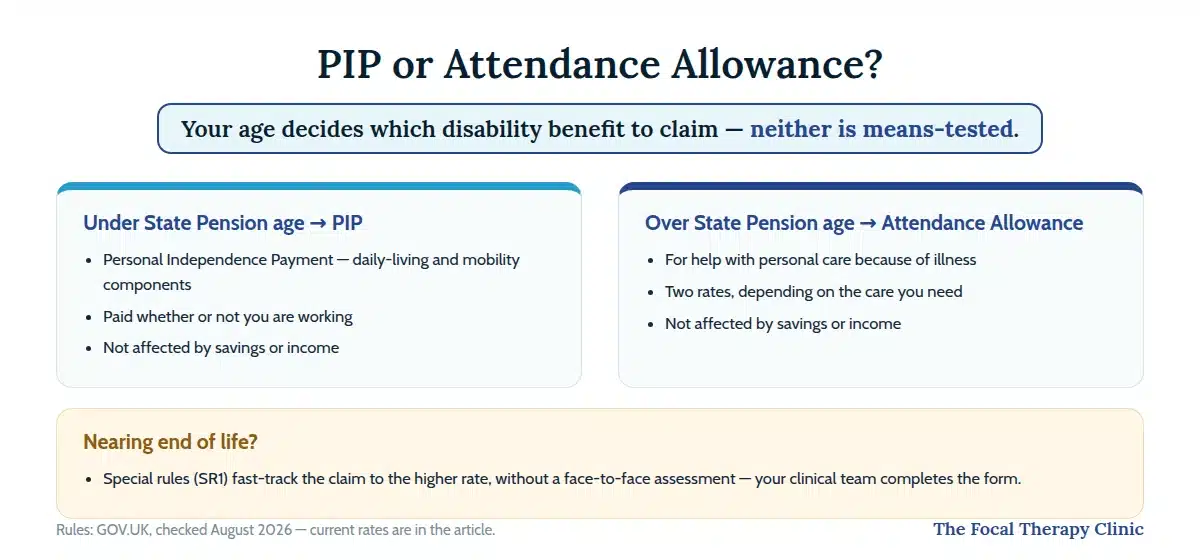
State Pension age is the dividing line: below it, a new claimant applies for Personal Independence Payment, while someone at or above it applies for Attendance Allowance. A new PIP claim cannot normally start after State Pension age, although an existing award can continue. Neither benefit is means-tested or taxable, and savings, income and work do not reduce it.
| Benefit | Who can claim | Components | Weekly rates (2026/27) | Means-tested |
|---|---|---|---|---|
| Personal Independence Payment | People below State Pension age when making a new claim | Daily living and mobility | Daily living: £76.70 or £114.60; mobility: £30.30 or £80.00 | No |
| Attendance Allowance | People at or above State Pension age | Lower or higher care rate; no mobility component | £76.70 or £114.60 | No |
| Adult Disability Payment (Scotland) | Working-age adults living in Scotland | Daily living and mobility | Same rates as PIP | No |
| Pension Age Disability Payment (Scotland) | People of State Pension age living in Scotland | Lower or higher care rate; no mobility component | Same rates as Attendance Allowance | No |
PIP rates and components
PIP has daily living and mobility components, each paid at a standard or enhanced rate, and a claimant may receive one, both or neither. Weekly rates are £76.70 or £114.60 for daily living and £30.30 or £80.00 for mobility, with a maximum of £194.60 a week or £778.40 every four weeks. Rates rose 3.8% in April 2026 and existing awards increased automatically. PIP for cancer patients is based on functional need. Note that the Timms Review of the PIP assessment published its interim report in July 2026, with final recommendations due in autumn 2026 — assessment criteria may change after that.
Attendance Allowance rates explained
Attendance Allowance is for people at or above State Pension age who need help or supervision because of illness or disability, and it has no mobility component. The lower rate is £76.70 a week for help during the day or night, while the £114.60 higher rate applies to help during both or to terminal illness. Four-week payments are £306.80 and £458.40. It is not means-tested and can be claimed alongside the State Pension.
Scotland, Wales and Northern Ireland
The benefit claimed depends on where a person lives. Scotland uses Adult Disability Payment and Pension Age Disability Payment, administered by Social Security Scotland at the same weekly rates but through a different process. Its terminal illness definition needs no expected timeframe, only a clinical judgement that the illness is terminal. Wales uses the DWP system, while Northern Ireland uses the same benefit names and rates through the Department for Communities.
What Benefits Can You Claim If You Stop Working?
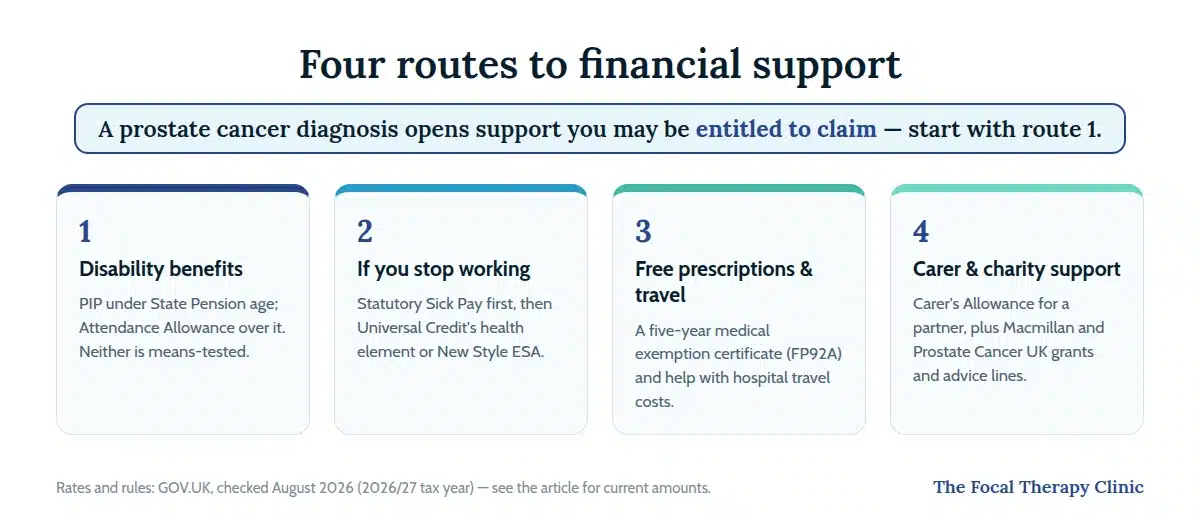
PIP and Attendance Allowance help with extra illness costs, while the benefits below replace income when someone cannot work. Many working-age people need both. Universal Credit is means-tested and considers household income and savings, while new-style ESA depends mainly on National Insurance contributions.
Universal Credit health element
Universal Credit is the main means-tested working-age benefit, and people found to have limited capability for work and work-related activity receive a monthly health element. Most new awards from April 2026 are £217.26 a month, around half the previous rate, while £429.80 is protected for eligible pre-April 2026 claimants, severe-conditions cases and Special Rules claims. The lower rate is frozen through 2029/30. The House of Commons Library confirms that most new recipients now receive less, so government benefits for cancer patients should be checked against household income, savings and housing costs.
Employment and Support Allowance
New-style Employment and Support Allowance is contribution-based support for people who have paid enough National Insurance and cannot work because of illness. It can be claimed with Universal Credit, although ESA is normally counted in the Universal Credit calculation. Claimants enter either the work-related activity or support group, and the support group has no work-search requirement. Special Rules claimants enter the support group automatically.
Statutory Sick Pay changes
Statutory Sick Pay is employer-paid support for an eligible employee who is off sick, and major reforms began on 6 April 2026. It pays £123.25 a week or 80% of average weekly earnings, whichever is lower. Payment now starts on the first qualifying day, and the lower earnings limit has been removed. SSP lasts up to 28 weeks, although contractual sick pay may be higher.
What Are the Special Rules for End of Life?
Special Rules for End of Life fast-track claims for people with a progressive condition who are not expected to live beyond 12 months. A doctor, nurse or other clinician completes form SR1, which replaced DS1500, using the judgement of whether they would be surprised if the person lived longer than 12 months.
A qualifying claimant can receive:
- The enhanced daily living component of PIP automatically, currently £114.60 a week
- The higher rate of Attendance Allowance automatically
- Placement in the ESA support group without an assessment
- The protected higher Universal Credit health element
- No functional assessment and no PIP2 form
- A fast-tracked decision, often within ten working days
The claimant or a family member can call 0800 917 2222 and say “Special Rules”; the patient need not be present when the claim is registered. The DWP still needs the required details and SR1 evidence. No penalty applies if the patient lives longer than expected because the clinician gave a reasonable judgement at the time.
Do Prostate Cancer Patients Get Free Prescriptions?
Yes, but the route differs across the UK. Prescriptions are free for everyone in Scotland, Wales and Northern Ireland. In England, anyone receiving treatment for cancer, the effects of cancer or the effects of cancer treatment can apply for a medical exemption certificate covering all NHS prescriptions.
Medical exemption certificate FP92A
Form FP92A is completed and signed by a GP, hospital doctor or authorised health professional with access to the patient’s medical records. For cancer treatment, or the effects of cancer or cancer treatment, the medical exemption certificate is valid for five years and covers all NHS prescriptions, not only cancer-related medicines. Once it is valid, the holder ticks box E on the prescription form. NHS Help with Health Costs can be contacted on 0300 330 1341.
Help with hospital travel costs
The Healthcare Travel Costs Scheme reimburses reasonable hospital travel for people on a qualifying benefit or low income. It may cover public transport, mileage, parking or a necessary escort. Claims usually need appointment evidence, receipts and proof of entitlement, submitted through the hospital cashier or PALS. Repeated scans, biopsies and reviews make this valuable financial support for cancer patients.
Can Your Partner Claim Carer’s Allowance?
Yes, a partner may qualify by providing at least 35 hours of care each week when the patient receives PIP daily living, Attendance Allowance or another qualifying benefit. Carer’s Allowance is £86.45 a week, with an earnings limit of £204 after deductions; Scotland pays Carer Support Payment instead.
The earnings limit is a cliff edge, so earning £1 too much can remove the full weekly payment. Carer’s Allowance overlaps with the State Pension, although an underlying entitlement may increase another means-tested benefit. Advice should be taken before claiming or changing work hours.
Charity Grants and Hardship Funds
Grants for cancer patients are usually small, one-off payments for costs such as heating, travel or specialist clothing, not ongoing income. Availability and value vary by area and circumstances. Many schemes require a professional referral.
Macmillan Grants
A Macmillan Grant was a one-off payment towards extra cancer costs, but the national scheme has ended. Some help may still be available locally or through other charities, and applications normally go through a nurse, social worker or benefits adviser rather than directly. The Macmillan Support Line on 0808 808 00 00 can check what is available in your area and run a full benefits check.
Prostate Cancer UK support
Prostate Cancer UK offers specialist nurse support and work-and-money guidance rather than direct cash grants. Other routes include:
- Maggie’s Centres for free benefits advice
- Local council hardship funds
- Council Tax Reduction
- The Blue Badge scheme
- Disabled Facilities Grants for necessary home adaptations
A welfare adviser can check which local and national routes apply together.
Get Expert Advice & The Latest Research
Subscribe to our newsletter to receive the latest updates, expert insights, and breakthrough research on prostate cancer-delivered straight to your inbox.
The Financial Impact of Treatment Choice
Mr Marc Laniado walks through what happens at a Focal Therapy Clinic consultation — what is reviewed, and how treatment decisions are reached with each patient.
Different treatments bring different recovery times and side effects, with financial consequences that may be overlooked at diagnosis. A radical prostatectomy often means four to six weeks away from work, while recovery after focal therapy may allow suitable men to return within about two weeks. Time away can affect wages, sick pay and caring arrangements.
Incontinence and erectile dysfunction may also affect work and daily tasks. These functional effects can influence PIP or Attendance Allowance assessments, so treatment side effects may shape long-term finances as well as quality of life. Clinical suitability and cancer control must remain central.
Paying for Private Focal Therapy
Targeted treatment is not uniformly commissioned across the NHS, so some men consider private care. Insurance usually needs pre-authorisation, while self-pay and instalment options may be available. Patients should ask whether treatment is covered, whether the consultant is recognised and what follow-up is included. The cost of private prostate cancer treatment guide explains the main cost categories.
How to Maximise Your Support
The most common reason men miss support is that no claim was made. These actions reduce delays:
- Get a free benefits check from a Macmillan adviser or Citizens Advice before making claims.
- Apply for the FP92A prescription exemption as soon as cancer treatment begins.
- Ask a clinical nurse specialist whether an SR1 form is appropriate when disease is advanced.
- Keep a symptom diary for at least two weeks before a PIP or Attendance Allowance assessment.
- Describe what happens on difficult days and explain how often those days occur, rather than describing only the best days.
- Request a mandatory reconsideration after a refusal when the decision does not reflect the evidence.
Citizens Advice Help to Claim provides free Universal Credit support. Clear records of symptoms, appointments and costs can strengthen an application.
Frequently Asked Questions
Can you claim PIP with prostate cancer?
Yes, when the claimant is below State Pension age and the cancer or treatment affects daily living or mobility. PIP is awarded for functional need rather than diagnosis, so a man with no symptoms or restrictions is unlikely to qualify. Advanced disease may allow a claim under Special Rules without a functional assessment.
What benefits can I claim if I am over State Pension age?
Attendance Allowance pays £76.70 or £114.60 a week in 2026/27, based on the help or supervision needed. It is not means-tested or taxable, and savings or State Pension income do not reduce it. A new PIP claim cannot normally start after State Pension age, while Scotland uses Pension Age Disability Payment.
How much is PIP for prostate cancer?
The 2026/27 PIP daily living component pays £76.70 a week at the standard rate or £114.60 at the enhanced rate. The mobility component pays £30.30 or £80.00, making the maximum combined award £194.60 a week. The amount depends on assessed functional need, not the prostate cancer stage.
Do prostate cancer patients get free prescriptions?
Prescriptions are free for everyone in Scotland, Wales and Northern Ireland. In England, people treated for cancer, its effects or treatment effects can receive a medical exemption certificate by asking an authorised health professional to complete form FP92A. For cancer-related treatment, the certificate is valid for five years and covers all NHS prescriptions, not only cancer-related medicines.
Can I get financial help to cover the cost of focal therapy?
Possibly, because some private medical insurance policies cover the treatment in full or in part, although approval and exclusions vary. Patients should obtain pre-authorisation and confirm that the consultant and hospital are recognised before booking. Self-pay and instalment arrangements may be available where insurance does not apply.
Does the NHS provide free treatment for prostate cancer?
Yes, NHS diagnostic tests and core treatments, including active surveillance, surgery, radiotherapy and hormone therapy, are free at the point of use. Targeted HIFU and NanoKnife treatment are not uniformly commissioned across every NHS area, so availability depends on location and clinical circumstances. Some men therefore choose private treatment after reviewing all options.
Which charities offer financial support to prostate cancer patients?
Selected local Macmillan schemes may offer one-off grants through professional referrals, although the national scheme has ended. Prostate Cancer UK provides specialist nurse guidance, while Maggie’s Centres offer benefits advice. Councils may also provide hardship funds, Council Tax Reduction or disability-related support.
Talk to Us About Your Treatment Options and What They Involve
Treatment decisions are easier when recovery and likely side effects are clear. The Focal Therapy Clinic discusses all prostate cancer treatment options, with every case reviewed by a multidisciplinary team. For suitable localised disease, HIFU and NanoKnife focal therapy are day-case options; our consultants have carried out more than 2,500 focal therapy procedures, and in our audit of 265 patients 97% maintained urinary continence and 90%+ preserved sexual function. Book a consultation to discuss the next steps.
References
Official sources; rates are for the 2026/27 tax year and were web-verified 26 August 2026 — re-verify each April.
- GOV.UK. Personal Independence Payment (PIP). https://www.gov.uk/pip
- GOV.UK. Attendance Allowance. https://www.gov.uk/attendance-allowance
- GOV.UK. Universal Credit. https://www.gov.uk/universal-credit
- GOV.UK. Statutory Sick Pay (SSP). https://www.gov.uk/statutory-sick-pay
- GOV.UK. Carer’s Allowance. https://www.gov.uk/carers-allowance
- GOV.UK. Benefits at the end of life (Special Rules / SR1). https://www.gov.uk/benefits-end-of-life
- NHS Business Services Authority. Medical exemption certificates (FP92A). https://www.nhsbsa.nhs.uk/exemption-certificates/medical-exemption-certificates
- House of Commons Library. Universal Credit health element changes. Research briefing CBP-10358. https://commonslibrary.parliament.uk/research-briefings/cbp-10358/
- Macmillan Cancer Support. Financial help and work. https://www.macmillan.org.uk/cancer-information-and-support/get-help/financial-and-work (support line 0808 808 00 00)
This information is for educational purposes and does not replace professional medical, welfare-rights or financial advice.