
At a Glance
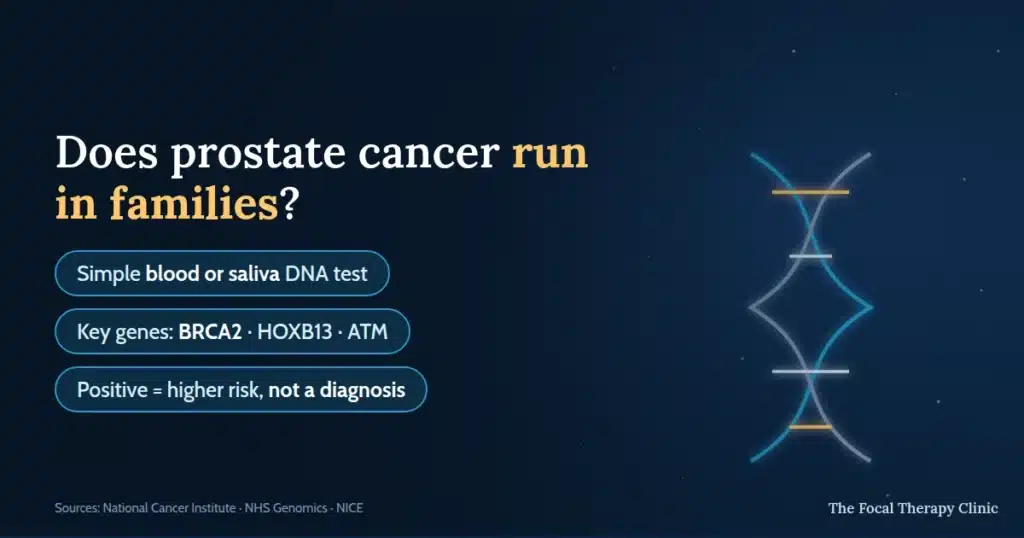
Genetic screening for prostate cancer analyses your DNA from a simple blood or saliva sample to identify inherited mutations — such as BRCA2, HOXB13, and ATM — that increase your risk of developing the disease. Around 5–10% of prostate cancers are linked to inherited gene mutations, and identifying these early allows you and your doctor to plan more targeted monitoring and, if needed, consider minimally invasive treatments such as focal therapy.
- Simple DNA test — a blood or saliva sample is analysed for inherited mutations in genes linked to prostate cancer risk
- Family history matters — men with a father or brother diagnosed under 60, or multiple affected relatives, benefit most from screening
- Early detection advantage — identifying high-risk mutations enables earlier PSA monitoring and MRI scanning, catching cancer when it is localised and treatable
- Treatment options preserved — localised cancers found early may be suitable for focal therapy, which preserves sexual function in 90%+ of men and urinary continence in 97% (FTC audit, n=265)
- Not a diagnosis — a positive result indicates increased risk, not a cancer diagnosis; genetic counselling helps interpret results and plan next steps
Why Does Genetic Risk Matter for Prostate Cancer?
Dr Christos Mikropoulos answers whether prostate cancer is genetic — how family history and inherited risk affect your chances and when testing is worth discussing.
1 in 6 UK males will be diagnosed with prostate cancer during their lifetime, and early-stage disease typically causes no symptoms. Genetic screening identifies inherited mutations that increase your risk — allowing you and your doctor to begin targeted monitoring earlier, when cancer is most treatable.
Understanding your genetic profile is particularly valuable because it shapes both monitoring and treatment decisions. Men identified as high-risk through genetic screening can be offered earlier PSA testing and MRI surveillance. If cancer is found while still localised, minimally invasive options such as focal therapy may be suitable — preserving quality of life while effectively controlling the disease.
At The Focal Therapy Clinic, our consultant urological surgeons assess every patient individually, combining genetic risk information with advanced imaging to recommend the most appropriate pathway. In our clinic’s experience of 2,500+ focal therapy procedures, early detection consistently leads to better outcomes and more treatment choices.
What Is Genetic Screening for Prostate Cancer?
Genetic screening for prostate cancer analyses your DNA — from a simple blood or saliva sample — to identify inherited mutations in genes linked to an increased risk of developing the disease. These are germline mutations (changes you were born with), distinct from somatic testing which examines the tumour itself after diagnosis.
Key genes associated with a higher prostate cancer risk include BRCA1, BRCA2 (also linked to breast and ovarian cancer), HOXB13, ATM, and CHEK2. Genes associated with Lynch syndrome (such as MLH1 and MSH2) are also implicated. Testing can examine a single gene or use panel tests that screen multiple genes simultaneously.
Because interpreting results can be complex, genetic counselling is a vital part of the process. A genetic counsellor explains what the results mean for you and your family before and after testing.
Why is genetic screening important for prostate cancer?
Early-stage prostate cancer frequently presents with no symptoms, which means it is often advanced by the time it is detected through symptoms alone. Genetic screening identifies men with a higher inherited risk before any symptoms appear, enabling earlier monitoring through PSA testing and MRI.
This is particularly important because certain mutations — especially in BRCA2 — are linked to more aggressive forms of prostate cancer. For men carrying these mutations, active surveillance may be less appropriate, and earlier treatment, including focal therapy, may be considered to manage the higher risk effectively.
Inherited mutations follow a 50% inheritance pattern for each child. If a man tests positive, his close relatives can seek their own genetic counselling and testing — BRCA mutations also increase the risk of breast, ovarian, and pancreatic cancers, making this information valuable for both male and female family members.
How Does Genetic Screening for Prostate Cancer Work?
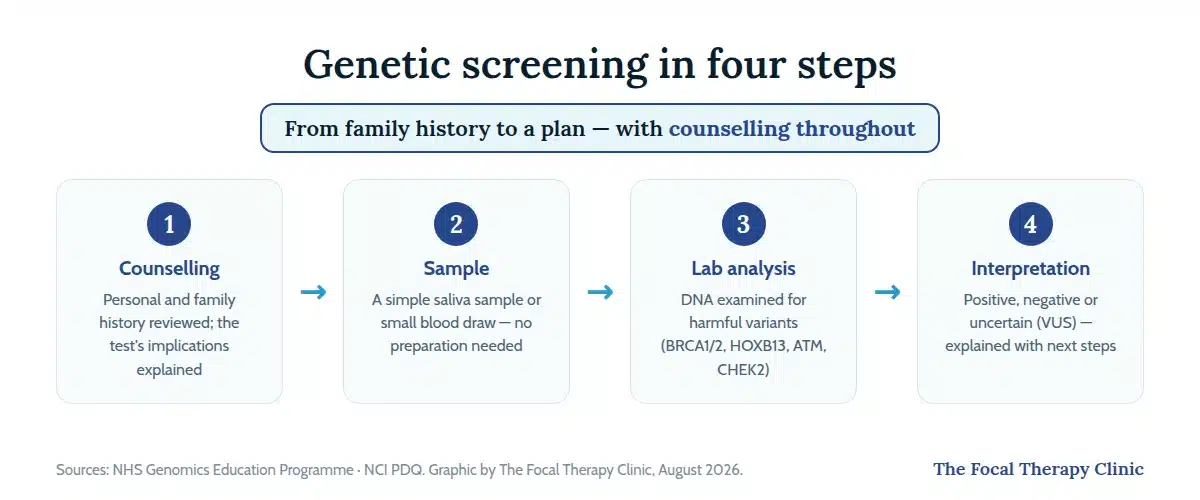
Genetic screening is a straightforward process that typically takes a few weeks from sample to results. A blood or saliva sample is taken and analysed in the laboratory for inherited mutations in genes such as BRCA1, BRCA2, HOXB13, ATM, and CHEK2. A genetic counsellor guides you through the process and helps interpret the results.
The process involves four steps:
- Consultation and counselling — your GP or a specialist genetics service discusses your personal and family history, explains the testing process, and helps you decide if screening is right for you.
- Sample collection — a simple saliva sample or small blood draw. No preparation is needed.
- Laboratory analysis — DNA is extracted and examined for known harmful variants in the genes of interest using specialised panel testing.
- Interpretation — results typically take several weeks. A genetic counsellor explains what your result means:
- Positive result — a gene variant known to increase prostate cancer risk has been found. This confirms higher inherited risk but does not mean cancer is inevitable.
- Negative result — none of the tested variants were found. This is reassuring but does not eliminate all risk, as other factors still play a role.
- Variant of uncertain significance (VUS) — a gene change is identified, but current science cannot determine whether it increases risk. This occurs in around 5% of cases. Further research may clarify its significance.
Who should consider genetic screening for prostate cancer?
Genetic screening is most informative for men with specific risk factors. NHS testing eligibility depends on personal and family history criteria, though private testing is available for men who do not qualify. Key groups who should discuss screening with their GP include:
- Significant family history — a father or brother diagnosed with prostate cancer (especially under 60), multiple affected relatives, or a family history of breast, ovarian, or pancreatic cancer. NHS referral criteria include prostate cancer diagnosed under 50 in the family, or metastatic prostate cancer under 60.
- Black African or Caribbean descent — about 1 in 4 Black men will get prostate cancer in their lifetime, roughly double the risk of other men. Guidelines recommend discussing risk and PSA testing from age 45.
- Ashkenazi Jewish ancestry — higher chance of carrying BRCA mutations; may be eligible for specific NHS testing programmes.
- Metastatic or high-grade diagnosis — genetic testing can guide treatment choices (e.g. PARP inhibitors for men with BRCA mutations) and identify inherited risk for family members.
- Proactive health management — men without strong risk factors who wish to understand their genetic profile after careful consideration of the benefits and limitations. Private testing may be required if NHS criteria are not met.
How Can Focal Therapy Help If Genetic Screening Finds Cancer Early?
Focal therapy is a NICE-approved, minimally invasive treatment for localised prostate cancer that targets only the cancerous tissue within the prostate, preserving the surrounding healthy structures that control urinary and sexual function. For men whose genetic screening has led to earlier cancer detection, focal therapy offers effective treatment with significantly fewer side effects than radical surgery or whole-gland radiotherapy.
Two main focal therapy technologies are available at The Focal Therapy Clinic:
- HIFU (High-Intensity Focused Ultrasound) — NICE-approved under HTG667, uses focused ultrasound waves to destroy cancerous tissue with precision
- NanoKnife IRE (Irreversible Electroporation) — NICE-approved under HTG688, uses electrical pulses to destroy cancer cells while preserving nearby nerves and blood vessels
In our clinic’s experience of 2,500+ procedures, focal therapy delivers excellent outcomes for appropriately selected men:
| Outcome | Focal therapy (FTC data) | Radical prostatectomy |
|---|---|---|
| Sexual function preserved | 90%+ (FTC audit, n=265) | 30–70% |
| Urinary continence | 97% (FTC audit, n=265) | 80–95% |
| Failure-free survival at 5 years (HIFU) | 88% (Guillaumier et al., 2018) | — |
| Recovery time | 1–2 weeks | 4–6 weeks |
| Hospital stay | Day-case (home same day) | 1–3 nights |
Source: FTC one-year outcome audit (n=265) and published literature.
This targeted approach is particularly relevant for men with BRCA2 mutations, where active surveillance may be less appropriate due to the risk of more aggressive disease. Focal therapy treats the cancer effectively while preserving the option for retreatment or other approaches if needed.
“Not every patient is suitable for focal therapy, and we’re transparent about that. We assess every referral carefully with mpMRI and targeted biopsy before recommending treatment.” — Mr Alan Doherty, Consultant Urological Surgeon (FRCS(Urol), GMC: 3279241)
How focal therapy works in combination with genetic screening
Modern prostate cancer care combines genetic risk information with advanced imaging for a truly personalised approach. Your genetic profile informs the “why” and “when” — a man with a high-risk gene mutation might opt for earlier treatment rather than active surveillance. Advanced diagnostics then inform the “where” and “how.”
Multiparametric MRI (mpMRI) has become essential for prostate cancer diagnosis in the UK. High-quality scans, assessed using the PI-QUAL scoring system, provide detailed images of the prostate that identify suspicious areas. For focal therapy planning, these MRI images are fused with live ultrasound during the procedure (MRI-US fusion), allowing the clinician to target HIFU or NanoKnife energy with precision to the exact location of the tumour.
This combination — genetic risk awareness prompting earlier monitoring, advanced imaging guiding precise treatment, and minimally invasive focal therapy preserving quality of life — is what enables the excellent outcomes our patients experience at The Focal Therapy Clinic.
Get Expert Advice & The Latest Research
Subscribe to our newsletter to receive the latest updates, expert insights, and breakthrough research on prostate cancer-delivered straight to your inbox.
What Are the Benefits and Limitations of Genetic Screening?
Genetic screening for prostate cancer risk is a valuable tool, but like any medical test it has both advantages and limitations. Understanding both helps you make an informed decision about whether screening is right for you.
Benefits:
- Early risk awareness — identifies inherited risk before symptoms appear, enabling proactive monitoring
- Tailored screening plans — prompts earlier or more frequent PSA testing and MRI for high-risk men
- Earlier cancer detection — catching localised cancer early opens up more treatment options, including focal therapy which preserves sexual function in 90%+ of men (FTC audit, n=265)
- Informed treatment decisions — genetic information can guide choice of treatment (e.g. PARP inhibitors for BRCA mutations)
- Family health protection — a positive result alerts close relatives to seek their own counselling and testing
Limitations:
- Not all cancers are genetic — only 5–10% of prostate cancers are caused by known inherited mutations; many occur without a detectable genetic cause
- Negative does not mean zero risk — the test only rules out the specific variants screened for; other factors still play a role
- Uncertain results possible — around 5% of tests return a Variant of Uncertain Significance (VUS), which cannot currently be classified as harmful or harmless
- Psychological impact — a positive result can cause anxiety, even though it indicates risk, not a cancer diagnosis
- Cost if NHS criteria not met — private testing may be needed for men who do not meet specific NHS referral criteria
- UK insurance protections exist — agreements are in place protecting people who use predictive genetic test results for most types of insurance, including life insurance
Regardless of the result, discussing it with your GP, genetic counsellor, or specialist is essential. Next steps typically include developing a personalised monitoring plan, discussing lifestyle factors, and — if cancer is diagnosed — using genetic information to guide treatment choices.
How Are Genetic Insights Shaping the Future of Prostate Cancer Treatment?
Prostate cancer diagnosis and treatment are moving towards increasingly personalised approaches. Research into polygenic risk scores — combining the effect of many common, low-risk genetic variants — may soon refine risk prediction beyond single-gene testing. Alongside this, advances in MRI quality and AI-assisted image analysis are improving early detection accuracy.
Focal therapy technologies such as HIFU (NICE HTG667) and NanoKnife IRE (NICE HTG688) are central to this shift. In our clinic’s experience of 2,500+ procedures, combining genetic risk assessment with advanced imaging and precise focal treatment delivers effective cancer control while preserving quality of life — 90%+ sexual function preservation and 97% urinary continence (FTC audit, n=265).
What should you do next?
If you have concerns about your prostate cancer risk — whether due to family history, ethnicity, age, or any other reason — the most important step is to speak with your GP. They can assess your individual situation and, if appropriate, refer you for genetic counselling.
If you have already been diagnosed with prostate cancer or would like a specialist second opinion, our consultant urological surgeons at The Focal Therapy Clinic can review your case and discuss whether focal therapy may be suitable for you. We treat patients at 8 hospital sites across six UK cities.
Contact us: Call 0207 036 8870 or email info@thefocaltherapyclinic.co.uk to book a consultation.
Frequently Asked Questions
Is there a genetic test for prostate cancer?
Yes. Genetic tests analyse DNA from a blood or saliva sample to identify inherited mutations in genes such as BRCA1, BRCA2, HOXB13, ATM, CHEK2, and Lynch syndrome genes (MLH1, MSH2). These tests assess your risk of developing prostate cancer — they do not diagnose existing cancer. Testing is available through the NHS (if eligibility criteria are met) or privately.
Why is early detection important if I have a higher genetic risk?
Catching prostate cancer early — while it is still localised — gives you the widest range of treatment options. For men with higher genetic risk, earlier PSA monitoring and MRI scanning can detect cancer at a stage when minimally invasive options such as focal therapy are most effective. In our clinic’s experience, focal therapy preserves sexual function in 90%+ of men and urinary continence in 97% (FTC audit, n=265), with HIFU achieving 88% failure-free survival at five years (Guillaumier et al., 2018).
Is prostate cancer always inherited if it runs in the family?
Not necessarily. Around 5–10% of prostate cancers are caused by inheriting specific high-risk gene mutations (hereditary cancer). A further 15–20% are considered “familial” — cancer occurs more often than expected by chance, likely due to a combination of shared lower-risk genes, environmental factors, and lifestyle. Many prostate cancers occur with no detectable genetic cause.
How does genetic screening for prostate cancer work?
It begins with genetic counselling to discuss your family history and the test’s implications. If you proceed, a blood or saliva sample is taken and sent to a laboratory, where your DNA is analysed for inherited mutations in genes linked to prostate cancer risk. Results typically take several weeks. A genetic counsellor then explains whether the result is positive, negative, or a variant of uncertain significance (VUS), and what this means for you and your family.
Who should consider genetic testing for prostate cancer risk?
Testing is most relevant for men with a strong family history — multiple close relatives with prostate cancer, relatives diagnosed under 60, or a family history of breast, ovarian, or pancreatic cancer. Men diagnosed with metastatic or high-grade prostate cancer may also be offered testing to guide treatment (e.g. PARP inhibitors for BRCA mutations). Men of Ashkenazi Jewish or Black African/Caribbean descent may have a higher genetic risk. NHS eligibility criteria are specific — speak to your GP or a specialist about your situation.
How much does genetic testing for prostate cancer cost?
The cost varies depending on the specific tests and provider. If you meet NHS eligibility criteria, testing may be available at no cost through your local genetics service. Private testing is an option for men who do not qualify. At The Focal Therapy Clinic, genetic testing is available as part of our comprehensive diagnostic pathway. Contact us on 0207 036 8870 or visit our fees page for details.
References
- Cancer Research UK — Prostate cancer statistics.
- National Cancer Institute — Genetics of Prostate Cancer (PDQ), Health Professional Version.
- NHS England Genomics Education Programme — Patient with a family history of prostate cancer.
- NICE CG164 — Familial breast cancer: classification, care and managing breast cancer and related risks in people with a family history of breast cancer.
- Valerio M, et al. The role of focal therapy in the management of localised prostate cancer: a systematic review. European Urology 2014;66(4):732–751.
- Guillaumier S, et al. A multicentre study of 5-year outcomes following focal therapy in treating clinically significant nonmetastatic prostate cancer. European Urology 2018;74(4):422–429.
This content is not intended to replace professional medical advice. Always consult your clinical team about your individual circumstances.