At a Glance
Every prostate cancer treatment carries side effects, but they differ sharply. Surgery most often affects urinary control and erections, radiotherapy affects the bowel, and hormone therapy affects the whole body. In our audit of 265 focal therapy patients, 97% maintained urinary continence and 90%+ preserved sexual function.
Key takeaways:
- Surgery — urinary leakage and immediate erectile change are the main risks; most continence recovery happens in the first twelve months.
- Radiotherapy — bowel irritation, fatigue and gradually developing sexual effects; modern techniques aim to reduce these.
- Hormone therapy — hot flushes, weight gain, bone thinning and near-universal loss of libido while treatment continues.
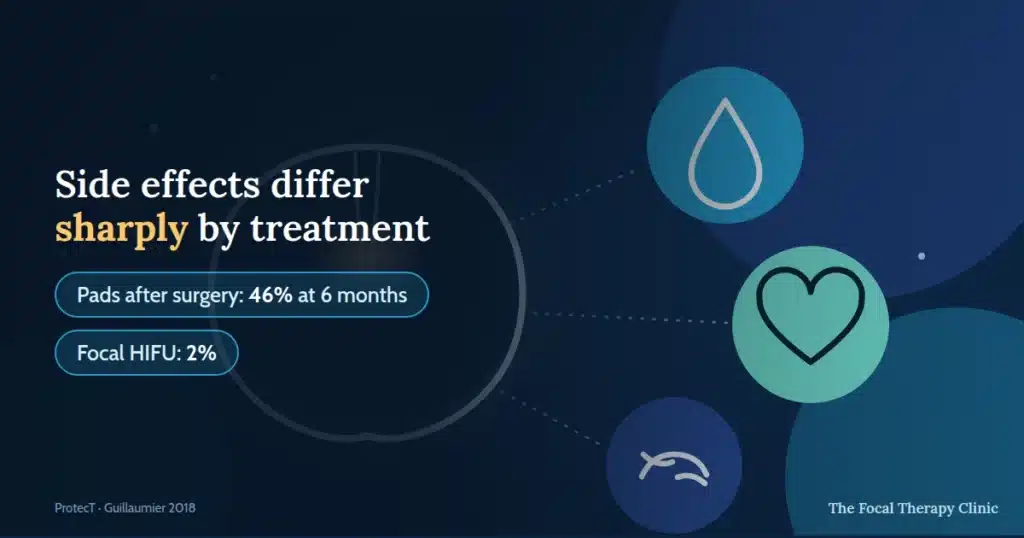
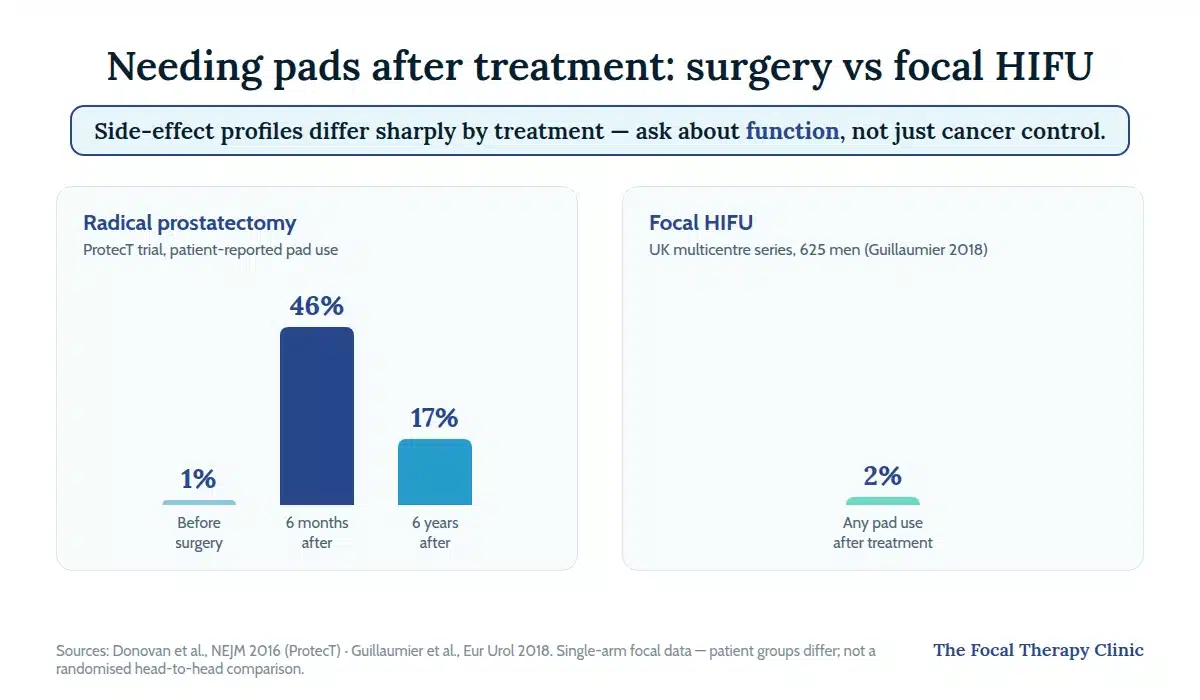
- Focal therapy — in the 625-man UK HIFU series co-authored by our consultants, only 2% of men needed pads (Guillaumier et al., 2018).
- No option is risk-free — the right choice balances cancer control against the side effects that matter most to you.
Surgery most often causes urinary incontinence and immediate erectile dysfunction. Radiotherapy causes more bowel irritation and fatigue, with sexual effects developing gradually, while hormone therapy can cause hot flushes, weight gain and bone loss. Focal therapy preserves urinary and sexual function in most selected men, but no option is free of risk.
Which Prostate Cancer Treatment Has the Fewest Side Effects?
Mr Tim Dudderidge explains why impotence and incontinence are less likely after focal therapy than after whole-gland treatment, and how tissue-sparing treatment protects the structures that control erections and bladder function.
Active surveillance has the fewest side effects because it is not a treatment. ProtecT found that men remaining on active monitoring mainly experienced gradual age-related declines in urinary and sexual function, avoiding treatment effects unless they later received treatment. Among active treatments, focal therapy has the most favourable functional profile in the available evidence, while surgery and radiotherapy carry different burdens and hormone therapy has the widest body-wide profile. The option with the fewest side effects is not always right because suitability depends on cancer grade, stage and location, and undertreated cancer has its own cost.
Side Effects of Each Treatment Compared
The sections below compare prostate cancer treatment side effects using the strongest evidence available for each option. Surgery and radiotherapy have randomised ProtecT data, while focal therapy evidence comes from registries, cohorts and meta-analyses rather than randomised comparisons.
A HIFU patient describes choosing focal therapy for its low incontinence risk, and what treatment and recovery were like in his own words.
An Imperial College-led study found similar cancer control between focal therapy and radical prostatectomy for selected men for up to eight years. Professor Hashim Ahmed reported that focal therapy can also reduce urinary and sexual side effects by up to ten-fold compared with radical treatment. That study — Shah et al., 2021 — was co-authored by The Focal Therapy Clinic’s Mr Tim Dudderidge and Mr Raj Nigam.
| Treatment | Urinary incontinence | Erectile function | Bowel problems | Fatigue | Loss of ejaculation | Recovery time |
|---|---|---|---|---|---|---|
| Active surveillance | No treatment-caused leakage | Gradual age-related decline | None from treatment | None from treatment | No | No recovery; ongoing monitoring |
| Radical prostatectomy | Pad use 46% at six months after surgery; 17% at six years (from 1% at baseline) | Of men with firm-enough erections at baseline, 12% retained them at six months and 17% at six years (ProtecT) | Rare | Common early | Permanent | About 4–6 weeks |
| External beam radiotherapy | Leakage uncommon; urgency can occur | 22% retained firm-enough erections at six months (ProtecT; arm included 3–6 months’ hormone therapy) | More common than after surgery | Common during treatment | Volume often falls | Outpatient; fatigue may last weeks |
| Brachytherapy | Leakage uncommon; urgency or retention possible | Can decline gradually | Irritation or bleeding possible | Usually mild to moderate | Reduced semen or dry orgasm possible | Days to two weeks |
| Hormone therapy | Not usually direct | Near-universal erectile dysfunction during treatment | Not usually direct | Very common | Often reduced | Effects persist during treatment |
| Focal therapy | 2% any-pad use after focal HIFU (Guillaumier 2018) | 90%+ preserved sexual function (FTC audit, n=265) | Rare | Usually short-lived | Usually preserved | Days to two weeks |
ProtecT surgery and radiotherapy figures come from a randomised trial; the ProtecT baseline matters — 67% of men had erections firm enough for intercourse before treatment. Focal therapy figures come from the FTC audit and from cohort and registry data, so they are not direct head-to-head comparisons.
Radical prostatectomy side effects
Radical prostatectomy removes the whole prostate, and urinary incontinence and erectile dysfunction can follow because the sphincter and erection nerves sit against the gland. In ProtecT’s patient-reported outcomes, absorbent-pad use rose from 1% before surgery to 46% at six months, settling at 17% at year six. For erections, the baseline-first picture is the honest one: 67% of ProtecT men had erections firm enough for intercourse before treatment; at six months after surgery 12% retained them, recovering to 17% at six years. Continence usually improves most during the first twelve months.
ProtecT recruited between 1999 and 2009, and its prostatectomies were predominantly open rather than robot-assisted. Contemporary nerve-sparing robotic technique may produce better functional outcomes than these figures suggest, though no randomised trial of comparable rigour has tested that. Other radical prostatectomy side effects include permanent loss of ejaculation, possible penile shortening and anastomotic stricture.
Radiotherapy side effects
Radiotherapy treats the prostate in place, so leakage is less common, bowel effects are more common and sexual effects usually develop gradually. In ProtecT, 22% of men in the radiotherapy arm retained erections firm enough for intercourse at six months (against the 67% baseline) — and that arm included three to six months of neoadjuvant hormone therapy, so some of the early sexual effect reflects hormone treatment rather than radiation alone. Bowel function was worse than after surgery or active monitoring. Acute side effects of radiotherapy for prostate cancer include urgency, loose stools and fatigue, while late effects include radiation proctitis, rectal bleeding, bowel urgency and a small second-cancer risk.
ProtecT predates modern IMRT and hypofractionated schedules, which aim to reduce these toxicities. Modern radiotherapy may therefore produce a different experience from the trial figures.
Hormone therapy side effects
Androgen deprivation lowers testosterone to very low levels, so the prostate cancer treatment hormone therapy side effects are body-wide rather than confined to the pelvis.
- Sexual: near-universal loss of libido and erectile dysfunction
- Physical: hot flushes, abdominal weight gain, muscle loss, breast tenderness and gynaecomastia
- Metabolic: insulin resistance and raised cardiovascular risk
- Skeletal: bone-density loss and increased fracture risk
- Cognitive and emotional: fatigue, low mood and possible concentration problems
Weight gain and muscle loss are direct treatment effects, not a failure of willpower, and resistance exercise with adequate protein can help. Most side effects of hormone therapy for prostate cancer improve if treatment stops, but recovery can take months and may remain incomplete. The likely duration of hormone therapy should form part of the treatment discussion.
Focal therapy side effects
Focal therapy uses HIFU or NanoKnife/IRE to treat the cancerous area while preserving surrounding tissue, the sphincter and the neurovascular bundles where possible. In the 625-man multicentre UK series co-authored by our consultants Mr Tim Dudderidge and Mr Raj Nigam (Guillaumier et al., 2018), only 2% of men needed pads after focal HIFU. In The Focal Therapy Clinic’s own audit of 265 patients, 97% maintained urinary continence and 90%+ preserved sexual function. Focal therapy outcomes come from registries, cohorts and audit data rather than randomised trials, and the men selected for focal therapy differ systematically from those who undergo surgery, so these figures cannot be read as a direct head-to-head comparison with the ProtecT data above.
Side effects include a temporary catheter, urinary irritation, urgency, haematuria and occasional urinary infection. Some men later need repeat focal treatment or radical treatment because only the identified lesion is treated. The published side effects of NanoKnife focal therapy should be discussed separately from HIFU effects.
Active surveillance considerations
Active surveillance is not a treatment and has no treatment side effects, but it still carries a burden. Men live with untreated cancer and face repeated PSA tests, MRI scans and biopsies, plus the possibility of later treatment. ProtecT found gradual age-related declines in urinary and sexual function among men remaining on monitoring rather than the immediate harms seen after radical treatment — at six years, 30% of monitoring-arm men retained firm-enough erections against the 67% baseline. Some men also experience substantial anxiety around results and possible progression.
Will You Have Bladder Control Problems?
It depends heavily on the treatment: surgery causes the most leakage, radiotherapy causes less leakage but more urgency, and focal therapy rarely causes lasting incontinence. The sphincter sits directly beneath the prostate, so removing the gland disturbs it, while treatments that leave the gland in place usually disturb it less. Pelvic floor exercises should begin before surgery where possible and continue during recovery.
Pads, duloxetine and specialist continence services may help. Persistent severe leakage can be treated with a male sling or artificial urinary sphincter. Most recovery occurs within twelve months, with limited improvement after eighteen months.
How Does Treatment Affect Erections?
Erectile dysfunction is the most common long-term side effect of prostate cancer treatment, but its pattern differs by treatment — and the starting point matters as much as the treatment. In ProtecT, 67% of men had erections firm enough for intercourse before treatment. At six months, 12% of surgery patients, 22% of radiotherapy patients and 52% of men on active monitoring retained them; the surgery figure recovered to 17% by six years. Erectile change is immediate after surgery, develops gradually after radiotherapy and is near-universal during hormone therapy. The neurovascular bundles run along the prostate, and nerve-sparing surgery aims to preserve them when the tumour position makes that safe.
Recovery depends on age, erections before treatment, cardiovascular health and whether nerve-sparing was possible. For focal treatment, the French AFU multicentre study (Rischmann et al., 2017) found 78% of men preserved erectile function (IIEF-5 score of 16 or above) at 12 months after HIFU hemiablation, with 97% continence. Options for treating erectile dysfunction include sildenafil or tadalafil, vacuum devices, injections, penile implants and early rehabilitation after surgery. Support should start early rather than waiting for function to return unaided.
Erectile dysfunction affects partners and relationships, not only the man receiving treatment. Changes in confidence, intimacy and communication may continue even when treatment helps erections. NHS psychosexual counselling and guidance on sex and relationships can help couples address the effect together.
Does Treatment Affect Fertility and Ejaculation?
Yes, and for most radical treatments the fertility effect is permanent. Any man who may want children should discuss sperm banking before treatment because it is the only reliable way to preserve that option.
Ejaculation after treatment
Radical prostatectomy removes the prostate and seminal vesicles, so ejaculation stops permanently. Orgasm sensation is usually retained, but no semen is released, and this dry orgasm can be distressing when unexpected. Radiotherapy reduces semen volume and may lead to dry orgasm, while focal therapy usually preserves ejaculation. Climacturia, or urine leakage at orgasm, affects a minority after prostatectomy.
Fertility and sperm banking
Prostatectomy causes permanent infertility, radiotherapy usually does, and hormone therapy suppresses fertility while it continues. Any man who may wish to father children must raise sperm banking before treatment starts because natural conception is not possible after prostatectomy. NHS sperm storage is available in defined circumstances. The clinical nurse specialist should start this discussion rather than wait for the patient to ask.
Can Treatment Cause Bowel Problems?
Bowel problems are mainly a side effect of radiotherapy because the rectum sits directly behind the prostate and receives some radiation dose. Surgery and focal therapy rarely cause them. Acute effects include loose stools, wind, urgency and discomfort, while late effects include radiation proctitis, rectal bleeding and persistent urgency.
Some centres use rectal spacer gels to increase the distance between the prostate and rectum. Temporary dietary changes may run against normal high-fibre advice, and persistent effects may need gastroenterology review. Any rectal bleeding should be reported rather than assumed to be radiation-related.
Fatigue, Nausea and Other Effects
Fatigue is among the most under-reported side effects of prostate cancer treatment, especially after radiotherapy and during hormone therapy, and it does not always resolve with rest. Tailored exercise is one of the most effective interventions for cancer-related fatigue. Nausea is uncommon and mainly occurs with chemotherapy for advanced disease or briefly after anaesthesia.
Other possible effects include:
- Lymphoedema after lymph-node removal
- Hot flushes on hormone therapy
- Gynaecomastia
- Hair thinning
- Bone thinning
- A small long-term second-cancer risk after radiotherapy
Men recovering from focal HIFU can review what to expect after HIFU treatment for procedure-specific effects.
Get Expert Advice & The Latest Research
Subscribe to our newsletter to receive the latest updates, expert insights, and breakthrough research on prostate cancer-delivered straight to your inbox.
How Does Treatment Affect Mental Health?
Anxiety and low mood are common during and after treatment, and they are a predictable response to a serious diagnosis rather than weakness. Fear of recurrence often peaks around each PSA test and is known as PSA anxiety. Erectile dysfunction and incontinence can affect identity and relationships, while androgen deprivation can cause mood change through low testosterone.
Many men feel isolated because they do not discuss the diagnosis with friends. Support is available through clinical nurse specialists, Prostate Cancer UK, Maggie’s Centres, psychosexual counselling and GP referral for talking therapies. Mood should be raised with the clinical team because it is treatable and frequently goes unmentioned.
Side Effect Timelines: What Improves and What Persists
Side effects may settle within weeks, improve over months to a year, or persist and worsen over several years.
| Side effect | Treatment | Typical onset | Typical course |
|---|---|---|---|
| Urinary incontinence | Surgery | Immediate | Most improvement within 12 months |
| Erectile dysfunction | Surgery | Immediate | Partial recovery over 1–2 years |
| Erectile dysfunction | Radiotherapy | Gradual | May worsen over years |
| Acute bowel effects | Radiotherapy | During treatment | Usually settle within weeks |
| Radiation proctitis | Radiotherapy | Months to years | May persist |
| Hot flushes | Hormone therapy | Within weeks | Continue while testosterone is suppressed |
| Urinary irritation | Focal therapy | First days | Usually settles within weeks |
Some effects do not improve, so decisions should assume that a side effect may be permanent rather than rely on the hope that it will resolve.
Frequently Asked Questions
How long does incontinence last after prostate surgery?
Most men regain bladder control within twelve months of prostatectomy, with the biggest improvement during the first three to six months. In ProtecT’s patient-reported outcomes, 46% of surgery patients were using absorbent pads at six months, falling to 17% at year six. Pelvic floor exercises started before surgery can support recovery.
Will I definitely lose my erections after treatment?
Not necessarily, because risk depends on the treatment and personal factors — starting with your function going in. In ProtecT, 67% of men had erections firm enough for intercourse at baseline; at six months, 12% retained them after surgery and 22% after radiotherapy, while 52% did on active monitoring. In our audit of 265 focal therapy patients, 90%+ preserved sexual function. Age, previous function and nerve preservation affect recovery.
What are the side effects of hormone therapy?
Hormone therapy lowers testosterone, causing hot flushes, loss of libido, erectile dysfunction, weight gain, muscle loss, bone thinning, fatigue and mood change. Most effects improve if treatment stops, although recovery can take months and may remain incomplete. Resistance exercise and adequate protein help limit muscle and bone loss.
Does focal therapy have fewer side effects than surgery?
The available evidence suggests that focal therapy has fewer functional side effects. Only 2% of men needed pads in the UK focal HIFU series co-authored by our consultants (Guillaumier 2018), and 90%+ preserved sexual function in our audit of 265 patients. Professor Hashim Ahmed has reported that focal therapy can reduce urinary and sexual side effects by up to ten-fold compared with radical treatment. These figures come from single-arm studies and audit data, not randomised direct comparisons, and the men selected for each treatment differ.
Can I still have children after prostate cancer treatment?
Natural conception is not possible after prostatectomy and is usually lost after radiotherapy, while hormone therapy suppresses fertility during treatment. Any man who may want children should raise sperm banking before treatment begins. After prostatectomy, sperm banking is no longer possible through normal ejaculation.
Do side effects mean the treatment is working?
No, the severity of side effects does not show whether treatment has controlled the cancer. Success is measured through PSA and, where relevant, follow-up imaging or biopsy. Men with few side effects are not undertreated, and men with severe effects are not better protected.
Understand Your Options Before You Decide
The decision is difficult because every option has a cost, and the right choice depends on the cancer as much as the side-effect profile. The Focal Therapy Clinic discusses active surveillance, surgery, radiotherapy and other options, with every case reviewed by a multidisciplinary team. HIFU and NanoKnife focal therapy are tissue-preserving options for suitable men with localised disease, and our consultants have carried out more than 2,500 focal therapy procedures. Book a consultation to discuss which options are suitable.
References
References verified via PubMed, 26 August 2026.
- Donovan JL, Hamdy FC, Lane JA, et al. Patient-reported outcomes after monitoring, surgery, or radiotherapy for prostate cancer (ProtecT). N Engl J Med 2016;375(15):1425–1437. PMID 27626365.
- Hamdy FC, Donovan JL, Lane JA, et al. 10-year outcomes after monitoring, surgery, or radiotherapy for localized prostate cancer (ProtecT). N Engl J Med 2016;375(15):1415–1424. PMID 27626136.
- Guillaumier S, Peters M, Arya M, et al. A multicentre study of 5-year outcomes following focal therapy in treating clinically significant nonmetastatic prostate cancer. Eur Urol 2018;74(4):422–429. PMID 29960750. (FTC co-authors: Mr Tim Dudderidge, Mr Raj Nigam)
- Shah TT, Reddy D, Peters M, et al. Focal therapy compared to radical prostatectomy for non-metastatic prostate cancer: a propensity score-matched study. Prostate Cancer Prostatic Dis 2021;24(2):567–574. PMID 33504940. (FTC co-authors: Mr Tim Dudderidge, Mr Raj Nigam)
- Reddy D, Peters M, Shah TT, et al. Cancer control outcomes following focal therapy using high-intensity focused ultrasound in 1,379 men with nonmetastatic prostate cancer (HEAT registry). Eur Urol 2022;81(4):407–413. PMID 35123819. (FTC co-authors: Mr Tim Dudderidge, Mr Raj Nigam)
- Rischmann P, Gelet A, Riche B, et al. Focal high intensity focused ultrasound of unilateral localized prostate cancer: a prospective multicentric hemiablation study of 111 patients. Eur Urol 2017;71(2):267–273. PMID 27720531.
- The Focal Therapy Clinic. Internal audit of focal therapy outcomes (n=265): continence and sexual-function preservation at 12 months. Internal clinical audit data.
This information is for educational purposes and does not replace professional medical advice. All treatment decisions should be made in consultation with a qualified healthcare professional.