
At a Glance
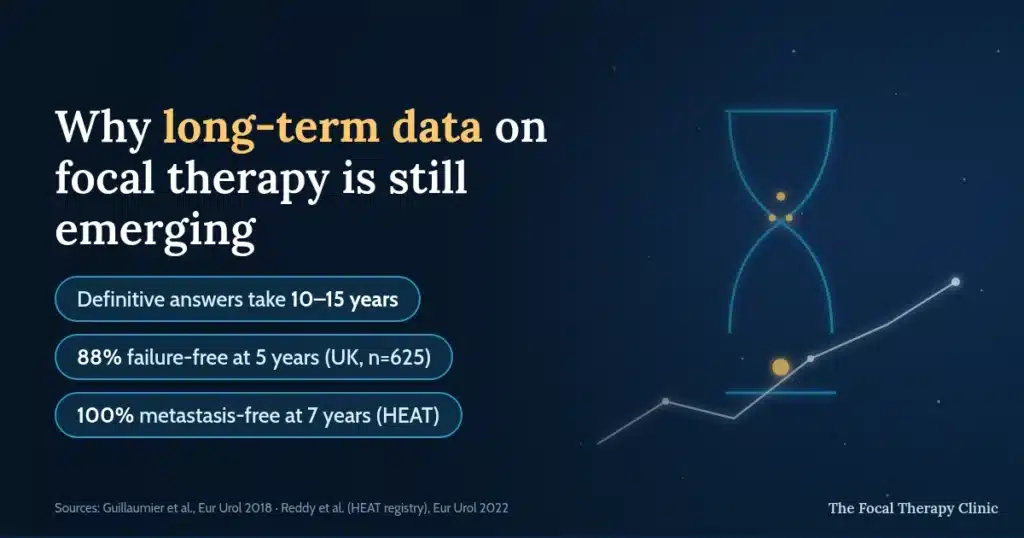
Focal therapy is a newer option for treating prostate cancer that targets only the tumour, not the whole prostate — designed to lower the risk of life-changing side effects like incontinence and erectile dysfunction. Definitive long-term data, typically measured over 10 to 15 years, is still emerging, because the imaging technologies that enable focal therapy only became widespread in the early 2000s. But medium-term results are strong: in the largest UK series, failure-free survival was 88% at five years,¹ and the national HEAT registry recorded 100% metastasis-free survival at seven years.²
Key takeaways:
- Focal therapy is a newer, targeted treatment for localised prostate cancer that aims to reduce side effects like incontinence and erectile dysfunction.
- Definitive long-term data takes 10 to 15 years to emerge — the technologies enabling focal therapy only became widespread in the early 2000s, and most prostate cancers grow slowly, so meaningful follow-up takes time.
- Medium-term results are strong — 88% failure-free survival at 5 years in the largest UK series (625 men),¹ and 100% metastasis-free survival at 7 years in the national HEAT registry (1,379 men).²
- Quality of life is largely preserved — in The Focal Therapy Clinic’s audited series of 265 men, 97% maintained urinary continence and 90%+ preserved sexual function, with quick recovery times.
- Evidence is growing — thousands of patients treated, and major trials such as PART are under way to provide stronger long-term comparisons.³
- Treatment decisions depend on personal priorities — balancing the long-term track record of radical treatments against the reduced side effects and innovation of focal therapy.
The timeline of prostate cancer treatments
Established treatments: surgery and radiotherapy
For over 30 years, radical prostatectomy (surgery) and radiotherapy have been the standard approaches for treating localised prostate cancer. These are “whole-gland” therapies, meaning they aim to remove or destroy the entire prostate gland. This approach provided a clear outcome which simplified data collection over many years. As a result, global cancer registries have accumulated decades of follow-up data, giving us an understanding of their long-term effectiveness — but also of their significant impacts on urinary and sexual function.
The newer introduction of focal therapy
Focal therapy was developed to give men a way to treat prostate cancer with fewer side effects. It became more practical after the introduction of MRI imaging and targeted biopsy techniques in the early 2000s. These developments allowed clinicians to accurately visualise and localise clinically significant cancer within the prostate.
In the UK, NICE approved HIFU, cryotherapy, and IRE under special conditions starting from 2012. These approvals required careful data collection and patient follow-up. Today, focal HIFU is covered by NICE HealthTech guidance HTG667, NanoKnife (irreversible electroporation) by HTG688, and focal cryoablation by IPG423. While this evidence-collection process is essential, it also means long-term data is still in progress.
Why long-term data takes time
Natural history of prostate cancer
Prostate cancer often has a long natural history. Many localised tumours are slow-growing and likely will not pose a threat to a man’s life. Because of this, key clinical outcomes such as cancer-specific survival can only be meaningfully assessed over very long follow-up periods, typically 10 to 15 years. When considering focal therapy, it is helpful to understand that we are only now reaching the point where the earliest groups of patients have been followed for this length of time.
How long-term survival studies are structured
Tracking outcomes over a decade or more isn’t simple. It involves regular scans, blood tests, and sometimes biopsies to confirm if the cancer has returned or spread. Studies also need to follow large numbers of patients to produce strong evidence.
This is easier when a treatment is widely used, like surgery or radiotherapy. Since focal therapy is still gaining ground, many of these studies are smaller or still in progress. Major trials such as PART (Partial prostate Ablation versus Radical Treatment) are under way but will take years to complete.³
What we know from medium-term data
Mr Marc Laniado explains how focal therapy has been tested — the trials and registries behind the treatment’s evidence base.
Even though long-term results are limited, there’s a lot we already know about focal therapy from 3 to 7-year studies. Many of these are from respected UK centres, where patient outcomes are carefully recorded. These findings already help shape a more personalised care pathway for men seeking effective treatment with fewer side effects.
3–7 year results
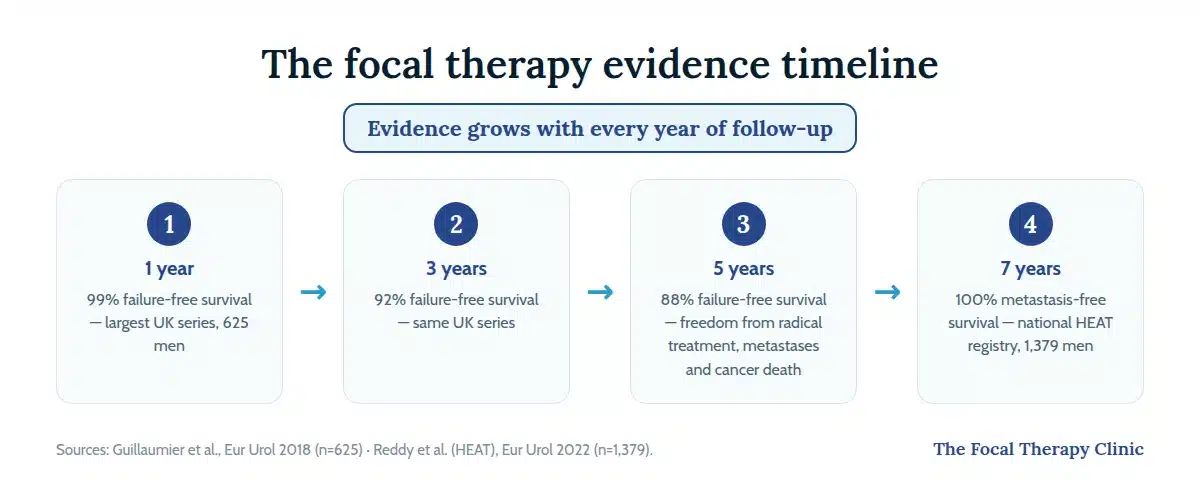
Medium-term results show that focal therapy can control cancer effectively. In the largest published UK series of focal HIFU (625 men across multiple centres), failure-free survival — freedom from radical or systemic treatment, metastases and prostate-cancer death — was 99% at one year, 92% at three years and 88% at five years.¹
In the national HEAT registry (1,379 men), metastasis-free survival was 100% at seven years.² In the Guillaumier series, 98% of men remained pad-free.¹
These figures demonstrate a high level of cancer control in the medium term. Furthermore, when additional treatment is required, it is often a repeat session of focal therapy rather than an immediate move to radical treatment, allowing men to remain on a less invasive treatment path.
Functional outcomes
One of the biggest strengths of focal therapy is how well it protects quality of life. In The Focal Therapy Clinic’s audited series of 265 men, fewer than 2% experienced urinary incontinence — equivalent to 97% maintaining continence — and more than 90% preserved sexual function.
Here’s how focal therapy compares on functional outcomes:
- Urinary continence preserved in 97% of cases (FTC audit, n=265)
- Sexual function preserved in 90%+ of cases (FTC audit, n=265)
- Return to normal activities often within days
- Low complication rates even after repeat treatment — in the HEAT registry, serious (Clavien-Dindo >2) adverse events occurred in just 0.5% of men²
Some men who need salvage surgery after focal therapy also report minimal side effects. That shows focal therapy doesn’t limit future treatment options.
Comparing evidence maturity across treatments
Radical treatments have decades of follow-up
Radical prostatectomy and radiotherapy have long been studied in large trials, including research going back to the 1990s and early 2000s. These treatments have a clear track record for long-term survival and recurrence control.
Because of this, doctors can offer well-informed advice about risks and benefits. However, these treatments are also linked to more side effects. Focal therapy was introduced to offer a middle ground between “doing nothing” and removing the entire prostate.
Focal therapy’s evidence base is growing
The Focal Therapy Clinic’s consultants have delivered more than 2,500 focal therapy procedures, and success rates remain high. The clinic uses MRI-ultrasound fusion imaging on every focal therapy case to ensure precision treatment, reducing the chance of missing cancerous tissue.
Professional bodies have also taken notice. The European Association of Urology (EAU) has acknowledged focal therapy’s potential, while the American Urological Association (AUA) has been more cautious, supporting focal therapy mainly within trials and registries. Despite differing positions, the body of evidence continues to grow.
Get Expert Advice & The Latest Research
Subscribe to our newsletter to receive the latest updates, expert insights, and breakthrough research on prostate cancer-delivered straight to your inbox.
What this means for patients today
If you’ve been diagnosed with localised prostate cancer, treatment decisions can feel overwhelming. Focal therapy is one of several modern options that could be suitable for you. Choosing the right approach depends on your health, your cancer, and your personal goals.
Balancing innovation and evidence
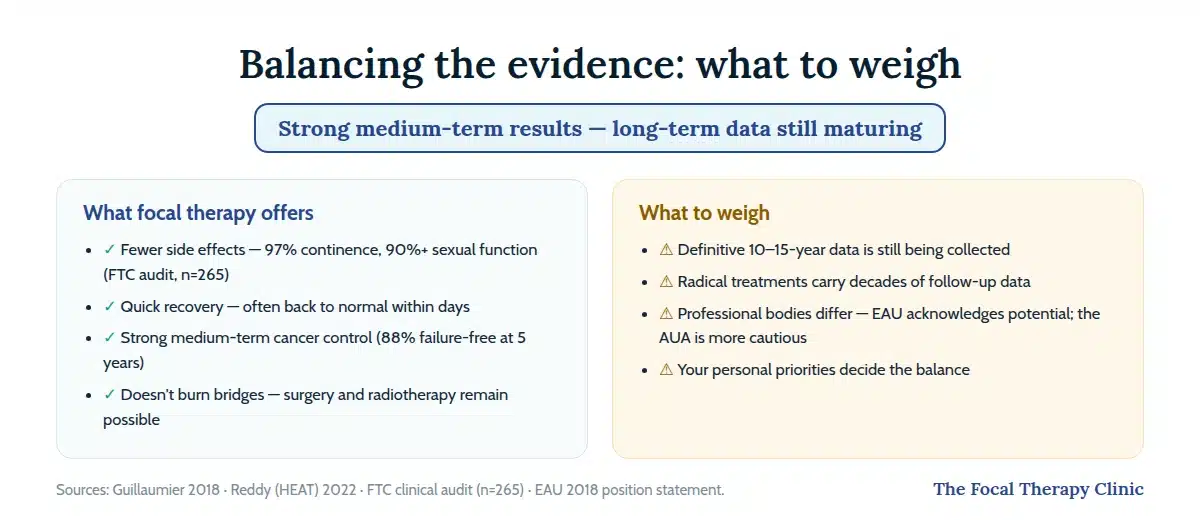
Focal therapy sits between traditional and emerging medicine. It offers strong medium-term outcomes, but long-term data is still developing. Some men are comfortable with that balance, especially when avoiding side effects is a top priority.
You may find that your consultant is open to discussing focal therapy even if it’s not the first option offered. Asking about different treatments is one way to explore what works best for you. Innovation in medicine always comes with a learning curve, but the medium-term signs for focal therapy are encouraging.
Considering personal priorities in treatment choice
Men often want to protect their quality of life, particularly when it comes to sexual and urinary function. Others may prefer a treatment with decades of data, even if side effects are more likely. There’s no one-size-fits-all answer.
Questions to ask yourself might include:
- What matters most — longevity, function, or peace of mind?
- How much risk am I willing to accept regarding side effects?
- Do I want a less invasive option or the most established one?
Your choice should be guided by your values and informed by a team of world-class consultants who understand your individual situation. Building a clear care pathway with your doctors can help you make the right decision.
Final thoughts
Focal therapy is gaining traction as a safe and effective treatment for localised prostate cancer. Although long-term data is still being collected, medium-term studies already show great potential. For many men, it offers the chance to treat cancer without sacrificing quality of life.
Frequently Asked Questions
Why is there limited long-term data on focal therapy?
Focal therapy is newer than surgery or radiotherapy, so there hasn’t been enough time to gather long-term results. Most structured studies began in the last 10–15 years. As time goes on, more of this data will become available.
How long has focal therapy been used for prostate cancer?
HIFU and cryotherapy have been used since the early 2000s. NICE approved them for focal use in 2012 under research protocols, and focal HIFU is now covered by HealthTech guidance HTG667. Since then, use has expanded and more trials are under way.
What do medium-term results tell us?
They show that focal therapy controls cancer effectively and preserves quality of life. In the largest UK series, failure-free survival was 88% at five years,¹ and the HEAT registry recorded 100% metastasis-free survival at seven years.² Many men report returning to normal routines soon after treatment.
Is it risky to choose a treatment with less long-term data?
There’s always some uncertainty with newer treatments. But focal therapy has shown excellent medium-term results in thousands of patients. Talking to experienced consultants can help you weigh the risks and benefits. An important consideration is that focal therapy does not “burn bridges” — if cancer were to recur, radical treatments like surgery or radiotherapy remain viable options.
How is focal therapy being studied for the future?
Large trials like PART are comparing focal therapy with radical treatment and tracking long-term results.³ These studies are run across NHS sites in the UK. Over time, they’ll help solidify focal therapy’s place in standard treatment guidelines.
Our own contribution to that evidence is published openly — see the one-year outcomes after MRI-fusion HIFU at The Focal Therapy Clinic.
This content is not intended to be a substitute for professional medical advice, diagnosis, or treatment. Always seek the advice of your urologist or other qualified health provider with any questions you may have regarding a medical condition.
References
- Guillaumier S, Peters M, Arya M, et al. A Multicentre Study of 5-year Outcomes Following Focal Therapy in Treating Clinically Significant Nonmetastatic Prostate Cancer. Eur Urol. 2018;74(4):422–429. doi:10.1016/j.eururo.2018.06.006
- Reddy D, Peters M, Shah TT, et al. Cancer Control Outcomes Following Focal Therapy Using High-intensity Focused Ultrasound in 1379 Men with Nonmetastatic Prostate Cancer: A Multi-institute 15-year Experience. Eur Urol. 2022;81(4):407–413. doi:10.1016/j.eururo.2022.01.005
- ISRCTN Registry. Partial prostate Ablation versus Radical Treatment (PART). ISRCTN17249875. 2022.
- Rokan N, Reddy D. Focal therapy in prostate cancer: Development, application and outcomes in the United Kingdom. BJUI Compass. 2025;6(2):e70000. doi:10.1002/bco2.70000
- Reddy D, et al. Focal therapy, time to join the multi-disciplinary team discussion? Transl Androl Urol. 2020;9(3):1526–1534. doi:10.21037/tau.2019.09.30