

Author: Dr Aqua Asif
Reading Time: 5 minutes
Medically reviewed on: Oct 30 2025 Dr Aqua Asif
The American Urological Association (AUA) is one of the most influential professional bodies in urology worldwide. Founded in 1902, it now represents more than 23,000 members across the globe and is recognised for setting high standards in urological care, education and research.
For men with prostate cancer, the AUA’s evidence-based guidelines shape how urologists diagnose, monitor and treat the disease. At The Focal Therapy Clinic, our consultants use AUA guidance alongside UK frameworks such as NICE and BAUS to support careful, personalised decisions about treatment, including whether focal therapy may be appropriate.
Key takeaways
- The American Urological Association (AUA) is a leading international authority in urology, producing widely used clinical guidelines and educational resources.
- Its prostate cancer guidance emphasises early detection of clinically significant disease, precision imaging (including MRI), risk-based treatment planning and shared decision-making.
- Focal therapy techniques such as HIFU and irreversible electroporation (NanoKnife) are regarded by the AUA as emerging options that should currently be delivered within clinical trials or structured data-collection programmes, rather than as routine standard treatment.
- Consultants at The Focal Therapy Clinic apply AUA principles in an imaging-led, multidisciplinary model of care that focuses on both cancer control and quality of life.
- For patients, AUA-aligned care offers reassurance that treatment choices are informed by global standards, high-quality evidence and real-world outcome data.
What Is the American Urological Association (AUA)?
The AUA was founded in 1902 and has grown into a premier urological association with members in North America and around the world. Its mission is to promote the highest standards of urological clinical care through education, research and health policy.
In practice, the AUA:
- develops clinical guidelines for common urological conditions, including prostate cancer
- runs large scientific meetings and training programmes for urologists at all career stages
- supports research and innovation through grants, registries and collaborations
- partners with its official foundation to provide patient information and public education
For people living with prostate cancer, this means that many of the diagnostic and treatment pathways used globally have been shaped, at least in part, by AUA-led work.
The AUA’s role in global urological care
Although based in the United States, the AUA’s influence is truly global. Its clinical guidelines are followed by urologists across the UK and Europe, and its recommendations are regularly considered by global health bodies. This leads to overlapping membership with NICE, EAU, and other expert-led organisations.
Urologists around the world attend the AUA’s annual meeting, where new trial data, surgical techniques and technologies are presented. Prostate MRI, targeted biopsy techniques and focal therapies have all featured prominently in recent years, helping to move these approaches from early research into carefully governed clinical practice.
For a clinic like The Focal Therapy Clinic, this global perspective is important. It allows our consultants to:
- benchmark local practice against international standards
- understand where evidence is strong, and where it is still evolving
- bring back insights from global experts to inform the advice we give our patients
In short, AUA helps ensure that local care is informed by worldwide experience.
Get Expert Advice & The Latest Research
Subscribe to our newsletter to receive the latest updates, expert insights, and breakthrough research on prostate cancer-delivered straight to your inbox.
AUA membership and professional development
AUA membership is a marker of professional engagement and ongoing learning. Members gain access to:
- comprehensive guideline documents and updates
- online and in-person educational courses
- subspecialty meetings and workshops
- journals, research summaries and clinical resources
At The Focal Therapy Clinic, many of the team are active members of the AUA, including:
These consultants engage closely with AUA and other international bodies. Their involvement in meetings, courses and research networks helps ensure that the advice they offer is aligned with the latest thinking in prostate cancer care.
For patients, this ongoing professional development translates into consultations that are informed not only by years of surgical and diagnostic experience, but also by current, high-quality evidence.
The AUA and prostate cancer guidelines
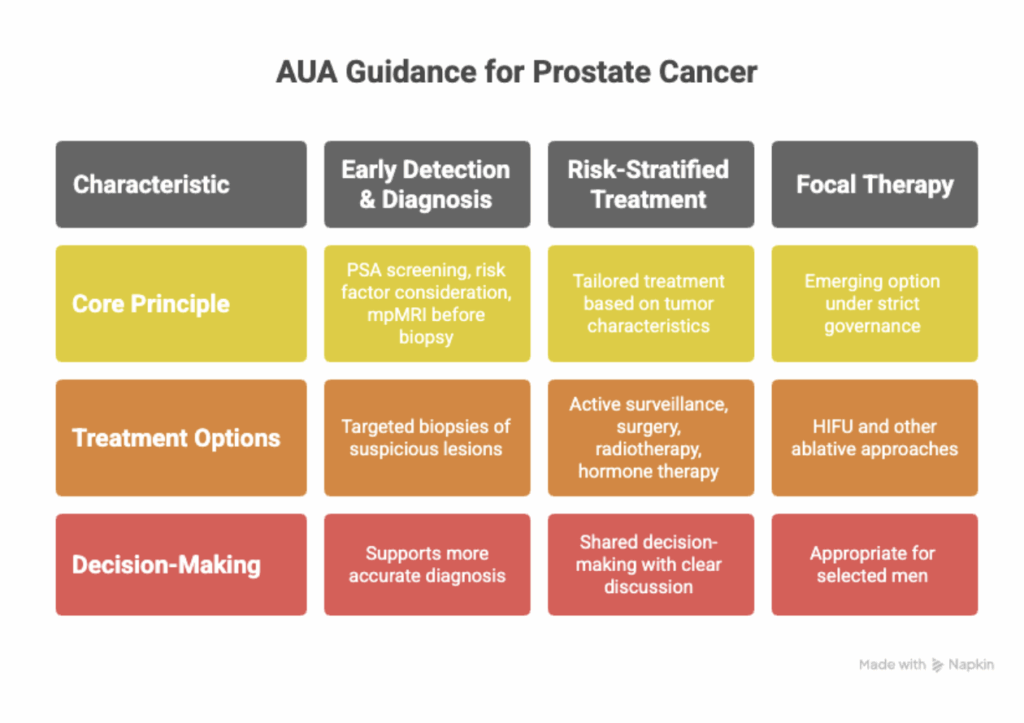
The AUA produces several key guidance documents relevant to men with prostate cancer, including guidelines on early detection and on clinically localised disease. These documents are updated periodically and cover the whole pathway from PSA testing to treatment and follow-up.
Early detection and diagnosis
AUA guidance on early detection focuses on identifying clinically significant prostate cancer while avoiding unnecessary tests and overtreatment. Core principles include:
- using PSA as the initial screening test when screening is undertaken
- considering factors such as age, family history, ethnicity and overall health when deciding whether to offer screening
- using multiparametric MRI before biopsy in many men, and performing targeted biopsies of any suspicious lesions
This approach supports more accurate diagnosis and reduces the risk of finding indolent cancers that might never cause harm.
Risk-stratified treatment planning
Rather than a one-size-fits-all strategy, treatment recommendations are tailored based on tumour characteristics (such as grade group and PSA), imaging findings and the patient’s overall health and preferences.
Broadly:
- very low-risk and low-risk disease: active surveillance is usually the preferred option, with surgery or radiotherapy considered in selected cases
- intermediate-risk disease: radical prostatectomy or radiotherapy, sometimes combined with hormone therapy, are standard options for many men
- high-risk disease: more intensive treatment combinations are generally recommended
Throughout, the guideline places strong emphasis on shared decision-making, with clear discussion of benefits, side effects and the possibility of salvage treatments if needed.
Focal therapy within AUA guidance
The AUA recognises focal therapy techniques such as HIFU and other ablative approaches as promising, organ-preserving options. However, it is clear that long-term data are still developing. Thus, a cautious, evidence-led approach is adopted: focal therapy is viewed as an emerging option, appropriate for selected men when it is offered under strict governance and prospective data collection.
How AUA-aligned care benefits patients at The Focal Therapy Clinic
At The Focal Therapy Clinic, AUA principles are built into how we care for men with prostate cancer, from first contact to long-term follow-up.
Imaging-led assessment
In line with AUA recommendations and UK guidance, we use high-quality MRI and, where appropriate, MRI–ultrasound fusion biopsies to define the location and extent of clinically significant cancer. This detailed mapping is essential whether a man is considering active surveillance, radical treatment or focal therapy.
Multidisciplinary team review
Each case is discussed in a multidisciplinary team (MDT) setting. Our MDT brings together:
- experienced prostatectomy surgeons
- focal therapy specialists
- radiologists with expertise in prostate MRI
- oncologists and other relevant experts
This collaborative approach mirrors the shared decision-making framework described in AUA guidelines, and helps ensure that no important detail is overlooked.
Balanced discussion of options
Because AUA guidance supports active surveillance for many low-risk cases and recognises that different treatments carry different side effects, we place considerable emphasis on honest, balanced counselling. Men are given time to weigh up:
- the potential cancer control of each option
- the likely effects on continence, erections and wider wellbeing
- what further treatments would still be possible in future
Many men also choose to seek a second opinion, either with us or elsewhere, before deciding. This is entirely consistent with AUA recommendations that patients should meet more than one specialist to make a fully informed choice.
Focal therapy within trials and registries
Treatments such as HIFU or NanoKnife are offered only to carefully selected men with localised disease, within structured clinical governance and data-collection frameworks. Outcomes are monitored closely over time.
Final thoughts: trusted care guided by global standards
When you are deciding how to treat prostate cancer, you want more than a persuasive brochure. You want to know that your urologist is working within robust, internationally recognised frameworks.
The American Urological Association provides exactly that kind of framework. Its guidelines on early detection and clinically localised prostate cancer are widely respected and strongly emphasise shared decision-making, risk stratification and quality of life.
At The Focal Therapy Clinic, our consultants use these principles every day. By combining AUA-aligned practice with UK standards from NICE and BAUS, we aim to offer men a thoughtful, evidence-based alternative to traditional whole-gland treatments.
If you are exploring options such as focal therapy, or simply want a detailed review of your diagnosis and management plan, arranging a second opinion with a team aligned to AUA standards can be a very sensible next step.
Frequently Asked Questions
The American Urological Association is a leading global organisation for specialists who treat conditions of the urinary tract and male reproductive system. Founded in 1902, it promotes high standards of urological care through clinical guidelines, education and research.
AUA membership reflects a commitment to safe, up-to-date, evidence-led care. Members have access to detailed guidelines, educational meetings and research updates, as well as an international professional community dedicated to improving patient outcomes.
Yes, several of the clinic’s consultants are active AUA members, including Mr Marc Ianaido, Mr Raj Nigam and Mr Alan Doherty. Each brings decades of experience, and their membership keeps them connected to global best practice and ongoing professional development.
The AUA develops global guidelines on early detection and clinically localised prostate cancer. These guide the use of PSA testing, MRI, biopsy, active surveillance, surgery and radiotherapy. They also describe focal therapy as an emerging option that should currently be offered only within clinical trials or structured data-collection programmes.
Patients benefit from investigations and treatments guided by rigorous, internationally recognised standards. At The Focal Therapy Clinic this includes MRI-led diagnosis, multidisciplinary review, clear discussion of risks and benefits, and focal therapy used only within strong governance and follow-up. The aim is to achieve good cancer control while maintaining quality of life as far as possible.
References
“About the AUA.” American Urological Association, www.auanet.org/about-us/aua-overview.
Eastham, James A., et al. “Clinically Localized Prostate Cancer: AUA/ASTRO Guideline.” The Journal of Urology, vol. 208, no. 3, Sept. 2022, pp. 505–07.
“History of the AUA.” American Urological Association, www.auanet.org/about-us/aua-overview/history-of-the-aua.
Tay, K. J., et al. “Established Focal Therapy—HIFU, IRE, or Cryotherapy—Where Are We Now?—A Systematic Review and Meta-Analysis.” Prostate Cancer and Prostatic Diseases, vol. 28, 2025, pp. 693–706.