
At a Glance
Chemotherapy for prostate cancer — most commonly docetaxel or cabazitaxel — is used when cancer has spread beyond the prostate or has stopped responding to hormone therapy. It is not typically used for early, localised prostate cancer, where treatments such as focal therapy, surgery, radiotherapy or active surveillance are more appropriate. For men with metastatic disease, chemotherapy may help control cancer, relieve symptoms and in some cases extend survival — often given alongside hormone therapy under NICE guideline NG131.¹
Key takeaways:
- For advanced disease only — chemotherapy is used for metastatic or hormone-resistant prostate cancer, not early localised disease.
- Two main drugs — docetaxel (used first) and cabazitaxel (after docetaxel if needed) are the standard chemotherapy agents.
- Given in cycles — typically once every three weeks through a drip, usually six cycles for newly diagnosed metastatic disease.¹
- Side effects are manageable but real — fatigue, infection risk, nausea, hair loss and nerve symptoms are common; your team monitors you closely.
- Focal therapy is a different pathway — for localised prostate cancer, focal therapy (HIFU, NICE HTG667; NanoKnife, NICE HTG688) treats the cancer within the prostate and is not chemotherapy.
When is chemotherapy used for prostate cancer?
Dr Christos Mikropoulos answers how long you can live with prostate cancer — and how stage and treatment change the outlook.
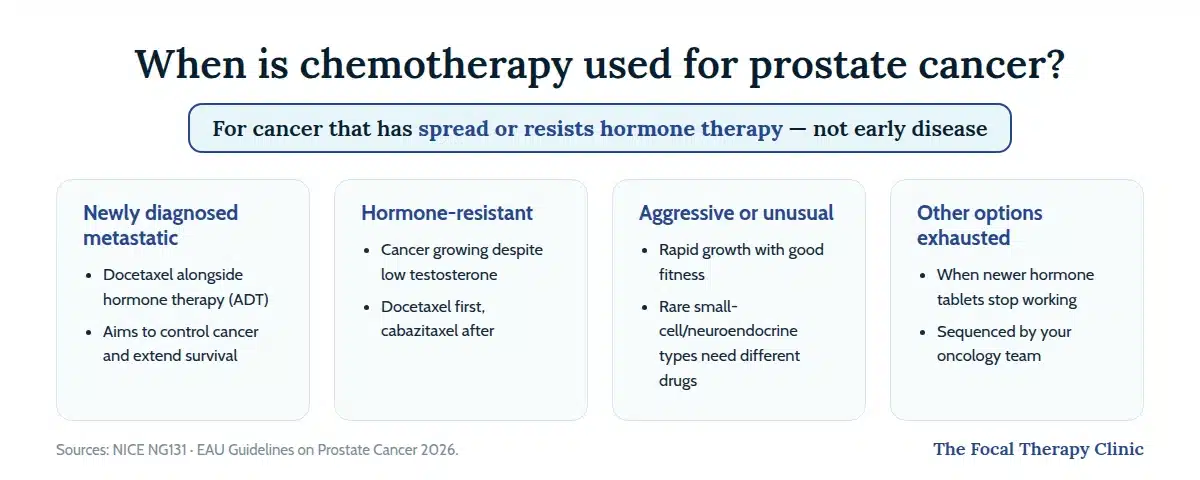
Chemotherapy is not usually used for cancer that is only inside the prostate. It is used when prostate cancer has spread — to bones, lymph nodes, lungs or liver.
Your oncologist may discuss chemotherapy if:
- The cancer is newly diagnosed and metastatic
- The cancer is causing symptoms or growing despite hormone therapy
- The disease is aggressive, and you are fit enough for treatment
- Other systemic treatments are unsuitable or have stopped working
Advanced or metastatic prostate cancer
Metastatic prostate cancer means cancer cells have spread beyond the prostate (our guide to where prostate cancer spreads explains the common sites). Treatment aims to control the cancer, reduce symptoms and help some men live longer.
For newly diagnosed metastatic disease, docetaxel may be offered alongside androgen deprivation therapy (hormone therapy that lowers testosterone).¹ Some men are instead offered newer hormone tablets — abiraterone, enzalutamide, apalutamide or darolutamide.² ³ These are not chemotherapy; they are systemic treatments targeting hormone signalling.
Hormone-resistant prostate cancer
Most prostate cancers depend on testosterone to grow, and hormone therapy lowers or blocks it. Over time, some cancers keep growing despite low testosterone — castration-resistant prostate cancer. If it has also spread, it is metastatic castration-resistant prostate cancer.
Chemotherapy is often used at this stage: docetaxel first (if not already given), then cabazitaxel — especially if the cancer has also grown after newer hormone tablets. The sequence depends on previous treatment and your general health.⁴
High-risk or unusual disease
Rare types such as small-cell or neuroendocrine prostate cancer behave differently from common adenocarcinoma and may need different chemotherapy drugs; your team may recommend extra tests if the cancer pattern is unusual.
Common chemotherapy drugs
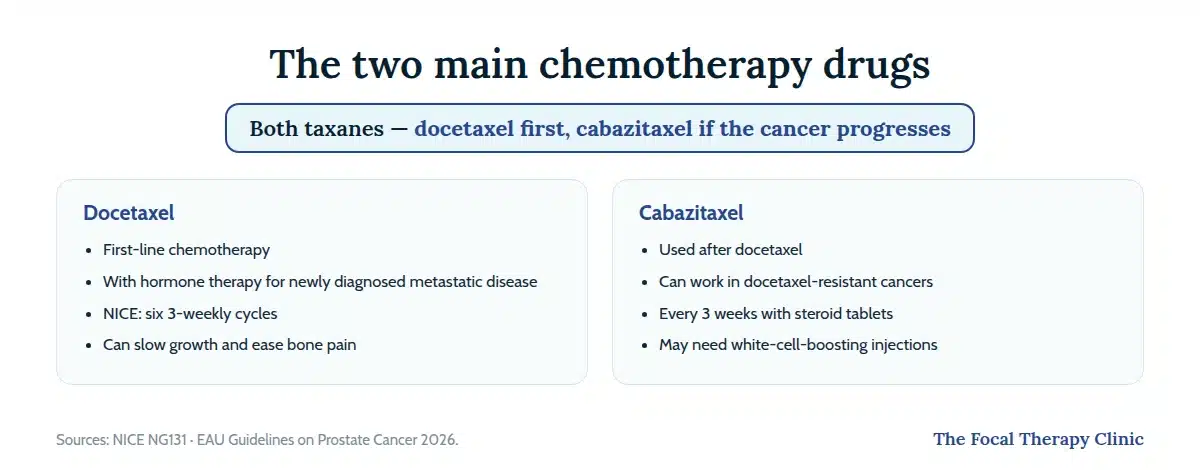
The two main drugs for typical advanced prostate cancer are docetaxel and cabazitaxel — both taxanes, which interfere with how cancer cells divide.
| Docetaxel | Cabazitaxel | |
|---|---|---|
| When used | First — with hormone therapy for newly diagnosed metastatic disease, or at hormone resistance | After docetaxel, if the cancer progresses |
| How given | Drip into a vein, every 3 weeks, usually with steroid tablets | Drip into a vein, every 3 weeks, usually with steroids |
| Notes | Can slow growth, improve survival and control bone pain¹ | Can work in docetaxel-resistant cancers; may need white-cell-boosting injections⁴ |
Other modern treatments are not chemotherapy — newer hormone tablets (abiraterone, enzalutamide, apalutamide, darolutamide), PARP inhibitors and radioligand therapy for selected men. Some require genetic testing to confirm suitability.
How chemotherapy is given
Chemotherapy is usually given in a hospital cancer day unit. A nurse gives the drug through a drip — a small tube in the hand or arm, or sometimes a longer PICC or central line. Before each cycle you have blood tests to check blood counts, liver and kidney function, plus medicines to reduce sickness or allergic-reaction risk.
Cycles: one treatment followed by a rest period for recovery. For newly diagnosed metastatic prostate cancer, NICE recommends six three-weekly cycles of docetaxel for men without significant comorbidities.¹ In later hormone-resistant disease, length varies. Your oncologist can stop, delay or reduce treatment if side effects are significant.
Combinations: chemotherapy is often combined with hormone therapy, which works differently — together they can improve cancer control in metastatic disease.¹ Radiotherapy may be added for the prostate or painful bone areas. For cancer still contained in the prostate, local treatments — surgery, radiotherapy, brachytherapy, active surveillance or focal therapy — are considered instead.
Side effects of chemotherapy
Chemotherapy affects some healthy fast-growing cells too, so side effects are expected — though not every man gets every one. The pattern depends on drug, dose, cycles and general health.
Common short-term effects: tiredness, increased infection risk, hair loss, feeling sick, appetite loss, taste changes, diarrhoea or constipation, sore mouth, nail changes, easier bruising or bleeding, breathlessness from anaemia.
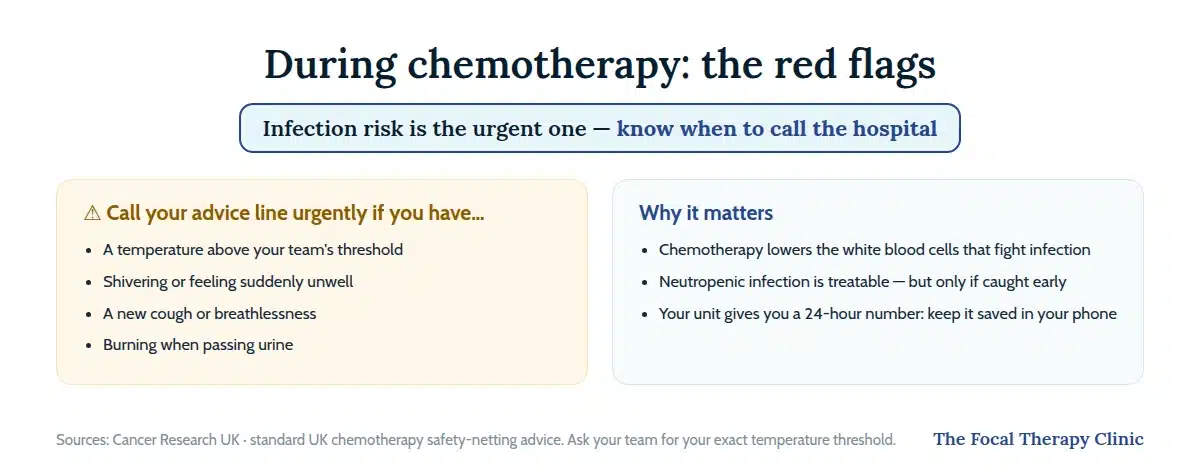
⚠ Infection is the urgent one. Chemotherapy lowers the white blood cells that fight infection. Contact your hospital advice line urgently if you feel unwell, have a temperature, feel shivery, develop a cough, or have burning when passing urine. Your team will give you the exact temperature threshold for urgent action.
Longer-term or cumulative effects: ongoing fatigue, numbness or tingling in hands or feet (peripheral neuropathy — tell your team early; doses can be adjusted), reduced fitness, memory or concentration changes, lower blood counts. Neuropathy often improves after treatment but can persist.
Balancing benefits and risks — your oncologist weighs where the cancer has spread, how fast it is growing, PSA pattern, scans, symptoms, previous treatments, organ function, fitness and — critically — your personal priorities. Some men value possible extra time even with side effects; others weight day-to-day quality of life more heavily. Both are legitimate choices.
Chemotherapy vs other prostate cancer treatments
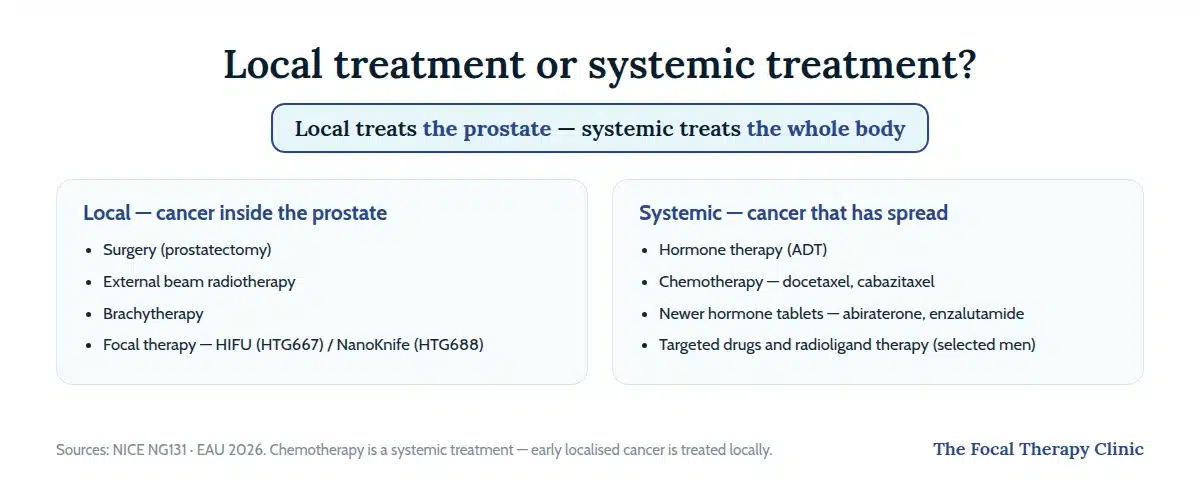
Local treatments target the prostate itself: surgery, external beam radiotherapy, brachytherapy, focal therapy.
Systemic treatments travel through the body, for cancer that has spread (or is at high risk of having spread): hormone therapy, chemotherapy, newer hormone tablets, targeted therapy, radioligand therapy. Chemotherapy is systemic.
Where focal therapy fits
Focal therapy is a local treatment for selected men with localised prostate cancer — it treats the known cancer area rather than the whole prostate, aiming to preserve urinary continence and erectile function. In FTC’s audited series of 265 men, 97% maintained continence and 90%+ preserved sexual function. Suitability depends on MRI findings, biopsy results, grade, volume and position — and if cancer has already spread, systemic treatment, not focal therapy, is usually needed. Read more about HIFU (NICE HTG667), NanoKnife (NICE HTG688) and focal therapy generally.
Get Expert Advice & The Latest Research
Subscribe to our newsletter to receive the latest updates, expert insights, and breakthrough research on prostate cancer-delivered straight to your inbox.
Deciding whether chemotherapy is right for you
Starting chemotherapy is a significant decision. Questions worth asking your oncologist or urologist:
- Why are you recommending chemotherapy now, and what are the expected benefits for my cancer?
- What side effects are most likely, and how many cycles are planned?
- What happens if I don’t tolerate treatment — or if the cancer grows despite it?
- Are there non-chemotherapy options, or suitable clinical trials?
- Who do I contact if I feel unwell?
How The Focal Therapy Clinic can help
Our consultant urological surgeons — 75+ years of combined focal therapy experience across 2,500+ procedures at 8 hospital sites in six UK cities — provide multidisciplinary reviews and detailed second opinions. If your cancer is localised, we can assess whether focal therapy is suitable; if your disease is advanced, we can help you understand the systemic pathway and the questions to ask. Book a consultation or see our fees.
Frequently Asked Questions
Is chemotherapy ever used for early prostate cancer?
Not typically. For cancer confined to the prostate, local treatments — surgery, radiotherapy, brachytherapy, active surveillance or focal therapy — are the standard options. Chemotherapy is reserved for metastatic or hormone-resistant disease.¹
Will I lose my hair?
Hair loss is a common side effect of docetaxel and cabazitaxel, though the degree varies. Hair usually regrows after treatment ends. Scalp cooling is available in some units — ask your team.
How long does a course of chemotherapy last?
For newly diagnosed metastatic disease, NICE recommends six cycles of docetaxel given three-weekly — about 18 weeks.¹ In hormone-resistant disease the length varies with response and tolerance.
Can I work during chemotherapy?
Many men continue some work, especially between cycles, but fatigue and infection precautions make flexibility important. The first few days after each cycle are usually the hardest.
What if chemotherapy stops working?
Options may include cabazitaxel, newer hormone tablets you haven’t yet had, targeted drugs (with genetic testing), radioligand therapy or clinical trials.⁴ Your oncologist will sequence treatments to your cancer and fitness.
This content is not intended to be a substitute for professional medical advice, diagnosis, or treatment. Always seek the advice of your oncologist, urologist or other qualified health provider with any questions you may have regarding a medical condition.
References
- National Institute for Health and Care Excellence. Prostate cancer: diagnosis and management (NG131). 2019, updated 2021. https://www.nice.org.uk/guidance/ng131
- National Institute for Health and Care Excellence. Darolutamide with androgen deprivation therapy for treating hormone-sensitive metastatic prostate cancer (TA1109). 2025. https://www.nice.org.uk/guidance/ta1109
- National Institute for Health and Care Excellence. Abiraterone for treating newly diagnosed high-risk hormone-sensitive metastatic prostate cancer (TA1110). 2025. https://www.nice.org.uk/guidance/ta1110
- European Association of Urology. EAU Guidelines on Prostate Cancer. 2026. https://uroweb.org/guidelines/prostate-cancer