
At a Glance
Focal cryoablation (focal cryotherapy) is a minimally invasive prostate cancer treatment recognised by NICE under IPG423 that uses precisely guided freezing to destroy a targeted cancer area while leaving the rest of the prostate intact.¹ It belongs to the same focal-therapy family as HIFU and NanoKnife, which The Focal Therapy Clinic delivers — in our one-year audit of 265 patients, 97% of men maintained urinary continence and 90%+ retained sexual function after focal treatment.
Key takeaways:
- Freeze-based focal therapy — cryoprobes inserted through the perineum under ultrasound guidance create a controlled ice ball that destroys targeted cancer tissue.
- NICE recognised (IPG423) — focal cryoablation is an option for localised prostate cancer in selected men.¹
- Lower side-effect aim — compared with whole-gland surgery or radiotherapy, focal approaches aim to reduce risk to continence and sexual function.
- Not suitable for everyone — careful MRI and biopsy assessment is required; choice also depends on tumour location, prostate anatomy and centre experience.
- HIFU and NanoKnife are alternatives — all three are focal therapies using different energy types; suitability depends on your cancer’s characteristics.
What is focal cryoablation?
Focal cryoablation treats only the area of the prostate containing the targeted cancer, rather than removing or treating the whole gland — which is why it sits under the umbrella of focal therapy.
How cryoablation works
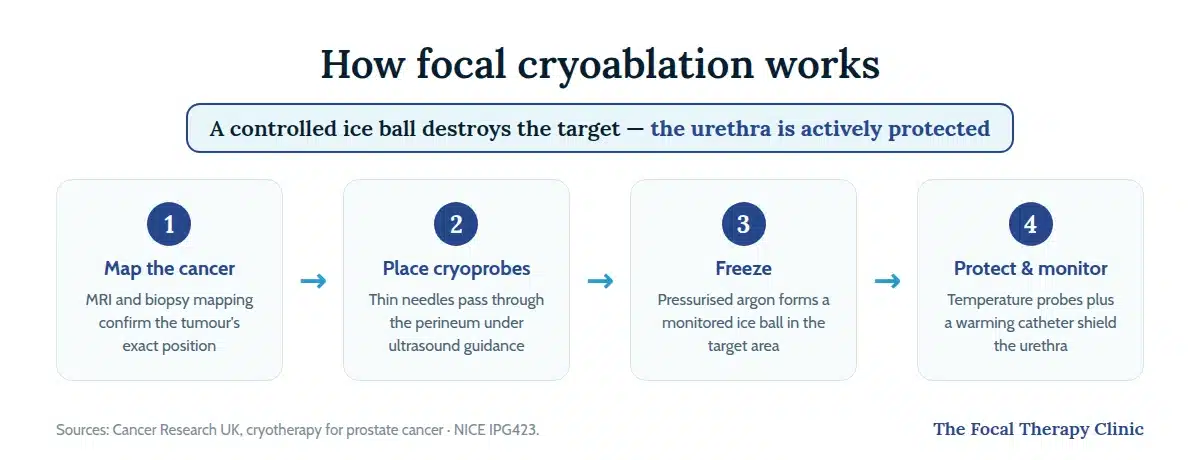
- Mapping — imaging and biopsy confirm the tumour’s location.
- Probe placement — thin needles (cryoprobes) are inserted into the prostate through the perineum (the skin between the scrotum and anus) under ultrasound guidance.
- Freezing — pressurised argon gas creates a controlled ice ball that destroys the targeted tissue.
- Protection — temperature probes monitor the freeze, and a warming catheter protects the urethra during treatment.²
What can focal cryoablation treat?
The goal is not to remove the prostate or eliminate all prostate tissue — it is to ablate a targeted area and, if successful, avoid or delay whole-gland treatment and its side effects. Careful, individualised assessment decides whether that is realistic for you.
- Cancer stage and risk matter — UK pathways recommend MRI as a first-line test for suspected localised prostate cancer, with biopsy strategy guided by the MRI.³ Focal therapy is discussed for localised disease with a clearly defined lesion that can genuinely be targeted. Prostate cancer can be multifocal, which is why outcomes depend heavily on selection and follow-up.
- Imaging and biopsy quality are vital — expect your team to review the MRI carefully and discuss whether the cancer is confined to a targetable area, and how aggressive it appears.
How cryoablation compares with HIFU and NanoKnife
Mr Tim Dudderidge explains the prostate cancer treatment options many men are never told about — including tissue-preserving focal therapy.
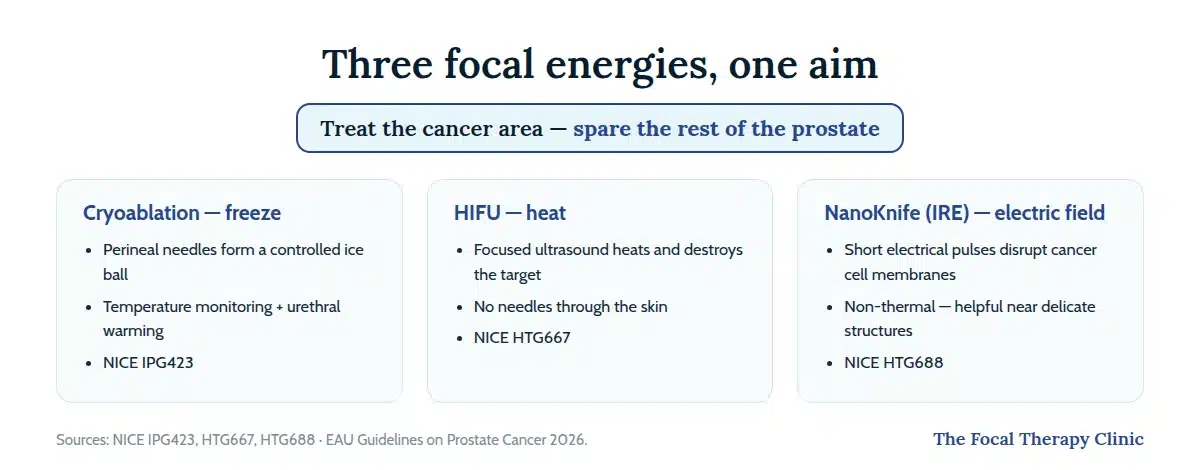
Cryoablation, HIFU and irreversible electroporation (IRE — usually called by the device name NanoKnife) are all focal approaches, but they interact with tissue differently:
| Treatment | Energy type | How it destroys tissue | Key idea |
|---|---|---|---|
| Focal cryoablation | Cold / freezing | Perineal needles form a monitored ice ball in the target | Freeze |
| HIFU (NICE HTG667) | Focused ultrasound | Probe heats and destroys target tissue with focused sound waves | Heat |
| NanoKnife / IRE (NICE HTG688) | Electrical pulses (non-thermal) | Needle electrodes deliver short pulses that disrupt cell membranes | Electric field |
Your anatomy, tumour position, tumour biology and your centre’s experience all matter — every case should be individualised.
Comparing patient experience and side effects
All focal treatments aim to treat the cancer while limiting damage to the rest of the prostate — different from surgery or radiotherapy, which treat or remove the whole gland. For carefully selected men, focal therapy may offer lower risks of urinary leakage and sexual side effects; outcomes depend on the cancer’s position, the treatment area’s size, baseline function and the team’s experience.⁴
- Urinary and sexual function — many men keep good urinary control, especially when only a small area is treated; erectile function is more variable, particularly if the cancer sits near the erection nerves. Ejaculation changes are also possible — discuss before deciding.
- Recovery — often quicker than after major surgery; many men return to normal activities within a short period.
- Options stay open — if cancer returns in the treated area or appears elsewhere, further treatment may be possible: another focal treatment, surgery, radiotherapy or monitoring.
How the choice is made: specialists review where the cancer is, its visibility on MRI, proximity to critical structures, and whether focal treatment is suitable at all. For some men HIFU is right; for others NanoKnife; cryoablation has a role in selected cases. Treatment should be matched to the cancer — not chosen because one technology sounds newer.
Get Expert Advice & The Latest Research
Subscribe to our newsletter to receive the latest updates, expert insights, and breakthrough research on prostate cancer-delivered straight to your inbox.
Benefits and limitations of focal cryoablation
Advantages
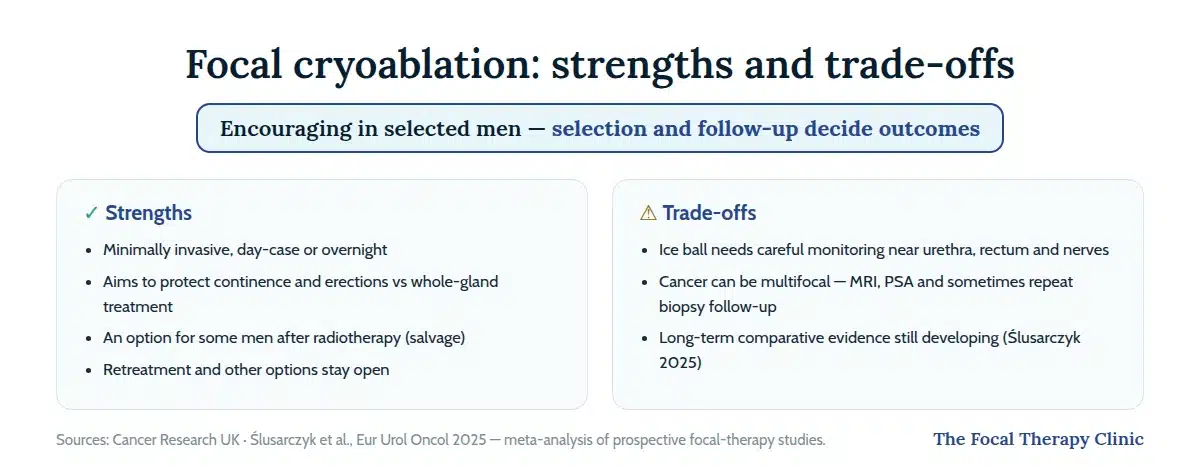
- Minimally invasive, targeting a selected area of the prostate
- May reduce urinary and sexual side-effect risk versus whole-gland treatment in well-selected patients⁴
- Can be considered for some men whose cancer has returned after radiotherapy — with particularly careful planning, since irradiated tissue heals less well
Limitations and considerations
- The ice ball needs careful monitoring near the urethra, rectum, bladder neck and erection nerves
- Follow-up is essential — MRI, PSA monitoring and sometimes repeat biopsy, because prostate cancer can be present in more than one area
- Evidence in selected men is encouraging, but long-term data and direct comparisons are still developing⁴
Is focal cryoablation right for you?
It is usually considered when the cancer is localised, clearly visible and safely targetable. The right treatment depends on grade, MRI findings, biopsy results, prostate size, urinary symptoms, sexual function and your priorities.
How The Focal Therapy Clinic helps you decide
We review each case in detail — MRI, biopsy results, PSA history, anatomy and your priorities — before advising. Our consultants hold 75+ years of combined focal therapy experience across 2,500+ procedures, delivering HIFU (NICE HTG667) and NanoKnife (NICE HTG688) at 8 hospital sites across six UK cities. Some men are better served by active surveillance, surgery, radiotherapy — or cryoablation elsewhere; our aim is clear, balanced advice on the realistic benefits and trade-offs of every option. Learn more about focal therapy or compare focal therapy with surgery and radiotherapy.
Frequently Asked Questions
Does the freezing hurt?
The procedure is done under general or spinal anaesthetic, so you feel nothing during treatment. Afterwards there may be perineal bruising and temporary urinary symptoms while swelling settles.²
How long is recovery after focal cryoablation?
Typically much shorter than after surgery — most men are home the same day or next morning and back to normal activities within days to a few weeks, depending on individual healing.²
How do doctors choose between cryoablation, HIFU and NanoKnife?
By tumour position and biology: each energy type has strengths in different parts of the prostate and near different structures. Anterior or apical lesions, proximity to the urethra or rectum, and centre expertise all shape the recommendation.
Can cryotherapy be used if cancer returns after radiotherapy?
Yes — in selected men, cryoablation is one of the salvage options after radiotherapy, with extra-careful planning because irradiated tissue is more fragile.²
Does The Focal Therapy Clinic offer cryoablation?
Our consultants deliver HIFU and NanoKnife focal therapy. If your case is better suited to cryoablation or another approach, we will tell you honestly and point you in the right direction — treatment matched to the cancer, not to the technology we happen to hold.
For the wider picture of where these techniques sit, see the latest treatments for prostate cancer.
This content is not intended to be a substitute for professional medical advice, diagnosis, or treatment. Always seek the advice of your urologist or other qualified health provider with any questions you may have regarding a medical condition.
References
- National Institute for Health and Care Excellence. Focal therapy using cryoablation for localised prostate cancer (IPG423). 2012. https://www.nice.org.uk/guidance/ipg423
- Cancer Research UK. Cryotherapy for prostate cancer. https://www.cancerresearchuk.org/about-cancer/prostate-cancer/treatment/cryotherapy
- National Institute for Health and Care Excellence. Prostate cancer: diagnosis and management (NG131). 2019, updated 2021. https://www.nice.org.uk/guidance/ng131
- Ślusarczyk A, Gurwin A, Barnaś A, et al. Outcomes of Focal Therapy for Localized Prostate Cancer: A Systematic Review and Meta-analysis of Prospective Studies. Eur Urol Oncol. 2025;8(6):1653–1672.
- National Institute for Health and Care Excellence. Focal therapy using high-intensity focused ultrasound for localised prostate cancer (HTG667). 2023. https://www.nice.org.uk/guidance/htg667
- National Institute for Health and Care Excellence. Irreversible electroporation for treating prostate cancer (HTG688). 2023. https://www.nice.org.uk/guidance/htg688
- Prostate Cancer UK. Cryotherapy. https://prostatecanceruk.org/prostate-information-and-support/treatments/cryotherapy