
At a Glance
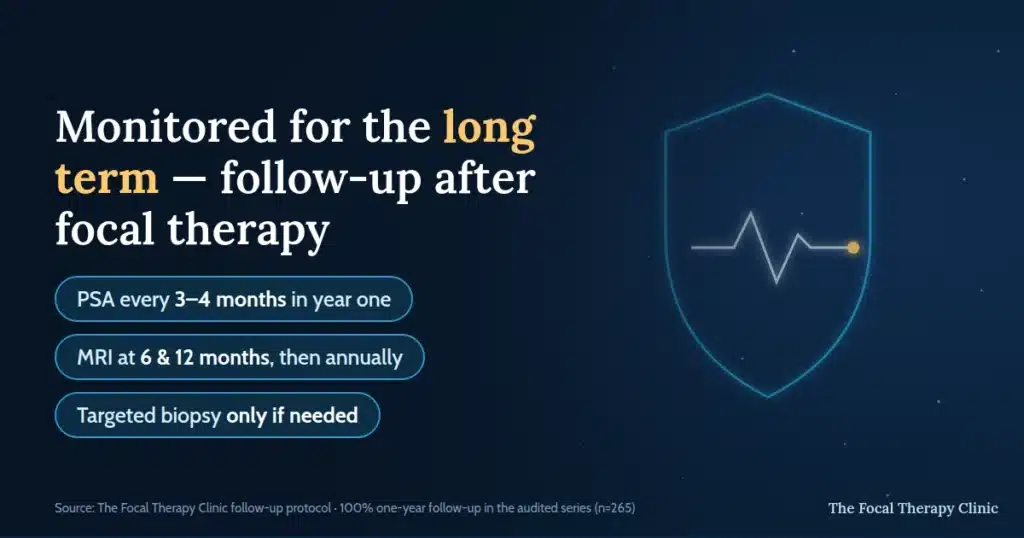
Focal therapy targets only the cancerous parts of the prostate, leaving healthy tissue alone to help preserve quality of life. Because the prostate remains in place, structured follow-up matters: PSA blood tests every 3–4 months in the first year, MRI at 6 and 12 months then annually, and targeted biopsy only when results raise concern. At The Focal Therapy Clinic this monitoring discipline is built in — our one-year audit of 265 men achieved 100% follow-up, and our data contributes to the national HEAT registry.
Key takeaways:
- Monitoring after focal therapy is essential to confirm cancer control, detect recurrence early, and provide long-term reassurance.
- Standard follow-up includes regular PSA blood tests, MRI scans, and occasional targeted biopsies — especially if test results raise concern.
- Most patients are monitored closely in the first year, then annually, with follow-up often continuing for 5–10 years.
- Focal therapy monitoring is more active than after surgery or radiotherapy because the prostate remains in place, allowing early detection of any new issues.
- The process is tailored to individual risk factors, using both medical data and patient-reported outcomes (such as EPIC-26) to guide care.
- Many patients find reassurance in structured monitoring, which combines medical vigilance with emotional support and quality-of-life tracking.
Why monitoring is essential after focal therapy
Mr Tim Dudderidge explains recovery after focal therapy — what to expect in the days and weeks after treatment, and how quickly most men return to normal life.
After focal therapy, patients enter a carefully planned follow-up programme. The main reason for this is to confirm that the cancer has been successfully treated and to detect any new or recurrent cancer at the earliest possible stage. Because focal therapy is a newer approach compared to surgery or radiation, a robust follow-up programme provides ongoing reassurance through regular check-ins and data. This long-term partnership between the patient and their consultant team is central to the care philosophy.
At The Focal Therapy Clinic, this discipline is measurable: our one-year clinical audit of 265 consecutive men achieved complete follow-up data for every patient, and our outcomes contribute to the national HEAT registry, which encourages prospective data capture across UK focal therapy centres.
The standard monitoring protocols
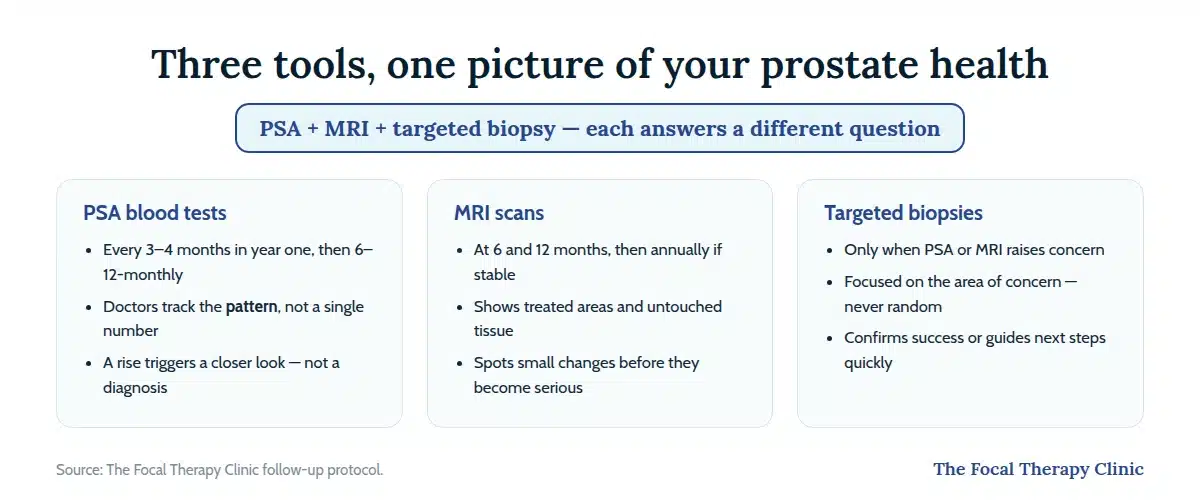
Focal therapy follow-up includes a mix of blood tests, imaging, and occasional biopsies. These tools work together to give doctors a full picture of the prostate’s condition. Each plays a unique role in ensuring long-term safety.
PSA blood tests
After focal therapy, PSA is usually checked every 3–4 months for the first year, then every 6–12 months after that. These tests help spot early signs of recurrence.
A rising PSA doesn’t always mean the cancer is back, but it tells doctors to look closer. They’ll consider other factors like MRI results and symptoms. This combined approach gives a clearer understanding of what’s happening.
MRI scans
MRI scans provide detailed imaging of the prostate and help detect abnormal changes. Most patients will have an MRI at 6 months and 12 months after treatment, and then annually if everything looks stable. This imaging shows both treated areas and untouched tissue.
MRIs are especially useful because they can spot small changes before they become serious. When combined with PSA results, they form a powerful monitoring strategy. MRI scans can help detect:
- Small tumours that may have been missed
- New areas of concern elsewhere in the prostate
- Changes in tissue following treatment
- Localised swelling or inflammation
Biopsies
Biopsies aren’t always necessary after focal therapy but are sometimes used to confirm what imaging suggests. If PSA rises or an MRI shows something suspicious, a targeted biopsy may be recommended. These aren’t random but focus only on the areas of concern, providing answers whilst avoiding unnecessary procedures.
The timeline of follow-up appointments
Immediate post-treatment monitoring
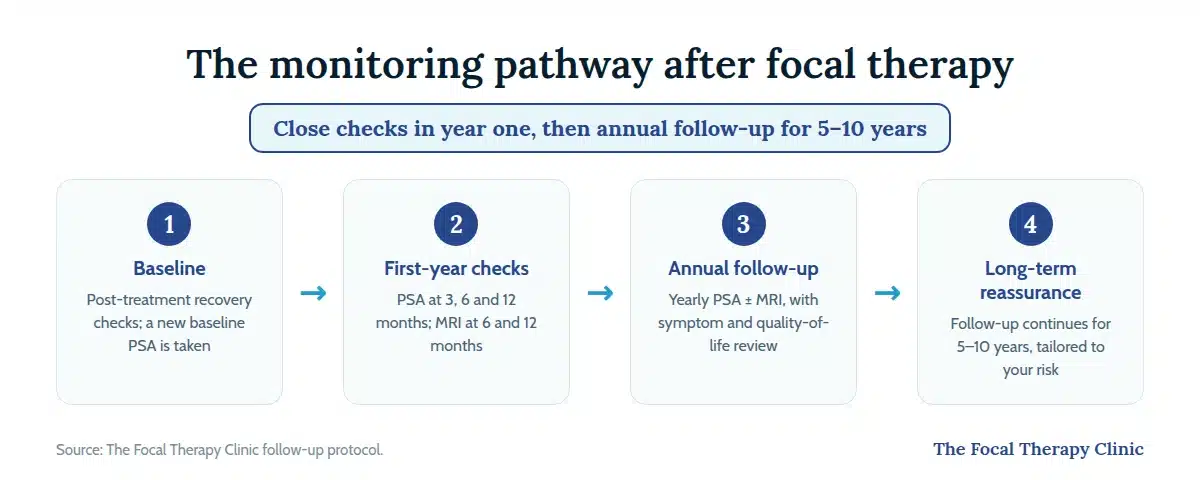
Right after treatment, patients are checked for side effects and recovery progress. They’ll often be asked about urination, energy levels, and sexual function. A PSA test may be taken as a new baseline.
This is also a good time for patients to ask questions and raise concerns. Clinics are used to hearing a wide range of reactions. Some men are surprised at how quickly they recover.
6-month, 12-month, and annual check-ups
The first year after treatment is the most active for monitoring. Patients typically have appointments at 3, 6, and 12 months. Each visit usually includes a PSA test and possibly an MRI scan.
From year two onwards, appointments are often annual. However, this can change based on how things look. Doctors stay flexible based on individual needs. Typically a check-up includes:
- PSA blood test
- Review of symptoms and quality of life
- MRI scan if required
- Consultation with your urologist or care team
Ongoing surveillance beyond 5 years
Monitoring doesn’t stop after a couple of years. In fact, many patients continue to be checked for 5–10 years. This long-term care helps ensure nothing is missed, even years down the line.
Cancer can sometimes reappear slowly, so long-term tracking is key. Most men find comfort in knowing they’re still being looked after. And the clinic’s approach helps keep that support affordable and accessible.
What doctors look for in monitoring
Doctors don’t just check boxes during follow-up appointments. They’re carefully reviewing your data to see what’s changed — and what hasn’t. They’re trained to spot early signs that something might be wrong.
Changes in PSA levels
Doctors look for patterns over time rather than just a single number. A slow, steady increase might prompt a closer look. If PSA remains stable, that’s a great sign. But any unexpected rise will trigger further tests.
Imaging results and comparison over time
Doctors compare new MRIs to previous ones to look for changes. They’ll check for any new or growing areas of concern. If anything looks unusual, they may recommend a biopsy.
Having consistent imaging over time allows them to track progress. It’s like building a visual timeline of your recovery. And that helps spot even small shifts early on.
Biopsy findings
When biopsies are needed, doctors analyse tissue to confirm whether cancer is present. This is usually done with advanced precision tools. If results are negative, it confirms treatment success. If something is found, it can usually be dealt with quickly. That’s why even occasional biopsies are valuable.
Patient experience during monitoring
Many patients feel nervous about follow-up care, and that’s perfectly normal. But most say the process gets easier with time. Knowing what to expect helps reduce the stress.
What to expect at follow-up appointments
Appointments are usually short and well-organised. Patients get their PSA results, ask questions, and review any imaging. It’s a good chance to touch base and stay on track.
Most men find follow-ups become routine over time. Some even enjoy the regular check-ins. Hearing other patient stories can also help build confidence in the journey.
Addressing anxiety and reassurance for patients
To ensure care is holistic, clinics also track quality of life through patient questionnaires that cover urinary, bowel, and sexual function. This helps the team address any issues that impact a patient’s daily life and provides another layer of reassurance.
Get Expert Advice & The Latest Research
Subscribe to our newsletter to receive the latest updates, expert insights, and breakthrough research on prostate cancer-delivered straight to your inbox.
Comparing monitoring in focal therapy vs other treatments
Patients often ask how focal therapy follow-up compares to other treatments. Each approach has its own monitoring process. It’s helpful to understand the differences.
How focal therapy monitoring differs from surgery or radiation follow-up
After surgery, patients may not need as many MRIs since the prostate is removed. Radiation patients have long-term PSA tracking but less imaging. Focal therapy requires more active monitoring because the prostate remains in place.
This means more MRIs and close PSA tracking. But it also means more opportunities to catch things early. Many men feel reassured knowing their doctors are keeping a close eye.
Why extra vigilance is important
Because focal therapy aims to target only part of the prostate, there’s a chance some cancer could return. That’s why careful follow-up is so important. It’s a safety net that protects the patient long after treatment.
Patients who value long-term reassurance often find this appealing. They know their team is ready to act if needed. It’s another reason many feel confident in choosing focal therapy.
The role of personalised care
Every patient is different, and their follow-up care should be too. That’s why the clinic doesn’t offer a one-size-fits-all model. Instead, the team adapts based on each man’s health, goals, and risk level.
Tailoring monitoring based on individual risk factors
Doctors consider things like tumour size, PSA history, and family history. Younger men or those with higher-risk disease may need closer monitoring. Lower-risk patients may have a simpler schedule.
Integration of patient-reported outcomes
Patient-reported outcomes (PROs) are used to track real-life effects of treatment, including urinary control, sexual function, and quality of life. Tools like the EPIC-26 questionnaire help identify issues that PSA or MRI alone can’t reveal. This data allows the clinic to personalise follow-up care and respond early to any emerging problems.
Frequently Asked Questions
How are patients monitored after focal therapy?
Patients are monitored with regular PSA blood tests, MRI scans, and sometimes biopsies. These tools help detect any changes early. Monitoring is structured and ongoing for several years.
How often do I need PSA tests after focal therapy?
PSA is usually checked every 3–4 months during the first year. After that, testing becomes less frequent if things stay stable. The exact schedule depends on your individual case.
Will I need MRI scans or biopsies following focal therapy?
Yes, MRI scans are a standard part of follow-up. Biopsies are used only if there’s a concern based on PSA or MRI results. Both help confirm treatment success or guide further care if needed.
How long does focal therapy monitoring last?
Monitoring often continues for 5 to 10 years. Some patients stay in follow-up even longer based on risk factors. Long-term care is part of staying safe and well.
This careful follow-up is also how the evidence base matures — why long-term focal therapy data is still emerging explains what the research timeline means for patients.
How does monitoring for focal therapy compare to other prostate cancer treatments?
Focal therapy follow-up includes more regular imaging and PSA tracking. Surgery and radiation have different follow-up paths. Focal therapy’s closer checks help preserve health and confidence.
This content is not intended to be a substitute for professional medical advice, diagnosis, or treatment. Always seek the advice of your urologist or other qualified health provider with any questions you may have regarding a medical condition.
References
- van der Poel HG, van den Bergh RCN, Briers E, et al. Focal Therapy in Primary Localised Prostate Cancer: The European Association of Urology Position in 2018. Eur Urol. 2018;74(1):84–91. doi:10.1016/j.eururo.2018.01.001
- Tay KJ, Scheltema MJ, Ahmed HU, et al. Patient selection for prostate focal therapy in the era of active surveillance: an International Delphi Consensus Project. Prostate Cancer Prostatic Dis. 2017;20(3):294–299. doi:10.1038/pcan.2017.8
- Koehler J, et al. Surveillance After Focal Therapy for Prostate Cancer: A Comprehensive Review. Cancers. 2025;17(8):1337. doi:10.3390/cancers17081337