
At a Glance
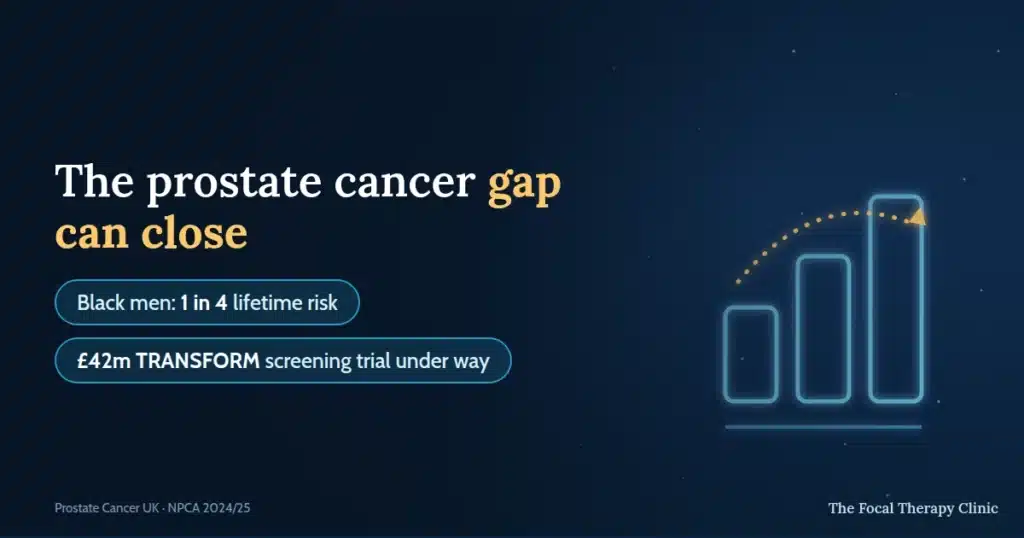
Prostate cancer inequality means your ethnicity, postcode, income or health literacy can measurably change whether your cancer is found early, how fully your treatment options are explained, and ultimately how well you do. Black UK men face roughly double the lifetime risk (about 1 in 4)¹ and, per the National Prostate Cancer Audit, are approximately a quarter less likely to receive radical treatment for high-risk disease.² Patients can narrow the gap themselves: request PSA testing earlier, ask for MRI before biopsy, and seek a second opinion.
Key takeaways:
- Ethnicity matters — Black men have roughly 2× the lifetime risk and are more likely to develop aggressive disease younger.¹
- Socioeconomic gaps — men from the most deprived areas are less likely to receive chemotherapy or hormone therapy for metastatic disease.²
- Geography gap — access to high-volume prostate centres and MRI-fusion biopsy varies by region.
- You can act now — request early PSA testing, insist on MRI before biopsy, seek a second opinion, and know your personal risk profile.
- System change is underway — the £42 million TRANSFORM screening trial and NICE NG131 updates aim to reduce disparities at scale.³
Inequalities in prostate cancer care
Prostate cancer inequality refers to preventable differences in how men experience diagnosis and treatment: some are diagnosed promptly and offered comprehensive assessment, others face delays or limited options — variations that directly affect survival, side effects and long-term wellbeing.
A health disparity is a measurable difference between groups; health inequality goes further — the differences are unjust and linked to modifiable factors: awareness, systemic capacity and access to specialist expertise.
- Diagnosis timing — some men have early PSA testing and imaging after a GP risk discussion; others present only when symptoms disrupt life, by which point the cancer may have progressed beyond the earliest stages.
- Access to specialists — some patients reach high-volume centres; others are managed in services facing acute resource pressures.
- Treatment discussions — time and capacity constraints can narrow conversations to surgery or radiotherapy without exploring less invasive approaches, weakening shared decision-making.
How inequality affects outcomes
Small delays in testing or referral can mean more advanced disease at diagnosis — and those early differences shape the whole journey. Men diagnosed with localised disease have far stronger long-term prospects; later diagnosis can rule out organ-preserving treatment.
- Risk assessment depends on PSA, biopsy and imaging: without detailed evaluation, aggressive disease can be underestimated.
- Advanced imaging — centres using high-quality MRI target biopsies accurately and avoid unnecessary procedures; limited access means incomplete assessment.
- Function preservation — specialist teams are more likely to offer planning that balances cancer control with continence and sexual function.
- Survival — early-stage UK survival is high; advanced-stage disease carries greater recurrence and progression risk. Early detection and specialist input remain the critical levers.
Who is most affected?
A patient urges men to get screened early, describing how a routine PSA test caught his cancer while every treatment option was still open.
- Age — most diagnoses come after 50, rising beyond 65. Older men are sometimes offered fewer options on chronological age alone; decisions should follow health status and preference instead.
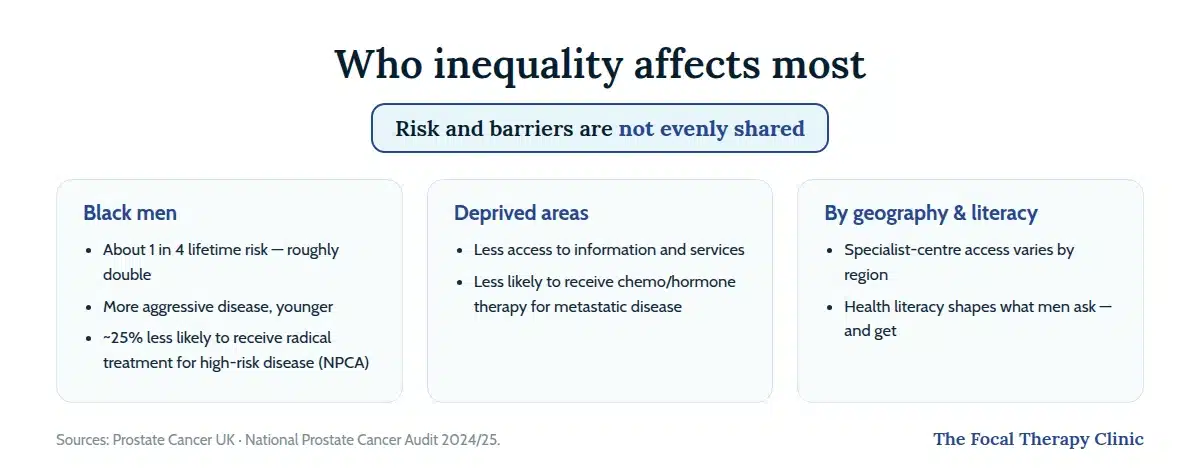
- Ethnicity — Black men have approximately double the risk of white men and more often develop aggressive disease younger.¹ The National Prostate Cancer Audit reports Black men are roughly a quarter less likely to receive radical treatment for high-risk or locally advanced disease.² Awareness and early-testing conversations are still not consistent in higher-risk communities — see our guide to how common prostate cancer is.
- Socioeconomic status — deprived areas mean less access to health information and preventative services; work, money and transport pressures delay appointments. Men from the most deprived areas are less likely to receive chemotherapy or additional hormone treatments for metastatic disease.²
- Geography — access to specialist centres differs between urban and rural regions; regions with lower diagnostic rates often show higher rates of metastatic presentation.
- Health literacy — understanding PSA results, biopsy reports and staging is hard; men who feel less confident asking questions get less from consultations. Clear communication is an equity tool.
Why prostate cancer inequality exists
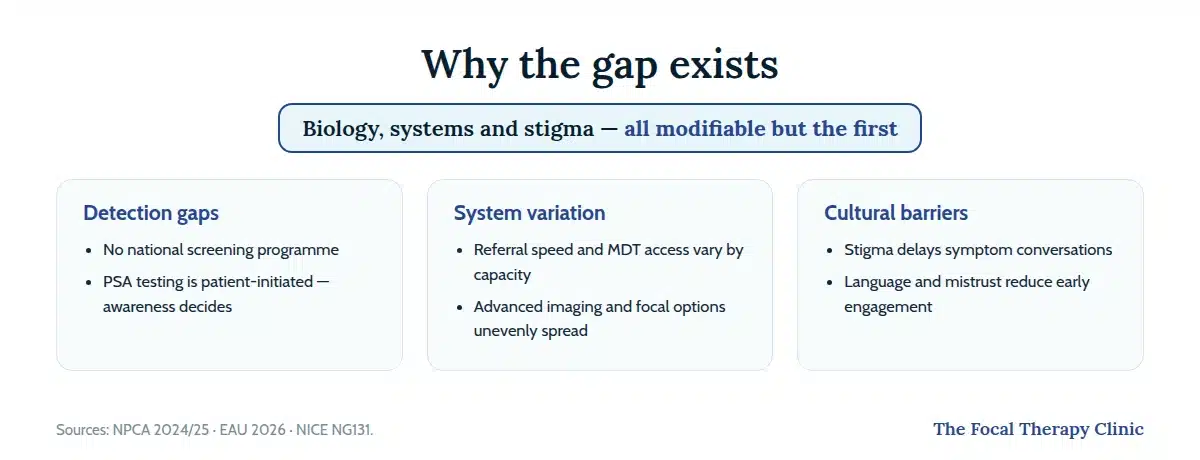
No single cause — a combination of biological risk, system variation and social influence:
- Gaps in early detection — the UK has no routine screening programme; PSA testing is patient-initiated, so awareness drives who gets tested early.
- Referral variation and capacity — differences between practices and regions frequently stem from workforce and capacity pressures rather than clinical intent; rising diagnoses place unprecedented demand on NHS services, so speed of access to diagnostics and MDT care varies by local system capacity.⁴
- Access to advanced technologies — high-resolution MRI, MRI-guided biopsy, organ-preserving treatments and comprehensive MDT review are unevenly distributed; their availability shapes both diagnostic precision and options offered.
- Cultural and communication barriers — stigma delays discussion of urinary and sexual symptoms; language differences and institutional mistrust reduce early engagement. Campaigns like Sir Steve McQueen’s “Embarrassed” show what culturally attuned awareness can do.
Consequences for patients and families
Inequality reaches beyond medical outcomes: emotional wellbeing, family stability and finances all feel it. Waiting and unclear communication heighten fear; when suitable treatments are never discussed, men believe their options are narrower than they are; partners carry appointment, travel and financial strain — our financial support guide covers the help available.
Get Expert Advice & The Latest Research
Subscribe to our newsletter to receive the latest updates, expert insights, and breakthrough research on prostate cancer-delivered straight to your inbox.
How patients can navigate inequality
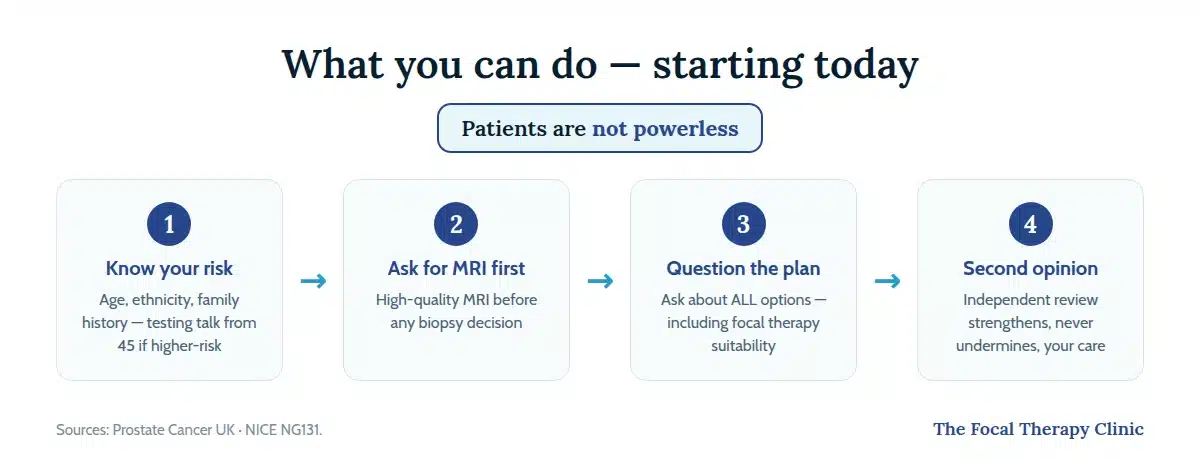
You are not powerless — preparation and information close much of the gap:
- Seek a second opinion — independent review confirms staging and biopsy interpretation, broadens the treatment discussion, and adds confidence. It strengthens, not undermines, shared decision-making.
- Ask about advanced imaging and focal therapy suitability — has a high-quality MRI been performed and reviewed by a specialist uroradiologist? Is the tumour clearly localised? Am I suitable for focal therapy? What are the expected functional outcomes?
- Understand your personal profile — PSA, imaging, biopsy, baseline function and overall health together weigh benefits against side effects.
- Prepare key questions — writing concerns down before appointments improves focus; structured question lists help.
What health professionals are doing — and what needs to change
- Research and data — the UK’s £42 million TRANSFORM trial, the largest prostate cancer screening study in a generation, is evaluating the safest, most effective ways to screen (including advanced MRI and genetic approaches) to build the evidence for a potential national programme — which could systematically reduce diagnostic inequality.³ Greater representation in research remains essential.
- Multidisciplinary collaboration — balanced surgeon/oncologist/radiologist discussion reduces bias and broadens expertise.
- Policy and standardisation — EAU guidance and NICE NG131 continue to refine imaging, surveillance and treatment standards; long-term change depends on coordinated national strategy.⁵
How The Focal Therapy Clinic supports equity
We are committed to improving access to advanced, personalised care for localised prostate cancer. Every patient receives comprehensive review by an experienced multidisciplinary team — leading surgeons, a specialist in male andrology and an experienced clinical oncologist — whose balanced expertise supports objective advice across all appropriate options.
Our consultant urological surgeons hold 75+ years of combined focal therapy experience across 2,500+ procedures at 8 hospital sites in six UK cities. In our one-year audit of 265 men, 97% maintained pad-free urinary continence and 90%+ preserved sexual function. Equity begins with access to clear information and specialist assessment — second opinions are how many of our patients start.
Frequently Asked Questions
Why are Black men at higher risk of prostate cancer?
The reasons are still being researched — a mix of genetics and other factors. What is established: about 1 in 4 Black men will get prostate cancer, they tend to be diagnosed younger, and testing conversations are advised from age 45.¹
Does where I live really change my treatment?
It can — access to high-volume centres, MRI-fusion biopsy and organ-preserving treatments varies by region, and audit data shows real treatment-rate differences by deprivation.² Second opinions and asking directly about advanced options are the practical counters.
What is the TRANSFORM trial?
A £42 million UK study — the largest prostate cancer screening trial in a generation — testing how best to screen men (advanced MRI, genetic risk and more), aiming to build the evidence for a national screening programme.³
What can I do today if I’m in a higher-risk group?
Talk to your GP about a PSA test from age 45 (Black men, or a father/brother affected), push for MRI before any biopsy, bring written questions, and take a second opinion if the options feel narrow.
This content is not intended to be a substitute for professional medical advice, diagnosis, or treatment. Always seek the advice of your urologist or other qualified health provider with any questions you may have regarding a medical condition.
References
- Prostate Cancer UK. Are you at risk? Statistics and risk for Black men. 2025. https://prostatecanceruk.org/prostate-information-and-support/risk-and-symptoms/are-you-at-risk
- National Prostate Cancer Audit. NPCA State of the Nation Report 2024/2025. Healthcare Quality Improvement Partnership. https://www.natcan.org.uk/wp-content/uploads/2025/07/NPCA-State-of-the-Nation-Report-2024_v2-1.pdf
- Prostate Cancer Research. Prostate Cancer Screening: The Impact on the NHS. 2025. https://www.prostate-cancer-research.org.uk/wp-content/uploads/2025/10/Prostate-Cancer-Screening-The-Impact-on-the-NHS-Report.pdf
- European Association of Urology. EAU Guidelines on Prostate Cancer. 2026. https://uroweb.org/guidelines/prostate-cancer
- National Institute for Health and Care Excellence. Prostate cancer: diagnosis and management (NG131). 2025 updates. https://www.nice.org.uk/guidance/ng131